

Synergy
Power
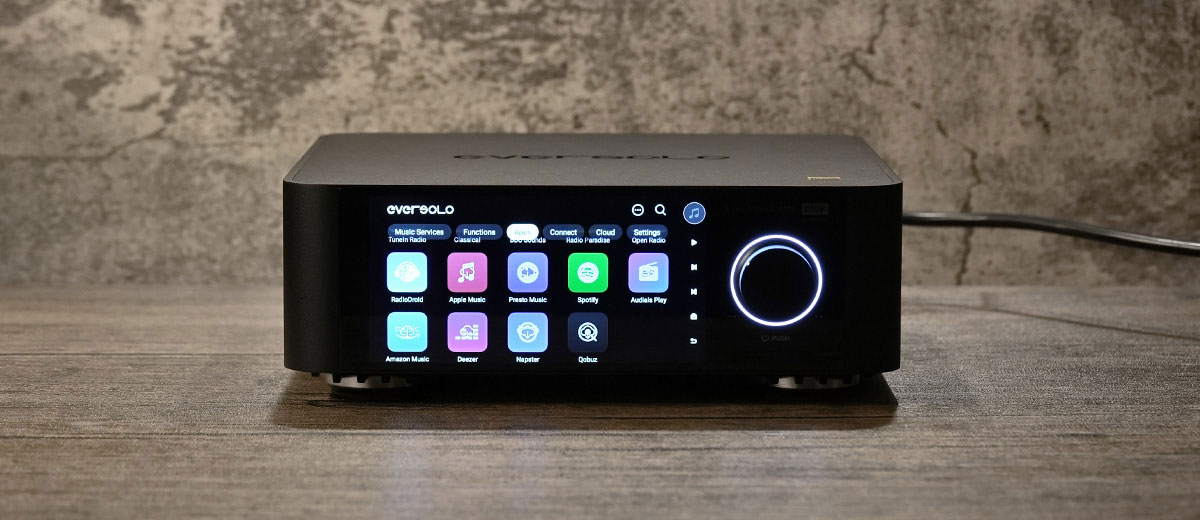
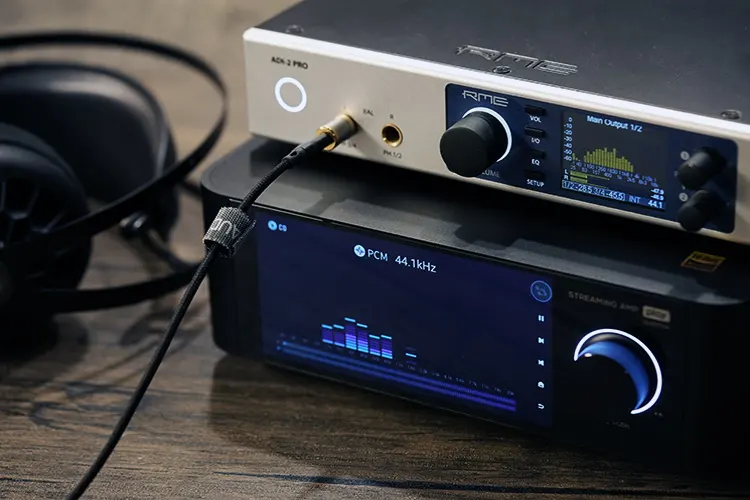
There are no XLR outputs on the Eversolo Play, so I tested its digital outputs connected to separate decoders and amplifiers above.
Generally, there is sufficient intensity in the USB out, which helps deliver a clean, noise-free output without passing on any audible noise to the connected devices.
I also had a good experience connecting the Eversolo Play to bookshelf speakers. It is sufficient for small speakers in the living room to sound quite loud while delivering good fullness.
The TI built-in power amplifier is quite powerful, but it is known to be sensitive to the quality of the PSU; if it is a poor PSU, it may sound noisy in the output.
Eversolo does a good job here despite not using a linear PSU, and the output is very clean with only very faint hisses at loud volume comparable to the gain noises in the track, which is negligible.
Pairings
While the COAX output may sound more pleasant in tuning, I would recommend using the USB connection with a bit of EQ for better, more definitive power. There are also 2 USB ports you can use, so it is flexible to connect to more than one decoding system.
And an additional note, be aware that the Eversolo Play does not have decoding functions for other USB sources, although it does work as an AirPlay and Bluetooth receiver.
The PMEQ feature and room correction allow a certain level of reshaping to the sound signature for speaker users, with no technical knowledge required, which is a big plus. This could avoid noticeable standing waves and greatly improve the perceived clarity.
Selected Comparisons
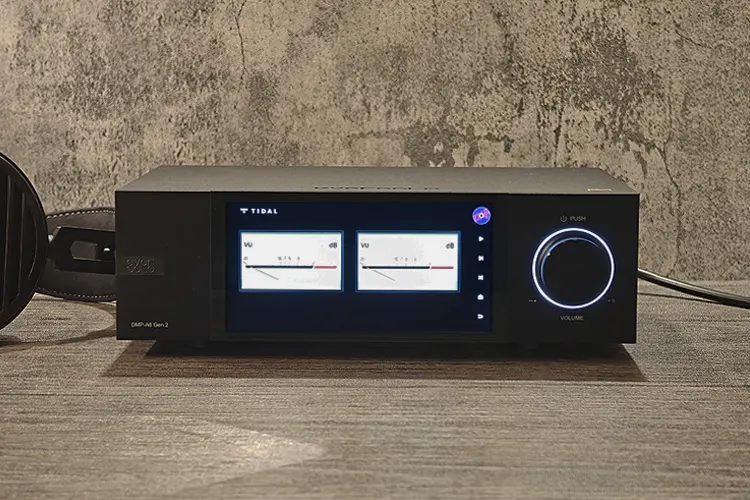
Eversolo DMP-A6 Gen 2
Technical
While the streaming features are similar, the DMP-A6 Gen 2 feels like a very differently positioned device considering its more elaborate analog section with an XLR output.
The DMP-A6 Gen 2 features dual ESS ES9038Q2M DACs for decoding, and TI OPA1642 in its amplification stage, which enables it to achieve >128dB dynamic range. It also has a low THD+N performance compared to the Eversolo Play.
However, technically, it is less comparable as you still need another separate amplifier for the DMP-A6 Gen2. Whereas for the Eversolo Play, you will need to connect it to another decoder and Amplifier if you want to use it for your headphones setup.
Design
The DMP-A6 Gen 2 is bigger in size with a slightly larger 6″ screen, which is not really an issue, as the 5.5″ screen on the Play is also quite big, and you can always use an iPad for control.
The design language is pretty much the same, and there is one detail I like about the Eversolo Play that is hidden in plain sight: the heat sink design below, carved from a solid metallic block.
The rest is similar as both devices are very nicely machined and with a matte black finish.
Performance
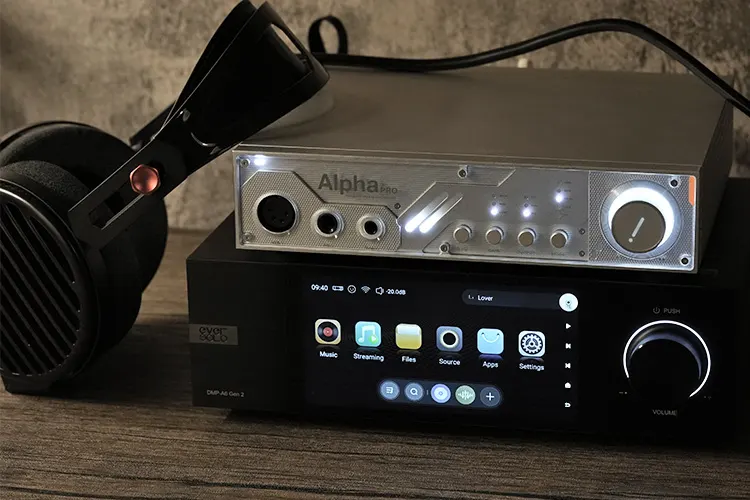
For a desktop scenario, since neither device has a headphone jack, I compared them by hooking them up with the D&A Alpha Pro and listening through its headphone output.
With the Eversolo Play as a USB source and the D&A Alpha Pro connected, the output is detailed, free from noise, and adequately extended without sounding compressed.
The pairing has a good sense of dynamics, control, and air, and the treble is smooth, retaining brilliance in the vocals but not getting too hot. Imaging feels quite precise.
With the DMP-A6 Gen 2 hooked up to the D&A Alpha Pro, the result is quite similar despite the two devices having different solutions and PSUs. The noise level is very low on the DMP-A6 Gen 2, so in terms of being a USB source, I would rate the two similarly.
For those with headphone amplifiers without a DAC, the DMP-A6 Gen2 with Pre-amp features would be a better choice.
That is when you can utilize its full power, as it has stronger decoding capabilities and a more refined tuning in its analogue output.
However, if you aren’t connecting to headphone amplifiers at all and have some small speakers from older stacks you want to revive, the Play would definitely be a more compact and flexible option.
FiiO S15
Technical
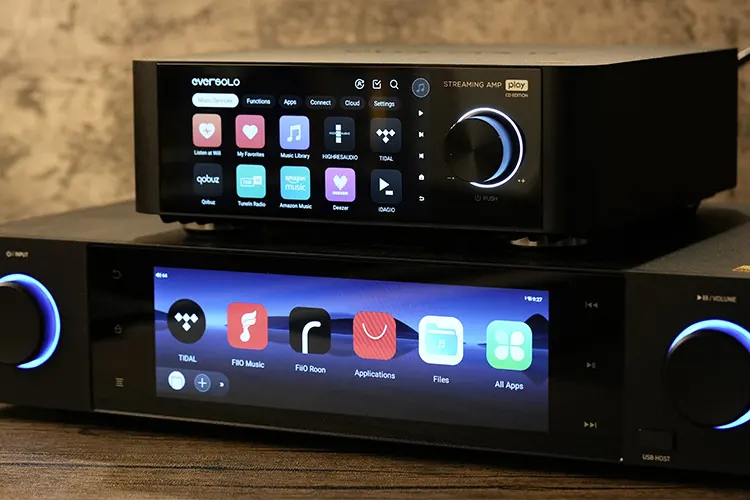
The FiiO S15 is a much larger streamer for a full-size rack. Like the Eversolo Play, it doesn’t have any headphone output, but the S15 does have an XLR out, just like the DMP-A6 Gen2 mentioned above.
The S15 runs Android 12 onboard and has the Snapdragon 660 MCU embedded, along with AKM AK4499 & AK4191EQ chips for decoding, also the Accusilicon AS318-B femtosecond oscillators for superior jitter control.
The FiiO S15 runs on the XMOS XU316 USB solution and supports 32-bit/768kHz and DSD512 with DoP/D2P/Native decoding capability. The bit rates supported are the same for the two devices.
Design
When I reviewed the DMP-A6 Gen 2, I compared it with the FiiO S15, but this time the Eversolo Play feels very different as it removes the pre-amp features and becomes a pure digital source, a Streamer with only USB output.
In practice, the S15 is also abundant with features that are not present on the Eversolo Play, such as AES and Optical output, and it comes with an ejectable SSD so you can connect it to a PC to tidy up the music library within, which is something I want to have on the Eversolo Play.
The way they interact with other gears are quite different. While both are labelled as a streamer, the key point to note before pulling triggers is whether you need a digital source or a pre-amp with XLR output for amplifiers.
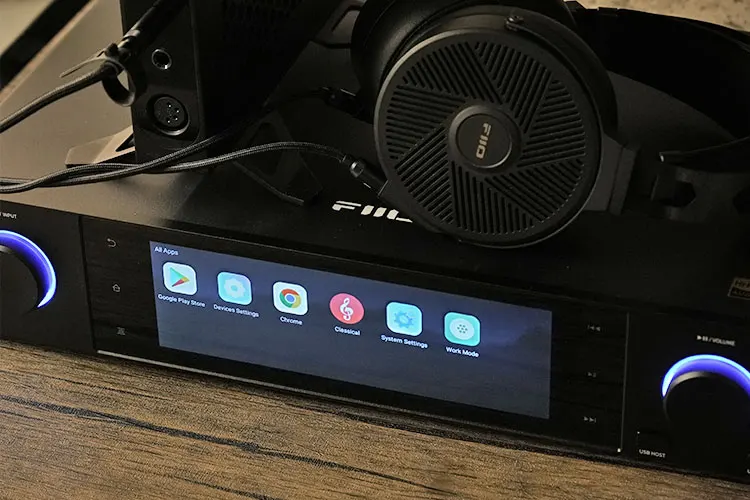
In terms of application support and the overall UI/UX, Eversolo is a clear winner, as their control app feels much more mature, with additional advanced features like room correction for speakers.
The customization level of the applications, layouts, on-screen guidelines, etc., are more user-friendly, developed on the Eversolo platform. The S15 feels rawer in design, with its forte in the analog amping section mainly.
Performance
I tried to do a different test here, to see if there are any differences in the perceived output quality using the same applications and playing back local files on a hard disk.
Since the only comparable outputs are the USB out and COAX out, but only the USB output supports the highest sampling rates so I will be comparing the USB out to see if there are audible differences.
Interestingly, at a lower bit rate, the FiiO S15 sounds a bit more polished and impacts firmer, and the Eversolo Play stresses a little bit more on the two ends.
At a higher bit rate, the difference is less distinguishable. I also find the output on the S15 marginally punchier and the Eversolo Play swifter in the lower end, though the difference isn’t very prominent, and the perceived layering and stage are similar.
Testing with the on-board Tidal apps, regardless of the better layout on the Play, the difference is marginal compared to the USB output of the two devices. The background noise control is also similar on the USB output.
Again, the Eversolo Play doesn’t have a pre-amp function, but it is much smaller in size. If your amplifier has a competent decoding section, you may not need to use an analog connection.
The Play could be a space-saving streamer choice with superior app-control experience and other fun features such as CD-ripping and room correction.
My Verdict
There is a lot of depth to the Eversolo Play desktop streamer, thanks to its mature OS features, well-customized applications, and connectivity with turntables.
The inclusion of features like digital room correction and CD ripping can bring old gear back to life and let you reinterpret it with modern definition.
A significant effort has gone into polishing the UI/UX and detailed settings, which is what makes it stand out from the competition, along with its quiet digital outputs and power amp feature.
For desktop headphone setups, the compact Eversolo Play desktop streamer serves as a solid digital source, a CD player, and a powerful lossless music player, all while keeping the form factor extremely compact.
Most importantly, the experience is enjoyable, leading to more listening and playback with its multifarious music sources. In this regard, it is a successfully designed product that lives up to its name.
Eversolo Play Technical Specifications
- Decoding chipsets: AK4493SEQ
Internal Memory: 4 GB DDR4 + 32 GB eMMC - Decoding: Supports up to Stereo DSD512, PCM 768KHz 32Bit
- Music File Formats Supported: DSD(DSF, DFF, SACD ISO) Support DST up to DSD512, MP3, APE, WAV, FLAC, AIF, AIFF, AAC, NRG, CUE
- Bluetooth Receiving: BT5.3, SBC/AAC
- HDMI ARC Input: ARC up to PCM 48kHz, eARC up to PCM 192kHz/24BIT
- Optical/Coaxial Input: Supports up to Stereo PCM 192KHz 24Bit and DOP64
- Analog Line In: Maximum input voltage 2VRMS
- USB Audio Output: Supports up to Stereo DSD512 Native and PCM 768KHz 32Bit
- (Supports DAC audio devices with the UAC standard only)
- Coaxial Output: Supports up to Stereo PCM 192KHz 24Bit and DOP64
- Subwoofer Output: Adjustable crossover frequency from 40 Hz to 500 Hz
- Output Power: 60W RMS@8Ω 110W RMS@4Ω
- THD: <0.0037% 5W at 1KHz
- Signal-to-Noise Ratio: >109dB, @A-wt 4Ω 110W
- Channel Crosstalk: <-108dB
- PHONO Amplifier gain: MM 60dB MC 74dB
- PHONO Input sensitivity: MM 5mV MC 0.5mV
