

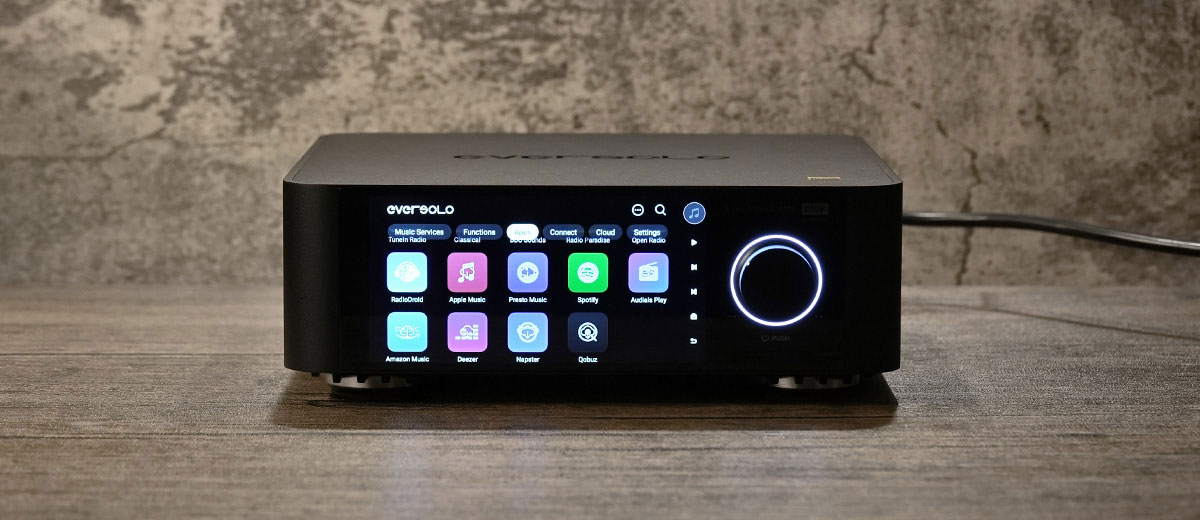
James reviews the Eversolo Play, a new desktop lossless music streaming amplifier with an integrated CD Player and smartphone app control. The CD Edition is currently priced at $799.
Disclaimer: This sample was sent to me in exchange for my honest opinion. Headfonics is an independent website with no affiliate links or status. I thank Eversolo for their support.
Click here to read more about streaming products we have previously reviewed on Headfonics.
This article follows our latest scoring guidelines, which you can read in more detail here.
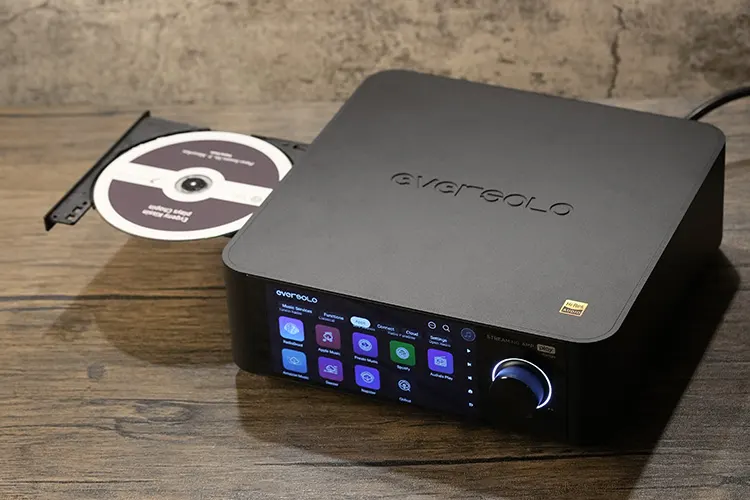
In this review, I will be testing the new Eversolo Play CD Edition desktop streamer. This is possibly the most compact, all-in-one Streamer, CD player, Phono-amp, and power amplifier in the market.
There are advanced features, including room correction, and you can sync and link multiple Eversolo devices. This unique device brings a lot of fun with an eye on traditional analog control over vinyl, CDs, turntables, and old speakers.
Available at $799, the Eversolo Play is one of the most versatile and space-saving streamers for those who need a wide-ranging digital source.
If you are planning to turn your DAC and Amplifier stack into a streaming setup or wondering how it compares to the DMP-A6 Gen 2 and FiiO’s S15, then you should definitely read on!
Features
DAC
At the core of the Eversolo Play is the Asahi Kasei Microdevices AK4493EQ DAC chipset and a rather decent dynamic range performance commonly seen on SACD players and other high-grade decoding designs.
Eversolo adopts a PFP + LLC PSU for the Play, enabling it to achieve a quiet background with ample power in its output. The THD performance in the output is decent at below 0.0037% @5W/1kHz load, with the SNR rated at 109dB, which is satisfactory.
The Eversolo Play supports native DSD512 and PCM 32-bit/768kHz decoding and can output at the same rate with its USB output function.
As it rides on the same platform as their other products, such as the DMP-A6 Gen 2, it has no issue reading and playing back mainstream audio codecs, including but not limited to DSD (dsf/dff/ SACD ISO/.DST), APE, FLAC, WAV, and AIFF.
HDMI ARC
The Eversolo Play allows inputting PCM 24/192 signals from the HDMI ARC port.
For example, you can connect Smart TVs supporting ARC output to the Eversolo Play over an HDMI cable, without needing to rely on another set of analog wiring, while enjoying the EQ and room correction features on board.
MM/MC Phono Input
This is a rather uncommon yet useful feature for those who want to seamlessly integrate their turntable into the system without the need to hook up a separate Phono amplifier, which will use an extra power outlet space. Y
You can select MC/MM in the connection menu and choose to playback from its digital outputs or speaker outputs. It would be even sweeter if Eversolo could consider adding a recording App, so users can store their vinyl collection digitally.
CD Player (Optional)
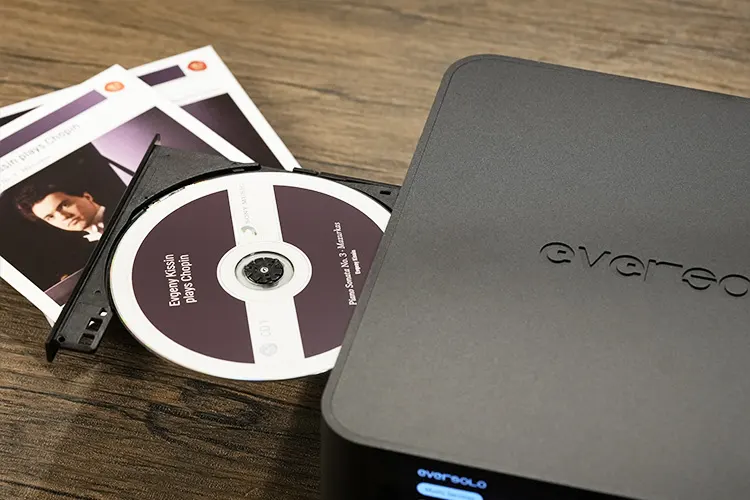
Getting the built-in CD player version of the Play would be more convenient for those who do not like to look for an external drive that is compatible with it.
The ROM is installed with shock-proofing components, plus Eversolo’s special error-correction algorithms are used to prevent errors when ripping discs that have been scratched or are aging.
After the CD pops up, it will soon go to the playback screen automatically; alternatively, you may choose the ripping option and then save disc as WAV or FLAC/add numberings before each track, and then move on to ripping. A CD can be extracted in only a few minutes.
This is a useful feature, but my only wish is that the extraction of tracks feature could be supplied with a few more options, in the sense of a slower ripping speed with extra correction settings, such as in EAC.
Unfortunately, the metadata of certain CDs is not always accurately read. I hope Eversolo will create a way for consumers to choose online-retrieved metadata and album covers that would make managing albums of lesser-known artists who are not signed to major labels easier.
Amplification
The Eversolo Play incorporates the Texas Instruments TPA3255 high-performance power amplifier, which is known for its technical prowess in bass extension and power efficiency.
The module outputs 60W into an 8Ω load and 110W into a 4Ω load, and testing with small speakers, it sounds noise-free and still has sufficient bite and body at higher volume levels, maintaining decent dynamics, separation, and feels naturally extended.
Design
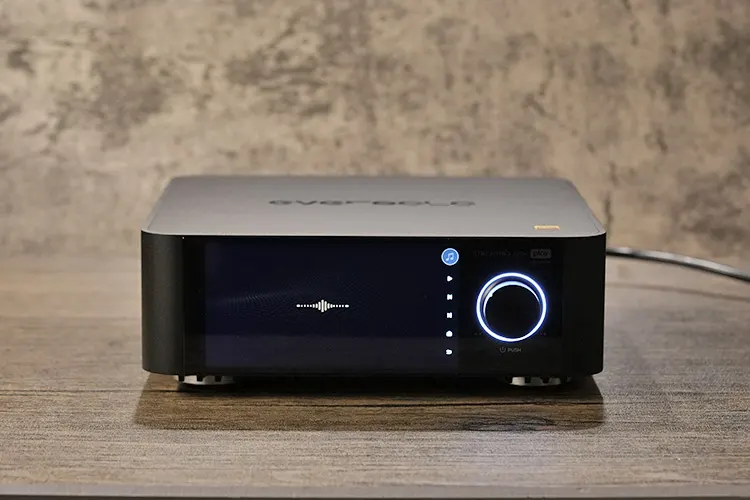
Eversolo’s designs involve intensive use of machined Aluminum and often come with a big screen; it is no exception for the Play.
This is basically a small metallic block with a huge 5.5” screen laminated under a huge glass panel across the front panel. The build is robust and may help deter EMF interferences and suppress resonances, together with dampening feet installed at the bottom.
The Play uses a clean, minimalist approach with details hiding in plain sight, such as the debossed logo and heatsink-shaped machining below the chassis, which are subtle but cool-looking alongside its sand-blasted, matte black finishing.
At just 23*23*7.5 CM is extremely friendly for desk spaces and can be easily stacked on other Decoders.
As usual, it has a multi-function volume knob that is lit with a ring of LED, which doubles as an on/off button. When fired up, the screen looks very clear under sunlight, with sufficient pixel density and brightness.
It works well with the gesture-controlled interface for navigating around different streaming Apps and settings, that is clearly and intuitively arranged.
I/O
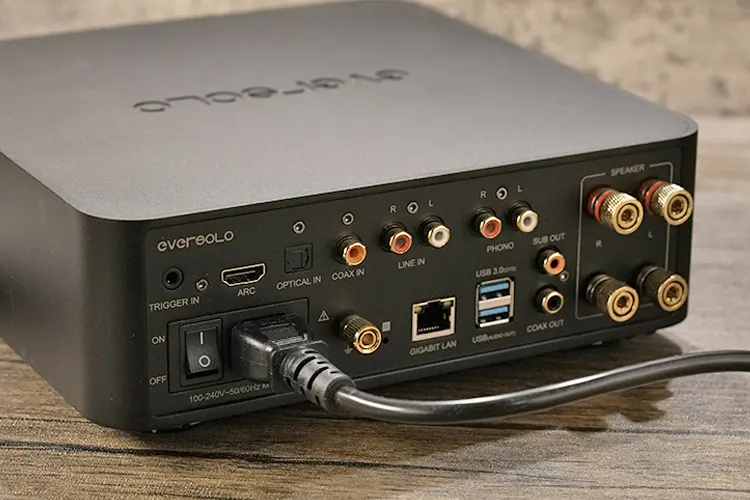
Aside from the HDMI ARC and Phono input mentioned, also two USB ports; the Eversolo Play supports optical/COAX input as well as RCA Line In.
You can hook up your old CD players, turntables, ARC-supported TV, other Digital sources, and stream it to other decoders, or simply enjoy it over speakers with Class D amplification.
What makes it special is that it has a dedicated SUB Out port, which allows adjusting the crossover point. And with this feature, you can turn a 2.0 system into a 2.1 to enjoy movies and live recordings on the TV system.
I haven’t even mentioned the streaming features yet, and together with the CD ripper and connectivity to turntables, this is clearly one of the most compact and versatile players I have tried, as you only need one single power socket to power the system and stream new content on old speakers.
For those who are concerned about ground loops, there is a grounding connector. I just wish Eversolo could put a USB-C jack on the side or on the front panel so it can more easily connect to other storage devices.
Controls
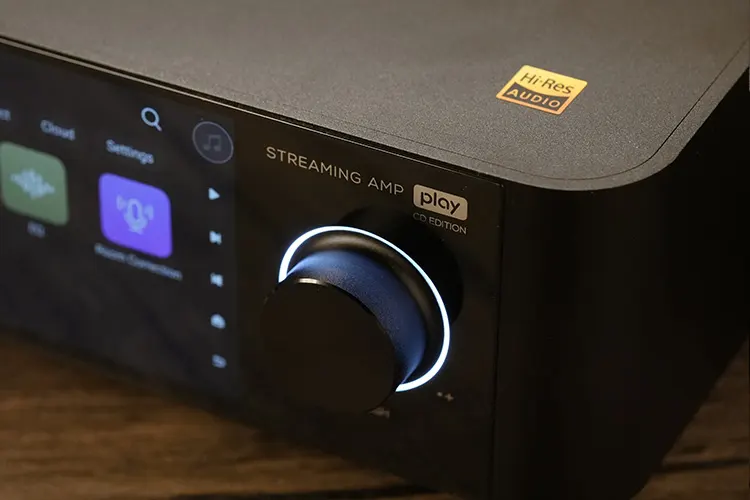
There is just one multi-function knob on the streamer, and I don’t think anyone needs any guidelines to learn how to control this device.
The friendly and mature UI/UX design with pop-ups in various functions to help first-time users also helps, and unless you have a big hand, then the on-screen control, even typing, would just work as smoothly as on a phone.
You may also notice Eversolo has grouped features into different menus, which helps users get to the settings and apps more easily.
Packaging & Accessories
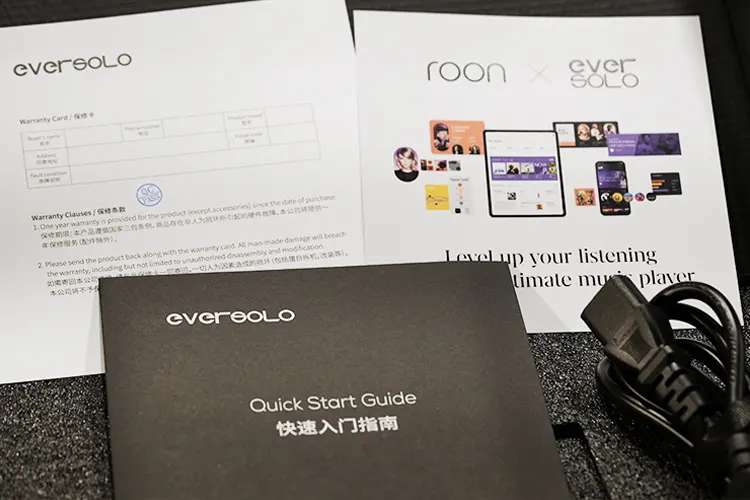
The Eversolo Play comes in a professional, well-padded packaging despite being built like a tank. Opening the box, the main unit sits within a dustbag and comes with a thick power cord, trigger cable, and user manuals. There are also leaflets of the ROON, Qobuz services, etc.
I am not really complaining about the lack of a remote control because you can just use the phone app, or you may get the separately sold Bluetooth remote, which could be handier.
Click on page 2 below for my software and sound impressions
Click on page 3 below for my recommended pairings and selected comparisons.
