

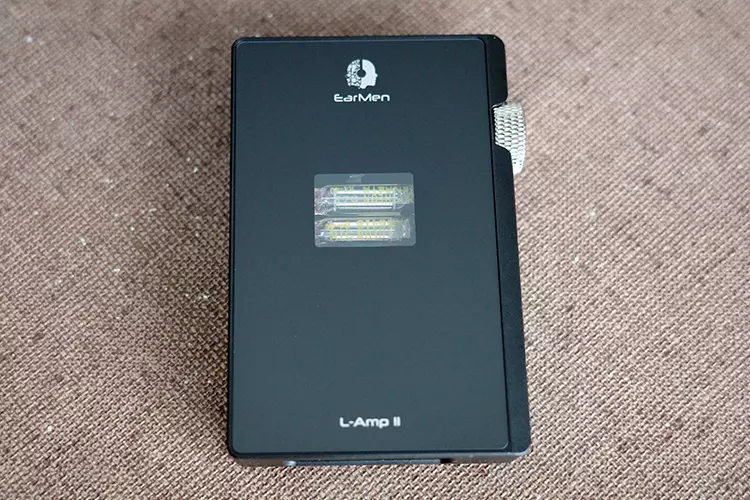
Lynn reviews the EarMen L-Amp MK2, a 2nd-gen portable tube headphone amplifier and DAC that delivers up to 1W of balanced output power. It is currently priced at $550.
Disclaimer: This sample was sent to me in exchange for my honest opinion. Headfonics is an independent website with no affiliate links or status. I thank EarMen for their support.
Click here to learn more about EarMen products previously reviewed on Headfonics.
This article follows our latest scoring guidelines, which you can read in more detail here.
Soon after receiving the MKI L-Amp, rumblings sounded of an improved MK2. I liked the MKI and still do.
With power abundant from the 4.4mm balanced output, the JAN6418 tubes delivered a sumptuous tube-like sound, with high-quality audio permeating whatever source was connected to the unit.
Some users reported ‘issues’ with the MKI, and EarMen addressed these immediately in the MK2. Not only does EarMen take customer service seriously, but they are also more than willing to make improvements. Immediately. And the L-Amp MK2 is the result.
Structurally similar to the MKI, but thicker, the functionality is still oriented towards that tube goodness wrought from the NOS JAN6418 offerings. While the effect is an improvement, along with a higher price, the L-Amp MK2 comes with instructions for proper usage.
This is a direct result of conversations with the customers (and reviewers, like me). Taken seriously, the L-Amp MK2 aims to build on the MKI’s excellent qualities while making its own mark as an improved unit.
The EarMen L-Amp MK2 currently retails for $553, so let’s see how it stacks up against the original, the TR-Amp, and the Angel in my full review below.
Features
The power regulation has been enhanced to reduce background noise, which impeded the first generation.
The two-level filters ensure that, whether you use IEMs or headphones, you get the full 1W @ 8 ohms. Those Burr-Brown INA 1620 SoundPlus op-amps have ultra-low THD+N and superior transparency compared to the MKI.
The ESS SABRE DAC (32-bit/384 kHz PCM, DSD DoP128) delivers high-resolution performance with a level of detail and realism not often found in portable tube amplifiers, except for high-end ones.
Thankfully, automatic power protection safeguards headphones and the circuitry from overload.
Unlike the first generation, there are no pops or clicks when plugging in or powering on/off. This was one of the main drawbacks, to me, from the first generation, which thankfully has been quelled.
Add in the gold-plated PCBs and connectors, which help maintain signal integrity, and the L-Amp MK2 shows improvements across the signal pathway.
Those NOS JAN6418 tubes, made in the USA, are isolated on a new four-point silicone suspension system, minimizing vibration and mechanical feedback.
Yes, I did the shake test, and it was silent. The hand-building of each unit adds to its high quality and lends a sense of personalization.
Design
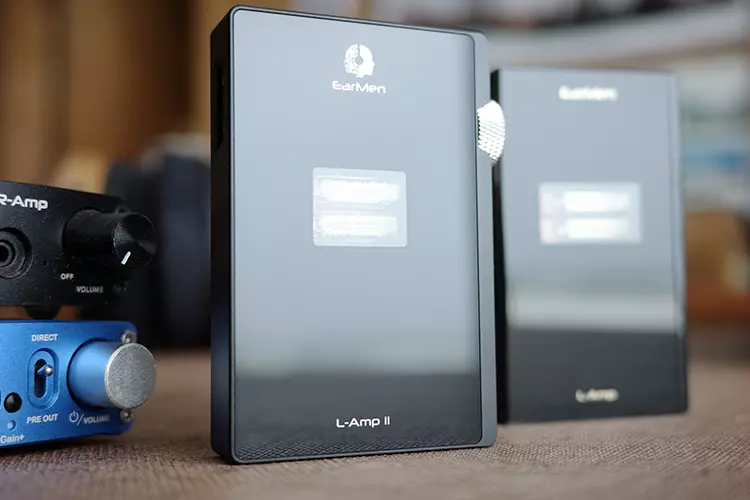
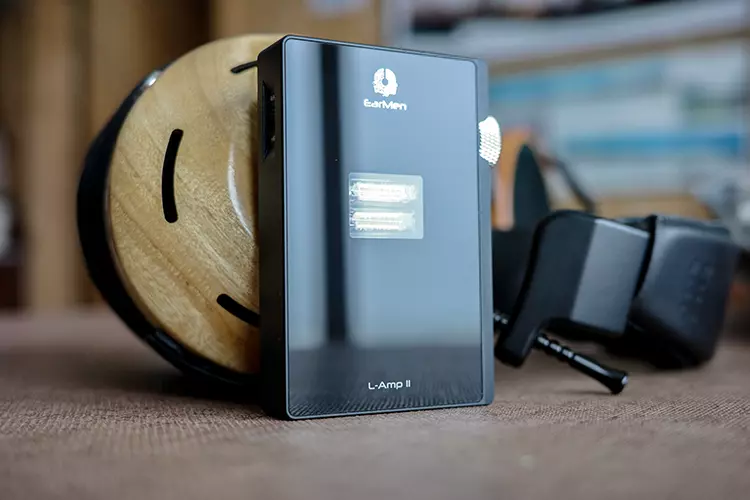
Sized similarly to the MKI, the L-Amp MK2 distinguishes itself with an analog volume potentiometer that doubles as the BASS X button (push).
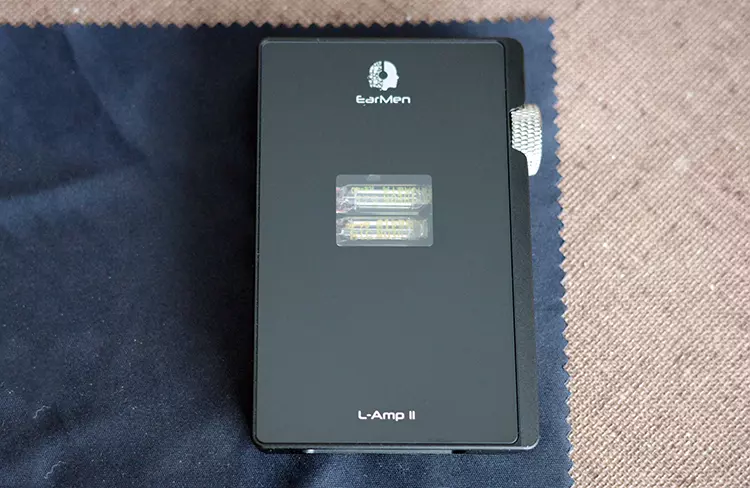
The viewing window to see the tubes is also smaller, focusing on the tubes themselves, instead of the connections and tubes of the previous generation.
Sleek glossy black still promotes fingerprints, but the shine looks stunning, with a high degree of reflectivity.
Save for the volume potentiometer, and IEM/HP switch on the sides and headphone jacks and data/power ports on the top & bottom, respectively, the L-Amp MK2 is simple and elegant.
I do sense a bit better build quality, but that would be like comparing a C-class Mercedes to an E-class.
Both are quality, but one is more upscale. The tactile areas on the side promote good grip, and the subdued look adds to the quality package. The monocoque shell adds to that allure.
Miki’s signature adorns the back again, along with long rubber strips on top and bottom for stacking. A rubber is even included in the gear. The back also has instructions for activating the BASS X function.
The isolation via the silicone subsystem also means that one can be a little harsher in usage, which, to me, is more typical of EarMen’s portable products. A robustness garnered by stellar aesthetics.
I/O
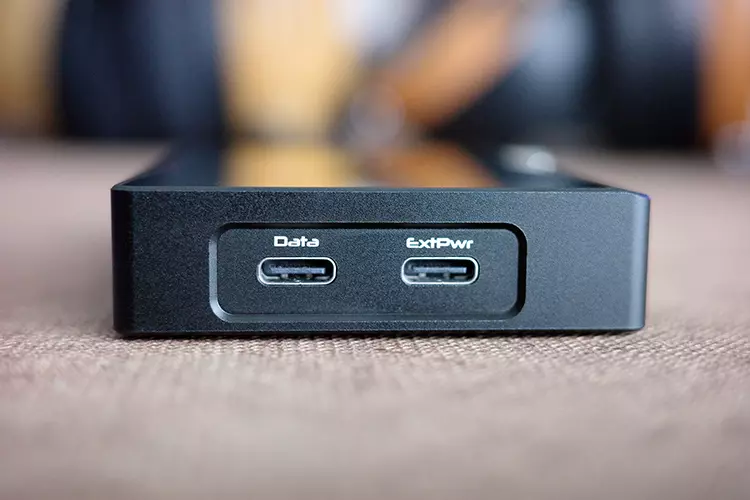
Simplicity rules for the L-Amp MK2’s inputs & outputs. A single USB-C input supports most smartphones and DAPs, as well as many desktop systems. Sometimes simplicity is more diverse than one might think.
The same ‘ExtPwr’ USB-C port also prevents your smartphone from draining its battery, enabling extended listening. I found the L-Amp MK2 ‘drained’ the battery at about the same usage rate as the OG, at 3-4% per hour on my iPhone 16 Pro Max.
Output options of 4.4mm balanced and 3.5mm SE can also be used to connect to an external source, such as powered speakers, or any device that supports them.
I did hook the L-Amp MK2 up to the FiiO SP5 active speakers via the 3.5mm SE port, and it worked. I also connected it to the 4.4mm balanced input on the EarMen CH-Amp Signature.
Controls
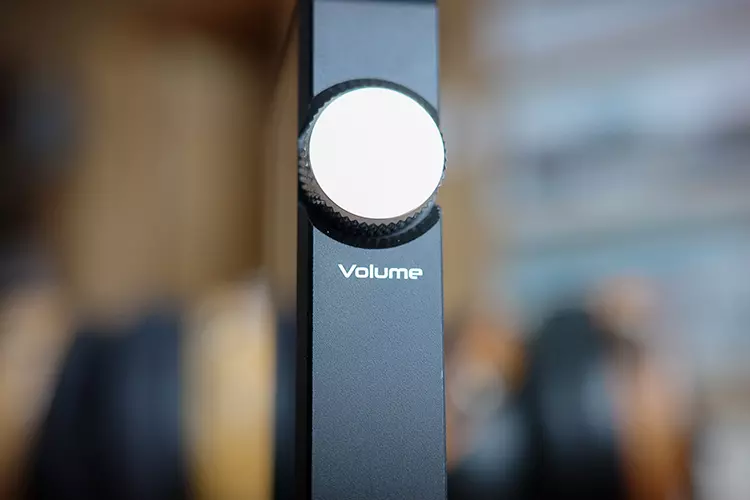
The analog volume potentiometer worked quite smoothly, with a concerted effort, but not overly so. The effort to change the volume up or down can be done one-handed without a problem. Plus, the wheel did not feel loose, which can happen with a multi-function ‘tool’.
A solid push activates or deactivates the BASS X for the only other ‘function’ that is user-oriented.
The only other switch changes the gain for IEMs (low gain, lower noise floor) or headphones (high gain, a smidge more noise). Be forewarned that changing this while using IEMs can result in a marked increase in volume.
Packaging & Accessories
The typical EarMen protected packing is used with the L-Amp MK2. Double-boxed, the inner black box features the traditional sticker on the back with the requisite information, including specifications.
Opening the lid, you are met with a warning card, first and foremost. This card contains the necessary connecting instructions, stating that the tubes need a proper warm-up to function properly. And a bold, capitalized “DO NOT UNPLUG CABLE,” in case the user does not understand.
This warning comes from previous users (including me) who stated that the MKI’s functionality was hindered by improper tube warm-up.
Miki & crew took our advice and added the warning so our device would receive a proper warm-up. And it works. I found that a short warm-up time of less than a minute was all that was needed. A very minor annoyance for proper functionality.
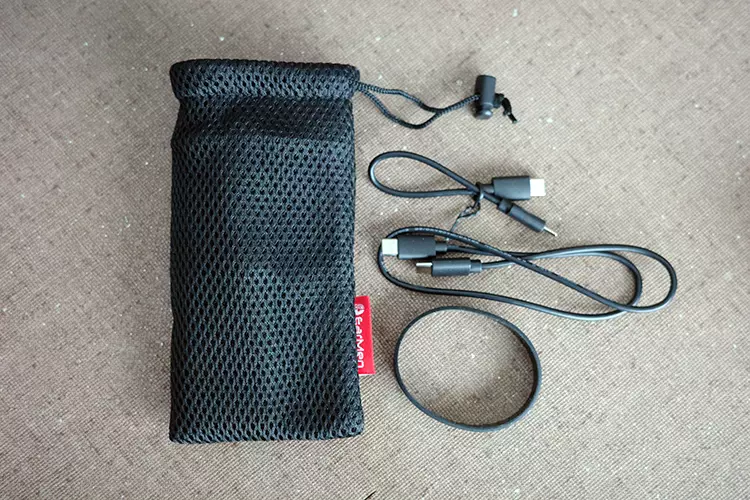
Next is the ubiquitous warranty card, a cleaning cloth, the unit itself protected in a soft foam insert, and a mesh pouch for carrying, which contained two USB-C cables (one was longer!!!), and a rubber for stacking.
Nothing spectacular, but functional, as expected.
Sound Impressions
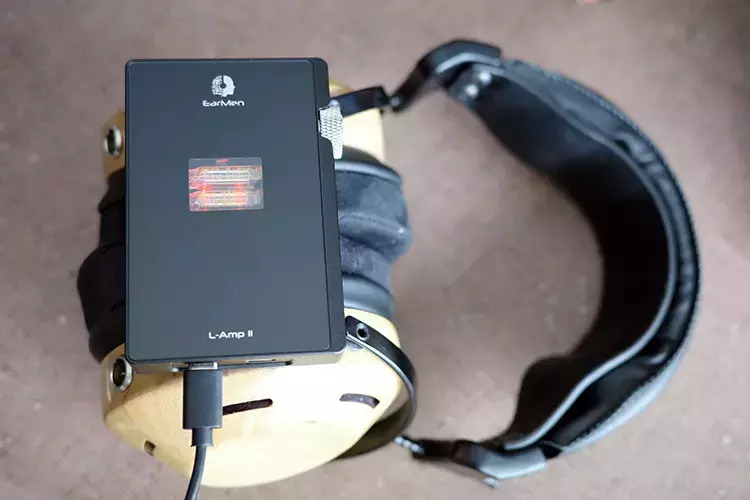
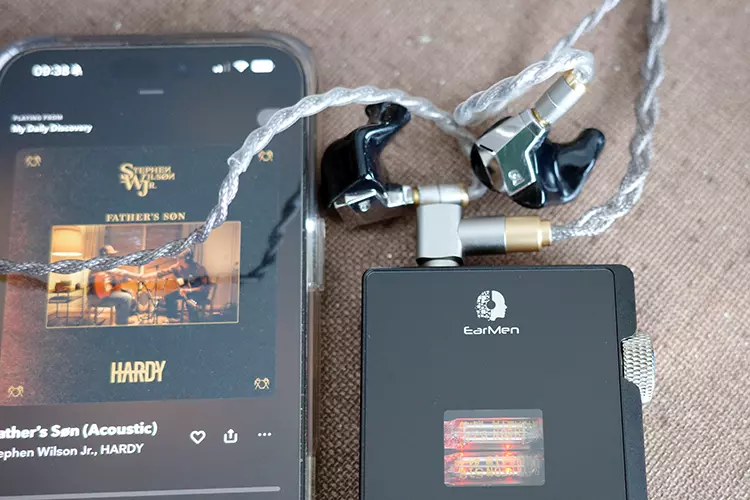
The following sound impression of the L-Amp MK2 was completed using my iPhone 16 Pro Max, MacBook Pro, EarMen’s own CH-Amp Signature, and the FiiO SP5.
The versatility of connectivity made up for the “lack” of other input/output options. IEMs ranged from the UM MEST Jet Black to the Campfire Audio Supermoon custom and ZMF Headphones Eikon, along with my Audeze LCD-3.
Summary
The original L-Amp had a warm richness that was enticing for its departure from a neutral, clear sound. The L-Amp MK2 shows those same tendencies, but with greater clarity and a more detailed response than one might find in a quality two-channel tube amplifier.
With the BASS X engaged, the low reaches into a range usually reserved for basshead-type responses. Except that the level of clarity overrides any potential shortcomings from a preponderance of bass quantity. That bass does move into the midrange, but in a mostly complementary fashion.
The bass can cover the lower midrange, making for a lack of exacting detail, but to me, this is typical of a quality tube offering, both portable and two-channel. When the BASS X switch is off, the overriding tendency subsides.
This evening of sound across all frequency ranges, with smooth midranges, lends them an appealing clarity but lacks some micro detail.
There is a nicely rounded top end with BASS X engaged, slightly lifted, extending the range and airiness. And with BASS X off, that smooth extension is further promoted with even better clarity.
I never felt there was any sibilance or piercing notes up top, which made for a nice, closed loop throughout the signature.
Timbre
The L-Amp MK2 offers a warm richness characteristic of tube amplifiers. While not as luscious as a true two-channel tube amplifier, the L-Amp MK2 mimics that sound with alacrity.
This does not dissuade one from hearing very good levels of detail retrieval and clarity that almost belie what one might expect.
While detail retrieval is very good, there is some overwriting of the lower end into the mids, again promoting tube goodness.
While that can certainly cover the lower mids, the overall midrange has enough presence to compensate nicely. I never felt there was any lacking, even with complicated pieces of varying instrumentation.
In fact, the layering of instruments lent to the overall laidback nature and naturalness of sound, such as a solid tube amplifier should. The JAN6418 NOS tubes present an interesting experiment in tube sound, and here the L-Amp MK2 presents the benefits better than the first iteration.
I found I could add volume more readily to this equation than to the first without suffering from errant sounds piercing the melancholic signature. The fine-tuning of the second generation is clearly evident here.
Vocals come across as smooth and detailed, with a bit of sultriness that makes for an alluring signature. But don’t get overly caught up in that, for the clarity of the overall can certainly add to the pleasure.
I did find a bit of a forward push to the upper midrange, which seems slightly disconnected on certain music, but this could certainly be the recording, too.
Staging & Dynamics
In three dimensions, the L-Amp MK2 offers greater height and depth, creating a seemingly holographic effect. The 3D effect came through more in the depth of the soundstage than in the width and height, which was a nice treat.
The width played slightly outside of my head, driven by different listening tools. The ZMF Eikon offered sumptuous levels of width that were well controlled.
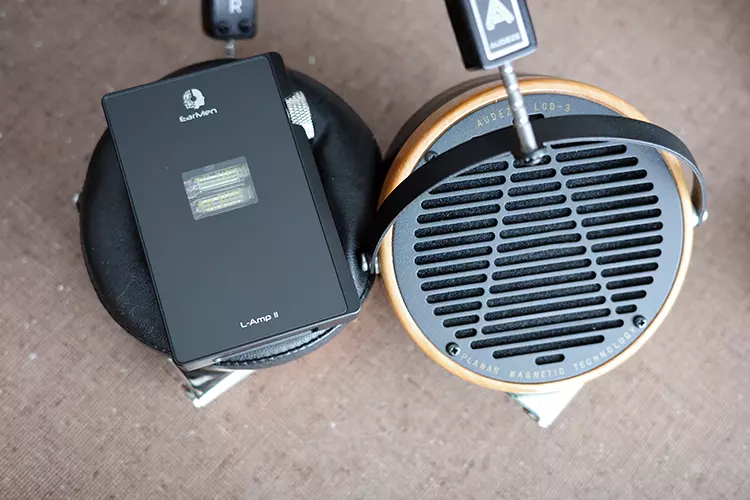
The Audeze LCD-3s added a warmer touch while maintaining excellent clarity. The transient response was about as good as it gets for a portable unit in this range, and the pairing made for excellent listening across all three dimensions.
The L-Amp MK2’s ability to play across many listening units enhanced versatility. Tailoring the sound with each headphone or IEM, the L-Amp MK2 lets each tool shine on its own merits.
A brighter IEM, such as the CFA Supermoon, never felt too bright, but was kept in check by the warmth and layering of the whole.
The layering is probably where the L-Amp MK2 suffered the most, with a lack of true definition in each layer.
That said, the instrumentation came across as accurate, and I never found myself hunting for the placement of any part, thanks to the depth’s 3D effect. What was lacking in true definition was countered by the excellent melding of the parts to make a whole.
Synergy
Efficiency
Driving the 350Ω ZMF Eikon took the most effort, and I have no doubt that had I used my older AKG 240DFs at 600Ω, the L-Amp MK2 might have suffered without the source’s help.
But for IEMs and headphones that are easier to drive, the L-Amp MK2 shone, as evidenced by the ones I used.
Power
True power might be lacking for harder-to-drive headphones, but for portable use and everyday use of IEMs, the L-Amp MK2 came through without issue.
I never felt there was a lack of power with anything, to be honest, but the final driving voltage required for a harder unit wasn’t quite there.
That should not dissuade you from the L-Amp MK2, though, because the good it does outweighs the final power necessary for some.
Pairings
My favorite pairing was probably the Audeze LCD-3s, which I do not listen to often enough because of reviews.
The warmth presented added to the typical Audeze sound, making for a very pleasant and detailed listen. Only lacking in true treble reach, the LCD-3s are still amongst my favorites for use and in testing (when possible).
The ZMF Eikon was very close behind, but with a bit brighter midrange that was quelled nicely by the L-Amp MK2. I appreciated the spatial awareness and 3D factoring of the Eikon/L-Amp MK2 presented together, with excellent detail retrieval and no missteps.
The Campfire Audio Supermoon Custom is a bright-sounding IEM that can make or break many sources. Considered too bright with the wrong source, the Supermoon paired very well with the L-Amp MK2. Bass was strong and deep, kept tightly controlled.
The excellent midrange gave me better spatial awareness than the LCD-3, but not so much as to become grating or tiresome. Layering was exceptional here, leading to excellent extension in the upper reaches.
The upper midrange melded smoothly, with detail into the lower treble, which then extended with an excellent, airy quality, defying the tube nature of the L-Amp MK2.
The UM MEST Jet Black was a treat I had in on loan for another review, and it did not disappoint. UM does Bone Conduction right, and it showed through the pairing. With excellent extension and a slightly thicker, detailed top end, the JB presented an excellent sound.
The almost guttural low end was well controlled and tight, almost sounding better than it had a right to. If not for the LCD-3, this would have been my favored pairing, and it was in terms of IEM usage.
