

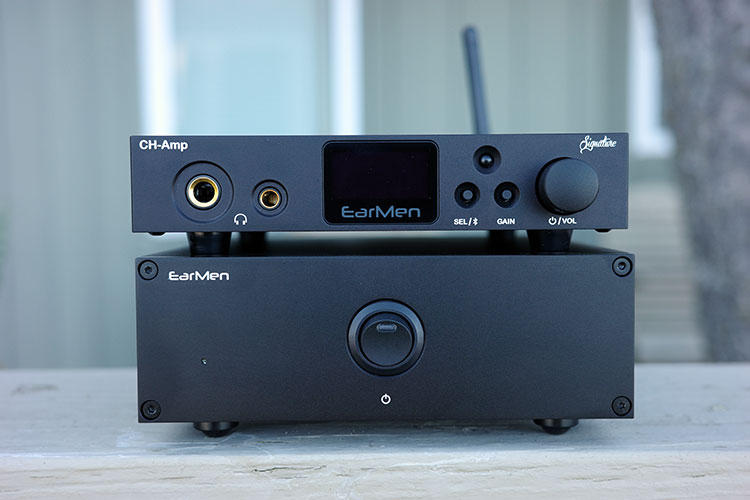
Lynn reviews the EarMen CH-Amp Signature, a wireless-capable compact desktop ESS9038 DAC, standalone PSU, and balanced headphone amplifier. It is currently priced at $949.00.
Disclaimer: This sample was sent to me in exchange for my honest opinion. Headfonics is an independent website with no affiliate links or status. I thank EarMen for their support.
Click here to learn more about EarMen products previously reviewed on Headfonics.
This article follows our latest scoring guidelines, which you can read in more detail here.
EarMen products are not new to me. As a website, we have reviewed all of their wares. I was lucky enough to have sample number 2 of the exceptional L-Amp JAN6418 infused portable tube amplifier.
We reviewed the previous iteration, the CH-Amp, which had a markedly higher price. Based upon that, you could think of the CH-Amp Signature as the racing version of the Porsche 911 Turbo to the decked-out luxury model 911 Turbo.
A no-nonsense amplifier, the “lighter” version of the CH-Amp has the “Signature” moniker for a reason, which will be discussed in detail below.
And, as per normal EarMen routine, the product reviewed here goes well beyond the statistics, including what I will call “conservative” 3.8W power estimates.
The CH-Amp Signature also has the same excellent build quality and functionality as the company’s other products. That is to say, top-notch.
During the course of this review, I put in roughly 150 hours of listening, between the normal 75 hours “warm-up” and 75 hours in dedicated listening.
As part of the break-in, I listened to determine if any changes were noted. I found very little, which means the CH-Amp Signature is good to go out of the box.
And, after the L-Amp, I eagerly awaited this product, knowing the history and excellent products EarMen provide us as listeners.
Features
The Ch-Amp Signature starts with a USB DAC (ESS9038) capable of decoding up to 32-bit/768kHz.
Using the acclaimed ESS’s patented HyperStream® II architecture and time domain jitter eliminator as part of the chip, the ESS9038 DAC delivers DNR of up to 140dB (123.5dB in 4.4mm bal, here), making it exceptionally versatile for portable and lower power amplifiers.
The efficiency of this chip is not lost in the CH-Amp Signature, allowing for clean, crisp sound that comes across as highly musical, too.
High-resolution Bluetooth gives the CH-Amp another input option, while the gain control can be set to low, high, and an IEM setting for those very sensitive IEMs that might be in your collection.
With a power of up to 3.8W (at 32Ω) in 4.4mm balanced, the CH-Amp Signature provides plenty of grunt. I had no trouble driving 600Ω headphones to very loud listening levels. Too loud for comfortable listening.
The external power supply (the unit comes in two parts) helps to keep noise to a minimum and is isolated from the business end of things, making for a better dynamic to the sound, purportedly.
The CNC aluminum chassis of each piece also acts to dissipate potential heat from hard driving.
Design
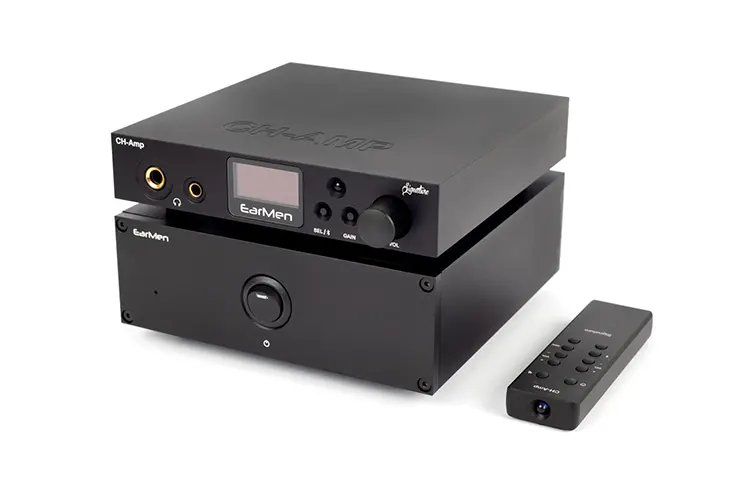
The CH-Amp Signature is a diminutive two-box design of CNC aluminum, with a single power switch on the external power supply/amplifier part. The slimmer DAC unit has an OLED display complete with LED meters like our cassette decks of old (or still have…).
Even the remote is made from a solid aluminum block, complete with an internal rechargeable battery. It does not come with a light, though; visibility is quite good. Tactility is too.
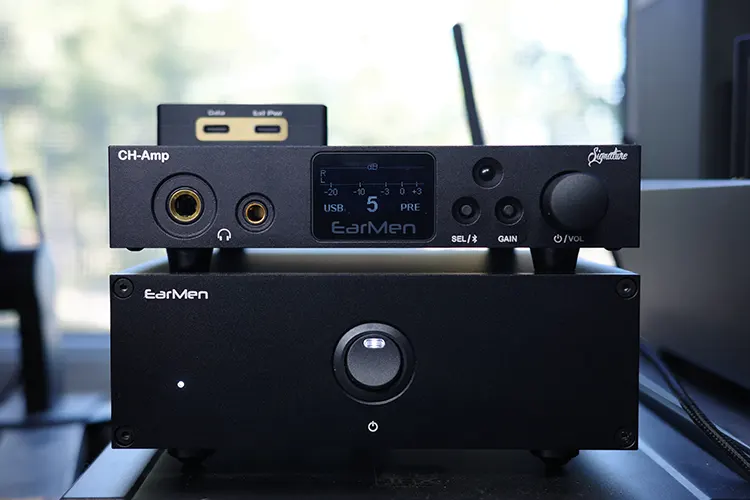
The 6.35mm SE jack starts business on the left front of the DAC, followed by the 4.4mm bal, OLED display, a triangle of options (IR for remote on top, SEL/BT button bottom-left, and GAIN bottom right), and the power/volume knob (with detents) on the far right.
The triad of buttons mimics the amplifier’s three feet, while the DAC unit has four. While stability was not much of a problem, the trio of bottom feet made for a good look.
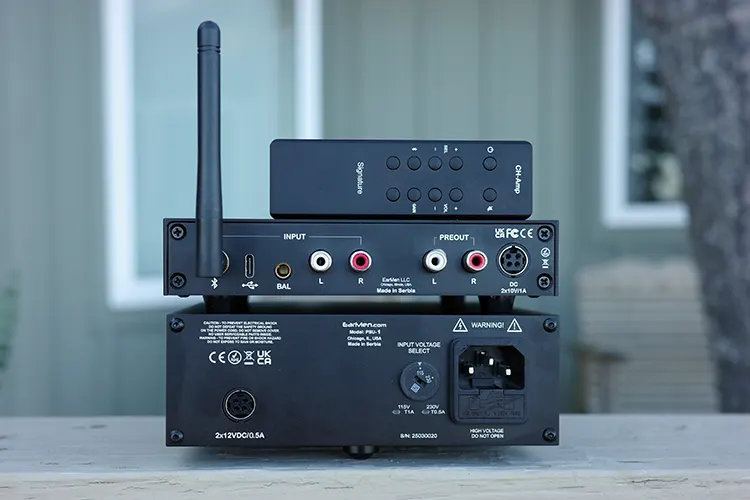
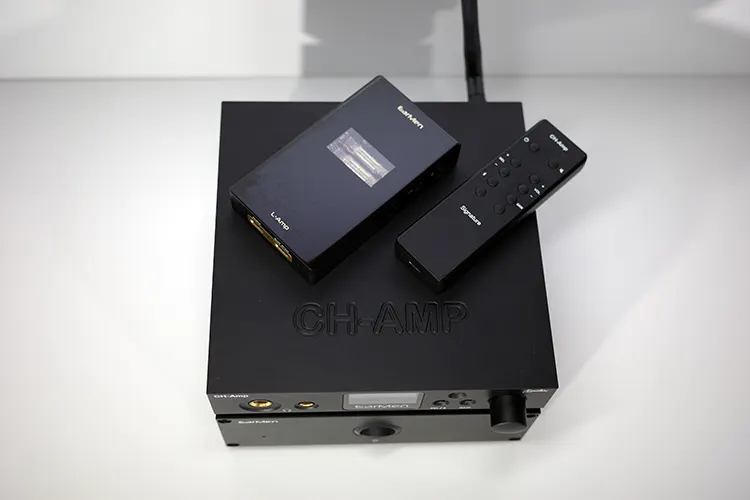
The CH-Amp inlaid stamp makes for a nice look on the top, too. The back of the DAC has the BT antenna, USB-C, 4.4mm balanced, and RCA inputs left to right. The right has RCA Pre-out connectivity for use as a DAC-only option to powered speakers or other sources..
The power supply unit has a 115V/230V option, which must be turned to your country’s power option. The DC 2x10V/1A plug goes from the power source to the DAC, which is then activated via the remote, after turning on the power supply.
The power supply may be left on, but I appreciated the switch being on the front so I did not have to reach around to the back like on most units. This makes access markedly better.
I/O
The CH-Amp Signature gives off a clean look, with an evenness to it that flows through into the inputs and outputs. The remote must be charged to turn the DAC on, so having that up and running is first and foremost.
Once powered on, you rely upon the small LED screen for information. Showing the input in the lower left allows you to quickly discern what source is playing. The lower right allows you to see the gain level, which can be fine-tuned quickly with the remote.
The 6.35mm SE jack does provide a lower power output, but I never felt the need for more when using it with the AKG 240DF. Yes, there is more power through the 4.4mm bal, but both can be used with confidence.
Inputs include Bluetooth, USB-C, 4.4mm balanced, and RCA. All options were tried during testing. There is also a pre-out RCA connection for use as a pure DAC. Most of my testing occurred using the USB-C input from either a DAP or my MacBook Pro.
I also connected from the xDuoo TA-32 through RCA inputs, so I could run the Oppo BDP-83 using Coaxial output into the TA-32. Reverse testing from the RCA output into the TA-32 was used as well.
Controls
There are three physical buttons on the CH-Amp Signature. A select source/BT button (for pairing), a gain button (low, IEM, and high), and the volume knob (medium detents, with good feel and very good accuracy).
Above the two smaller buttons is the IR for the remote, making a triangle between the three.
Once the power source/amplifier is turned on, the remote is used to power on the DAC unit. This can be left in standby if the power unit is turned off.
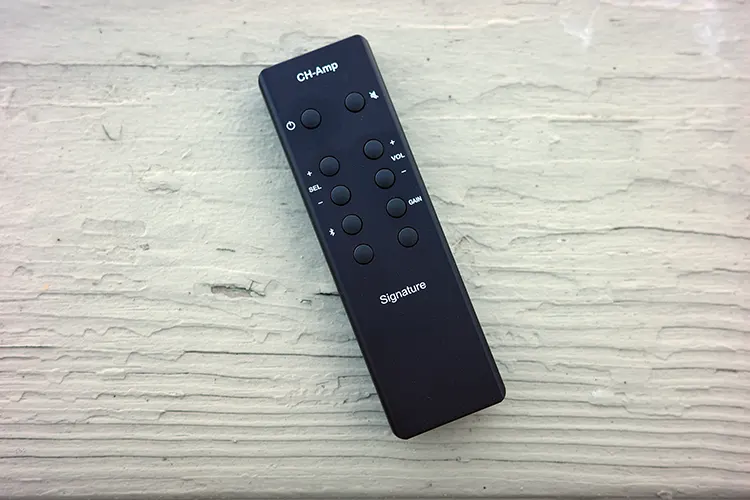
The full-featured remote is what I used for 90%+ of the time, only using the volume knob to change volume one level at a time. Using the remote raised or lowered the volume by two with each actuation.
While small, the remote has a good feel to it, and the white lettering is easy to see. Use was straightforward, once I became acclimated to the location of each function.
There are even a couple of extra buttons for future updates, potentially. The only thing lacking for me would be backlighting, so you could see the controls in low-light situations.
Packaging & Accessories
The CH-Amp Signature comes in a double-boxed set, including the shipping box. The inner box is where the goodies are. Retail packages come with a sticker on the back with pertinent information and specifications.
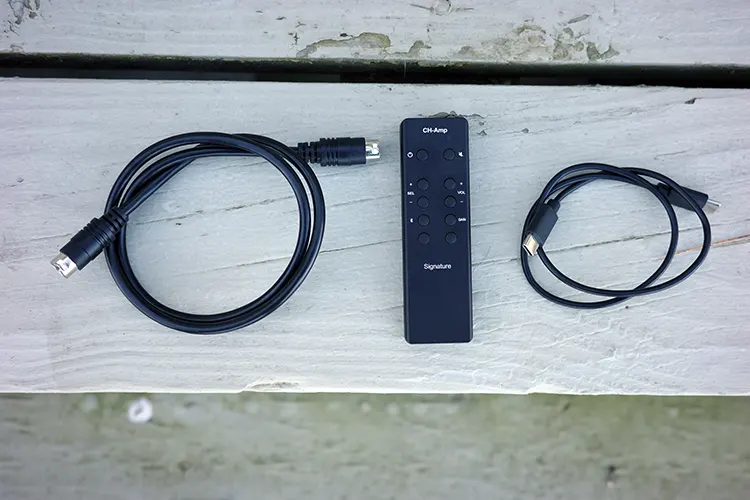
Separated by soft foam cutouts, the thinner rectangular box looks similar to a boxed CD set. No power cord is included, and I did have to order one (knowing beforehand). I had another need, so I ordered two.
The remote comes with a rechargeable lithium-ion battery, so you could say “batteries are included.”
Also included is a shorter USB-C to USB-C cable for connection. Since most of us have RCA and USB-C cables lying around, this is a minor omission to me.
Connectivity
Bluetooth
Connection to either my iPhone 16 Pro Max or the HiBy R4 was seamless. Watching YouTube videos or gaming was a very good experience, with no latency detected. Spatial awareness was also good.
Music listening, streaming through either Tidal or Qobuz, was equally good, with very little drop in quality compared to wired.
USB-C
As my main listening option, the experience was seamless and sounded quite good. The quality jump over BT was minimal to me, which leans more towards BT closing the gap than USB-C “deficiencies.” Anymore, this is my preferred method for listening.
Deep-reaching bass was heard while streaming either service, through the USB-C, with excellent soundstage qualities to boot. Having a longer cable made the difference to me, too, so the included cable was not used.
RCA input
Running the RCA input through a 3.5mm SE jack on the other end provided another excellent option.
When activated on the R4 as LO, the CH-Amp Signature was in charge of volume levels. Running both the source and the CH-Amp Signature as “normal” did give me more versatility.
The midrange sounded vibrant (like similar EarMen products), without becoming tizzy. Another good option.
When hooked to the TA-32, the tube sound emanating from the xDuoo warmed the CH-Amp Signature’s sound into a pleasant listening experience, without losing detail.
RCA output
Going the other way, using the pure DAC of the CH-Amp Signature allowed for the excellent detail retrieval to come forth with good clarity.
Combined with the tube sound of the TA-32, the Audeze LCD-3 headphones, the sound showed a liquidity to it that provided a smooth signature that was also detailed. Two polar opposite versions, providing very good sonic qualities.
Click on page 2 below for my sound impressions and recommended pairings
