

Selected Comparisons
The following comparisons to the Cayin iHA-8 were completed using a mix of the Cayin iDAC-8 desktop DAC (Transistor mode) and the iDAP-8 streamer as my main source input. Headphones used included the Audeze LCD-5 and the Austrian Audio The Composer.
Cayin iHA-6
The iHA-6 was launched in 2016-2017, with our review published in 2017. It also won our Top Gear 2017 Award for Best Desktop Solid State Amp.
Technical
Like the iHA-8, the iHA-6 is also a 4-channel (balanced) discrete-engineered headphone amplifier. However, instead of a pure Class A topology, the iHA-6 uses a discrete push-pull headphone amp with current control (as opposed to the iHA-8 Hyper Mode).
The iHA-6 current mode setting allows the user to switch between a high and standard current output setting from the front panel. In doing so, you effectively reduced the voltage bias to compensate, creating a favorable output setting for low impedance but less sensitive headgear, such as planars.
With Hyper Mode, the iHA-8 increases current output without decreasing the voltage output. This is achieved by changing the power supply condition, which is not possible on the iHA-6. Arguably, the best of both worlds.
On paper, the iHA-6 output rating is still very competitive and can deliver up to 2.2W into a 32Ω single-ended and an impressive 7W balanced into the same load using a low current setting. Arguably, that is higher than the iHA-8’s 5.4W balanced and 1.8W SE into the same load in standard mode.
However, enter the Hyper Mode setting, which now boosts the iHA-8 to a higher 7.7W balanced and 2.5W into 32Ω without a loss in current and voltage levels to compensate.
Other significant differences to note are the iHA-8’s superior customized ALPS stepped attenuator with electrical control as opposed to the iHA-6’s older ALPS 4-channel rotary potentiometer and the ability to switch a power amp mode via a PRE input, which the iHA-6 is not designed to do.
Design
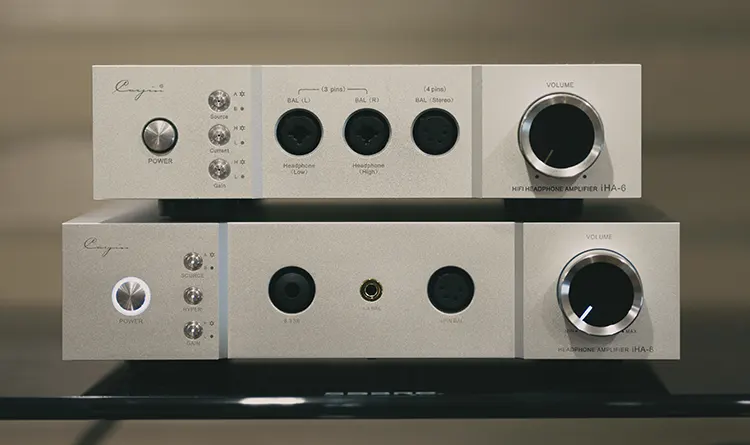
The most obvious physical difference is the size. Though there is not a huge gap, the larger dimensions of the IHA-8 are noticeable when placed beside its older, more compact sibling.
That size gain also comes with a weight difference of just over 1kg more for the iHA-8. Both still should be classed as desktop units, you need a bit more space for the iHA-8.
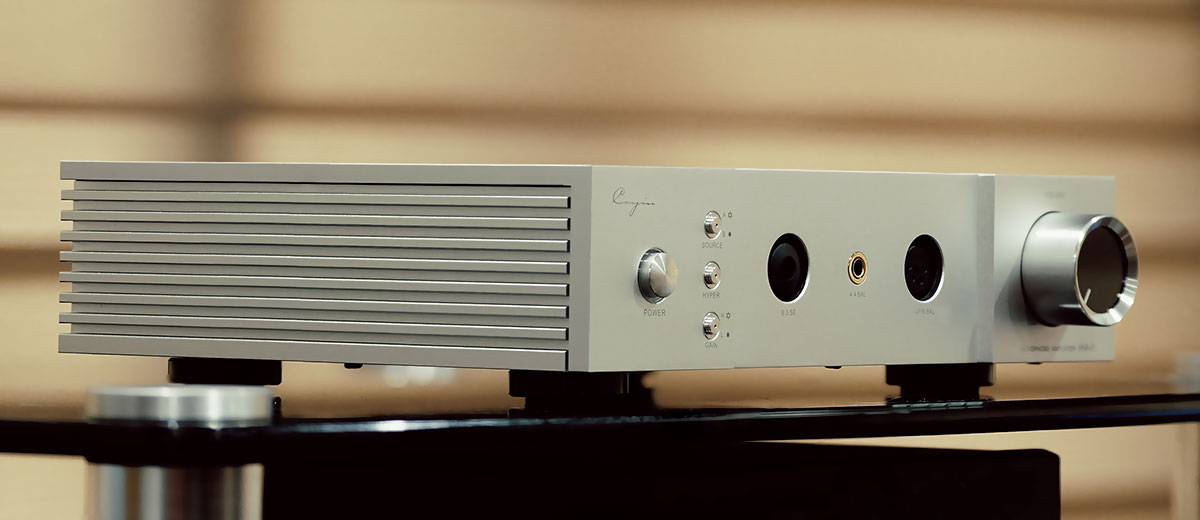
The second notable difference is the heat sink finish on the sides of the iHA-8, something not present on the iHA-6. The iHA-8 is a Class A amp and usually generates a bit more heat than push-pull. You will sense more heat from the iHA-8, particularly on the left side where the PSU is housed.
That being said, I like the more aggressive profiling of the iHA-8 panels courtesy of those heat sinks. It creates a more striking look compared to the very ‘samey’ styling of the iHA-6.
Aside from that, the design language is very similar, save for some nuanced panel splits moved to the rear of the iHA-8 rather than at the front of the iHA-6. Both amps have similar front facia panel designs, and both have sandblasted and anodized aluminum finishing.
The I/O on the iHA-8 is simpler and easier to understand for me. There are no more low or high impedance single-ended sockets; just balanced or unbalanced, with the Hyper mode button doing all the ‘donkey work’. The inclusion of the 4.4mm on the iHA-8 is a sign of just how long ago the iHA-6 first came out.
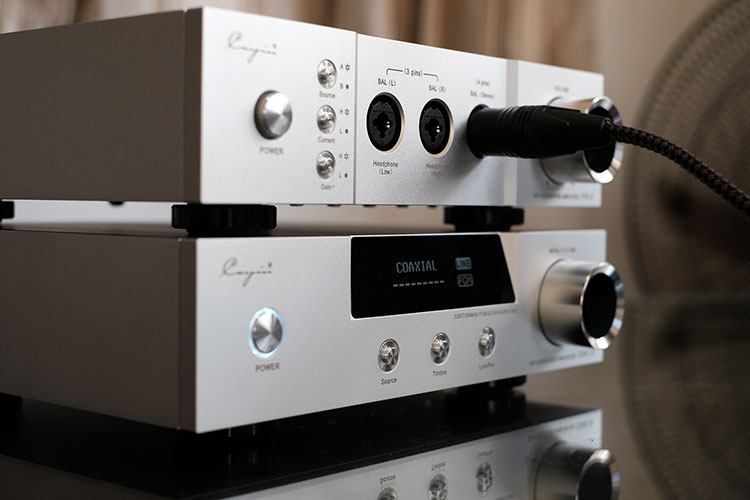
Both amps have XLR and RCA analog inputs on the rear panel, with the biggest change coming with the inclusion of the switch to choose a Line or PRE input on the iHA-8.
Performance
Comparing these two amplifiers is a bit like how I view the dual operating mode in Cayin’s portable gear, except this time the iHA-8 is a very good Class A amp, especially with Hyper Mode for some headphone pairings, versus the iHA-6’s good push-pull Class AB alternative.
What does that mean? To my ear, the iHA-8 has a smoother flowing nature to its presentation, and yet at the same time, with Hyper Mode on, the dynamic range and instrumental/vocal separation are superior to the iHA-6.
The older iHA-6 is more neutral-sounding, slightly drier, and leaner in the highs with a punchier but less fulsome sounding low-end.
It has a more ‘upright’ and direct performance with plenty of energy, and you might perceive it as giving recordings a bit more ‘gusto’ than the iHA-8.
However, that’s more due to the natural, relaxed style of the iHA-8’s tuning. Dig deeper, and you will hear a lot more nuanced details in the iHA-8 note texture, better extension, and more headroom.
I found the iHA-8 more agreeable with headphones that are fussier with treble in recordings. For example, the Austrian Audio Composer can be less forgiving with poor treble.
Though the iHA-6 is not that edgy with the Composer, it can sound pinched compared to the more liquid delivery of the iHA-8, especially when you turn Hyper Mode off.
With the LCD-5, it’s about space with these two amps. The iHA-8 demonstrates better width, staging depth, and air, whereas the iHA-6 sounds flatter and more restrictive, particularly on the X-axis.
It’s a similar situation with the ZMF Headphones Atrium. I like the drier sound of the iHA-6 with this warmer headphone tuning, but the way the iHA-8 delivers in terms of enhanced staging depth and life-like timbre is more compelling.
Chord Electronics Anni
The Chord Electronics Anni was launched in late 2021, with our review coming out in 2022. It forms part of Chord’s mini-desktop stack, which includes the Qutest and the Huei Phono Stage.
Technical
On paper, the Anni is quite a different proposition. Although both are MOFSET-based, the Anni is an integrated Class AB headphone as opposed to pure Class A and also includes direct-to-speaker amplification compared to the iHA-8’s PRE power amplifier functionality.
The Anni topology is a single-ended rather than balanced, with a peak of 10W into 8Ω output power rating suitable for speakers, dropping down to a very respectable 3W into 32Ω, and 500mW into 300Ω for headphones.
That is a higher level of output power than the iHA-8’s single-ended equivalent of 2.2W into 32Ω and 360 mW into 300Ω using the new Hyper Mode.
Of course, the iHA-8 is a balanced amplifier, and that is where it outmuscles the Anni with its 7.7W on a 32Ω balanced rating down to 1.4W on a 300Ω load. If you want pure headroom for hard-to-drive headphones, the balanced output of the iHA-8 in Hyper Mode (and standard mode) will give you a lot more.
Both amplifiers have gain stages, with the iHA-8 dB swing a little more at 12 dB compared to 8-9 dB for the Anni. Sadly, the Anni gain stage system is only for direct to speak output and does not affect the headphone output performance.
And because the Anni is single-ended, there are no 4.4mm or XLR 4-pin PO or 3-pin XLR analog line level inputs. Instead, it provides 6.35mm and 3.5mm SE outputs on the front panel and 2 RCA-based line inputs on the rear.
Design
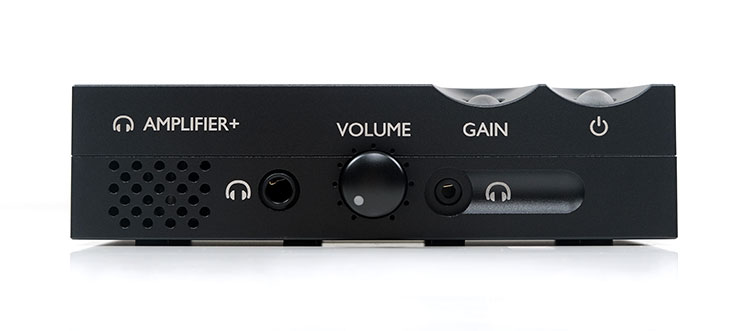
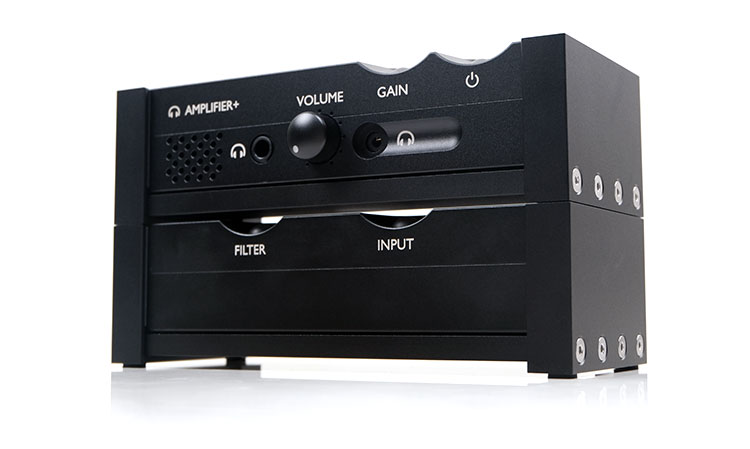
My goodness, the Anni is tiny when placed beside the iHA-8. The Chord design is incredibly tough and durable, and can slip into the tightest of desktop spaces easily. This is a low-profile setup, even with the Qutest on top, its footprint is negligible.
Of course, there are some sacrifices to get down to that size, namely the external switching power supply, something I am much less fond of compared to that excellent 75W toroidal PSU inside the iHA-8.
Chord probably realizes that also and has included a power conversion kit with the short USB-A to micro-USB cable to allow you to hook up the Qutest (and the Huei) and allow the Anni to power them all without having to use separate plugs.
Despite the size, the Anni can also get fairly hot, so it does come equipped with a fair amount of venting as opposed to the iHA-8 heat sinks. I have never found the heat a major issue when stacking with the other Qutest Series components, but it is something to be aware of.
Aesthetically, it’s the orb system that dominates the clean-cut lines of the Anni. The iHA-8 is much easier to understand in that respect, but there will be fans of the quaint color coding system for the Anni.
In truth, the Anni version is a lot easier to understand than their DAC orb systems, so it’s not as steep a learning curve as you might expect.
Also, despite the diminutive size, the I/O spacing on the Anni is excellent. Granted, it uses almost every square cm of space compared to the rather moribund visual on the iHA-8 rear panel, but even so, it never feels congested during use.
Performance
Compared to the iHA-8, the Anni sounds fuller, especially on the lows, but also darker in the highs. That tonal tilt affects staging perception, with the Anni lacking comparative headroom and air.
If you want a hard-hitting amplifier on the lows, then the Anni will sound weightier, and that was the case with my tested headphones, the DCA EXPANSE, the Atrium, and the LCD-5. It is a good choice if you want to take the edge of a bright set of headphones.
However, the Anni tends to emphasize the lower aspects of the instrumental and vocal Harmonic Order due to the relaxed treble presence. That results in instruments and vocals sounding quite rounded, dulling one’s perception of clarity, something the iHA-8 does not suffer from.
Both amplifiers lean to the natural and musical side rather than neutral, but for my tastes, the balance is better on the iHA-8, especially if you are not looking to max out the bass response.
The iHA-8 low-end is more controlled, but I think that is a benefit rather than a drawback, as it provides space for a more open-sounding midrange and improved perception of instrumental and vocal imaging.
Neither of these amps had any trouble driving the aforementioned headphones, it’s more about that sense of height from the Anni. Its depth is excellent, but it lacks a bit of sparkle and sheen, so you will not get a tonal quality that is heavy on ‘excitable’ contrast to tease out the detail.
The iHA-8 has that improved contrast, sounding a little more nimble in the mids and highs, generating a stronger perception of articulation in the process. Of the two, it’s a more balanced sound signature for a wider range of headphones.
Gustard H26
The H26 was launched sometime in late 2023, with our review coming out in 2024. This amplifier also won the Top Gear 2024 Award for Best Solid-State Amplifier.
Technical
Like the iHA-8, the H26 also uses a fully-balanced discrete Class A topology, however, it also includes pre-amping capability as well as headphone amplification.
The H26 offers single-ended and balanced PO, LO, preamplification output, dual RCA, and 3-Pin XLR analog input for DACs and other source equipment where applicable.
All amplification circuit paths are powered independently, meaning you can keep headphones and preamps turned on simultaneously or turn one off and keep the other on, depending on your needs.
Unlike the 75W version inside the iHA-8, the H26 uses a smaller 50W toroidal transformer size but packs in two of them, one per channel.
The H26, at least on paper, has some excellent output specs. It has up to a maximum of 12W balanced PO output power on a 32Ω load, though there is a caveat with a further clarification that up to a maximum of 6W is only for undistorted power.
So I am kind of on the fence about just how powerful the H26 is. If that is correct, then the iHA-8’s balanced hyper mode 7.7W rating produces more headroom and possibly more dynamic range, depending on how much current and voltage the H26 has to offer under heavy use.
What I can tell you is that the H26 will drive the Susvara OG, but you need a good DAC with 4- 5Vrms balanced output to get a lively response. I tend to use the same setup anyhow for the iHA-8/Susvara pairing, but it does feel like the iHA-8 has more headroom than the H26.
The volume bias on the H26 doesn’t help. It feels less linear than the iHA-8’s stepped attenuator. Only when you get near the top does it release the necessary headroom to get the Susvara up to adequate listening levels.
Design
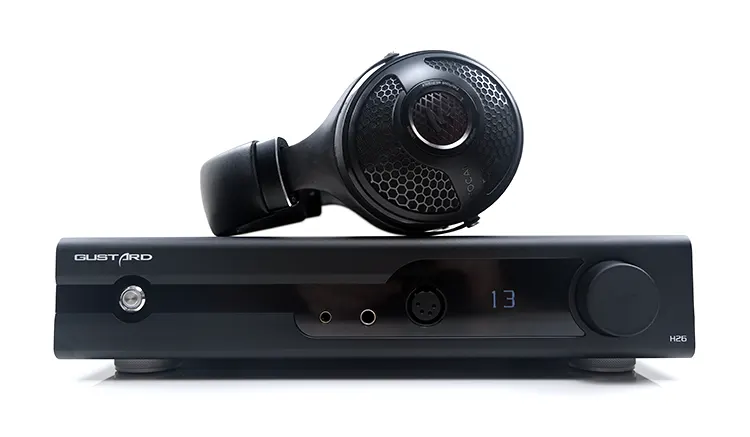
The H26 is a bigger amp in all directions save for height. It is also heavier than the iHA-8 by 2kg. It’s more of a rack amp than a compact desktop amp and is designed to stack neatly with its similarly sized sibling, the A26 DAC.
The design language of the H26 is more digital than analog on the front panel, with that LCD and multifunction rotary volume dial as the only physical traits of its control system.
The iHA-8 is more tactile with buttons for controls, though it lacks the H26’s remote control; something I wish Cayin introduced beyond the iDAP-8 mirror app compatibility.
Both amps’ design languages are dominated by heat sink integration on the side panels. I find the H26 elongated oval patterning and smoother curves in its chassis a little more aesthetically pleasing, but both are still quite striking designs.
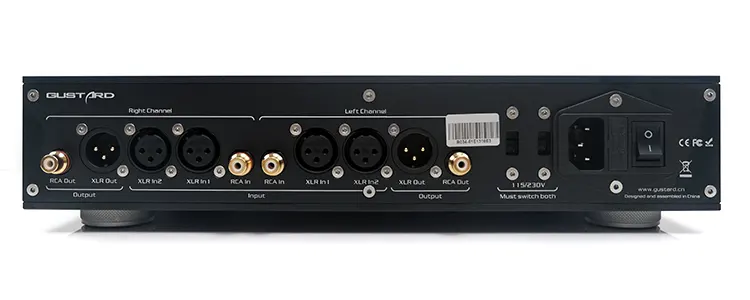
They also have similar PO with provision for a balanced 4-pin XLR, 6.35mm SE, and 4.4mm Pentaconn for modern headgear connection plugs. It’s more the back that delivers the striking differences due to the H26’s pre-amp functionality.
The iHA-8 has 2 connections, and all are line-level inputs, balanced and unbalanced. The H26 has more connections on its rear panel, including 2 balanced and 2 single-ended line inputs, and 1 3-pin XLR and 1 dual RCA pre-amp output.
One minor note, the iHA-8 has a fixed voltage PSU, meaning the PSU will be adjusted to the region you are in when you receive it, for example, 110V. The H26 can switch between 115V/230V, giving it more regional flexibility.
Performance
The H26 is probably the closest competitor to the iHA-8 in terms of a smooth and natural flow to their respective performances. However, they do have some fundamental differences.
The most striking is the iHA-8’s stronger low-end weight and dynamic snap, which gives its staging a deeper quality than the more mid-centric but very wide H26 presentation.
The second key difference is the treble influence. Both are fairly natural-sounding, but comparatively, the H26 has a softer, sweeter sound, and the iHA-8 is more upright with stronger levels of contrast, imbuing midrange timbre with a more accurate harmonic balance.
The third difference is dynamic range. It’s not as obvious until you run it through several headphone pairings, but the H26 sounds a little flatter and not quite as explosive with loud impactful sound, nor are quieter notes as nuanced and as easy to pick out.
This was more the case with precision headphones such as the Composer rather than more laid-back back easy listening offerings such as the Atrium.
The likes of the Atrium play wonderfully well with the H26’s excellent headroom and X-axis staging quality, which can also mask the slightly observational quality of the amp’s soundstage.
The iHA-8 sounds firmer and clearer in the mids. Though arguably, the H26 is superior in staging width, it’s a more two-dimensional experience with the iHA-8’s better dynamics snap on the lows, providing a dimension to recordings that can go missing with the H26.
My Verdict
Given its price point, features, and performance, I can honestly find very little to fault the Cayin iHA-8.
This is a worthy upgrade on the more neutral and flatter sound of the iHA-6 and closely follows what Cayin has been doing with Class A amplification in the portable sphere.
That means a little more warmth and easy-going naturalness to the sound, a bigger, more holographic presentation, and plenty of headroom for demanding headphones. In Hyper Mode, the iHA-8 flips the auditory switch and gives you some additional oomph and ‘drive’ when required.
The only thing missing is a set of analog outputs in power amp mode. I get the argument that if you are using an iDAC-8, there is no need, but not everyone will buy both, and not all 3rd party DACs offer pre-amp capability.
Having said all that, is the iHA-8 a smart standalone purchase? The answer is yes, very much so.
The iHA-8 is a great representation of what I consider to be the modern Cayin solid-state ‘House sound’ and provides a lot more flexibility and dynamism than the older iHA-6 for modern headphones in today’s market.
Cayin iHA-8 Technical Specifications
- Circuit Design: 4Ch Discrete MOSFET Pure Class A
- Special: Hyper Mode
- Volume Control: (2x) MUSES72320 stereo e-volume, ALPS potentiometer
- Power Supply: 75W Toroidal transformer
- Power Management: 50,000uF Nichicon capacitors with ultra-fast recovery rectifier
- Amplifier Modes: Line level input, Pre-Amp input
- Phone Outputs: SE 6.35mm, BAL 4-pin XLR, 4.4mm
- Analog Inputs: BAL XLR (2x), SE RCA (2x)
- Gain Control: Low Gain, High Gain, +12dB
- Physical Control: Power On/Off, Source, Hyper, Gain, Line/Pre, Volume Knob
- Weight: 11 lbs
- Dimensions: 270mm x 215mm x 70mm
