

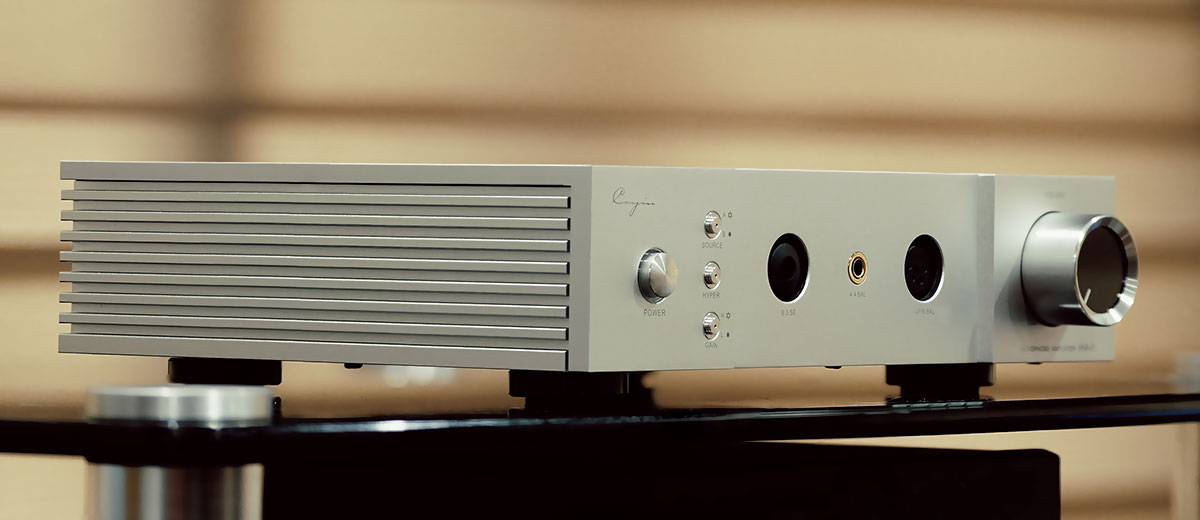
Sound Impressions
The following sound impressions of the Cayin iHA-8 were completed using a mix of the Cayin iDAC-8 desktop DAC and the iDAP-8 streamer as my main source. Headphones used included the Audeze LCD-5, the ZMF Headphones Atrium, and the Dan Clark Audio EXPANSE.
Summary
The iHA-8 is a very different proposition from the older Class AB push-pull iHA-6 in terms of performance and tuning.
Not only can the iHA-8 deliver a smoother, more natural-sounding and relaxing presentation typical of Cayin’s approach to Class A tuning, but it can also suddenly tighten up and deliver a superior bass snap, impressive vocal bloom, and treble brilliance with a flick of that Hyper Mode switch.
Which mode appeals to you the most will depend on what you pair the iHA-8 to in terms of DAC and headphones.
I recommend the Hyper Mode for spacious yet relaxed-sounding headphones such as the Atrium if you intend to listen to rhythmically driven recordings where enhanced contrast and a tighter, more impactful bass are required.
Conversely, if you listen to acoustic, vocal-centric recordings or own a neutral to slightly bright-sounding set of headphones such as the Austrian Audio Composer, switching off Hyper Mode will soften the delivery just enough to enhance the listening experience.
In either mode, the iHA-8 has power, and loads of it. There is no shortage of headroom and dynamic range with harder to drive or high impedance headphones, such as the DCA EXPANSE and the ZMF Headphones Atrium.
It would be remiss of me not to include IEM performances when discussing the iHA-8. It delivers a very quiet background and good channel balancing on low volumes using a low gain with the 4.4mm output.
Sensitive IEM owners might find the new stepped attenuator a little more difficult to control for nuanced volume tweaking. However, medium sensitivity IEMs such as the Noble Audio Ragnar and PMG Audio’s Apx have no such issues.

Coloration
Against competing amplifiers such as the Chord Electronics Anni, the older iHA-6, and Gustard’s H26, I found the iHA-8 faithfully follows Cayin’s interpretation of Class A tuning derived from their portable offerings, such as the recent N6iii and the C9ii.
That means a smooth and comparatively relaxed sound, at least when compared to the iHA-6, but also one with a fuller bass response, a more life-like, less analytical midrange, and a slight sweetness and sparkle to the treble timbre.
However, having tested all of those amplifiers using the same iDAC-8 DAC behind them, it became quite clear that the iHA-8 still retains a natural tone that sounds quite balanced across the FR.
That is not to say the iHA-8 is akin to ‘honey dripping off a knife’, there is some necessary contrast in its performance, one that creates some welcome definition in the mids. Rather, the overall sound does not sound as dense and thick as the Anni, nor as dead, neutral, and flat as the iHA-6.
If there is one criticism I could lay at the door of another smooth-sounding amp, the Gustard H26, it might be that it is too safe-sounding. Airy, yes, but also a bit polite in the punch.
That is not the case with the iHA-8, especially with Hyper Mode, which, to my ear, enhances the upper harmonics and treble sparkle along with the dynamics in the lows to create a more vivid sound.
However, Hyper Mode can stiffen the treble tone with some headphones. Not so much that it is edgy or very hard sounding, but rather if the treble is raised naturally in a headphone’s FR, then the Hyper Mode forces it out a bit more, which some might find a bit too aggressive.
Staging & Dynamics
Of the three compared amplifiers, only the Gustard H26 projected an airier or taller soundstage, with the iHA-8 sounding significantly wider and more holographic than the Anni or the older iHA-6.
However, the H26 lacks depth, an aspect which is noticeably stronger on the iHA-8, more so with Hyper Mode turned on.
Depth does not come at the cost of additional bloom either. This is not a dense bass-forward sound; there is some elevation in the low-end of my tested headphones, but it’s quite balanced compared to the boom and roundness of the Anni low-end and the flatter nature of the iHA-6.
Without Hyper Mode, the mids and treble are quite open-sounding, but they are also a little more relaxed in imaging and placement.
The treble presence is a little softer and pushed back, which I found very suitable for brighter recordings or headphones with tilted upper-mids and highs such as the Audeze LCD-5 and the Composer.
With Hyper Mode, the presentation takes a step forward, imaging-wise. It is still quite holographic with excellent width, but the vocal presence and bass power are much more palatable from the likes of the EXPANSE and the Atrium.
These are two headphones I found to gel very nicely with the enhanced dynamics of the iHA-8’s Hyper Mode.

Synergy
IEM Pairings
The Cayin iHA-8 has a very strong output rating on low impedance gear, capable of up to 9.5W in Hyper mode on just a 16Ω load.
Of course, with IEMs, that amount of power is not needed, so we look instead to the noise floor and usable volume from its 4.4mm output.
With an SNR of 127 dB (32Ω standard) to 130 dB (32Ω Hyper Mode), the iHA-8 looks good on paper for delivering a quiet and clean signal for IEM use.
The good news is yes, the noise floor is excellent, even when using the iDAC-8 tube mode, there were no trademark waterfall hiss moments from the iHA-8 when using sensitive IEMs such as the Vision Ears VE8.
The bad news is that the new stepped attenuated might not be super ideal for volume control with IEMs such as the VE10, which need a very delicate hand, given the power the IHA-8 has at its disposal.
For medium efficiency IEMs such as the PMG Audio Apx and Noble Audio’s Viking Ragnar, there is some decent wiggle room on a low gain setting, though I would advise against Hyper Mode, especially with the Ragnar.
I could happily leave Hyper Mode on with most headphones, but I was fussier on the results with IEMs. It can introduce a hard edge to the treble, and if your IEM already has a treble peak, such as the Ragnar, it can sound too frantic and fatiguing.
The Apx was perfect with the iHA-8. It sounded huge, dynamic, and beautifully controlled. I could live with it in either the iDAC-8 transistor or the Vacuum mode feeding the iHA-8. Vocal tones are more natural than the Ragnar pairing, with more volume control than the VE10.

Headphone Pairings
I tested the iHA-8 with 4 open-back headphones of varying drivers, loads, and sensitivity. This included the ZMF Headphones Atrium, Dan Clark Audio’s EXPANSE, the Audeze LCD-5, and the Austrian Audio The Composer.
None of them had issues with headroom when paired with the iHA-8. There is plenty of power to drive them well, even without activating the Hyper Mode or going into high gain, as was the case with the Composer and the Atrium.
Both the EXPANSE and the LCD-5 sounded more spacious and dynamic with the iHA-8 compared to the older, somewhat flatter and neutral sound of the iHA-6. Particularly on the lows with the EXPANSE bass line sounding very responsive using Hyper Mode.
The iHA-8’s Hyper Mode will change performance significantly, especially the bass dynamics, vocal bloom, and treble sparkle. I found myself turning that on more often than not to stiffen the bass delivery in otherwise smooth and relaxed pairings such as the Atrium.
The Atrium sounds a lot more convincing with Hyper Mode on. It has a relaxed but spacious tuning and maybe too mellow for my tastes, with dance music using the stock iHA-8 sound. With Hyper Mode, the Atrium sounds a lot more taut and energetic.
It is not always the case that Hyper Mode means a better performance, as it can tease out or exaggerate any underlying sharpness in a headphone’s tuning.
The Composer is one such example, with a neutral to slightly bright treble tuning that I usually prefer with smooth-sounding amplifiers.
With Hyper Mode, the impact and precision are amplified, but so is the treble overtone, which can unbalance the delicate harmonic balance in the mids. Turning Hyper Mode off, the Composer sounds smoother and more agreeable across the entire FR.

iDAC-8 Pairing
I just wanted to briefly touch on the iHA-8 performance when paired with the iDAC-8, primarily on the timbre control. I will go into more detail regarding this DAC in my dedicated review.
I found the iHA-8 to be a fairly transparent amplifier when paired with the iDAC-8, with immediate differences noted when switching between the two timbre modes, namely Transistor and Tube.
Combined with the iHA-8’s Hyper Mode, it starts to feel like the desktop equivalent of the C9ii portable amp with plenty of tweaks to help you fine-tune your pairings’ performance.
There are some important observations between the two timbre modes via the iHA-8. The first is the slight volume or gain difference, with the Transistor Mode noticeably louder than the Tube mode.
The second is the dynamic snap with the Transistor mode sounding more energetic and tighter than the Tube mode on the lows, but conversely less euphonic through the mids and highs.
Transistor mode is more suitable for warmer headphones or EDM and rhythmic-driven recordings where you need a more ‘driven, clean sound’.
I would opt for the Tube mode but with Hyper Mode turned off for brighter headphones such as the Composer and for listening to emotive vocal-centric music.
