

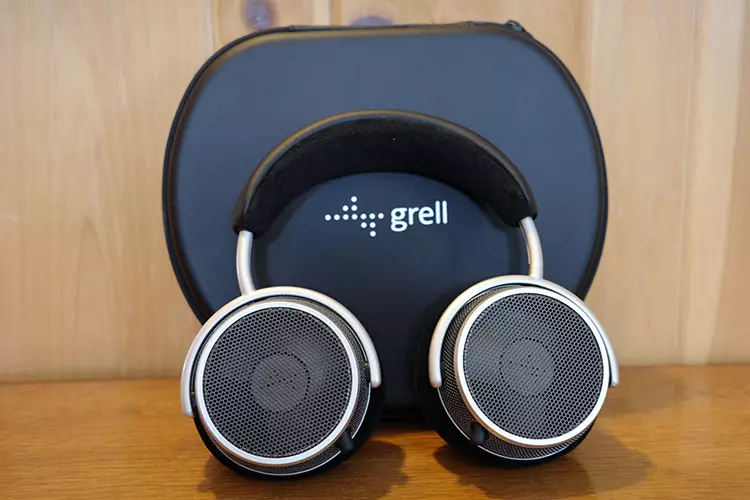
Lynn reviews the Grell OAE2, a 2nd-gen set of open-back front-sided transducer headphones featuring the company’s FSFM technology. It is currently priced at $599.00.
Disclaimer: This sample was sent to me in exchange for my honest opinion. Headfonics is an independent website with no affiliate links or services. I thank Grell for their support.
Click here to learn more about Grell products previously reviewed on Headfonics.
This article follows our current scoring guidelines, which you can read in more detail here.

Axel Grell served as chief engineer at Sennheiser, joining the company in 1991 and remaining until 2019 with a string of classic headphones launched under his wing, including the HD 600, HD 650, and HD 800.
After leaving Sennheiser in 2019, he founded Grell Audio in 2021. The OAE1 followed, and today’s review subject, the $599 OAE2, is not far behind.
Putting an interesting twist on driver placement, the OAE2s are purported to mimic nearfield monitors, including the outstanding soundstage associated with a quality set of those speakers. Grell also oriented the sound to come in a more frontal manner, much like our speakers do.
Having heard (and owned or borrowed) most of the Sennheiser models listed above, I can attest to the outstanding sound qualities of many. Some may not like the Sennheiser “house sound, but the impact upon the headphone industry cannot be denied.
If the OAE2 comes close in sound and competes well with the likes of the current HD 6XX or FiiO’s popular FT3, then success will smoothly carry over to the Grell moniker.
Features
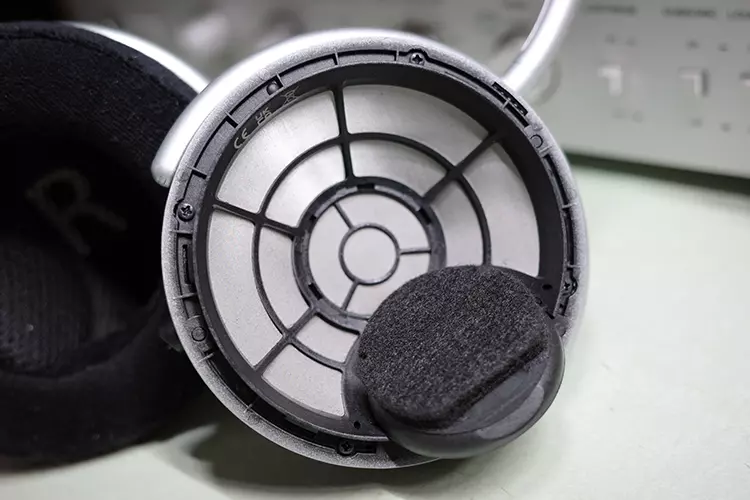
Sporting a smaller-than-average 40mm dynamic driver than something in this category might, attention is focused upon driver placement and fine-tuning of the cavity.
Labeled Front-sided Sound Field Modulation (FSFM), the design portends to a listener’s nearfield monitors, or a small listening room in permutation.
The bio-cellulose diaphragm makes for speedy recovery and impact of notes, minimizing any potential distorting possibilities.
Much time was also spent on the development of damping and baffling material(s) to further the sound quality. Usually, with an open-backed headphone, you can cover the outside of the ear cup and change the sound significantly.
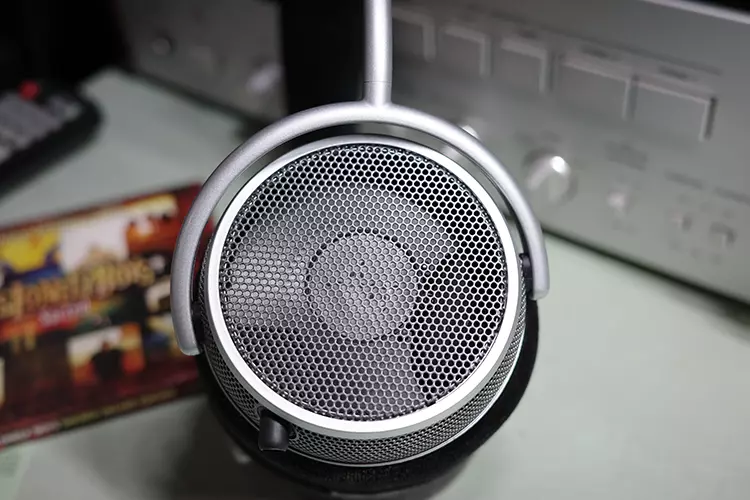
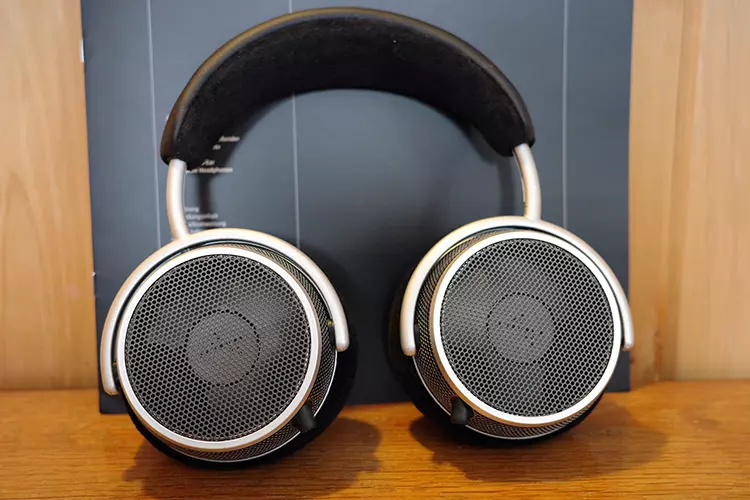
Not so here, due to the development of the acoustically transparent stainless-steel mesh, injection molded into a robust plastic dome, according to the literature.
A special geometric pattern (patent pending) helps quell any potential distortion, presenting a very open sound. Plus, covering them with my mitts made no difference.
The circular pattern of the baffle may not be different than many, but the technology in design and implementation is, for the OAE2. That bio-cellulose mentioned above plays a large part in radiating the sound across that large baffle space.
The size of that baffled area also sets the OAE2 apart from others. It is almost twice the size of other open-backed headphones.
This allows sound to spread more quickly, unencumbered by a restrictive space for a more even tonality, ranging from the highs to the lows.
The stainless-steel mesh ensures an even response across the frequency spectrum, making the OAE2 quite neutral in character as a result.
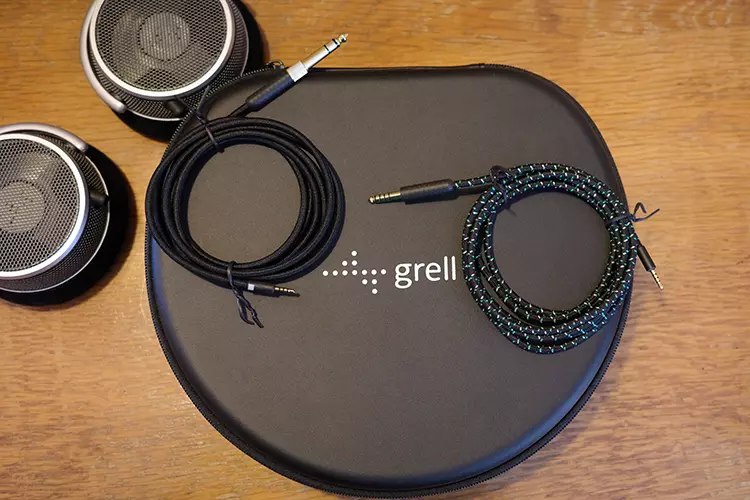
The two included cables (3.5mm SE and 4.4mm BAL) attach at a single headphone port, allowing the cable to stay out of the way, too.
Design
There is no denying the quality that exudes from the OAE2 as soon as you open the large flat case.
Dare I say, typical Germanic efficiency allows the melding into a whole unit rather than a mishmash of parts. The silver stanchions adjoin the adjustable silver headband rods, leading into the well-padded black headband.
The headband has equal parts of a terrycloth sweatband and a top band of leather, looking the part.
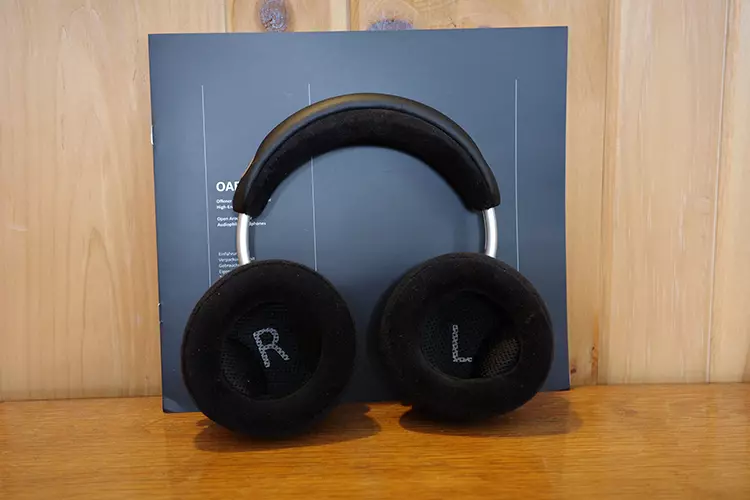
Subtle lettering on the bottom of the headphone port denotes left to right without drawing attention to itself. The velour pads promote comfort and sound-deadening capabilities. High marks go to the interaction of all parts together, as well as their quality.
There are no marks denoting how far out one has pulled the headband, which takes a bit of getting used to. But eyeballing gives a good estimation of each side being equal.
The matched geometric pattern on both the outbound side of the ear cup and sides gives a uniformity to the look and design that draws attention to itself on looks alone, but without being garish.
One thing I would like changed, though, is adding a longer grab housing to the business end of each headphone cable.
When fully inserted, a click is heard, which is good, but leaves the cable exposed at the end of the headphone port. Extending the jack sheathing might quell any potential consternation I may have from repeated insertions and removals.
After watching a video on ear pad removal, I was less bothered by the “dust protector” inserted into each ear cup and labeled “L” or “R.”
On my first ear pad removal, I took great care in replacing that dustproofing. Afterwards, I was less concerned. I also listened both with and without that dustproofing, with changes being minimal.
Comfort & Isolation
The Grell OAE2s are eminently comfortable. Sometimes, I find that when using suede pads, the fit becomes a bit too cushy.
Not so here, due to the stiffer nature of the pads. Suede-shorn pads also tend to diffuse sound a bit more in my opinion, but combined with the cup & baffle design, the sound stays focused.
Those stiffer pads also give a good foundation for the fit to be not only comfortable, but stable.
Clamping pressure is a smidge too high for me, but I never felt pressure below my ears like I do when that pressure is too high. Even wearing my reading glasses to type, the pressure was not too much. And for pure listening, the comfort was top-notch.
The headband adjustment is stiff and stable too, but I did reach nearly to the end of the extension while wearing a hat. Those with elongated heads in the vertical plane may run out of adjustment, but I did not.
The isolation is, as expected, average for an open-backed headphone, even with the music playing. The constant pecking on my keyboard could be heard, but the music isolated my ears quite well, without the outside noise denigrating my experience in the least.
Some items I read over the course of this review stated that the underside padding on the headband was insufficient.
What I found was that the padding is exactly where it needs to be in the top center. While it is a bit stiff, that structural makeup affords good stability and comfort for my elongated cranial matter.
The quality construction allowed for a comfortable fit, and long listening sessions were no problem (and many in quantity), such was the fit of the Grell OAE2.
Packaging & Accessories
The sleeved packaging of the Grell OAE2 covers a clamshell inner box that seems to be made of recycled material. That outer sleeve has a larger-than-life view of one ear cup on the front, with the requisite information on the back.
Opening the clamshell inner box, the slim, rounded case of the OAE2 immediately makes its presence known under the excellent “manual” that is more akin to an informational brochure combined with instructions.
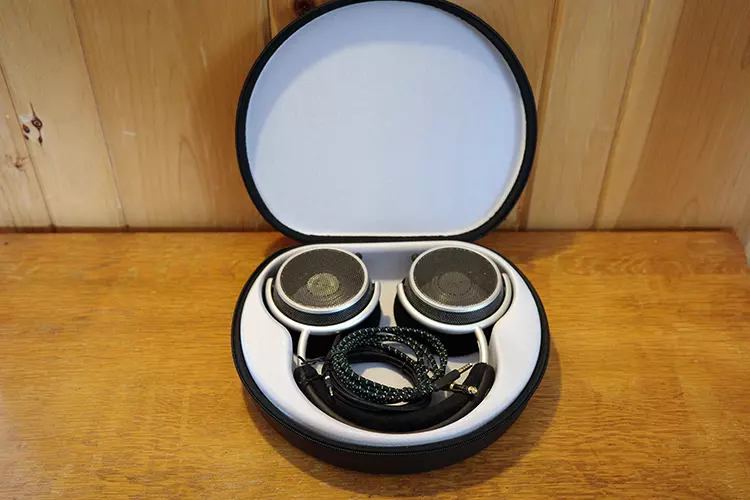
A very nice presentation. Unzipping that case, you are met with the headphones folded flat, with both cables tucked neatly into the headband area.
There is a form-fitted spot for each earcup, holding them in place. I found that you can remove this insert if you desire. I did not.
Simple and elegant, like the look and design of the headphone. Focus on the sound, not the box.
Carry Case
This is for me one of the more unusual cases I have experienced. Slim and elongated in a semi-circular manner, it is about the size of a biology textbook, but without the weight. Something that can easily fit into your backpack on your commute.
If one thing is lacking, it would be a place for another set of ear pads or a dedicated spot for cables. But, as mentioned above, the insert can be removed, which would give a bit more room. Just not the protection afforded by that form-fitting shape.
I do like the case, though, due to its ease of use and a quality zippering affair.
Sound Impressions
Listening impressions for the Grell OAE2 came about after 75 hours of burn-in. This is still my standard protocol when reviewing headphones, regardless of belief in this “system.”
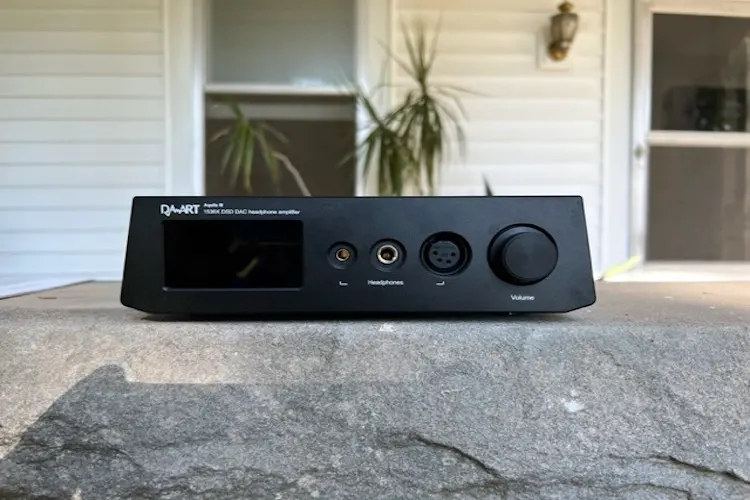
The gear used for critical and pleasurable listening purposes consisted of the JC Acoustics UDP-5, Yulong Aquila DA-ART Aquila III, Oppo BDP-83 (Coax into both desktop units), Cayin N6ii (A01 motherboard), and the HiBy R4 DAP.
Comparisons were made with the Crosszone CZ-10 Enhanced (for a “similar” design aspect), the FiiO FT3 32Ω, and the Drop x Sennheiser HD 6XX.
Summary
The Grell OAE2 comes across as surprisingly neutral in sound characteristics. Others have noted that the sound presentation is neutral, but not until you hear it does that quality hit. That neutrality also hits naturally, with an organic character to it that is not overly smooth and lacking.
Rather, the design qualities of the headphone help to make for a spacious but fulfilling experience. Note weight is excellent across the frequency curve, with not one area dominating.
Bass reach is impressive for a “smaller” dynamic driver, while the extension on the top end is also a natural extension of the spacious tuning.
Across many genres, the clarity of each note is excellent. The details wrought from the OAE2’s character are equally excellent.
Raising the volume, no matter the source, was easy, and the spaciousness indeed mimicked a speaker setting with a frontal attack. But in a positive manner rather than alarming or pointed.
Spread across the three dimensions, the note weight filled that space, without a busyness that can complicate and degrade the sound quality.
The combined efforts in tuning and design come together to make the complete package here.
Bass
Using a smaller-than-average dynamic driver for a headphone (other than, say, wireless headphones), the Grell OAE2 uses the architecture of design to its advantage.
The angled driver functions perfectly in reflecting the lows around the baffle, without sounding muddy or misplaced.
The frontal driver placement allows for the speaker-like aspect of the sound to present those lows without becoming bloated or inducing an overpreponderance of character on the rest of the show.
There is no bleed into the lower mids that I can discern, but instead a tie that seamlessly binds the two together, like a good speaker should, and in this case, the headphone.
If the source music contains a quantity of bass that is excessive, the OAE2 affords the characteristic of the music to show through without hindering or dimming that sound.
In other words, if the level of bass is meant to override the rest momentarily or longer, the OAE2 allows that quality to show forth. I would call that transparency of presentation, and it is good.
Mids
The midrange sits squarely where it should be. Frontal, yes, but without becoming raised, lifted, or artificially moved in presentation.
The succinctness with which the OAE2 allows placement of the midrange tuning to come across is additive to the low end, presenting a seamless transition between the two.
But it can showcase music that sits squarely within that realm, across many genres. The neutrality of the midrange is sometimes a panacea of presentation. Not so here, because that neutrality affords the music to come forth as not only smooth, but with excellent spatial characteristics, too.
The imaging of notes in the midrange affords the listener an inside feel to the show itself, like we are sitting front row-center. Like a speaker presentation (yes, mentioned again).
The articulation of individual musical instruments within the midrange is to be commended and could well be the highlight of the sound signature. Lifelike and crisp, the details wrought across the midrange are fantastic.
Treble
The extension of treble notes never became grating to me. Sometimes in a design such as this, the upward extension can become harsh to me, like when I raise the volume on my Klipsch Forte II’s. Yes, they are fabulous, but on some music, I cannot raise the volume to the levels I would like.
Not so here, as I found myself reaching for the volume knob on both the DA-ART Aquilla III and JC Acoustics UDP-5 without issue.
The smoothness presented by the OAE2 complemented each desktop amplifier, instead of holding back each as can happen. The neutrality of presentation was certainly a positive here.
The speed with which the treble notes responded defied the potential for harshness with a slight smoothing. But not in a negative manner.
The positive nature of the top end allowed for the spacious characteristic in the sound to spread in height, without losing note weight. The note girth kept its composure even with the additional height offered.
Staging & Imaging
Proper speaker placement is a testament to the room’s qualities and time taken. In taking that time to properly place your speakers, you are rewarded with excellent musical characteristics. And yes, it is a very personal aspect to our listening.
The Grell OAE2 takes that out of the equation for the listener but provides the benefits. As purported by the Grell literature, the goal was to mimic a speaker-like sound to the OAE2. And they succeeded. The three-dimensionality presented when listening is among the best I have heard. Period.
That presentation may not be the widest or tallest or have the most depth, but it is one of the most complete bestowals of soundstage I have heard.
Oftentimes, a soundstage can be wide or tall but lacks the note weight to take advantage of that spaciousness. The OAE2 fills the 3D space almost perfectly.
The frontal presentation does not dissuade the listener from enjoying the sound across and dimension. The weight of notes helps to not only fill the space but also does so in a manner that is not combative or competitive.
The complementary approach in design and presentation of the notes within the sphere not only represents a speaker’s best qualities but does so in a manner that does not step on any toes within that sphere.
Click on page 2 below for my recommended pairings and selected comparisons.
