

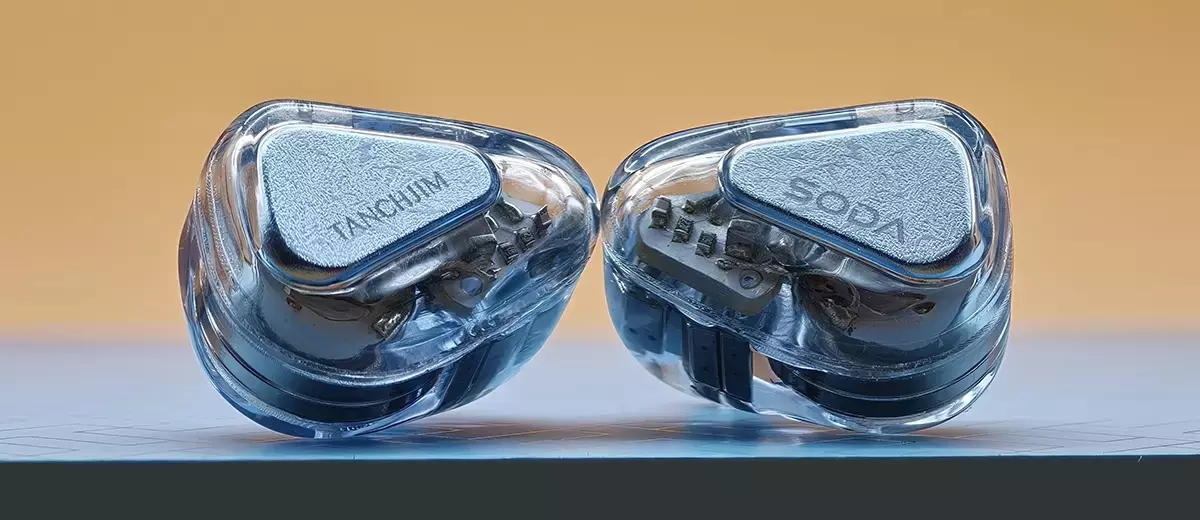
Kurt reviews the Tanchjim SODA, a new hybrid universal IEM featuring a 10mm dynamic, 4 BA, and a unique dual passive Silk System driver design. It is currently priced at $309.99.
Disclaimer: I received this sample in exchange for my honest opinion. Headfonics is an independent website with no affiliate links or services. I thank Linsoul and Tanchjim for their support.
You can click here to learn more about the Tanchjim audio gear we have previously reviewed on Headfonics.
This post follows our scoring guidelines, which you can read in more detail here.
Tanchjim has firmly established itself in the audio community with standout dynamic driver releases like the HANA 2021 and the more recent Origin.
They built this reputation through excellent dynamic driver IEMs, though they are now revisiting hybrid territory with their latest release.
Now we have the Tanchjim SODA, priced at $309.99. This IEM features a tribrid configuration of one dynamic driver, four balanced armatures, and two passive units.
With this return to a multi-driver setup, can Tanchjim prove that their engineering extends beyond dynamic driver IEMs?
And how does it compare to the likes of the ZiiGaat Horizon and the InAwaken Twilight-DS? I found out in my full review below.
Features
The Tanchjim SODA runs a seven-driver tribrid setup, consisting of one 10mm dynamic driver, four in-house PURE series balanced armatures, and two Silk System passive units.
The dynamic driver handles the low frequencies, the four PURE balanced armatures are split into two for midrange and two for treble, while the two passive units are assigned to the 16-23kHz range.
The 10mm dynamic driver is built on Tanchjim’s DMT5 architecture, featuring a dual-magnetic double-cavity structure and a PU surround DLC dome composite diaphragm. A low-distortion waveguide faceplate technology is also integrated into its design.
The four PURE series balanced armatures are Tanchjim’s own in-house drivers, built specifically for this IEM. They are designed around a low-distortion, high-conversion-efficiency target with characteristics aligned to Tanchjim’s own tuning curve.
The two Silk System passive units sit in a series of stepped microchambers arranged close to the BA drivers. Each microchamber is individually tuned, and the entire structure is fabricated using high-precision DLP 3D printing technology.
Binding all seven drivers together is Tanchjim’s HPFD-SEG 3-way precision crossover, a custom-engineered physical crossover designed to maintain flat phase alignment and consistent group delay across the full driver configuration.
Design
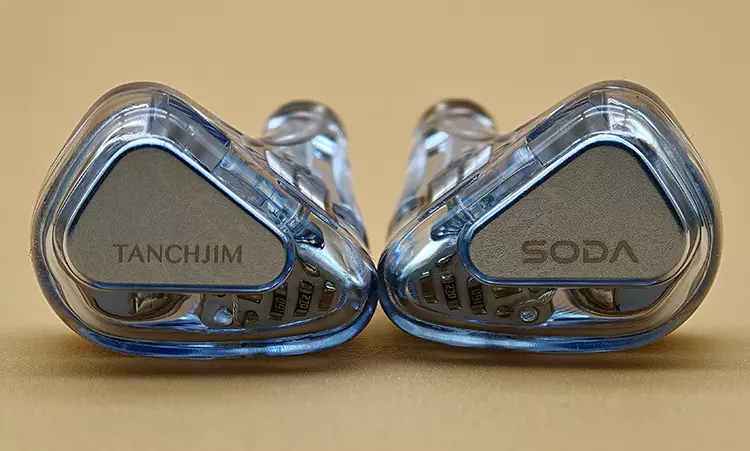
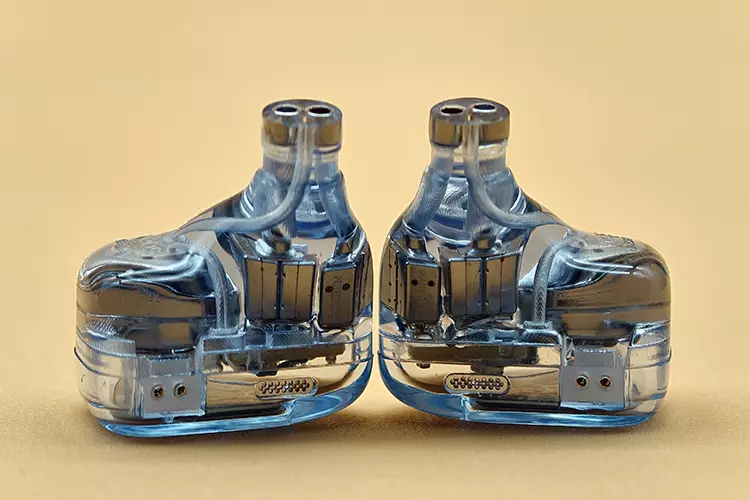
The Tanchjim SODA’s design draws a clear visual parallel to its name, with a fully transparent light blue resin shell that mimics the appearance of a glass soda bottle.
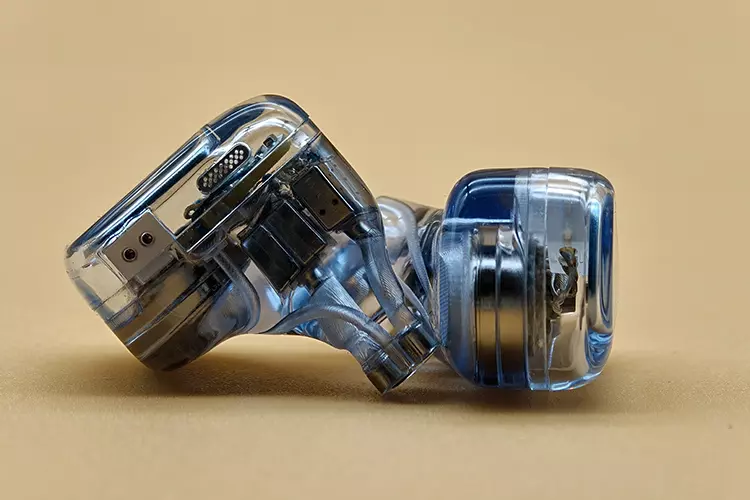
The internal driver arrangement, crossover components, and wiring are all visible through the clear material, mirroring how it looks through glass.
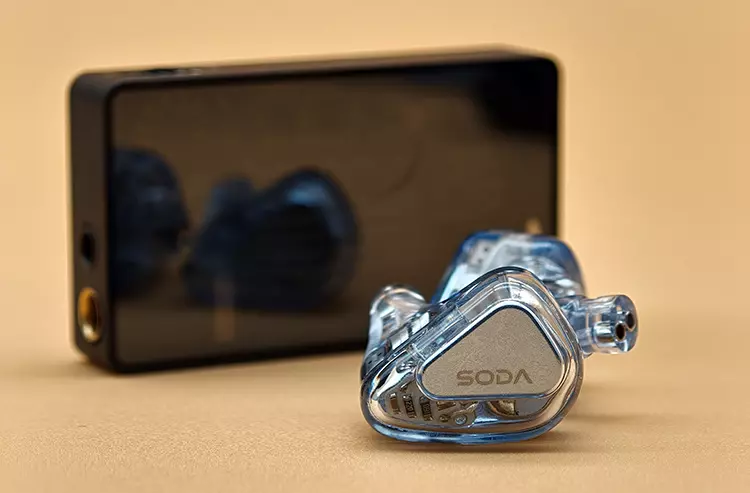
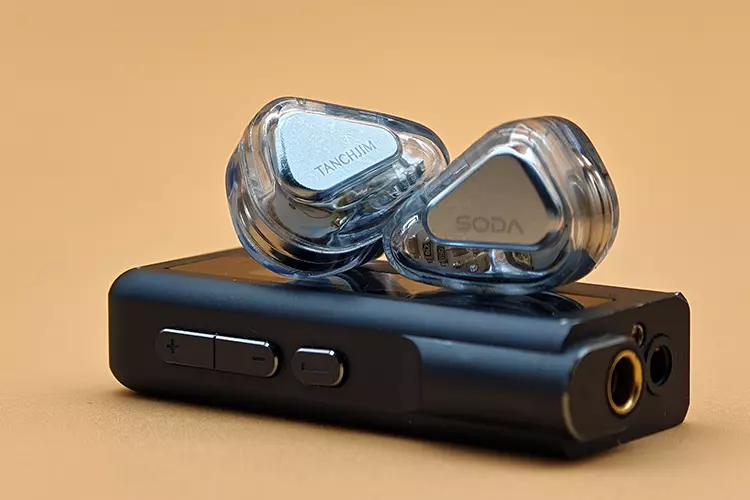
The faceplate takes an unconventional approach by only covering a small triangular portion rather than the entire area. Though this partial coverage resembles the branded wrapper on a glass bottle, leaving most of the shell exposed to display what’s inside.
Both faceplates share the same frosted blue finish with faint lines and dots running across the surface, creating a subtle carbonation effect against the glass-like shell.
The right faceplate carries the “TANCHJIM” engraving, while the left displays “SODA”, keeping the branding simple and evenly distributed across both channels.
The shell itself maintains complete transparency throughout, with rounded edges and smooth contours from top to bottom.
Very faint markings are printed on the inner side of each shell, showing “Tanchjim SODA” along with the corresponding “L” or “R” channel indicator.
A single vent is positioned near the 0.78mm 2-pin connector on the upper section of the shell. This vent features Tanchjim’s patented pressure-relief design, covered with a fine metal mesh grille that sits flush with the surface.
Comfort & Isolation
The Tanchjim SODA sits on the medium side in terms of shell size, making it suitable for smaller ears without overwhelming them.
Despite this, it feels bigger than it is once inserted due to the longer nozzle length pushing the shell further back from the ear canal.
This longer nozzle creates a disjointed fit where the shell doesn’t sit flush against the outer ear. The resulting gap leaves space between the IEM and the ear, weakening the seal and allowing outside noise to seep through more easily than other IEMs.
Isolation suffers as a direct result of this fit, failing to block ambient sounds effectively. The incomplete seal makes it less ideal for noisy environments where stronger passive isolation would be necessary.
For long listening sessions, the SODA remains serviceable but not particularly comfortable. It doesn’t cause immediate discomfort, but the fit isn’t reassuring enough to make it a first choice for extended use.
Weight is a non-issue, as the resin shell keeps the SODA lightweight and barely noticeable once worn. This lighter build does help with general wearability, especially during travel or commutes where weight fatigue can become a factor.
However, the SODA is not suitable for lying down or side sleeping. Any added pressure on the shell causes the nozzle to press uncomfortably into the ear canal, making it unusable in bed.

Ear Tips
Two types of silicone ear tips are included with the Tanchjim SODA, each labeled for a specific purpose. One set is marked as treble-enhancing, while the other is designed for bass enhancement.
Surprisingly, both sets deliver on their intended effect and noticeably alter SODA’s sound signature. The difference between them isn’t subtle; choosing between the two is a meaningful decision depending on what you prioritize.
The bass-enhancing tips use a balanced bore design and provide a better seal compared to the treble tips. This improved seal thickens the subbass, giving it more body and weight without becoming bloated or muddy.
However, the trade-off is that the midrange gets pushed back slightly, reducing vocal detail and presence. The treble benefits from this shift, as it tames the spiciness and energy without stripping away its sparkle or air.
The treble-enhancing tips feature a wide bore design that opens up the midrange and treble considerably. Vocal texture becomes more accurate, and the added clarity reveals nuances that the bass tips tend to smooth over.
The downside is a weaker seal that leaves the bass feeling underwhelming and less impactful. The treble also regains its sharpness, bringing back the spiciness and energy that can become fatiguing over longer sessions without crossing fully into sibilance.
Stock Cable
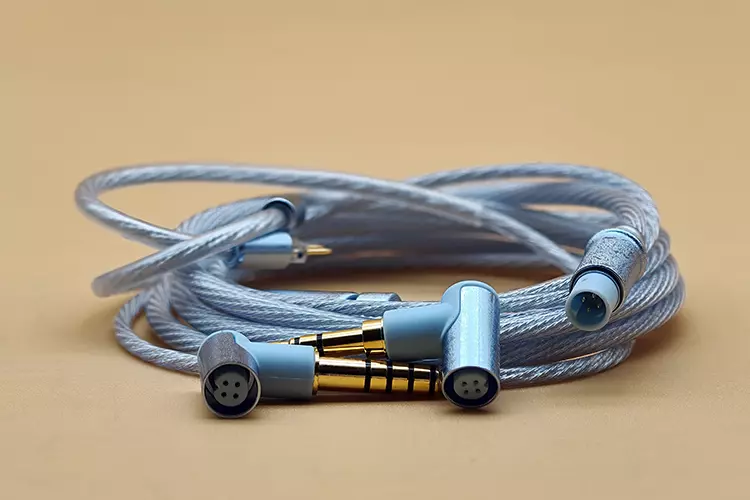
A single-strand cable is included with the Tanchjim SODA, and it’s genuinely impressive right out of the box.
Unlike the typical braided designs found on most IEMs, this thicker single cable stays completely tangle-free and maintains a clean, streamlined look that’s far easier to manage.
The cable is built from high-purity silver-plated copper using Litz multi-strand coaxial braiding technology. This construction aims to control resistance and inductance for cleaner signal transmission across the frequency range.
The color scheme follows the SODA’s blue aesthetic, with light blue hardware on the 2-pin connectors, chin slider, and splitter. This coordination ties the cable visually to the IEM itself, creating a cohesive look across the entire package.
The termination uses an L-shaped angled plug rather than a standard straight plug. This angled design reduces strain on the jack and keeps the cable sitting closer to the device when plugged in.
The modular system includes both 3.5mm and 4.4mm plugs, though it relies on a friction-based locking mechanism rather than a screw-lock design. This makes swapping plugs quick but less secure compared to screw-in alternatives.

Packaging & Accessories
The outer sleeve of the Tanchjim SODA features an anime-style artwork on the front, with the girl wearing the SODA, enhancing its blue theme.
The back of the sleeve provides a frequency response graph and technical specifications in multiple languages, alongside manufacturing details and certifications.
Removing the sleeve reveals a plain blue box with Tanchjim’s logo embossed in gold on the front. Sliding out the inner box, a large white card with “SODA” printed in blue sits at the very top, containing user guides and documentation.
Below the white card, the IEMs are in dedicated cutouts with a small pull tab for easy removal. A smaller “SODA” cardboard cover sits directly beneath the IEM cutouts.
The ear tips are positioned below the cutouts, with the wide-bore and balanced-bore sets separated and clearly labeled.
Meanwhile, below the smaller SODA cardboard cover sits a white PVC carrying case featuring a textured finish with “TANCHJIM” embossed on the flap.
Inside the case, the cable is neatly coiled along with both 3.5mm and 4.4mm modular plugs, keeping everything organized and ready to use. The case uses a click-lock mechanism to stay closed, but it only has enough room to store the IEMs.
Sound Impressions
The following sound impression of the Tanchjim SODA was completed using a mix of the Colorfly CDA-M2 and Heartfield R1 Dongle DACs. The treble-enhancing tips were used for my sound impressions of the Tanchjim SODA.
Bass
The bass on the Tanchjim SODA carries that signature Tanchjim refinement found in their single dynamic driver releases, but this might be their most polished low-end to date.
The bass quality stands out immediately, with each note carrying texture and clarity while staying clean and controlled.
Subbass delivers genuine weight and impact, rumbling deep with authority that never becomes overbearing. The power feels substantial, giving tracks a solid foundation without dominating the rest of the frequency range.
Mid-bass brings energy without crossing into basshead territory or turning boomy. When it hits, it hits with a satisfying punch that feels purposeful rather than excessive.
Drums carry a natural texture and accurate tone that makes them easy to identify in the mix. Bass guitars sound great as well, though they can lose some definition when layered with other low-end elements, occasionally blending instead of staying distinct.
Mids
The midrange sits very forward in the mix, with a strong amount of upper midrange energy focused on female vocals. This type of tuning pushes things right to the edge of fatigue without crossing into thin or overly bright territory, maintaining a fine balance throughout.
That brightness pays off in vocal and instrumental detail, capturing nuances with impressive clarity. Tiny inflections, breaths, and playful touches from vocalists are all audible here, making the midrange feel expressive and engaging.
Male vocals sound accurate with enough note weight to give them body and fullness. The forward presentation makes them more pronounced than usual, bringing them closer to the listener than they might naturally sit.
Instruments are excellent in both tonality and texture, with stringed instruments sounding realistic even if slightly boosted at times. Timbre is accurate for the most part, though male vocals can occasionally sound too defined, standing out unnaturally from the rest of the mix.
Treble
Detail retrieval is strong in the treble, with proper extension that reveals nuances easily. The highs bring out finer details without sounding artificially sharpened or aggressive.
There’s no real sharpness here, with the treble sitting more neutral than the upper midrange energy would suggest. Everything sounds smoother than expected, avoiding the peakiness that often accompanies this kind of tuning.
Sibilance is present but not overwhelming, sitting at a moderate level. It’ll bother those who are sensitive to it, but for others, it just adds a bit of energy without becoming truly fatiguing.
Airiness is acceptable, sounding open enough without being particularly spacious. The SODA compensates with a stronger sparkle, giving tracks a lively feel that keeps things engaging.
Cymbals sound accurate with a properly metallic tone. The added sparkle enhances their sound, giving them a realistic, splashy quality that makes them feel natural and dynamic.
Staging & Dynamics
The staging and imaging are easily the strongest aspects of the Tanchjim SODA, elevating the entire listening experience. This is where Tanchjim’s SS passive units in the configuration prove their worth.
The soundstage is wide with noticeable height and depth, even if the latter sits at average levels rather than exceptional ones. It creates a more immersive presentation that pulls the listener into the music rather than keeping everything flat and centered.
Imaging is what truly elevates the experience, using the available stage space with precision.
Height and depth positioning are handled exceptionally well, placing sounds slightly up or down, forward or backward, without ever sounding disconnected or disjointed from the rest of the mix.
Separation is strong but not perfect, with the bass occasionally blending on busier tracks. The mids and treble maintain their clarity and distinction even when things get crowded.
Dynamics are excellent, with the SODA showing scaling potential when paired with better sources. Interestingly, it’s the staging and bass that benefit most from additional power, opening up and gaining even more control and impact.
Click on page 2 below for my recommended pairings and selected comparisons.
