

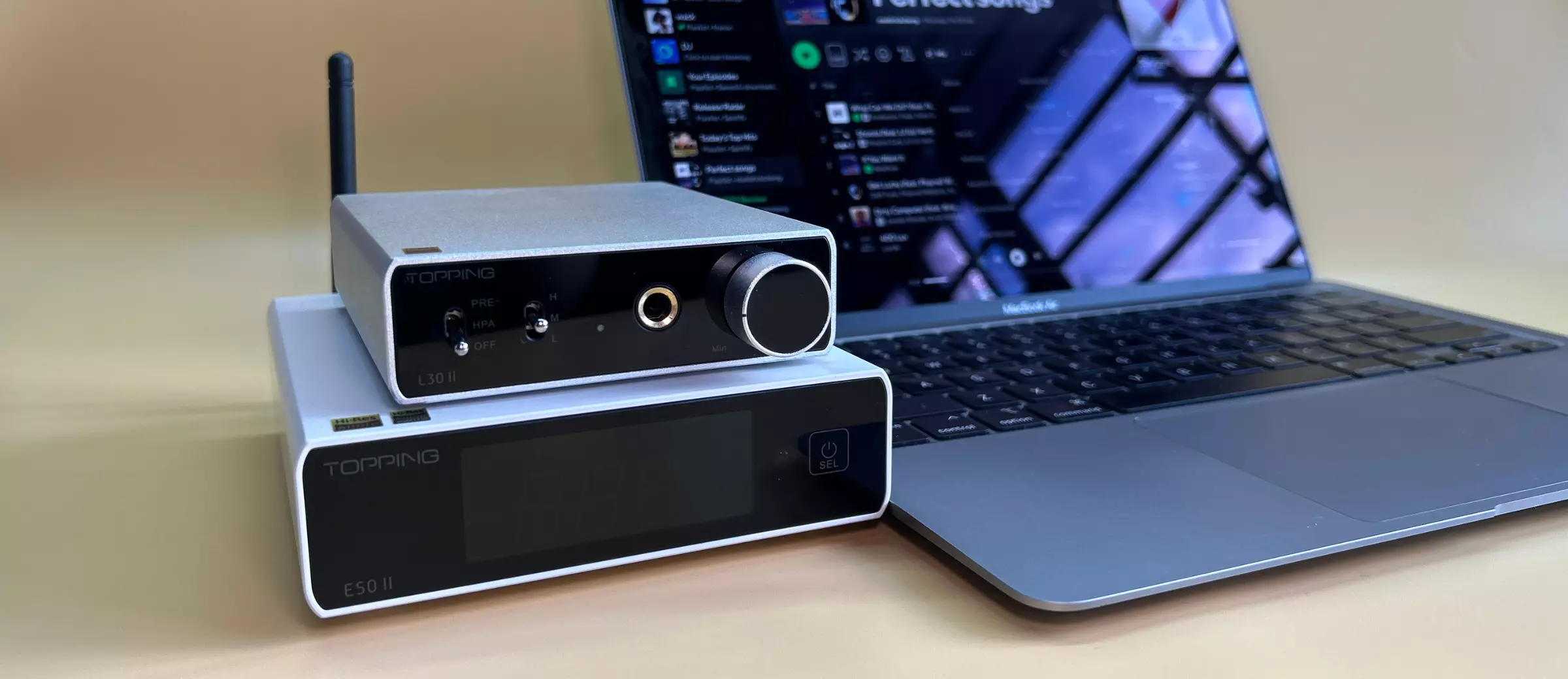
Meldrick reviews the Topping E50 II, an affordable compact AK4497S-equipped desktop DAC with DSD512 decoding and Home App integration. It is currently priced at $199.00.
Disclaimer: This sample unit was sent to me in exchange for my honest opinion. Headfonics is an independent website with no affiliate links or status. I thank the team at Topping for supporting us.
Click here to read more about Topping products previously reviewed on Headfonics.
This article follows our current scoring guidelines, which you can read in more detail here.
Topping has been a consistent mainstay within the Chinese audiophile market with popular desktop components such as the A90, DX9, and 2021’s E50.
The E50 II desktop DAC represents a significant evolution from its predecessor, swapping its ESS ES9068AS chip for AKM’s newer AK4497S DAC and adding Bluetooth 5.4 with LDAC support.
Priced at $199, the E50 II lies towards the lower end of Toppings DAC lineup, but it aims to deliver premium features at an accessible price point, competing directly with units like the Fosi ZD3, SMSL D-6S, and FiiO’s K13 R2R.
Does it successfully balance technical excellence with practical functionality? Read my full review below to find out.
Features
At the E50 II’s core sits the AKM’s new AK4497S DAC chip from its VELVET SOUND family, enabling the unit to achieve an industry-leading 131 dB signal-to-noise ratio and THD+N of just 0.0001%.
One of the E50 II’s most compelling additions is its comprehensive 10-band parametric EQ system, accessible via the Topping Home mobile app or Topping Tune desktop software.
Unlike simple bass/treble controls, this PEQ offers precise frequency-specific adjustments with independent left/right channel control that is rarely found at this price point.
The E50 II also incorporates several connectivity features, including Bluetooth 5.4 with LDAC, aptX Adaptive, and aptX HD codecs, plus a dual-format optical input that handles both standard S/PDIF and ADAT signals.
The latter expands the E50 II’s functionality, giving it additional synergy with home studio setups where multi-channel ADAT routing is still common practice.
Design
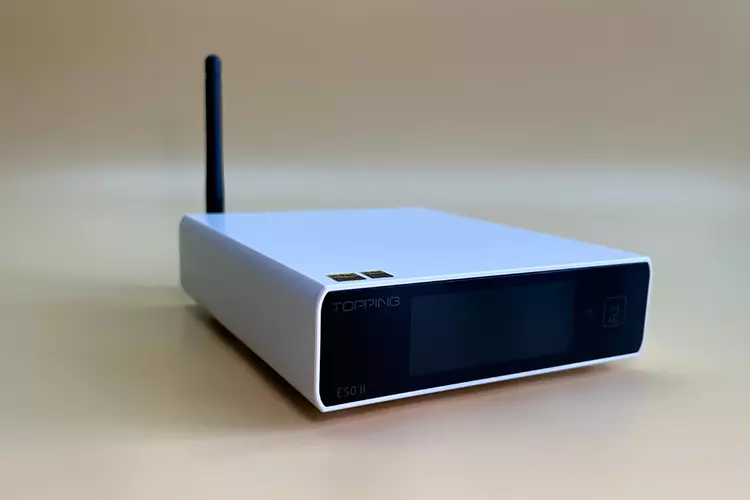
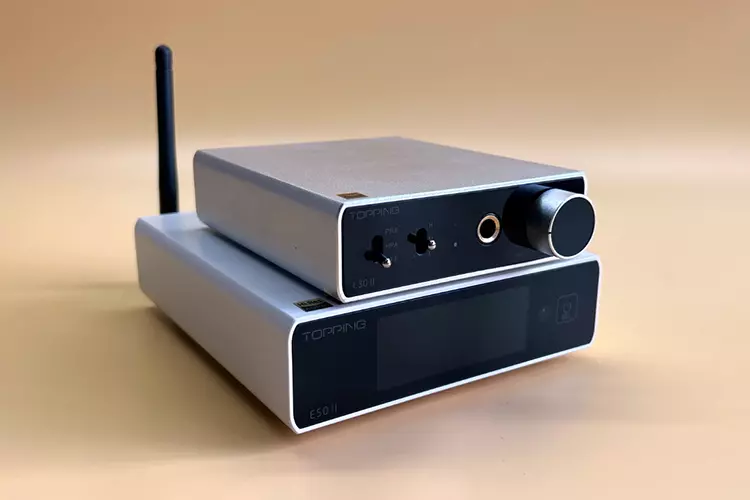
The E50 II follows Topping’s refined utilitarian design language, featuring clean lines and a no-nonsense aesthetic that prioritizes function over flashy embellishment.
The unit is constructed from machined aluminum, with my unit coming in the white variant. However, it is also available in black or silver colorways. The finish resists fingerprints well and remains low-maintenance during my testing
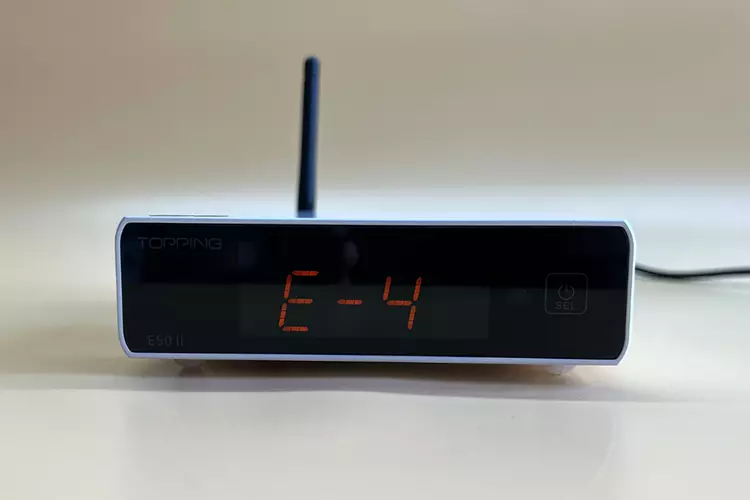
The front panel is dominated by a high-contrast orange monochrome 7-segment display that shows key information, including active input, sample rate, bit depth, and volume level.
The display is bright and legible from across a room, though some users may find it overly prominent in dark environments.
Fortunately, Topping includes adjustable brightness settings with the option to dim or disable the screen after a period of inactivity.
To the right of the display sits a capacitive touch button that handles power, input selection, and menu navigation. While touch controls offer a sleek, seamless appearance, they lack the tactile feedback of physical buttons.
During testing, I occasionally found myself uncertain whether my input had registered, requiring a second glance at the display for confirmation.
This is just a minor inconvenience, but users who prefer positive physical feedback may find it less satisfying than traditional buttons.
Four rubber feet on the underside provide excellent stability despite the unit’s relatively light weight. The compact dimensions make it easy to integrate into space-constrained desktop setups, and the unit remains stable even when heavy cables are attached to the rear panel.
Build quality throughout is decent-to-good, with tight tolerances and a unified, solid feel.
I/O
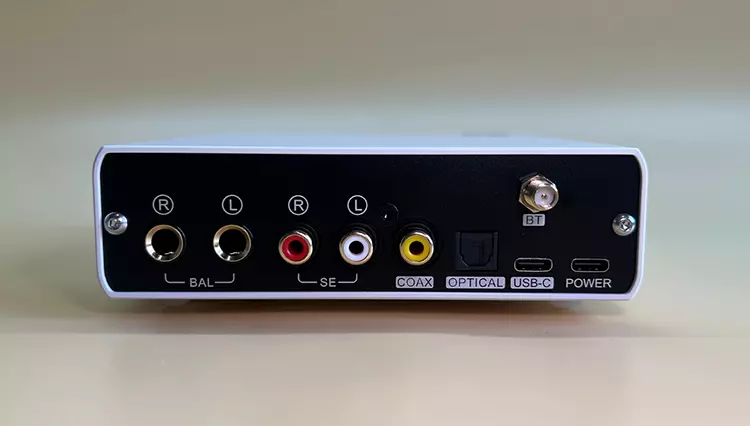
The E50 II’s rear panel houses a comprehensive array of connectivity options. Starting from the right, you’ll find 2x USB-C ports, one for power and one for data.
Right above it is the slot for the included Bluetooth antenna, while to its left are the optical and coaxial digital inputs. The optical input is dual-function, automatically detecting and switching between standard S/PDIF and ADAT signals depending on what’s connected.
Moving left, the output section features balanced TRS outputs (selectable between 2.6Vrms and 11.3Vrms) and single-ended RCA outputs (selectable between 2.6Vrms and 5.6Vrms).
The ability to select output voltage via the unit’s high and low gain modes makes the E50 II exceptionally flexible for pairing with different amplifier types.
The maximum 11.3Vrms balanced output is particularly noteworthy, providing ample voltage for pro monitors and power amplifiers that require hot input levels.
A Bluetooth antenna attachment point sits at the rear, housing Qualcomm’s QCC5125 chipset that enables LDAC (up to 96kHz/24-bit), aptX Adaptive, aptX HD, aptX, AAC, and SBC codec support. This comprehensive codec suite ensures maximum compatibility across different source devices.
The unit works driver-free with Windows 10+, macOS 10.6+, Linux, Android, and iOS. The optical and coaxial inputs support up to 24-bit/192kHz PCM and DSD64 (DoP), while the ADAT input handles up to eight channels of 24-bit/48kHz or four channels of 24-bit/96kHz.
Connectivity
The Topping E50 II’s connectivity options represent a significant step forward from its predecessor, offering both wired flexibility and wireless convenience that address most use cases.
Wired
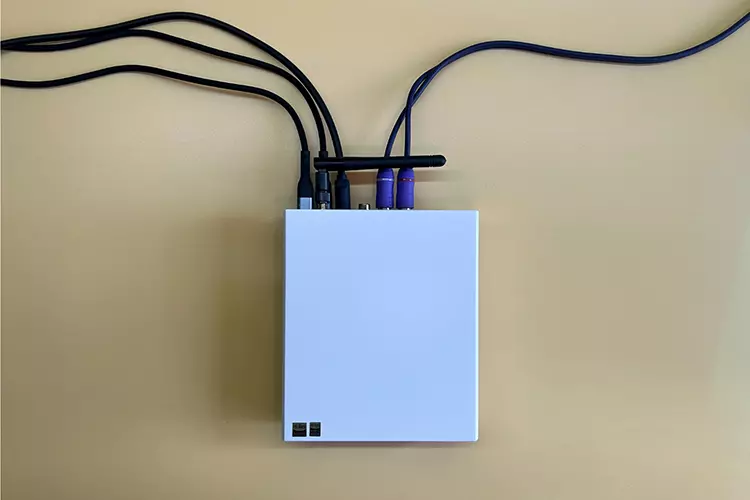
With its range of three digital inputs and dual outputs, the E50 II allows users to connect multiple sources and playback systems simultaneously.
For this review, I connected the RCA SE outputs to a Topping L30 II headphone amplifier and SMSL DA-1 speaker amplifier. Inputs in use included USB-C from my laptop, optical from a WiiM Mini streamer, and coaxial from a CD transport.
Wireless
I tested wireless pairing using my iPhone 14, MacBook Air M1, and a ZTE Blade A75 Android smartphone. Initial pairing to all three devices was straightforward, requiring only a few seconds to establish a connection.
The iPhone and MacBook both supported AAC, while the Android device automatically negotiated LDAC for higher-quality streaming.
Throughout my testing period, all devices maintained solid connections with the E50 II, and I never experienced any signal dropouts or stuttering during playback.
Controls
The E50 II’s control scheme centers around the front-panel touch button and is supplemented by comprehensive smartphone and desktop app control.
A simple tap of the touch button cycles through the available input sources (USB, optical, coaxial, Bluetooth). The current selection is clearly displayed on the screen along with detailed signal information. A long press then shuts off the unit.
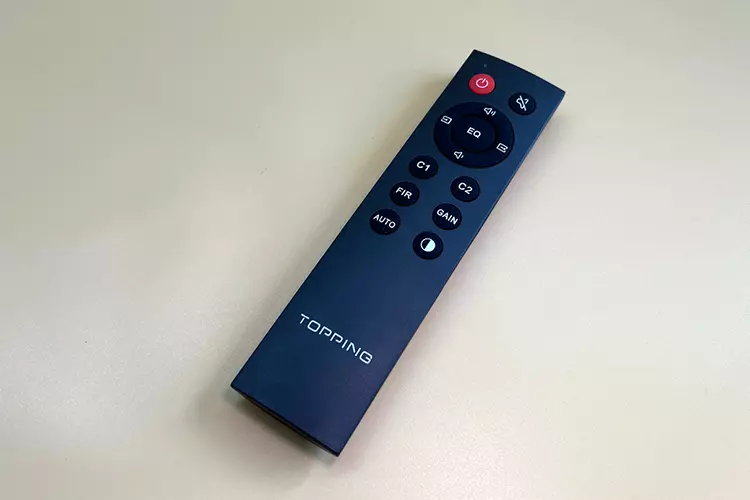
The included infrared remote control provides convenient operation from a distance, offering buttons for power, input selection, volume adjustment, and mute.
Unfortunately, these functions and menu navigation are only accessible via the remote and the companion app. I would have appreciated having more robust on-device controls, as this would have made the unit easier to use on a desktop setup.
Volume control operates electronically with smooth, precise increments. When operating in preamp mode, the volume can be adjusted via the remote, the Topping Home app, or the Topping Tune desktop software.
Software & App Control
Topping Home App
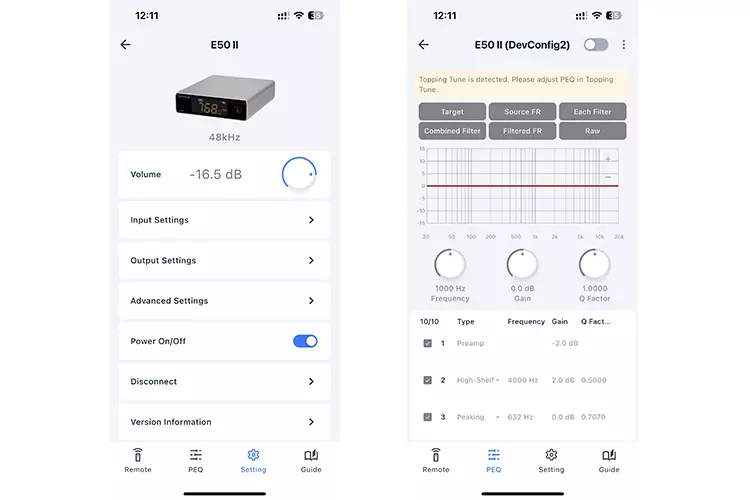
The Topping Home mobile app (available for both iOS and Android) provides real-time control over virtually every aspect of the E50 II’s operation directly from your smartphone.
Once paired via Bluetooth, the app automatically detects the E50 II and presents a clean, intuitive interface.
Through the app, you can switch between input sources, adjust volume in real-time, toggle between DAC and preamp modes, and access the full 10-band parametric EQ.
The interface is responsive and well-designed, with clear labeling and logical organization. I found myself reaching for my phone to make adjustments far more often than using the physical remote.
The only limitation is that the E50 II must be in Bluetooth mode or connected via USB to receive app commands, though this was only a minor inconvenience during my testing.
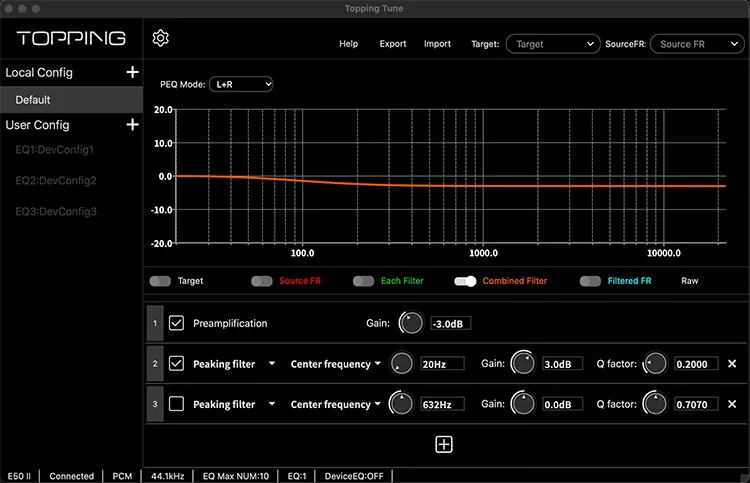
Topping Tune Desktop Software
The Topping Tune desktop software (available for Windows and macOS) offers EQ customization with a more sophisticated interface and additional features.
When connected via USB, the software automatically detects the E50 II within seconds and presents a comprehensive control panel.
The centerpiece of Topping Tune is its visual EQ interface, which displays frequency response curves in real-time as you make adjustments.
Each of the 10 parametric bands can be individually configured for frequency, gain (±12dB), and Q factor (bandwidth), with independent control for left and right channels.
The software displays not only individual filter curves but also the cumulative effect of all filters combined, making it easy to visualize the total frequency response.
One of Topping Tune’s most powerful features is its ability to import and export EQ profiles. You can load target frequency response curves, import measured frequency responses from your own headphones or speakers, and then use the PEQ to compensate for deviations from your target.
The software supports creating multiple local configurations, allowing you to save different EQ settings for various headphones.
During testing, I found Topping Tune’s interface to be generally intuitive, though there’s a learning curve for users unfamiliar with parametric EQ concepts.
The ability to see real-time visual feedback of your adjustments proved invaluable when compensating for headphone frequency response irregularities.
Packaging & Accessories
The Topping E50 II arrives in a clean white retail box featuring minimal graphics and key specifications printed on the exterior. Inside, dense foam inserts protect the unit during shipping, and everything arrives in pristine condition with no rattling or movement during transit.
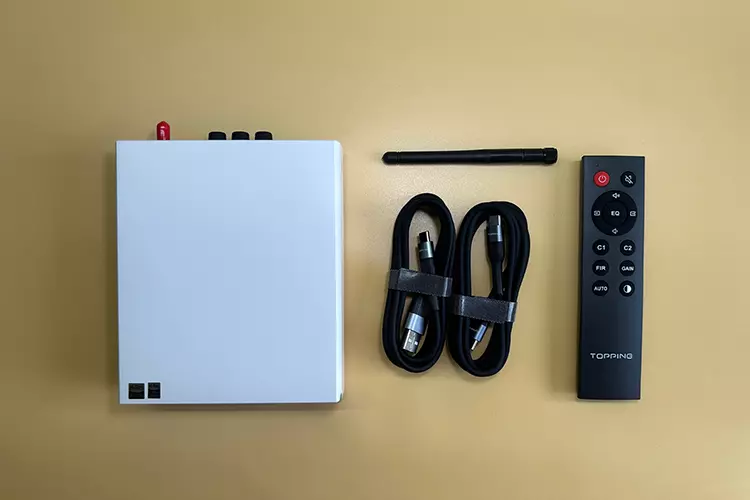
The package includes the E50 II unit wrapped in protective plastic, two USB cables (one USB-A to USB-C for power, one USB-C to USB-C for data), a Bluetooth antenna, and an infrared remote control. Also included is a compact user manual with clear instructions and complete specifications.
Notably absent are analog interconnect cables, a 12v power adapter, and included AA batteries. Topping includes neither TRS nor RCA cables, which means users will need to source their own to connect the E50 II to amplification.
While this keeps costs down and allows users to select cables matching their preferences, it does mean the unit cannot be used immediately out of the box without additional purchases.
Most users building a system around the E50 II likely already have appropriate cables, power adapters, and batteries on hand, but first-time system builders should prepare accordingly.
Sound Impressions
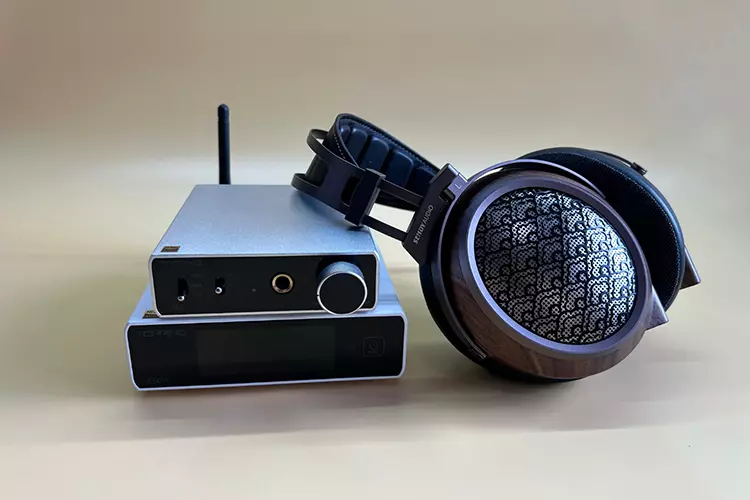
The following sound impressions of the Topping E50 II were done using the Topping L30 II amplifier, the Sennheiser HD 600, Sendy Audio Egret, and Modhouse Argon Mk3 headphones, the MOONDROP Blessing 3, and Yanyin Canon II IEMs.
I also tested the E50 II with my SMSL DA-1 speaker amplifier paired with Wharfedale Diamond 12.1 bookshelf speakers. Testing was conducted using the single-ended RCA outputs.
Summary
The Topping E50 II presents a neutral, transparent, and highly resolving sound signature that prioritizes technical accuracy and detail retrieval, making it an excellent reference source for critical listening.
Bass response is tight, controlled, and extends cleanly into the sub-bass region without audible roll-off. Kick drums and bass guitars are rendered with good texture and definition, though they lack the mid-bass warmth and body that some listeners prefer.
The E50 II’s midrange delivers vocals and instruments with exceptional clarity and natural timbre. Male vocals maintain appropriate chest resonance without sounding hollow, while female vocals exhibit good clarity and sibilance control. String instruments display strong texture and harmonics
Treble is extended, airy, and detailed without crossing into harshness or fatigue. Cymbal crashes and high-hat hits have excellent shimmer and extended decay, providing that sense of air and space that characterizes high-quality audio reproduction. The top-end sparkle enhances the sense of resolution without introducing grain or glare.
Soundstage width is excellent, creating an expansive presentation that extends well beyond the physical boundaries of headphones or speakers. Depth layering is equally impressive, with instruments positioned at varying distances that create a realistic sense of three-dimensional space.
Imaging precision is a highlight, with pinpoint accuracy in instrument placement. In complex mixes, individual elements maintain their distinct positions rather than blending together. Dynamics are strong, with satisfying impact and natural note decay.
Timbre
The E50 II’s timbral presentation leans decidedly toward neutrality with excellent accuracy across the entire frequency spectrum.
Bass notes are tight and controlled, with electric bass and kick drums feeling precise and articulate rather than bloated or overemphasized.
In electronic and hip-hop tracks, the sub-bass extends deep with excellent definition, though it doesn’t deliver the visceral, room-shaking impact that more colored DACs provide.
The midrange excels at rendering acoustic instruments and vocals. String instruments exhibit good body and harmonic complexity, with violin notes carrying appropriate woody resonance and cello strokes delivering both weight and texture.
Piano strikes sound natural and well-balanced, with proper weight in the lower registers and crystalline clarity in the upper keys.
Vocal presentation is among the E50 II’s strongest suits. Male vocals display full chest resonance with excellent clarity, avoiding both the hollow quality of recessed mids and the nasal character of forward upper mids.
Female vocals maintain presence and clarity with excellent breath detail and micro-dynamics, though the neutral presentation may feel slightly analytical compared to warmer DACs.
The upper midrange through treble region exhibits excellent extension and detail with minimal coloration. Snare drums have crisp snap and realistic tone, guitars deliver texture and bite without harshness, and brass instruments maintain their characteristic brilliance without becoming piercing.
Cymbal crashes and high-hat strikes are cleanly articulated with excellent shimmer and extended decay, creating that sense of air and space that marks high-quality reproduction.
This treble character proves beneficial with well-recorded material, extracting every nuance without fatigue, though it can reveal harshness in poorly recorded tracks.
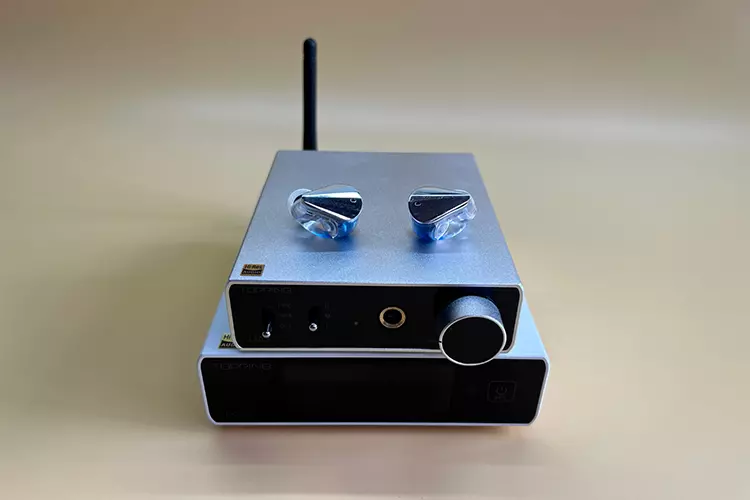
Staging and Dynamics
The E50 II delivers an expansive, three-dimensional soundstage with excellent width and impressive depth layering. The presentation extends well beyond the physical confines of headphones or speakers.
Imaging precision is very good, allowing precise identification of instrument positions within the soundstage. In simpler recordings, placement feels locked and stable, while in dense, complex mixes, individual elements remain distinctly positioned rather than blurring together.
This imaging capability makes the E50 II valuable for mixing and mastering work where accurate spatial representation is critical.
Dynamics are a genuine strength, particularly in the way the E50 II handles both macro and micro-dynamic contrasts. Large dynamic swings from quiet passages to loud crescendos are rendered with impressive authority and control, never feeling compressed or constrained.
Micro-dynamics are equally well resolved, with subtle volume variations and textural details clearly audible. This dynamic capability gives music an engaging, lifelike quality that more compressed presentations lack.
Click on page 2 below for my recommended pairings and selected comparisons.
