

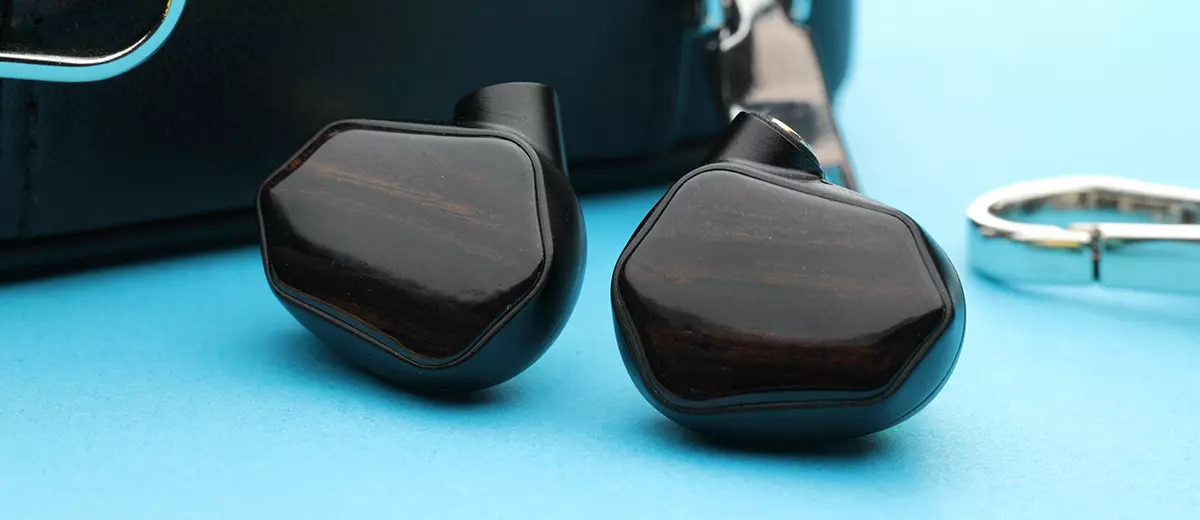
Marcelo reviews the TinHiFi T7, a new flagship single 10mm ultra-linear gold-plated diaphragm dynamic driver universal IEM priced at $192.00.
Disclaimer: This sample was sent to me in exchange for my honest opinion. Headfonics is an independent website with no affiliate links or status. I thank TinHifi for their support.
Click here to read more about the TinHiFi audio products previously reviewed on Headfonics.
This article follows our latest scoring guidelines, which you can read in more detail here.
TinHiFi, formerly known as TIN Audio, has been around since 2018 with the release of the TIN HiFi T2. It was considered one of the best and most popular single dynamic driver IEMs upon its release.
TinHiFi is known for its IEMs, and some of its models have been reviewed here at Headfonics before, including the T5S, P1 Max II, and the T6, which I recently reviewed.
Even though TinHiFi has been around for a long time, I never had the opportunity to hear their IEMs. It is only recently that I got to hear one, so the TinHiFi T7, which sells for $199, is the second TinHiFi IEM I have recently reviewed.
What is interesting about the T7 is its 10 mm dynamic driver. It is gold-plated and coupled with a Tesla-rated magnetic system. And because of that, T7 promises a step up in detail and transparency.
Will the T7 deliver on its promises? And how will it perform compared to other high-performance dynamic driver IEMs, such as HIDIZS MK12 Turris Titanium Edition and the TWISTURA Woodnote? Let’s find out.
Features
The T7 is the high-end flagship single dynamic driver IEM from TinHiFi, featuring a 10 mm driver with a gold-plated, metal-deposited diaphragm produced using an advanced process they call Ultra-High Vacuum Vapor Deposition Technology.
This process is intended to produce an ultra-thin, precision-engineered film layer that imparts exceptional rigidity to the material while enabling precise control over acoustic damping properties.
The T7 also features their Patented Ultra-Linear Dual Tesla Magnetic Drivers, equipped with a powerful dual Tesla magnetic system and an innovative patented magnetic conduction plate.
This design integrates the magnetic fields of two high-performance magnets, increasing magnetic strength by 60% over conventional drivers.
The T7 employs a Dual-Curved Acoustic Chamber. The unique properties of dual-curved surfaces effectively minimize sound-wave reflections, resonance, and interference, thereby significantly enhancing audio purity and depth.
The TinHiFi T7 has an impedance of 22Ω and a sensitivity of 112 dB.
Additionally, the T7 features an effective pressure-release system that prevents pressure buildup in the ear canal, which can cause headache, nausea, and ear pain during walking and running.
Design
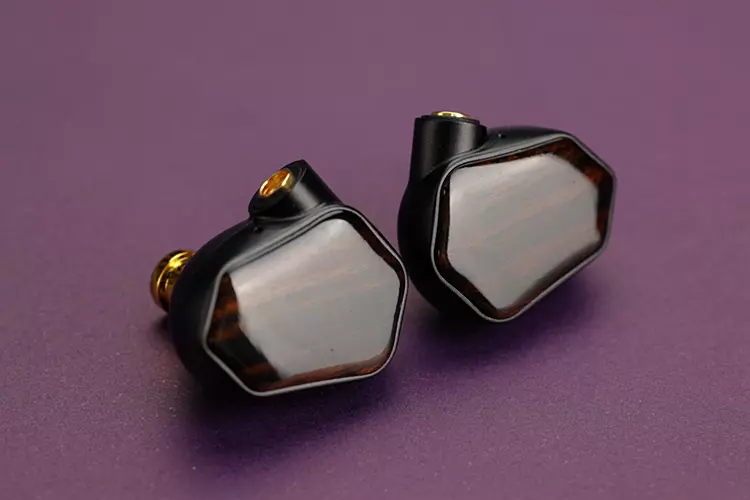
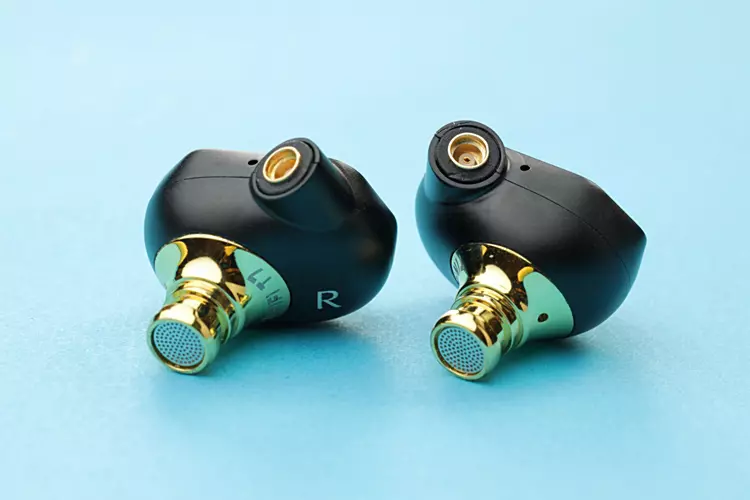
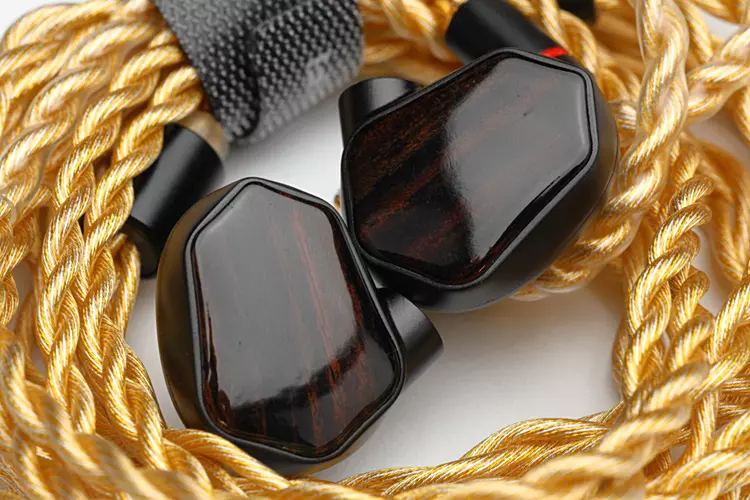
The T7 looks beautiful, with its black CNC-machined aluminum alloy main shell paired with a gold-plated copper nozzle area and a dark ebony wood faceplate. The overall aesthetic combines classic traditional material with modern technology, making the T7 look and feel luxurious.
There is a small vent near the nozzle area that serves as a pressure relief, and another vent near the faceplate beside the MMCX connector.
I like the T7’s compact size, which is below average for most IEMs, and its average weight of 7.7 grams per shell. The nozzle size is average, with a diameter of 6.1 mm.
Stock Cable
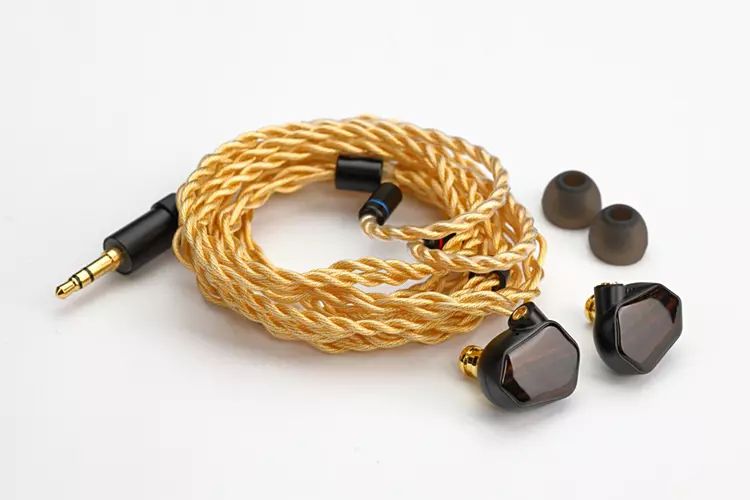
The gold-colored 1.2 m MMCX 4-core cable feels very high-quality and is 5.7 mm thick, which is on the thicker side but not so thick as to be impractical for portability. Its wires are each 1.5 mm thick and composed of a blend of single-crystal and oxygen-free copper.
All parts are made of metal, with the plug supports interchangeable 3.5mm and 4.4mm plugs, which are included in the package.
I like that there are red and blue rings on the right and left MMCX plugs for easy channel identification. I also like that there is an arrow on the plug and the cable connector to make the connection easy.
Comfort & Isolation
I have fallen asleep with the T7 on my ears, thanks to its compact size. I didn’t realize I was wearing it when I woke up; it was only when I got up that I noticed an IEM cable dangling from my ears.
The T7 is very comfortable to wear and does not protrude from the ears too much; it sits almost flush. I’ve worn it during my walking exercise, at a coffee shop, and at home, and I feel I could comfortably use the T7 for hours.
Noise isolation is average and good. I can easily hear the background noise when there is no music playing, but it becomes inaudible with just a little music.
Packaging & Accessories
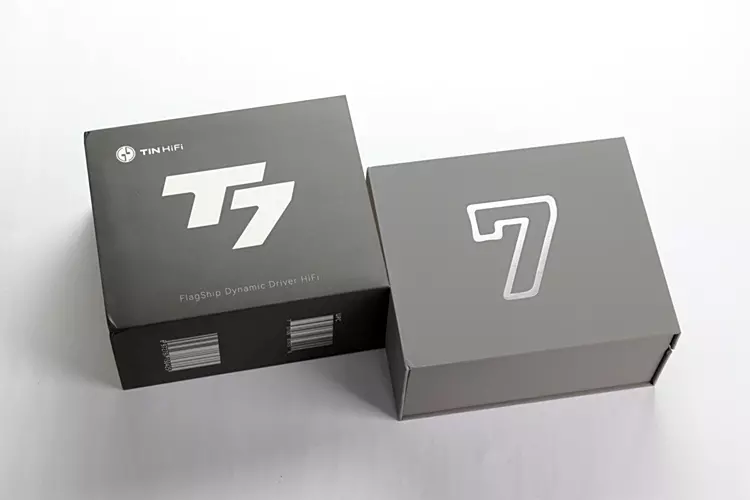
I had difficulty removing the outer sleeve during unboxing with the T7. It’s a big, grey, 180 x 150 x 86 mm sleeve-covered clamshell box. Foam and cardboard protect the IEMs inside.
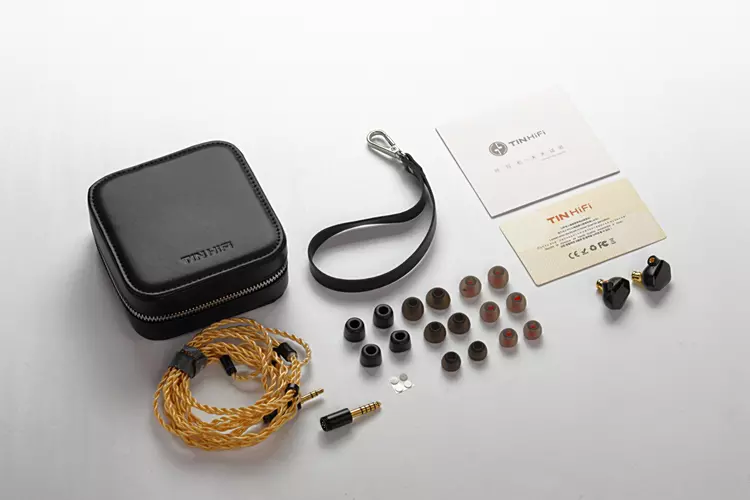
The package includes a pair of T7 IEMs, eight pairs of ear tips, user manuals, a calling card, a 1.2 m cable, a 3.5 mm plug, a 4.4 mm plug, a hard leather case, a hand strap, and two pairs of tuning grills.
It’s nice to see the two extra pairs of replacement tuning grills in the package, as these grills have fine mesh that can clog over time and need replacing.
Sound Impressions
Of the three ear tip types included, I chose the red-stemmed ear tips because I find them the most comfortable and smoothest-sounding. The black ear tips are comfortable too, but I didn’t like how they sounded.
The slow rebound foam tips are among the most comfortable stock foam tips I’ve tried. I still find them less comfortable than the silicone ear tips, plus the loss in bass and treble is not to my liking. I use the stock cable with the 4.4 mm balanced plug.
I did my standard 24-hour burn-in period, but since I was busy with other reviews, I must have left it burning for around 50 hours. That said, the sound became noticeably smoother than my already smooth initial impression of the T7.
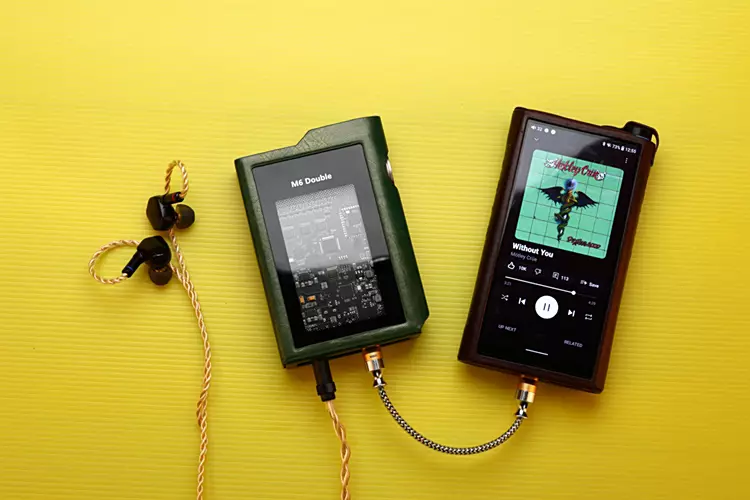
For the sources, I used my iBasso DC-Elite and MUSE HiFi M6 Double DAC amplifiers, with my OnePlus 13 Android phone and Sony DAP as the music source, and the FiiO M15s DAP, using either UAPP or PowerAmp music player Apps. No EQ or any sound enhancement programs were used.
Measurements
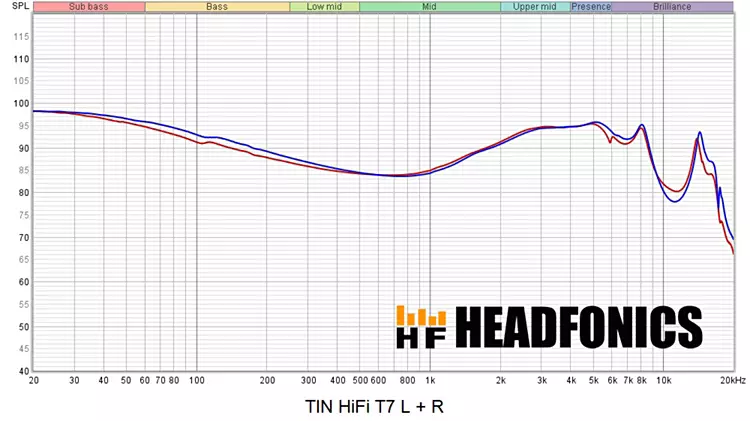
My measurements reveal a well-balanced channel set, with only a minor, inaudible imbalance in the mid-bass and upper treble.
There is a very healthy 15 dB boost in the sub-bass and a moderate 10 dB elevation around 3 kHz, the pinna gain region. This amount of elevation in that area should give the T7 a good balance of vocal presence without sounding shouty.
There are mild peaks at 5 and 8 kHz, which don’t sound peaky on actual listening. The huge peak at 15 kHz is benign and not piercing; it only adds air to the sound.
Summary
I was mostly enjoying near-neutral-sounding headphones and IEMs while the T7 was burning in, since I was reviewing DAPs.
When the time came to listen to the T7 seriously, I was blown away by its huge, deep bass presentation and the grand scale at which it presented the music, compared to the near-neutral headphones and IEMs.
The first thing I noticed was the warm, bassy, moderately V-shaped sound signature with a very extended, clean treble. The sub-bass is unashamedly boosted, yet it is clean, relatively tight, and never bleeds into the lower midrange or drowns out the already laid-back midrange.
The low frequency is more sub-bass-focused than mid-bass-focused, making the bass sound clean and articulate. Yet the mid-bass is very present as well, and the overall note weight presentation is on the thick side.
The midrange is slightly recessed but never sounds buried by the bass and treble. It has a good presence and sounds clean and clear, but never shouty or fatiguing, thanks to the way the pinna gain or the upper midrange peak was tuned, which is not too little and not too much, just enough.
One of the first things I noticed was how the T7 renders high frequencies: it is remarkably clean and highly detailed, rivaling some good hybrid IEMs in extension, yet the sound is very natural and coherent.
I hear the small details rendered with the correct delicacy and naturalness, while the overall treble presentation is crisp and clean.
Coloration
Aside from the T7’s aforementioned warm, bassy, moderately V-shaped sound signature, with a very extended, clean treble. The overall sound is very natural; there is no negative coloration, such as a peaky upper midrange and piercing treble.
There is one thing that stands out, though: the bass boost and warmth. As a neutral person, I find it on the verge of being overbearing on some songs; fortunately, it never crossed the line, allowing me to enjoy most of the music with the T7.
Soundstage
The T7 has a spacious soundstage with good depth and width, and a noticeably high ceiling. It is not the biggest soundstage I’ve heard, but it is certainly way above average.
There is a distant feel to the stage, where the main vocals and the rest of the band are situated at a moderate distance, like watching a concert in the fifth row or a movie near the center of a cinema.
The overall presentation of most songs is clear but never in-your-face, even though the resolution and detail retrieval are high.
Although the instrument decay is clean and the stage has good depth, the front-to-back layering of the instruments is not the most layered or well-separated longitudinally.
This is due to the laid-back midrange presentation, which does not project the sound in your face; it also lacks the precise center projection of a floating image of the vocalist, positioned far enough forward to allow the rest of the background instruments and vocals to recede to the back with apparent layering.
However, the side-to-side separation of the images is good, and there is good definition and space between the instruments. And the instruments have their own spaces, including those soft background instruments.
Dynamics
Despite the smooth sound signature and slightly laid-back midrange presentation, the T7 sounds very dynamic and bubbling with energy, especially in the bass.
The moderate treble elevation nicely balances the bass energy, preventing the T7 from sounding dark at the top.
Thanks to its ease of driving, efficiency, and sensitivity, even when paired with low-powered tail-style dongle DACs not mentioned in this review, the dynamics are effortless.
And when paired with high-powered sources such as the FiiO M15s, the T7 can take all the power and go as loud as my hearing can handle.
Click on page 2 below for my recommended pairings and selected comparisons.
