

Sound Impressions
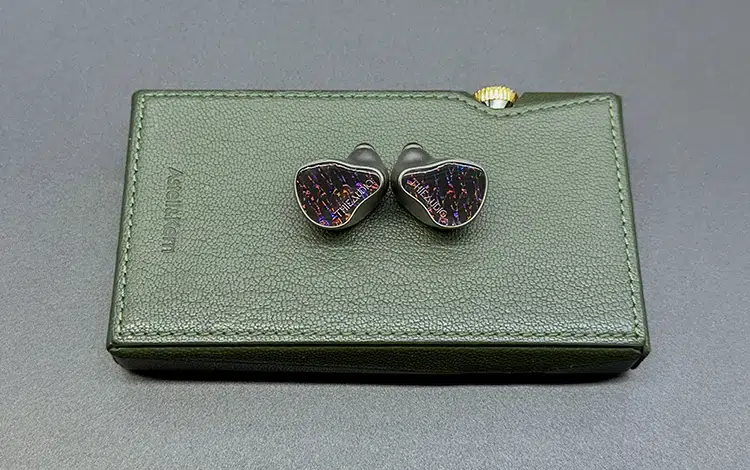
The following sound impressions of the THIEAUDIO Valhalla were completed using a mixture of my main source, Lotoo’s PAW Gold Touch, the Astell&Kern SP3000, and the Questyle CMA18P.
For the review, I paired the IEMs with the stock cable and stock silicon ear tips, size L.
Summary
So how do those 19 drivers sound? I would say the Valhalla lives up to the expectations and delivers a premium sound. The Valhalla isn’t tuned to impress you instantly. It took me some time to truly appreciate its accuracy and coherence, and the sound gradually grew on me as I listened more.
It has a U-shaped sound with a slight boost in the low end and some in the treble region. The initial few days with the Valhalla sounded a bit bright, but with some tip rolling and some adjustment to the sound, it felt quite all right.
The bass has a good impact, while the midrange remains quite natural with minimal coloration. The upper frequencies are fairly detailed without ever sounding harsh or spicy.
The tonal character of each instrument comes through naturally and accurately. The overall sound remains very transparent, presenting the audio clearly and in high detail, free from muddiness or coloration.
The best part about the whole tuning is how musical it appears. On previous occasions with some of the THIEAUDIO IEMs, where they tried to keep the midrange as neutral as possible, some bit of musicality felt lost, but not here on the Valhalla.
The technical aspects place it rightly as a champion among its peers.
Bass
In a blind test, it would be hard to tell if the Valhalla did not have any dynamic driver helping with its low end. I mean, it does have the typical characteristics of the balanced armature driver’s bass, but the way the bass shows off some traits of dynamic drivers, it got me confused initially.
The bass has a surprising level of physicality and reverberations, with a satisfying punch and weight that gives some hints of the sensation of dynamic driver bass. There’s plenty of sub-bass extension, showing off deep rumbles when it’s needed.
There is also a slight focus on the mid-bass, which adds warmth and fullness to the low end. Going by the quantity of the bass, I would not place it in a basshead category, though.
This bass is fast, responsive, and very well-controlled, something I would associate with a bouncy bass. It makes the rhythms sound lively and energetic, adding some fun to the mix. The clean and controlled bass helps a lot with the separation of bass notes.
For example, in the drum strikes, each impact feels clean without smearing into the next note. Similarly, with vibrations from plucked bass guitar strings, they are distinct and don’t blur into each other.
Valhalla’s bass has a quick attack, with just enough lingering. This makes bass feel fuller and immersive. The bass does not interfere much with the higher frequencies and remains well-separated. For an all-BA setup, Valhalla’s bass is highly dynamic and satisfying.
Midrange
Similar to most of the THIEAUDIO IEMs that I have tried, the Valhalla follows a neutral midrange slope but with a slightly more forward and fuller midrange.
The minor gripe I had on previous occasions of a drier and rather less musical midrange seems to be fixed here. The midrange here has more warmth, while the resolution remains one of the best in the class.
The lower midrange is gently recessed but remains well-balanced, providing enough warmth and body to male vocals and instruments like cellos, guitars, and pianos.
The notes in this region are clean and avoid any kind of muddiness or excessive warmth. This character lends a solid foundation for the midrange.
One strong aspect of the midrange is that the timbre remains impressively clean and accurate. Even in complex musical passages, the separation of notes is outstanding, with each instrument occupying its own space comfortably. The vocals are rendered faithfully, conveying all the emotion one would look for.
The upper midrange on the Valhalla is slightly elevated, adding a sense of presence and air. It enhances the details and extension in the female vocals and instruments such as violins and flutes, without any harshness or shoutiness.
Overall, this midrange feels quite familiar, but it looks like THIEAUDIO saved the most musical midrange for the Valhalla.
Treble
In the first few days with the Valhalla, I noticed some glare and sharpness, which made the higher frequencies a bit piercing. It took me a couple of days to adjust to the sound, and switching to narrower tips also helped the treble settle down.
Similar to most of the THIEAUDIO offerings, Valhalla also offers a very detailed and resolving treble. The transition from the upper midrange to the treble is quite smooth and coherent.
The lower treble is not emphasized much, which helps prevent extra crunchiness and sibilance. Every note comes through with impressive clarity, making it suitable for all types of music.
Treble notes feel tall and exhibit natural decay, which helps in enhancing the overall clarity and resolution. The treble region has a good sense of energy, making the sound lively but remains smooth most of the time.
There are some noticeable peaks, which do add a sense of sparkle, but on certain tracks can make their presence felt. The extension into the upper treble region brings a sense of air and separation to instruments.
The overall presentation remains clean, articulate, and engaging, bringing out micro-details and subtle nuances with ease.
Staging & Dynamics
Whether it is the Oracle MKIII, the Hype 10, or the Origin, THIEAUDIO has never compromised on the technical aspects, and with Valhalla, they have truly pushed the boundary.
The soundstage on the Valhalla feels very accurate, with neither width nor depth being artificially exaggerated. There is sufficient space for instruments to breathe, creating a vivid sense of placement.
This natural staging works well for every type of music; be it intimate recordings or larger orchestral pieces, they sound true to life. The width allows instruments to occupy their own space across the stage, so you can distinctly perceive sounds coming from the far left or right.
More than the width, I find the depth of the stage more impressive, which lets you hear layers of instruments placed both near and far.
The precise imaging on Valhalla makes it easy to pinpoint individual instruments and vocals within the soundstage. The openness of the sound and the airy treble enhance the imaging by ensuring positional cues are clear and helping spatial effects in recordings come alive.
When it comes to resolution, the Valhalla doesn’t miss a beat. From tiny details to subtle textures and nuances, everything comes through clearly to the front. None of the details are missed in the background.
The expansive soundstage helps the instruments with enough breathing space around them. Even on complex tracks, there is hardly any sense of congestion.
The layering is handled with ease, ensuring the musical picture is presented distinctly without any blurring or overlapping. This allows dense arrangements to sound layered and coherent, with each layer of sound easily distinguishable from the others.
Synergy
Efficiency
THIEAUDIO Valhalla has an impedance of 9Ω @ 1 kHz and a sensitivity rating of 103 dB/Vrms. The IEM can be comfortably driven by low-rated sources such as dongles and smartphones.
Even if the Valhalla does not demand additional power, it benefits from a powerful source, as I find the stage expanding a bit and the notes gaining some weight as well. The IEM feels fairly stable even with more powerful sources.
Notably, it does not have background static hissing noise with sources such as Questyle CMA18P. On the SP3000, the Valhalla takes a volume level near 40, and on the LPGT, it takes less than 30 volume clicks.
Source Pairings
When paired with the LPGT, the Valhalla has a tad more warmth than usual. The IEM benefits from the DAP’s power, resulting in a lush and rich sound. The LPGT boosts the low end a bit, giving a more impactful bass shelf; however, Valhalla strictly doesn’t need any help there.
The midrange remains neutral for the most part. Vocals are rich and full of emotion. The upper midrange extension helps the female vocals and instruments gain a sense of openness.
The treble is smooth for the most part; however, on some tracks, there is just some emphasis in the mid-to-upper treble region. The LPGT brings out details effortlessly, and the depth in the soundstage is commendable.
On the Questyle CMA18P, which features an AKM 4493 DAC chipset, the Valhalla has more or less a similar presentation, except it’s not as resolving and detailed. The CMA18P, being a very powerful source, opens up the Valhalla and expands the stage.
The bass has slightly more focus on mid-bass than the LPGT. The midrange remains neutral with enough fullness. The treble is not as emphasized as I had imagined, and I find it a bit smoother than on the LPGT.
With the Astell&Kern SP3000, the Valhalla is very resolving. The bass sounds more rounded, and the transition from sub-bass to mid-bass is more even. The mid-bass presence is not as strong, while the sub-bass feels more prominent.
The neutral profile of the SP3000 reduces extra warmth and delivers a cleaner, more transparent midrange.
Overall resolution is improved, and the treble region feels a touch smoother and more detailed compared to the LPGT. The soundstage width increases while maintaining a similar depth. There is an added sense of vertical height, making the overall stage feel more immersive.
