

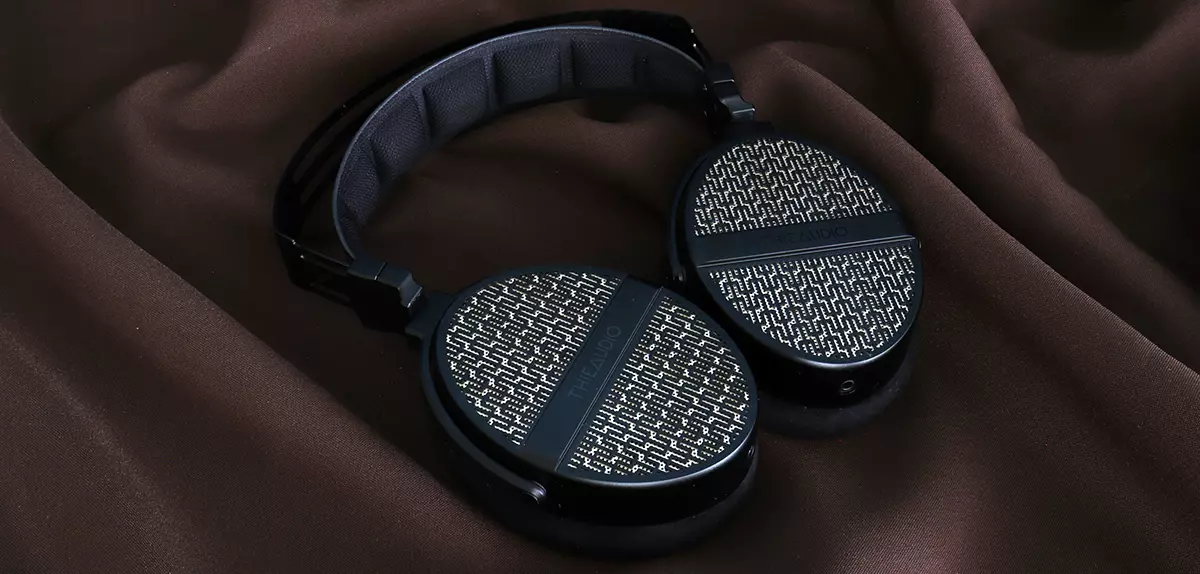
Louis reviews the THIEAUDIO Cypher, a new flagship set of 50mm dynamic driver semi-open-back headphones featuring a 20-core N45 magnet array. They are currently priced at $399 MSRP, with Kickstarter prices starting from $329.
Disclaimer: This is a sample in exchange for my honest opinion. Headfonics is an independent website with no affiliate links or status. I thank Linsoul and THIEAUDIO for this opportunity.
Click here to read more about THIEAUDIO products previously reviewed on Headfonics.
This article follows our latest scoring guidelines, which you can read in more detail here.

THIEAUDIO has flourished in the IEM community but has had a more limited focus on the headphone market.
We have reviewed their Ghost and Wraith models, but these have now been dethroned by their new flagship open-back Cypher, which retails for $399.
The Cypher, the new top model in THIEAUDIO’s headphone line, is a reinforcement of their devotion to this segment and enhances their presence in this market to four models if we also include the Phantom.
Introduced at the NAMM show and Can Jam Dubai 2026, the Cypher is a headphone that THIEAUDIO tuned to have a reference sonic character, assembled with premium materials, and aimed at Audiophiles and professionals in the music industry alike.
How does it perform and compare to the likes of HIFIMAN Edition XV, Meze Audio’s 99 Classics 2nd Gen, and the Sennheiser HD 550? I found out in my full review below.
Features
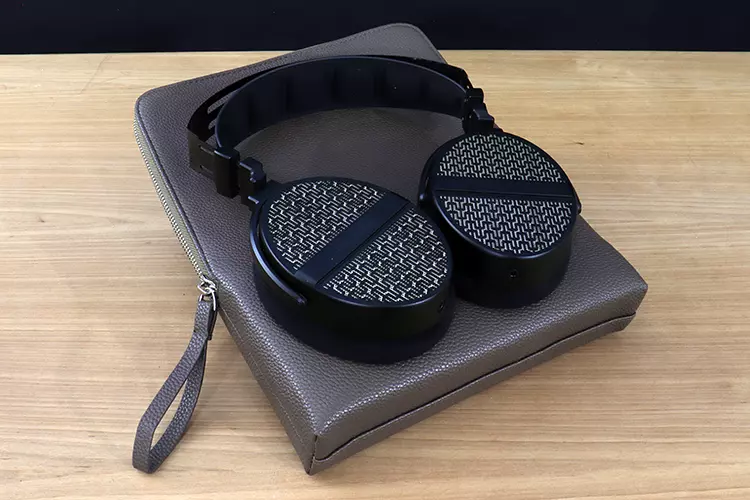
The THIEAUDIO Cypher’s main feature is that it is a semi-open-back headphone with a premium build, which is not common. THIEAUDIO also claims it’s good for use as monitoring headphones for professionals, on top of offering audiophile-quality audio production.
The last time I checked, the closed-back headphones have dominated that camp because they provide improved isolation. The Cypher tends to play with the senses and somehow brings both worlds together.
In other words, they provide ample isolation for an open-back headphone while maintaining the virtues of both open-back and closed-back designs. I think that’s one of their niche points.
The Cypher uses a newly designed single 50mm dynamic driver with a rather unique 20-core N45 magnetic assembly, tuned for critical listening and mastering, and featuring a Semicrystalline polymer and rubber composite diaphragm.
On build quality, the THIEAUDIO Cypher uses components that are meticulously detailed and uses premium components everywhere you look within their overall assembly on a level that’s almost unmatched in this price tier.
It’s apparent from the ground up that THIEAUDIO was aiming for overall balance, and their attempt to please a large crowd is evident.
The Cypher is a headphone that’s not too obtrusive, has an overall balanced sound signature, and offers a level of build quality that many eyes will find appealing.
Design
THIEAUDIO is aiming for balance, yes, and there is plenty here, starting with the overall construction and the cups’ orientation. The design even employs an almost ambidextrous orientation, with no left or right to the observer’s eye.
The only difference between the two sides is that they mount the drivers at a visible angle, and I believe that the wider back part goes to the rear.
Otherwise, it could cause comfort issues if used backwards. To mount the pads, you have to go by that to determine which side is correct.
To wear them correctly, you must go by the small, white L and R markings on the stock cable, or by the large L and R markings inside the pads, to guide you, but their low contrast makes them a bit hard to see in low light or certain lighting conditions. There are no left and right markings on the frame itself.
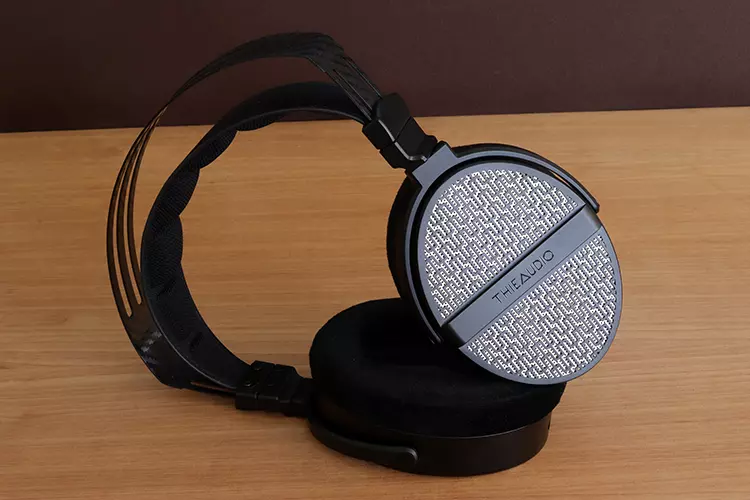
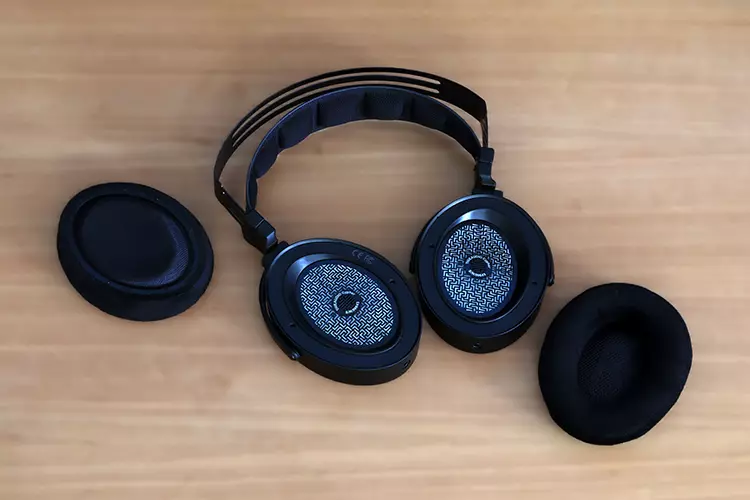
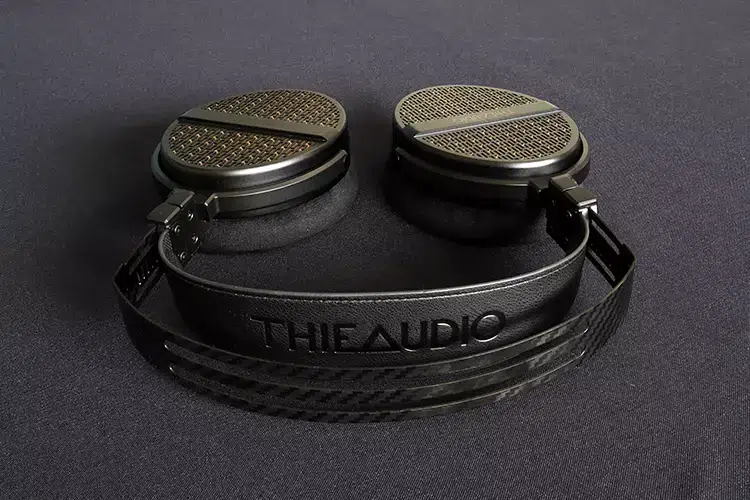
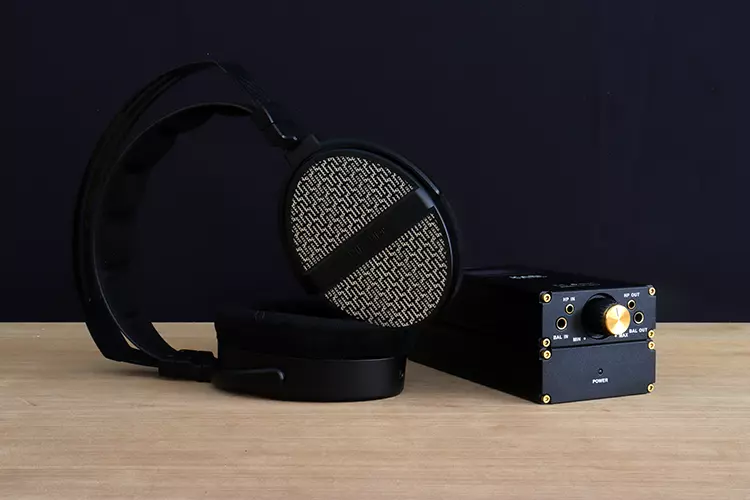
Overall, their construction is quite hefty but meticulous. For example, if you remove the stock pads, the grill inside the cup is just as elaborate or even more so than the one on the outer backplate. The Cypher has what I call subtle bling that can only be appreciated up close.
The Cypher employs gorgeously CNC-machined Aluminum cups held in place by metal yokes and adjusters, and there isn’t a hint of plastic anywhere.
The only headband component that’s not metal is the arched top main spring, which is made of carbon fiber. And of course, the pads and the segmented bubble-style padded head strap.
The metal headband adjusters are not made for arthritic hands, for certain, since they seem quite tight and hard to turn to adjust. This headband assembly employs tight tolerances throughout. But trust me, once you adjust the headband, it will stay put.
Stock Pads
I’ve always been an advocate of stock pads that are attached by magnets, and the Cypher is another set that employs that design.
The only thing one has to do is match the pads’ two pegs on each side under the pads’ mounting ring to properly orient their position on the cups.
But not only are the THIEAUDIO Cypher stock pads easy to remove and replace, but they’re super comfy as well. THIEAUDIO used a soft, low-density foam inside the pads and a plush velour material on the outside.
I truly hope that when the day comes, THIEAUDIO makes available these stock pads when they go over their expected lifespan.
There are models out there that come with two sets of pads, but the Cypher only comes with one set. I’m exploring the possibility that these pads might even be washable, but I’m not sure how they will hold up to a rigorous wash and rinse cycle.
Comfort
The soft, plush pads are cup-matching oval-shaped and cover my ears entirely. Alongside a clamping force that’s not too bad and just the right amount translates into a comfortable headphone.
The yokes are also capable of a 180-degree swivel, so you can lay them flat on a table, a la DJ, which is a good feature to have because it also adds comfort since they can then precisely angle themselves to your head’s shape.
The head strap also uses bubbles or nugget-style fragmented bumps. But for me personally, the head strap sits at a flat angle on my head, and for that reason, it did not conform to the contour of the top of my head well, and I was feeling a small pressure spot on top, center.
Stock Cable
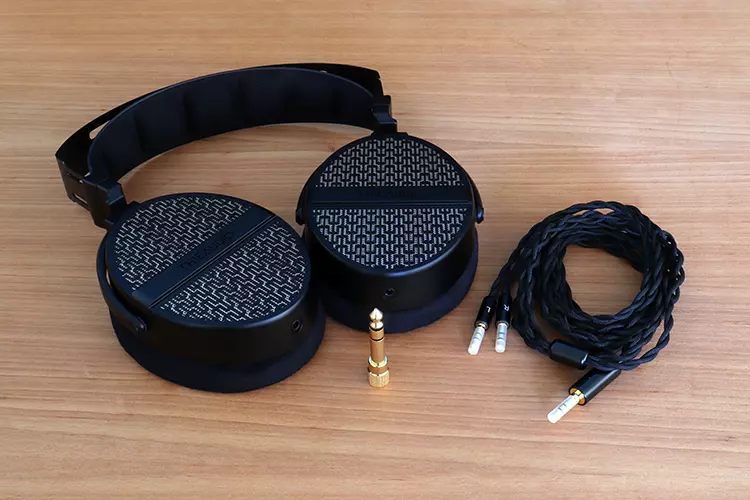
The THIEAUDIO Cypher comes with a stock cable that might not need upgrading for most when you get a set. It’s a six-footer equipped with some generic 3.5mm plugs, which are metal, black, and gold-plated tips. The only con is that you only get 3.5mm connectivity.
The tip that connects to the amplification is larger than the two that connect to the cups, and all the tips are color-matched. The tips that insert into the cups sit flush, while the input tip has a raised bump to accommodate mobile devices with protective cases.
I do like the fact that the cable is cloth-wrapped top to bottom. It adds a sense of durability, although most cables fail at the tips. This cable assembly looks. However, there’s no chinstrap adjuster at the metal Y split, but that doesn’t break the deal in any way.
Packaging & Accessories
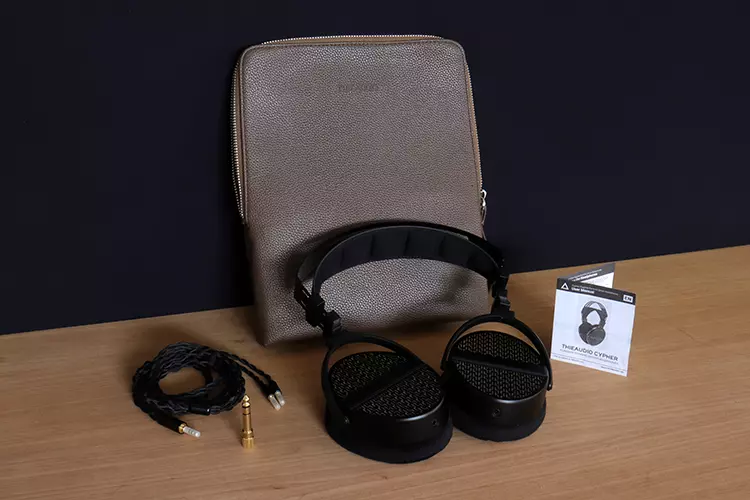
When I received the box they came in, I thought for a second that I had been shipped the wrong product because I received a rather flat box. What full-sized headphone comes in a flat box?
Well, it turns out that they shipped the Cypher headphones lying flat within a carrying case that is also flat. The case carries a resemblance to a leather portfolio more than anything. I really like it.
Besides that, you get the stock cable with a 3.5mm to 6.35mm adapter and a small, paper manual. It all comes in a well-laminated box, a quite nice box.
Sound Impressions
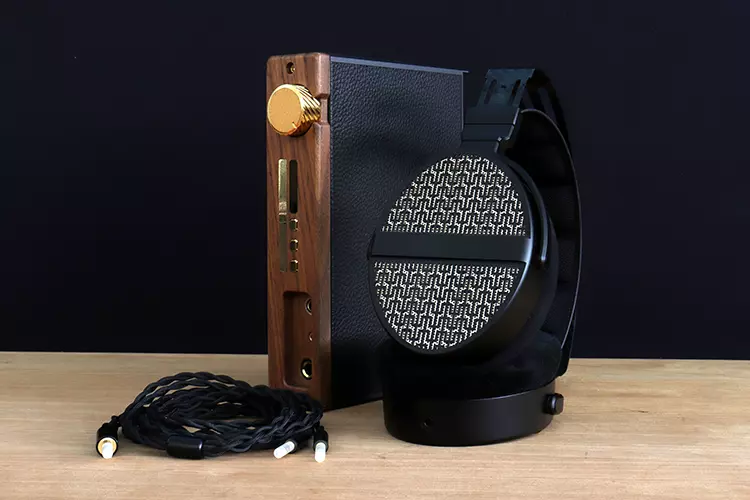
My desktop arsenal is composed of the SMSL SU-X and SH-X combo plus a Rose Technics RT-5000, so that’s what I used. I also used an xDuoo TA26 momentarily as a main amplifier and as a preamplifier.
I also used the Meze Audio dongle that came with their 99 Classics V2 to test their efficiency. I also used a recently acquired Kaei Tap 1 with the proprietary power supply upgrade, the Questyle Sigma and Sigma Pro, plus a Shanling UA7.
Summary
The THIEAUDIO Cypher sounds more like an electrostatic than a dynamic to my ears because of its speed.
To be honest, they sound to me like a Stax SR-X1 with an SRM-D10 portable combo I heard a month ago, minus the highs, which were improved on the Stax set, and not to my surprise, but the low end is opposite.
The Cypher caters to the top-end enthusiasts, with crisp, realistic, clean high frequencies. Then they produce a full-bodied midrange response that, together with the upper frequencies, produces lots of accurate tones, and they also cater to those who want a ton of nuanced details in those regions.
I ran a tone sweep on these, and below 200Hz, the output drops considerably fast and in a constant, even downward slope, and below 20Hz, and at that frequency, there is no bass presence. I also ran into a peak at around and above the 2kHz mark that was quite prominent.
They’re a detail-oriented set overall that sounds good with most genres of music but cater most to realism and clarity over coloration and fun factor. They prefer acoustic music over anything else. They also produce a balanced amount of sterility with a touch of liveliness.
Bass
The bass response is quick and responsive, but it lacks the punch of similar dynamic driver headphones and caters mostly to acoustic genres rather than to the thundering, thumping some prefer from dynamic drivers.
If you were to add a couple of decibels to frequencies below 80Hz, then they would become more in line with the kind of bass that I like, which, to me, needs more potency below 50Hz.
The bass is refined and uncolored, but does not supply a full-bodied experience and is more auditory than anything.
You can cleanly distinguish notes in the lower region on account of that; since coloration is kept out of the mix, it also serves up plenty of definition.
I would call this type of bass tactical and not physically tactile. It’s a controlled bass response that’s free of boominess that gives the Cypher a tonality contrary to a heavy, fun bass headphone, and one that prefers to serve up a natural and lean tonal signature.
Midrange
There is a lot of pleasant forwardness coming from the midrange section of the THIEAUDIO Cypher, and to me, it is one of the strong points of this headphone.
A high amount of micro-detail is produced by this headphone around the midrange and high frequencies over the average model in this price tier.
Let’s get the bad out of the way first, or shall I say the worst aspect of the sonic signature, and that’s a prominent peak at around 2k and a bit above that, which at loud volume levels can become ardent and prominent. May I suggest a drop in frequency output of 3 decibels between 2 and 4 kHz?
At a moderate volume level, the elevated area gives the area a forward presence and enhances the auditive clarity of the midrange. It can also be contributing to the massive amount of boldness in the midsection. But the overall tonality is mostly spot on.
Vocals are one of the Cypher’s strong points since they’re produced with a realistic tone and a hint of ‘calid poignance’. The Cypher is down-to-earth as far as their vocal presentation, plus they tend to do as well with most instruments.
Treble
The high frequencies are produced with a higher level of quality than I was expecting, and I was surprised to hear lots of high frequency presence produced with a level of clarity that I consider delicate but detail-oriented.
I would consider the amount of shimmer to be somewhat midrange in producing those top notes, but notes are certainly produced with some weight on this set, and the produced highs are bold but not pesky.
What I find interesting is that the high frequencies are not what I call runaway highs in that stage-wise, they are not excessively expansive and tend to project high frequency notes within a certain focal point up front, but precise nonetheless within their given space.
Staging & Dynamics
Considering that the Cypher is not a bass head headphones, one can’t expect a ton of slam.
I would consider the Cypher to be best used with music that is acoustic in nature because the dynamics are not aggressive and mostly depend on recording quality to produce much body or color at all.
They tend to be gentle but not lacking in dynamic response. They also tend to produce a microcosm of elements within one’s head within the mid-bands, and it doesn’t take much to perceive and pinpoint locations of elements.
The overall size of the soundstage is not a very large one and tends to focus elements in a forward position, with sidelines that create microcosms of their own. Staging is interesting in this set, just not colossal in size.
Click on page 2 below for my recommended pairings and selected comparisons.
