

Synergy
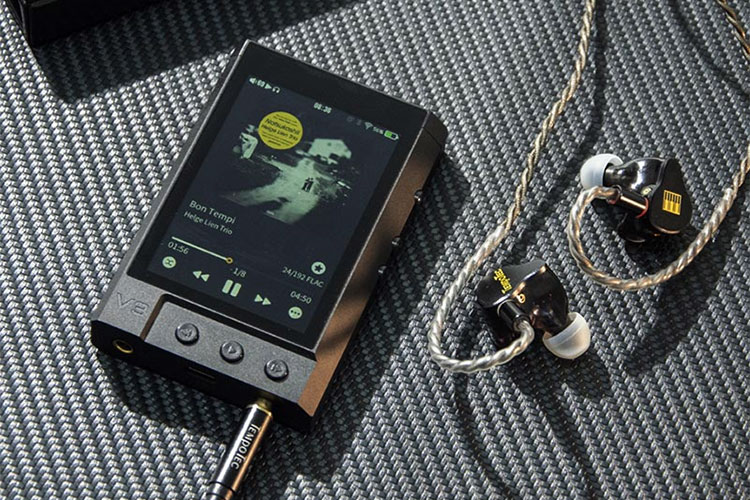
Using the V3 Blaze across many listening devices gave me a good interpretation of what works and what might be less than ideal.
I did find that using the V3 Blaze as a USB-DAC was especially satisfying. Paired with the SMSL PA-X and the KEFs, presented another good option for use of SD card music, or paired with my iPhone or MacBook Pro.
The benefit of using the AK DAC chips allowed for a slightly warmer, richer signature than without on those sources, which played well across the board.
The ability to pair through the HiByLink proved useful for streaming purposes of my music collection, as did the WiFi connectivity option and Tidal or Qobuz.
All options functioned without issue, making the V3 Blaze one of the easiest to use devices of late.
Efficiency
While I did not try any monstrously hard to drive headphones, the differences between what I used were enough to differentiate how efficient the V3 Blaze is. Only when pushed through AirPlay did I need to raise the volume more than the other source options.
This showed that while the native SD card option and HiByLink options functioned more smoothly, more effort was needed to provide the same experience with AirPlay.
Driving through the USB-DAC was easy to boot, presenting no issues with any listenable volume level.
Power
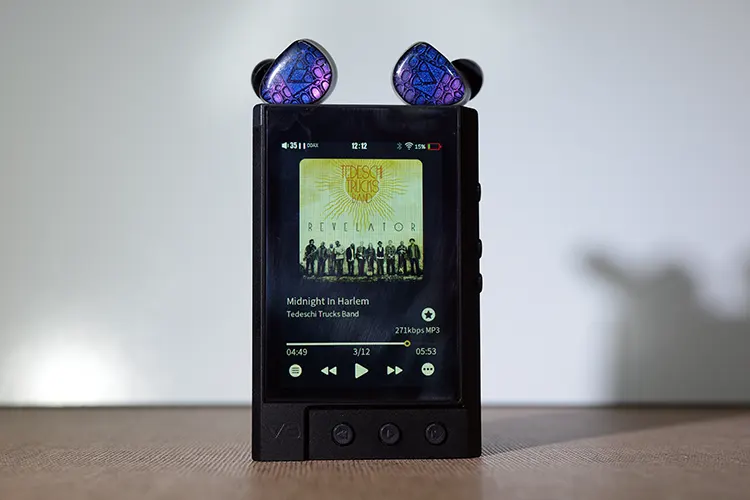
One of the main sticking points I mentioned with the OG V3 was a lack of power to drive your listening sources. There was no hiding that while you could reach high volumes, the necessary voltage to drive the IEM or headphone was lacking for me.
Thankfully, this has been corrected with the V3 Blaze version. I would say that the power ratings might be underestimated for some listening devices, too. I found that the volume necessary to achieve a good listening session varied more by source input than by listening tool.
I was quite happy with the resulting increase in power across the board with the V3 Blaze. This is another example of the company listening to those of us out here and correcting a potential shortcoming.
But there were obvious differences as mentioned below.
Pairings
The V3 Blaze worked especially well with the upcoming headphone in for review, giving excellent extension down low and a melodic, slightly darker signature (due to the headphone). I appreciated the pairing for that vibrant character, while it came across with a bit more “soul.”
The Noble Audio Knight was used through the 4.4mm jack exclusively and shone. This was my favorite pairing, and that vibrant character paired with the excellent details present through the Knight made for a near-ideal pairing.
I did have to raise the volume over the other two used here, but the result was a fully immersive quality that allowed me to isolate myself from the outside world.
The Campfire Audio x Drop Dark Star, on the other hand, proved to be too hot for the listener. The Dark Star pairs well with the FiiO JM21 or HiBy R4, but not as much here.
The upper-end presented too much dizziness to me, but I do not fault the V3. Instead, this was just one pairing that did not work for me.
When using BT5.1 through the Noble FoKus Apollo, the sound was deep and rich, promoting the large driver aspects in the lower regions. Raising the volume, the midrange, especially vocals, was full and rich with very good definition.
The top end extended slightly, but without the dizziness experienced in the IEMs mentioned above. The V3 Blaze can function with BT headphones quite well and has become one of my favored pairings as a result.
Select Comparisons
TempoTec V3
Features
The TempoTec V3 uses HiByOS as its operating system, just like the V3 Blaze, while also sharing much of the sound hardware as the flagship V6. Using dual DAC AK4493SEQ, the V3 achieved an SNR of 124dB and a THD+N distortion of 0.0005%. Identical to the V3 Blaze.
With a power rating of 610mW for 4.4mm balanced, 330mW via 3.5mm SE from the headphone output, it cannot match the V3 Blaze’s numbers (1659mW, 4.4mm balanced & 490mW@32Ω, 3.5mm SE). A standard 2Vrms SE and 4Vrms balanced for the line out.
Running a pyramid analog amplifying circuit for each channel, the order flows from the mono ESS chips to dual OPA1652 op-amps for each channel, sending the signal to either the 3.5mm SE or 4.4mm balanced in LO mode. Again, identical to the v3 Blaze.
Post switch, the signal is fed through dual OPA1688 Op-amps per channel in PO mode for both 3.5mm SE and 4.4mm balanced, as opposed to the two SGM8262 for each channel on the V3 Blaze.
Professional FPGA digital technology, matched with a custom-made dual-crystal oscillator system, keeps the quality high, while decoding levels are also identical.
Two-way Qualcomm 5.1 BT support, along with 2.4GHz WiFi, HiByLink, AirPlay, and DLNA Audio sources. MicroSD local, LDAC, AAC, aptX, and USB DAC round out the listening options.
Design
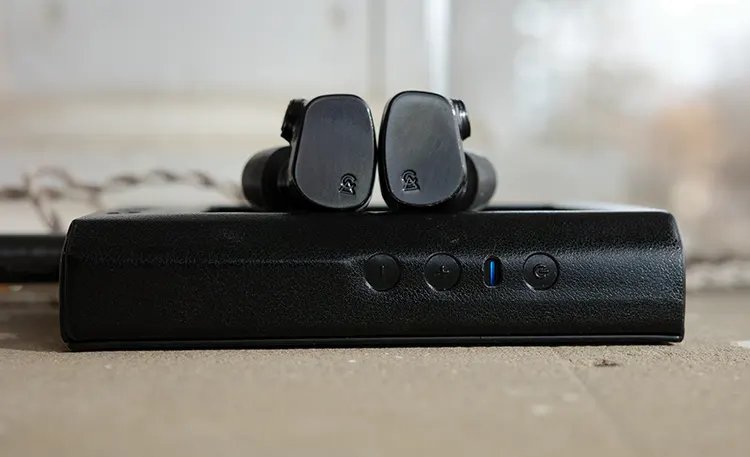
The V3 is on the smaller side of DAPs and identical to the V3 Blaze. With dimensions of 100 x 65 x 17mm, and a weight of approximately 200g (surprisingly 166g for the V3 Blaze without the case), the V3 fits right into one’s palm without too much burden.
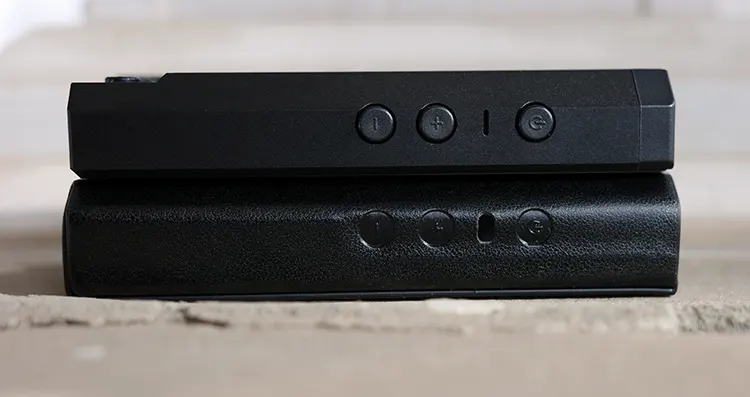
The rectangular shape has a “rounded” right side (front) for easy use with your right hand. With the case on, access to the buttons on the right and bottom was acceptable, but could have been more tactful.
To me, those side buttons were too close to the bend in the V3, rendering them less intuitive to touch and access. I have the same qualms for the V3 Blaze.
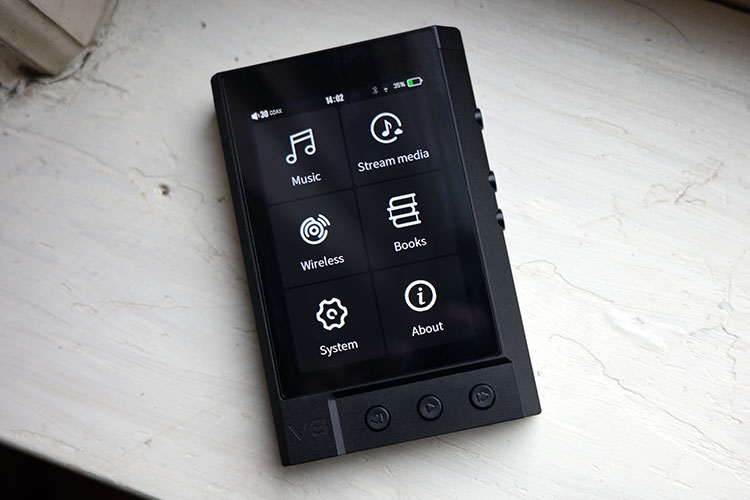
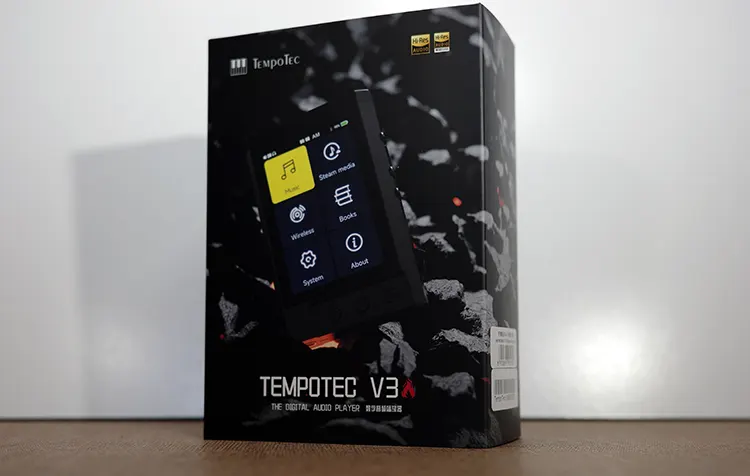
The 3.2” screen displays the system’s native apps, including music, books, streaming, wireless, and “about.” The screen brightness can be adjusted in black and white so that viewing is not an issue. Identical to the Blaze.
Both the front and back of each model come with screen protectors already installed, and you get an extra for each in the package. You only need to remove that last layer of protection, like you would on your smartphone. The protection is appreciated, but the front is still fingerprint-prone.
The case fits very snugly, and the only reason you would need it off is to change SD cards. While the case is very snug, I appreciated that the V3 will not slide out, such as on some other manufacturers’ case options. The same issues hold for the V3 Blaze, unfortunately.
The use of the play, FF, and REW buttons on the bottom was not good with the case on, requiring a very hard push to make any changes. Since those three buttons are on a slightly recessed panel without the case, thicker button points would have alleviated this.
Performance
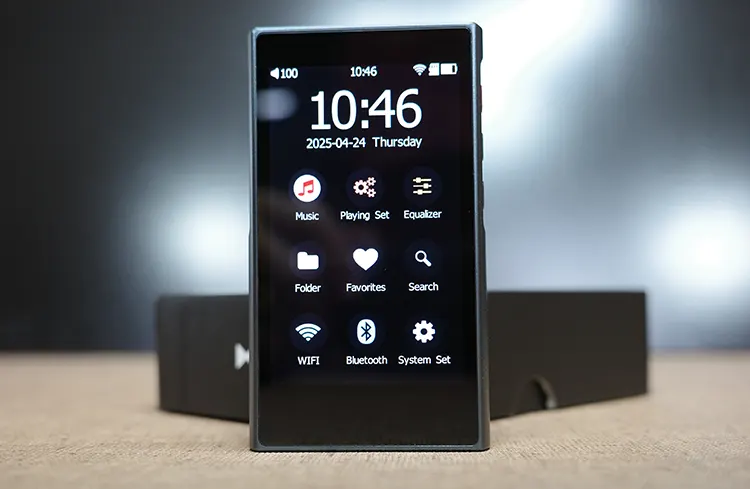
When I reviewed the TempoTec V6, I found it to offer very good levels of detail and clarity, without much coloration.
The same can be said of the V3, with very good extension up top. The low end carries on with aplomb and fairly good control. Reaching fairly deep as well, the V3 provided an overall level of detail that should be appreciated by most listeners.
Where the V3 differs from the Blaze lies within the vibrant tonality coming forth under control with the newer model. I also found detail retrieval to be a bit better on the new unit.
I appreciated the sound signature with its ability to portray a natural, realistic signature that portrayed the intent without coloration or any false sense of sound heard throughout the testing.
There is no denying that the increase of power in the V3 Blaze is a positive over the V3. That increase in power corrects some of the issues had by not providing enough girth to the note weight, making for a more fulfilling signature.
xDuoo X5
Features
The xDuoo X5 features dual Cirrus Logic CS43131 DAC chips (as opposed to the AK on the V3 Blaze), supporting up to 32-bit/384 kHz PCM and DSD256 audio formats, including both wired and wireless connectivity options. Conversely, the V3 Blaze can decode up to DSD512 and PCM 32-bit/768kHz.
With a 3.5-inch touchscreen, 10-band equalizer, and two-way 4.2 Bluetooth support, it’s designed to be flexible enough for different listening styles, while still being utilized as a source. This falls behind the Blaze’s BT5.1, and I found connectivity was easier across the V3 Blaze.
This dual-DAC setup means potentially better dynamics with a cleaner sound, something that may matter if you’re after more detail and depth in your music. Ditto for the V3 Blaze.
For use with wired headphones or IEMs, you can choose between a standard 3.5mm jack or a 4.4mm balanced output, or Bluetooth 4.2 with LDAC support, for use with your Bluetooth headphones or speakers. Both can operate as a USB-DAC, which is a positive for both in my opinion.
It also works in reverse (two-way BT)—so you can stream music from your phone to the X5, using it as a Bluetooth receiver, just like the V3 Blaze.
Plug it in via the USB on the bottom of both, and they act as a DAC for use with your listening purposes. If you plug the X5 into your car’s USB port, it will automatically turn on and off with the ignition, saving you from manually starting it every time. Yet another nice change from streaming. I am unsure if the V3 Blaze does that.
The xDuoo X5 supports microSD cards up to 1 TB, the same as the Blaze. There’s also a voice-activated song search when connected to WiFi, allowing you to search for a specific song. The V3 Blaze does not carry that feature.
With an output power that reaches 270 mW, the X5 is capable of driving various types of headphones, but it falls far behind the V3 Blaze.
Design
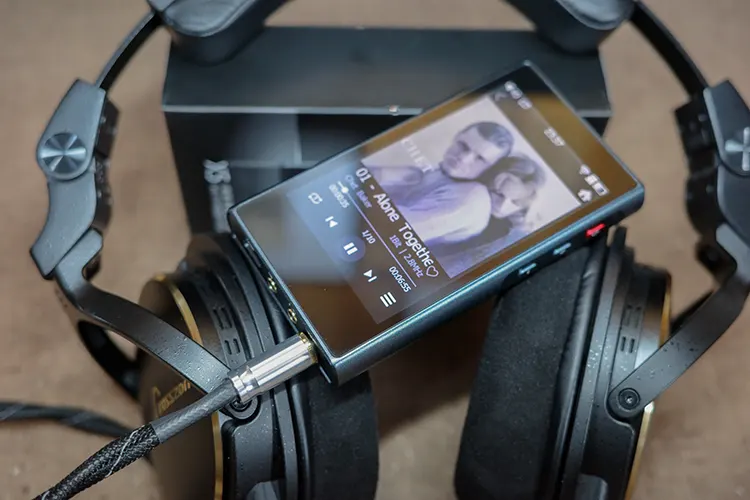
The 3.5-inch IPS high-definition screen with a resolution of 480×800 pixels is surrounded by the device measuring 10.5cm x 6.0cm x 1.6cm with a weight of a scant 0.15kg. Almost identical to the V3 Blaze, the shape carries better on the X5 ergonomically.
The bottom has a USB-C plug, an output 3.5mm jack for use as a transport to other devices, and the 3.5mm single-ended and 4.4mm balanced jacks are left to right. Again, similar to the V3 Blaze.
The “Gold-plated” headphone jacks functioned with sufficient force, but to me, they were both a little tight for my liking. Much tighter and prone to potential problems than the V3 Blaze, to me.
The right side carries the red on/off button, which also functions to wake the device, and the volume up and volume down buttons.
That’s it. There is no double tap to wake the device like you would find on a typical Android-driven device, so the red button will see quite a bit of use. The V3 Blaze does carry more functionality with well-spaced and tactile buttons.
An odd design on the back carries a rectangular “glass” plate inlay on the top ⅓ over, well, nothing. There is no logo or design; it is simply an inlay over the blue-gray color of the X5. There are already a micro-scratch or two on that area.
The shape, while similar in size, comes across as vastly different between the two, with the V3 Blaze carrying a bit more “modern” look.
Performance
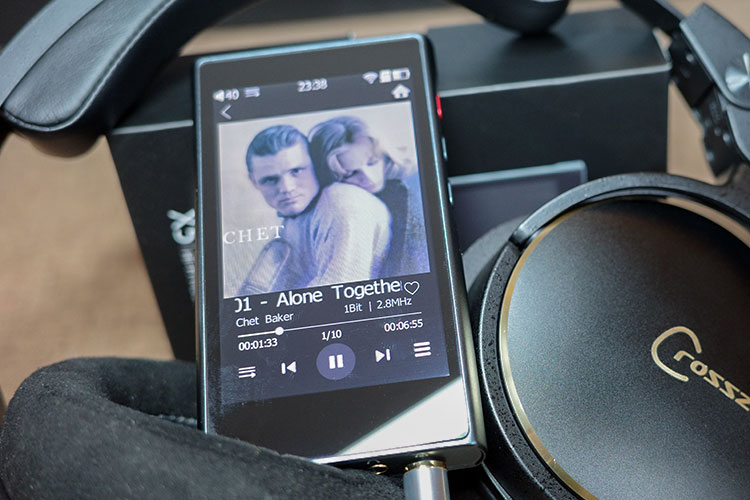
Harkening back to the xDuoo X10T, I remembered how impressed I was with the sound. A marked difference from streaming services at the time, the X10T was my go-to listening source for close to six months while reviewing or for comparisons.
The X5’s familial resemblance is heard with excellent detail retrieval and transient response right up there with many more “diverse” offerings. The sound between the two is quite similar, with less presence in the midrange on the V3 Blaze.
A punctuating midrange carries excellent volume to the note weight without becoming brittle or overbearing. The bass response is taut, but not thunderous, carrying forward the music of the recording with minimal impact upon clarity. The more intimate sound of the V3 Blaze falls slightly behind here.
The extension up top is one where, for once, I appreciate the extended reach, which did not bother my high-end intolerance. The level of detail retrieval heard from the upper end provides excellent detail while allowing individual offerings to shine.
This tops the V3 Blaze, which carries a bit more spikiness to the treble notes, and a bit less cohesion, even with the intimate nature of the signature.
One might think this disconnected nature would hinder the overall signature. Rather, the combination presents an airiness and weight to the sound signature that comes across as vibrant without becoming thin or invasive.
The V3 Blaze presents a more coherent overall signature, but that is born in the intimacy, which sacrifices overall clarity and level of detail for a musical signature. The X5 presents better definition to the notes, but with a less emotive effect. Take that as you will between the two.
My Verdict
The TempoTec V3 Blaze fits neatly into its price range, with very good sound qualities and source options for most users. I found the versatility in use was better than its predecessor, the V3. That is, even though they both share mostly the same options.
To me, this comes down to the additional power from within. That alone covered most of the shortcomings. But it is more than that.
The V3 Blaze sounds good in all aspects tested, which is a testament to the engineers listening to the public’s grumblings regarding the other. In that alone, they should be applauded, allowing for the V3 Blaze to synergistically fit into many situations that one might not think work.
While not having a touchscreen outside of the functionality (i.e., surfing and app ability), the V3 Blaze works orderly, albeit in a somewhat archaic manner. No bells and whistles allow the user to delve into the music and listening options without bother.
That said, the case is still a problem for me. While protection is still very, very good, functionality is not. When push comes to shove, the case is left off, to the potential detriment of impending damage, such as a drop. A minor consideration when the opposite is better tactility across the board.
So the V3 Blaze has indeed stepped up in the power section. It also worked across a multitude of hook-up options, ranging from a desktop amplifier to powered speakers if necessary, adding to its versatility.
The V3 Blaze has a good sound signature, versatility, and power for pretty much anything, except the hardest-to-drive headphones. Taking in the criticisms of the V3 and correcting those issues should be applauded, and it paid off.
TempoTec V3 Blaze Technical Specifications
- TempoTec V3 Blaze – Portable DAP, HIFI Music Player, Digital Audio Player, MP3 Player.
- Output power: 825mW+825mW/4.4mm@32Ω
- High-performance digital circuit
- Pyramid analog circuit
- Stream media App: TIDAL, Qobuz
- DAC chip: 2*AK4493SEQ
- Wireless: Two-way Bluetooth 5.1, 2.4GHz WiFi, HIBYLINK, AirPlay, DLNA
- Audio sources: Micro SD Audio, LDAC&AAC APTX, USB DAC
- Supported formats: DSD512, MQA 8X, DXD, PCM 32bit/768kHz
- Battery capacity: 3500mAh
- Size: 10cm x 6.5cm x 1.7cm
- Weight: 166.5g
