

Select Comparisons
xDuoo TA-32
Features
The xDuoo TA-32 is a fully operational tube amplifier and pre-amplifier that is capable of true 1-bit DSD while using the made-for-home-audio ROHM BD34301 interchangeable chip set. It can be used in a two-channel system like the PA-X, too.
The TA-32 came with the stock ROHM DAC card installed. Having the ability to change cards as well, combined with tube rolling, makes the TA-32 worthy of much personalization.
Bluetooth 5.1 paired with a Qualcomm QCC5125 receiver chip, the TA-32 supports SBC, AAC, aptX, aptX LL, aptX HD (24-bit/48kHz), and LDAC (up to 24-bit/96kHz), whereas the PA-X does not support BT.
With the use of balanced XLR-out, you can easily run the TA-32 with powered speakers or use the tube-out option in a two-channel system. Used mainly as a headphone amplifier, though, the versatility shines. The PA-X can only support unpowered speakers as is.
Combined with all of this, the TA-32 is also capable of up to 3000mW (at 32Ω) for use with headphones from 16-600Ω, while the PA-X provides up to 250Wrms for 8Ω speakers only.
This difference should not persuade you to make a judgment, though. The xDuoo can hold its own when driving powered speakers.
Design
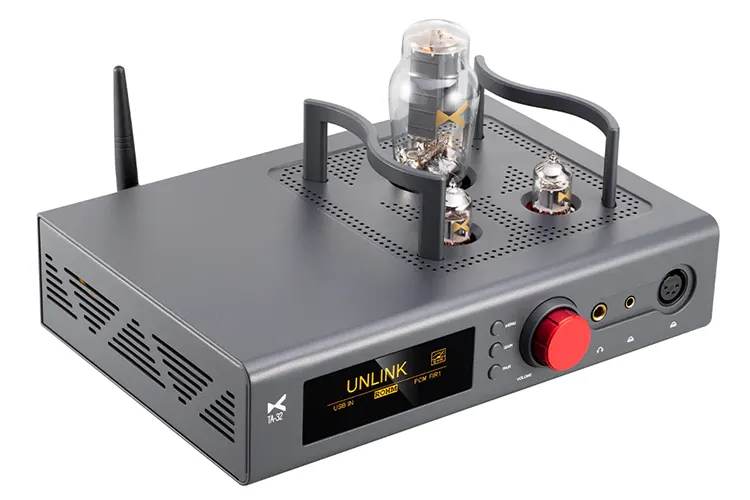
There is a certain industrial look to most xDuoo products, and the TA-32 is no different, with a semi-gloss dark gray color that reminds me of The Peaky Blinders’ gray Birmingham landscape.
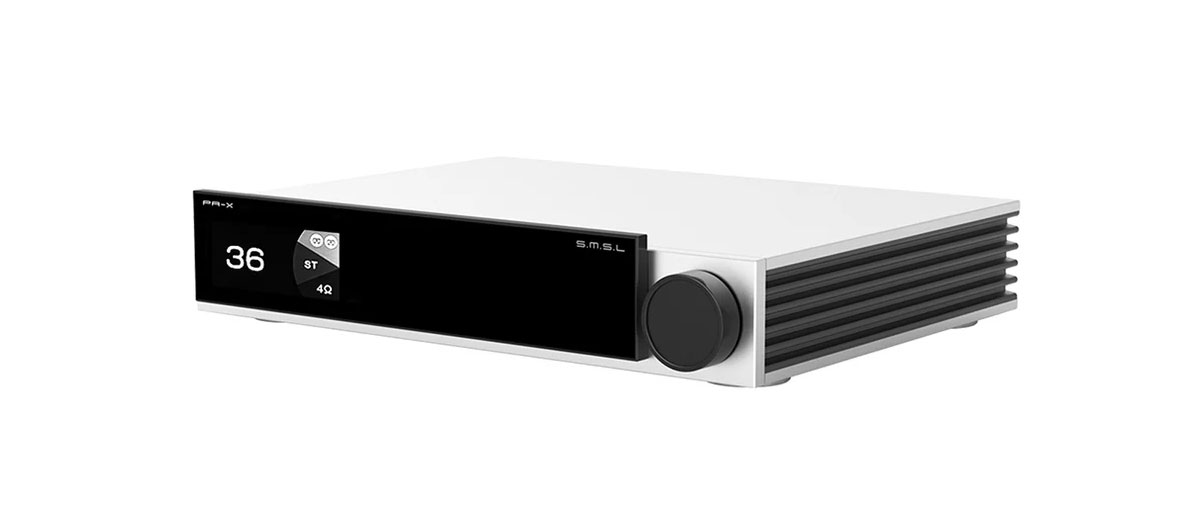
I like both. The PA-X has a forward-thinking current design with the all-black frontal plate either on all the time or set to turn off after a length.
Coming in at slightly over 11 lbs., the TA-32 is stout, carrying a staunchness to it that exudes business. The curvaceous railings carry over from the TA-30 but, alas, are not removable.
No bother, though, as this works to highlight the three tubes doing the business. While the SMSL also has good heft, it is not nearly as heavy or large-looking, fitting subtly into your system. There is very little that is subtle about the TA-32.
The tube area, which lies to the right side on top, has multiple vent holes meant to dissipate heat. It works. There is even enough space to the left of that for a set of headphones to lie without coming close to the tubes.
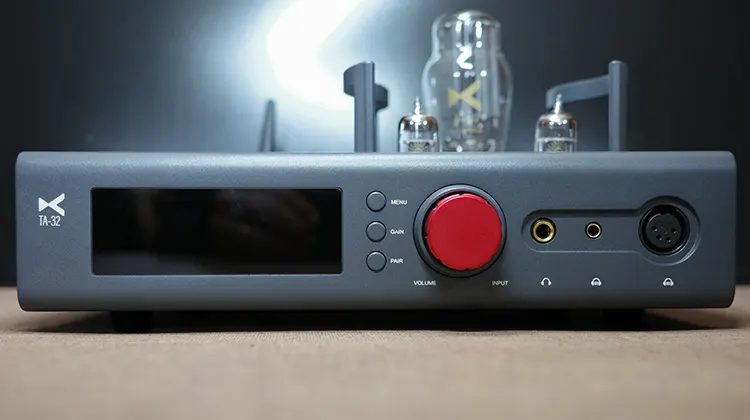
The 3.12” OLED screen has a lighter olive-green color to its lettering, which is easily discernible from a distance.
Access to the sub-menus is via three vertical buttons to the right, with a large red multi-function volume knob to the right of that. The three headphone jacks lie to the right of the knob, without bother.
The PA-X has a similar straightforward approach to the screen, but with a modern look. Minimalism is greatly appreciated. No remote is included, but once acclimated, the functionality is easy to remember. The PA-X comes with an efficiently operating remote.
Performance
As the top xDuoo model, you expect two things: great power to handle all it can and sound to back that up.
The TA-32 handles both with aplomb. The 3000mW on both 4.4 balanced and XLR shows it can handle the most demanding headphones out there, and the ability to play nicely with easier-to-drive units as well.
The PA-X has that same brutish performance ability, with only the faint of heart reaching its limits of power.
The stock tubes promote a tube-like sound that also has very good detail retrieval in the sound characteristics. The PA-X, on the other hand, delivers a more neutral presence, with decent reach down low.
Detail levels are better on the PA-X as expected, but even with the tube effect, the TA-32 sounds quite good.
Tight, controlled bass can be heard through the music when the source plays a more analytical sound, while an additional, melodic midrange has excellent clarity to it, and the lusciousness of tubes when called upon. Bass does not reach as low on the PA-X but keeps tight control with speedy attack and decay.
Both top ends offer good extension in the highs, but there is a bit more crispness in the details to the PA-X.
SMSL RAW HA-1
Features
Using the German company Infineon for the choice of digital amplification gives the RAW-HA1 a solid base on which to stand. The PA-X has a newer GaN FET iteration, and performs to a higher degree, as expected..
The JRC NJW1194 volume attenuation keeps things accurate when raising or lowering the volume. Gone are the small channel imbalances that were on analog volume pots.
The TI PGA2311 volume chip helps to accurately raise and lower the volume on the PA-X.
Using the same basic DAC chip as some current DAPs, the Cirrus Logic CS43131 DAC chip rounds out the decoding needs, with good results.
Qualcomm’s Bluetooth 5.1 supports LDAC, aptX HD, SBC, and AAC. A leg up on its bigger sibling, but the PA-X does not suffer as a result.
Design
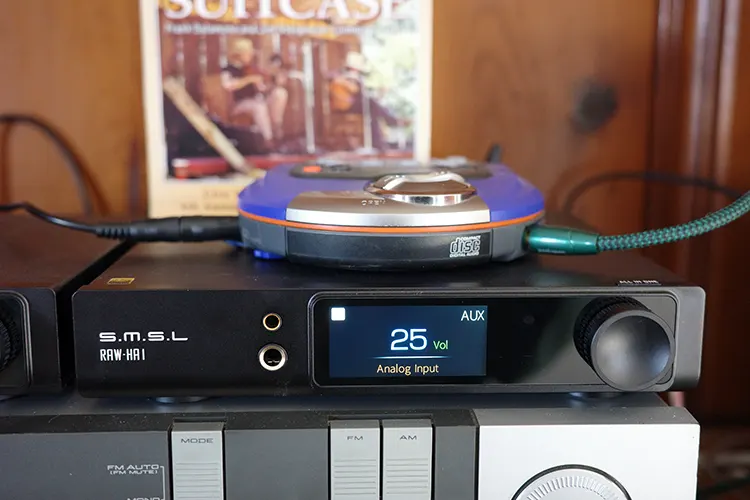
The familiar black rectangular shape was unmistakably SMSL at the time, with minimal “interference” on the front, except for the screen and volume knob, which acts as a function knob, too. The PA-X does look more upscale with its silver frame and black plexiglass on the front.
Sized to fit neatly on your desktop at 8.62 x 1.77 x 7.48 inches (219 x 45 x 190 mm), the 3.42lb unit can be easily shifted around, which is much lighter and smaller than the PA-X.
With a new design, the UI flows easily between the two screen aspects. The curved section allows for a bit of flair between the two sections.
The LCD screen is easy to see, even from a distance, but I do wish that the right side, which includes the source option and HPA/Speakers, was a bit larger. Of course, once you choose the source and listening option, this is less important.
The headphone jacks are readily accessible for large jacks as opposed to previous SMSL models that were inset. The semi-gloss black also hides fingerprints, even on the volume knob, which is again appreciated. The PA-X does not carry fingerprints.
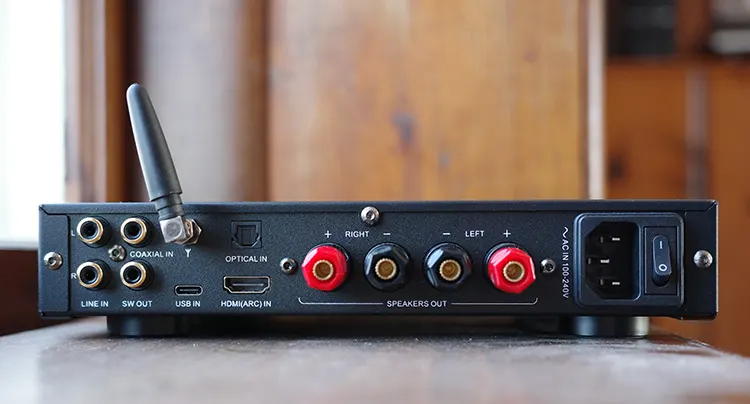
Performance
Sometimes, gauging the sonic ability of an item is not as easy as listening to the item. The RAW-HA1 would be one of those times.
With the ability to be used as a pure headphone amplifier or for speakers, the impressions broaden a bit to take each aspect into account.
Especially when you can add both treble and bass (+9dB each) to the mix. There is no getting around the fact that the HA-1 is a much better headphone amplifier than a two-channel.
Running the RAW-HA1 in base settings gives a good approach to the sound for headphones. I found the soundstage height allowed the layers to spread up while staying connected to the whole, giving a good representation of note weight, which was just about right.
But when switched to a direct comparison, there isn’t one. The PA-X smashes the HA-1. Used exclusively as a headphone amplifier, it will work. But only in cases of need would it be used for a two-channel system. The PA-X is the much better alternative.
My Verdict
The SMSL PA-X Gallium Nitride desktop power amplifier has an admirable level of performance and excellent levels of power. Throw in a good DAC, and you have the makings of a quality small office or listening room set up.
As for missed opportunities? I would have liked the front plexiglass to incorporate more information across the screen. As is, that large black unused area separates the left and right sides too much. Provide a visual EQ, or something to help tie the sides together.
But, when taken as it should be, the PA-X is competitive in a multitude of situations and with many sources. That might be its best trait: the ability to provide an amplifier with gobs of usable power, and while limited, incorporate what inputs it has with a quality DAC of your choice.
To me, this is the best aspect of the PA-X, and it will continue to see much use within my systems across time.
SMSL PA-X Technical Specifications
- Inputs: Balanced (XLR) / Line in (RCA) / Mono (XLR)
- THD+N: 0.003%
- SNR: 115dB
- Channel separation: 75dB
- Input sensitivity:
- RCA: 0.96Vrms / 22kΩ
- XLR: 2.1Vrms / 22kΩ
- Mono XLR: 2.7Vrms / 22kΩ
- Output power:
- Stereo 4Ω: 250Wrms x2
- Stereo 8Ω: 200Wrms x2
- Mono 8Ω: 500Wrms x1
- Standby power: 0.5W
- Power consumption: 40W (at normal volume)
- Dimensions: 8.8in x 2in x 9.8in (222.5mm x 51mm x 250mm)
- Weight: 5.67 lbs. (2.57kg)
- Gallium Nitride power transistor (Infineon)
- Up to 1MHz switching frequency
- 115dB SNR
- Ultra-low THD+N of 0.003%
- Stereo and mono modes
- RCA, balanced XLR, and mono XLR inputs
- Custom high-power switching supply for audio
- Gold-plated input and output terminals
- Overcurrent and overheating protection circuits
- 250W x2 @ 4Ω / 200W x2 @ 8Ω (stereo)
- 500W x1 @ 8Ω (mono)
- Remote control included
