

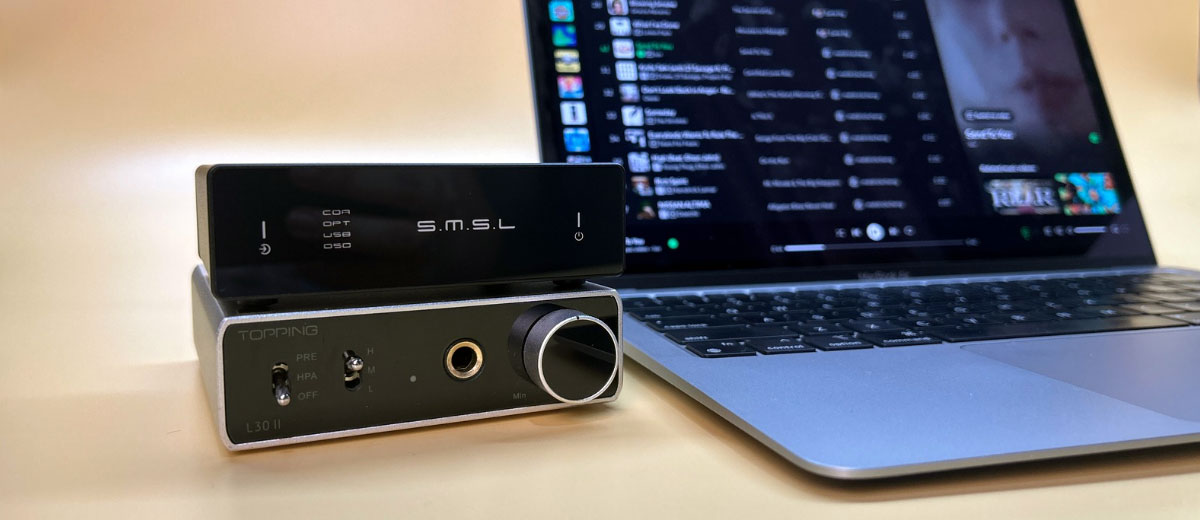
Meldrick reviews the SMSL D1, a compact and affordable desktop DAC with touch controls and capable of up to 32-bit/768kHz and DSD512 decoding. It is currently priced at $79.99.
Disclaimer: I received this sample in exchange for my honest opinion. Headfonics is an independent website with no affiliate links or partnerships. Thank you to Shenzhen Audio and SMSL for their support.
Click here to learn more about the SMSL products we have previously reviewed on Headfonics.
This article follows our current scoring guidelines, which you can find in more detail here.
As a staple of the Chi-Fi industry, SMSL needs no introduction. By consistently coming out with high-performance desktop products with equally high value, such as the DA-1 and D-6S, they’ve become a steady choice for many audiophiles.
Now, they re-enter the ring with a compact sub-$100 DAC with an ace up its sleeve. Their latest D1 DAC houses a ROHM BD34352EKV DAC chip instead of the more common ESS or AKM Chips.
With no display, no remote, and no Bluetooth, does the D1 DAC have what it takes to go up against price-competitive DACs such as the SU-1 and FiiO’s K11? Read my full review below to find out.
Features
Taking just one look at the D1’s spec sheet shows its claim to fame: the ROHM BD34352EKV.
This chip is what enables the D1 to deliver an industry-leading 126 dB Signal-to-Noise ratio while maintaining the same codec and bit rate flexibility of other AKM and ESS DACs.
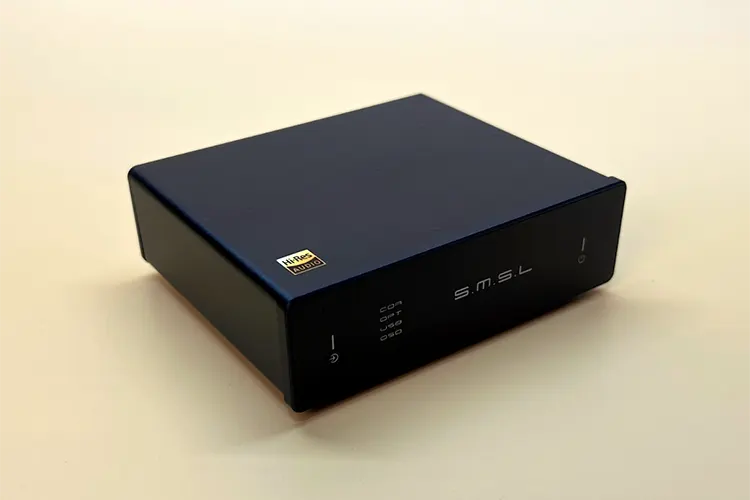
The D1 ties this all together in a package that’s just 101×90.1x30mm. The D1’s extremely compact chassis fits in the palm of my hand, making it a seamless fit in 2-Channel Hi-Fi setups, desktop IEM setups, and everything in between.
With its XMOS XU-316, the D1 supports driver-free compatibility with Windows, macOS, and Linux-based computers, improving its versatility in a wide range of listening setups.
However, installing the SMSL driver is required to unlock up to 768 and DSD512 decoding.
Design
What first stood out to me was the D1’s remarkably compact footprint. Although designed as a desktop or home Hi-Fi DAC, its size could easily be mistaken for that of a portable unit.
Four rubber feet can be found on the underside of the CNC-machined aluminum body. The D1 has an anodized black finish, giving it an understated appearance that blends seamlessly into any desktop headphone station or home Hi-Fi stack without drawing attention.
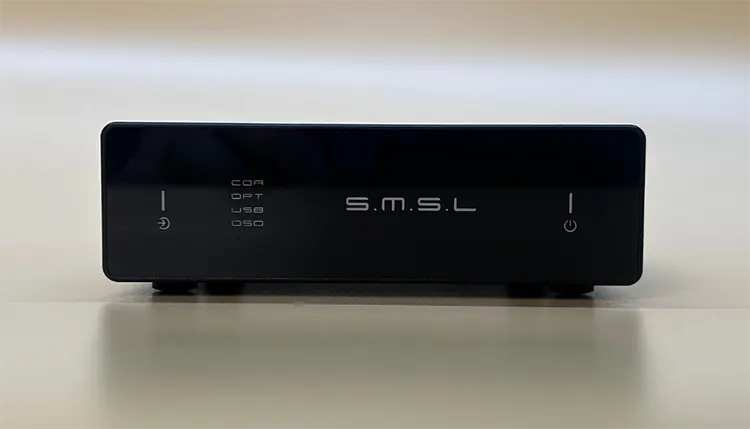
The front panel features a glossy, mirror-like acrylic surface with the SMSL logo centered prominently.
To the right sits a soft-touch power button, while to the left is a vertical column of LEDs indicating the active input. A matching soft-touch button beside the LEDs allows quick cycling through sources.
While I prefer the anodized metal front plates found on other DACs such as the SU-1, I understand that the glass-like finish of the D1 was likely necessary to accommodate its soft-touch buttons.
That said, the combination of a glossy surface and touch controls means the panel easily collects visible fingerprints, which can detract from its otherwise clean and simple aesthetic.
Despite its feather-light weight, the D1 remains stable in use thanks to its well-placed rubber feet, which provide enough grip to keep it securely in place even when heavier RCA cables are connected.

I/O
While the D1 carries a minimalist, utilitarian design, it still offers a respectable range of input and output options. On the rear panel, you’ll find two USB-C ports—one labeled “Power” for a dedicated 5V supply, and another labeled “USB” for data.
Aside from this, it also comes with a Toslink optical input and a coaxial digital input. In testing, I found that when using the USB input mode, the D1 can draw enough power directly from the data USB connection, eliminating the need for a separate connection to the “Power” port in many setups.
This is a surprisingly versatile selection for a DAC in the sub-$100 category, making the D1 a capable hub for systems with multiple digital sources such as streamers, computers, and CD players.
The separation of USB power and data inputs also allows the unit to be paired with a clean 5V supply when desired, helping minimize potential noise and improving compatibility with non-USB sources
The USB input supports Windows 7/8/8.1/10/11 after automatic driver installation, and works driver-free with macOS 10.6+, Linux, Android, and iOS devices.
Once the dedicated drivers are installed, the D1 can handle PCM streams up to 32-bit/768 kHz and native DSD512 playback. Without the driver, it retains plug-and-play compatibility, albeit with support limited to lower bit and sample rates.

Controls
The D1’s user experience is refreshingly simple. The front panel houses just two soft-touch capacitive controls: a short tap on the left button cycles through inputs, while a short tap on the right button toggles power on and off.
That’s the entirety of its operation; no menus or volume controls to navigate. Active inputs are indicated by white LEDs for coaxial, optical, and USB sources, while a green LED beneath them lights during DSD playback.
This same green light also flashes briefly when cycling through inputs. There are no hidden long-press functions; all navigation relies solely on quick taps.
This stripped-down approach keeps the operation intuitive and distraction-free, allowing you to focus purely on listening.
However, I prefer the tactile reassurance of physical buttons. With capacitive controls offering no feedback, there were moments when I wasn’t certain my tap had registered.
Another omission I noticed was the lack of a remote control. Including one would have expanded the D1’s versatility, making it more practical in setups beyond a desk, such as integrating into a TV system or a basic two-channel home theater.
Packaging & Accessories
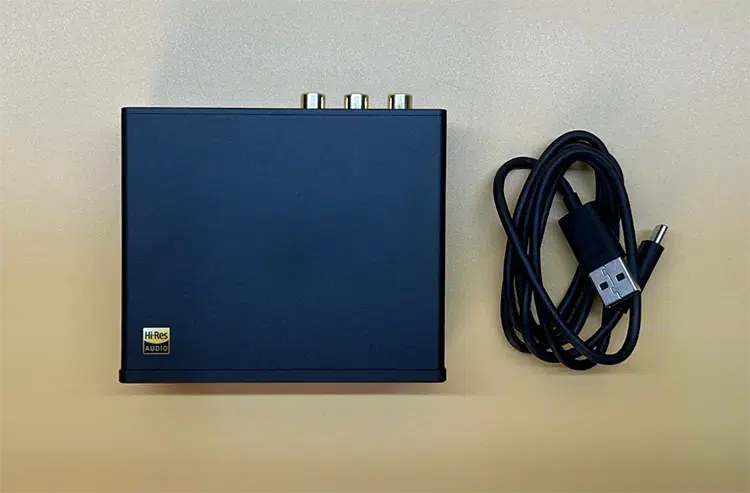
The SMSL D‑1 arrives in a compact box with protective foam inserts. Inside, you get the D‑1 unit, a short USB-C cable, and a basic user manual. No RCA cables, and no power adapter.
Packaging is minimal but sufficient, nothing is rattling inside, and the unit is well‑wrapped in plastic.
I would have appreciated the inclusion of a USB power brick to give the unit out-of-the-box compatibility with non-USB sources like CD players, but it would be safe to assume that most users have an extra 5V USB power brick lying around.
While not flashy, the packaging is functional, and the unboxing experience reinforces the DAC’s straightforward nature.
Sound Impressions
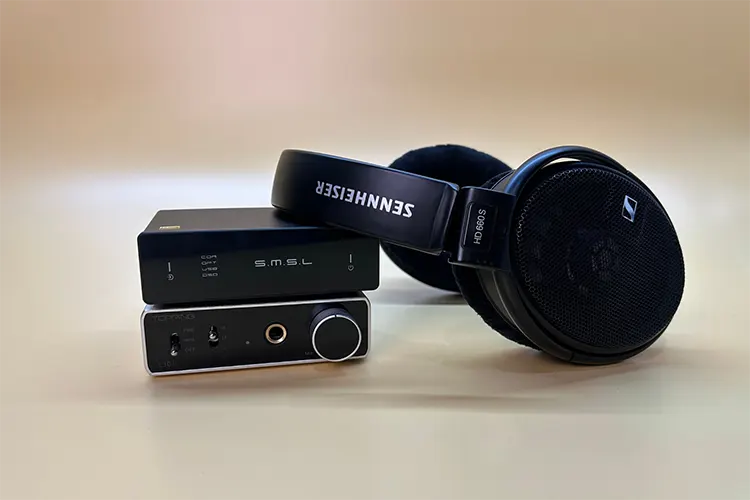
The following sound impressions of the SMSL D1 were completed using the Topping L30 II amplifier, the Sennheiser HD 600, the MOONDROP Blessing 3, and Yanyin’s Canon II for my selected headgear.
Summary
The SMSL D1 leans toward a fuller, warmer, and more atmospheric presentation.
Low-end notes carry satisfying reverb and body, with mid-bass instruments delivering a textured, weighty presence. While sub-bass is articulate, it lacks the absolute depth and slam of some competitors.
The midrange continues this sense of richness, lending string instruments an organic decay and lower-register vocals a natural warmth.
Higher-pitched female vocals, chimes, and upper harmonics, however, are slightly less airy and resolving, with treble that can ride the edge of sibilance on certain recordings.
The top end emphasizes energy over micro-detail, giving cymbals and high notes boldness rather than delicacy.
Spatially, the D1 impresses with a wide soundstage that projects an enveloping 360-degree fee. Imaging remains clear in dense mixes, though not pinpoint precise.
Dynamics, particularly in the mid-bass and lower mids, are a highlight, with lifelike note weight and satisfying decay.
Timbre
The D1 delivers a fuller and more atmospheric presentation compared to neutral DACs. Low-end notes carry stronger reverb, most evident in bass guitar strums in Pop-Rock tracks, where mid-bass instruments have more body and note weight.
Roaring synths and organ swells seem to emerge earlier in the mix, giving tracks a greater sense of build-up and depth. Sub-bass, while textured, doesn’t hit with the same sheer depth and slam as some competitors.
Lower-register vocals are presented with added body and warmth, avoiding the hollow quality that leaner DACs sometimes introduce. The midrange retains this weight, lending string instruments a pleasing organic decay.
However, higher-pitched female vocals and chimes are rendered with less air and resolution, producing a slightly blunted top end.
The treble region can sound more forward than strictly neutral, riding the edge of sibilance on certain recordings. While this emphasis can bring energy to the presentation, it also lacks some of the shimmer and micro-detail of more delicate DACs.
Cymbal strikes and upper harmonics are still clearly articulated, but their presentation leans more towards boldness than refinement. Overall, the D1 prioritizes warmth, body, and atmosphere over surgical detail and ultra-smooth treble.
Staging & Dynamics
The D1 presents a wide and spacious soundstage that extends well, contributing to an immersive, almost 360-degree atmosphere. This openness allows music to feel more expansive and engaging for ambient, orchestral, or live recordings.
While the stage is impressively large, the D1’s imaging isn’t as razor-sharp as that of some more neutral DACs. Individual instruments remain easy to distinguish from one another, but in more complex mixes, their exact placement can feel less precise.
Dynamics are a strong suit for the D1, especially in the mid-bass and lower midrange. Instruments in this region exhibit satisfying note weight and natural decay. This gives hits and strums a textured, lifelike presence that leaner or more clinical DACs sometimes miss.
String instruments in the midrange also benefit from this dynamic character, with a richness and harmonic fullness that enhances their realism.
Compared to ultra-flat DACs, the D1’s presentation may feel less analytically precise, instead opting for a more atmospheric and organic sound signature.
Click on page 2 below for my recommended pairings and selected comparisons.
