

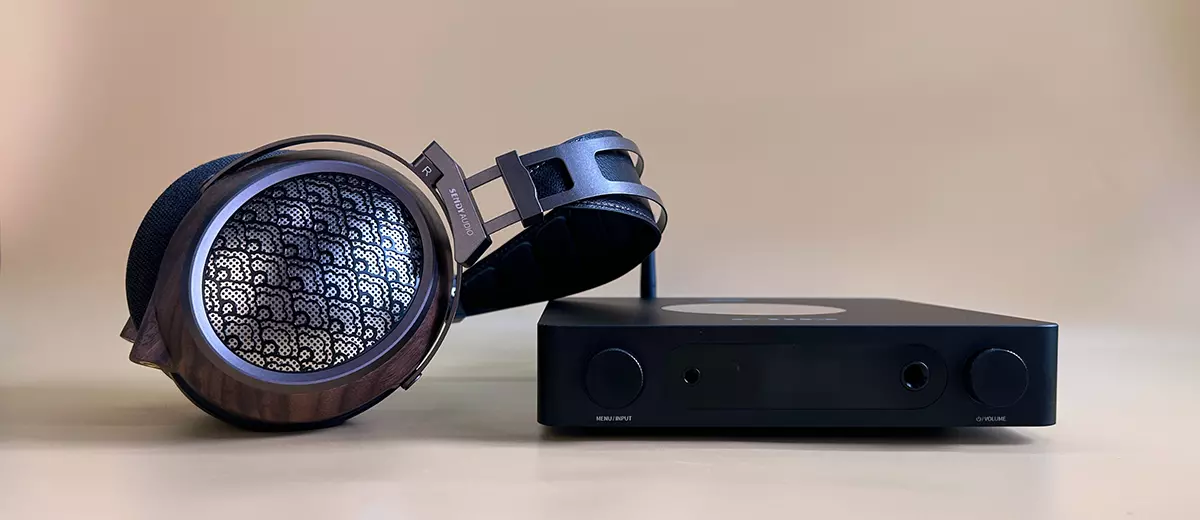
Meldrick reviews the Sendy Audio Egret, a new set of open-back 98x84mm planar magnetic driver headphones with black walnut wood earcups. It is currently priced at $799.00.
Disclaimer: This sample was sent to me in exchange for my honest opinion. Headfonics is an independent website with no affiliate links or status. I thank Sendy Audio for their support.
Click here to learn more about Sendy Audio products previously reviewed on Headfonics.
This post follows our current scoring guidelines, which you can read in more detail here.

Sendy Audio, the premium sub-brand of SIVGA, has steadily carved out a reputation for producing planar magnetic headphones that blend cutting-edge driver technology with stunning handcrafted aesthetics, like the Aiva 2 and Peacock.
Their latest release, the Egret, is an open-back planar headphone featuring a newly developed 98 x 84mm driver with sub-800-nanometer diaphragm technology and signature solid wood construction.
Priced at $799, it positions itself firmly in the mid-to-high tier of the planar market.
To see if Sendy Audio’s latest flagship-class headphone keeps up with other options in the market, such as the HarmonicDyne BAROQUE, HD 600, and the SIVGA Peng, read my full thoughts below.

Features
At the heart of the Sendy Audio Egret lies a custom-built 98 x 84mm planar magnetic driver, the largest and most advanced driver Sendy has produced to date. This represents a significant step forward from their previous offerings.
The driver features a nano-scale composite diaphragm measuring less than 800 nanometers thick.
Sendy claims this ultra-thin construction enables fast transient response, superior precision, and remarkably low distortion across the entire frequency spectrum.
With an impedance of 24Ω and a sensitivity of 95 dB, the Egret is reasonably efficient for a planar magnetic headphone.
It pairs well with a wide range of sources, from high-end desktop amplifiers down to capable portable DAC/amps, without requiring extreme power to reach its full potential.

Design
The Sendy Audio Egret showcases a design philosophy that marries natural materials with precision engineering.
The handcrafted North American black walnut earcups are the visual centerpiece, each pair featuring unique grain patterns, ensuring no two units look identical.
The outer grilles are inspired by the wings of an egret in flight, featuring an acoustically transparent mesh design with elegant tactile detailing.
Structural components, including the earcups, yokes, and headband framework, are CNC-machined from high-purity aluminum and finished in a distinctive gunmetal anodization.
This combination of materials provides excellent rigidity and durability while maintaining reasonable weight distribution.
Unlike some competitors, the Egret’s earcups offer a full range of articulation with rotation and tilt adjustability.
This flexibility helps achieve a proper seal across different head shapes, though the cups don’t fold completely flat for storage.

Comfort
The Egret’s comfort profile is one of its stronger attributes, particularly for a planar magnetic headphone at this weight class. The contoured leather headband features a padded suspension design that distributes weight evenly across the top of the head.
The suspension strap breathes well and prevents heat buildup during extended listening. There are no sharp pressure points, and the headband doesn’t dig in even after several hours of continuous use.
The earpads are a highlight of the Egret’s comfort design. They feature a thick, soft leather construction with angled positioning that naturally aligns with the shape of the human head. The pads are deep enough to accommodate most ear sizes without contact with the driver housing.
The angled design serves a dual purpose: it improves the acoustic seal and enhances comfort by reducing pressure on the jaw. This thoughtful engineering makes the Egret more wearable than many competitors at similar weight points.
Clamping force is moderate and well-calibrated. The headphones provide enough grip to stay secure during movement without creating uncomfortable pressure. The range of adjustment in the sliders ensures a good fit for head sizes from small to large.
While the 43-gram weight is well-distributed, it’s still noticeable during marathon listening sessions. I found myself wanting to take short breaks after 4-5 hours of continuous use.
The open-back design provides excellent breathability, preventing the heat buildup that often plagues closed-back alternatives.
Stock Cable
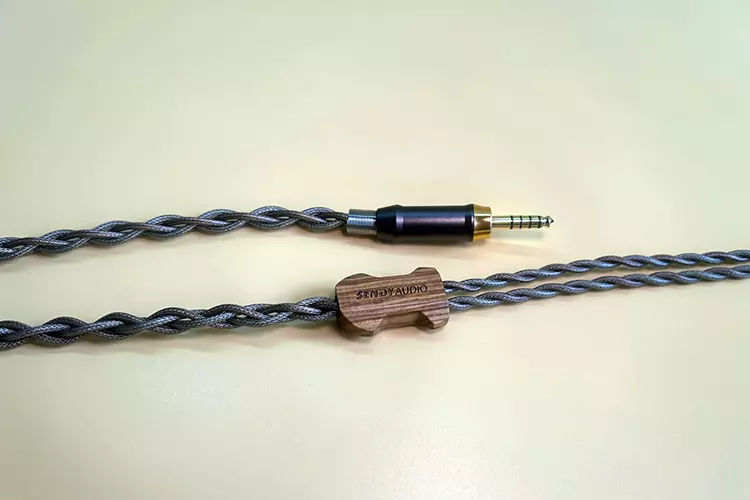
The Egret comes with a single premium detachable balanced cable, representing a significant step up from typical stock offerings. This is a 1.8-meter cable featuring Sendy’s unique triple-composite construction.
The cable incorporates three different conductor materials: 30 strands of Furukawa Oxygen-Free Copper (OFC), 10 strands of silver-plated copper, and 10 strands of enameled gold-plated copper.
A graphene-reinforced PVC jacket provides exceptional durability while maintaining excellent flexibility. The cable never feels stiff or memory-prone, lying flat naturally and resisting tangles even after repeated coiling and storage.
The cable terminates in dual 3.5mm balanced connectors at the earcup side, following Sendy’s existing modular approach.
At the source end, the cable has a 4.4mm balanced termination, and Sendy includes both a quality 4.4 mm-to-3.5 mm single-ended adapter and a 6.3mm adapter for broad compatibility.

Packaging & Accessories
The Egret arrives in an elegant presentation box featuring artistic renderings of the headphones themselves. Included accessories are:
- Detachable 1.8m triple-composite balanced cable (4.4mm termination)
- 4.4mm to 3.5mm SE adapter
- 6.35mm adapter
- Hemp-textile drawstring pouch
- Leather hard-shell carrying case
- Documentation and warranty information
The case is lined with a soft felt interior and has room for the headphones and some cables. While not ultra-rugged, its synthetic, leather-lined exterior is miles ahead of fabric pouches included with similarly priced headphones.
Sound Impressions
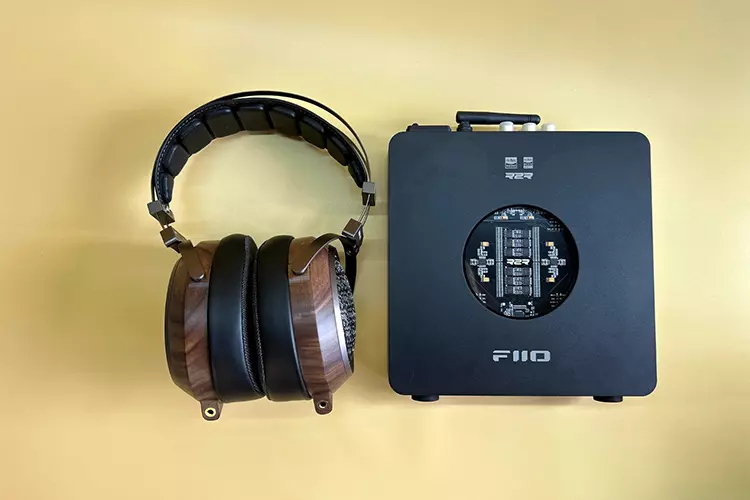
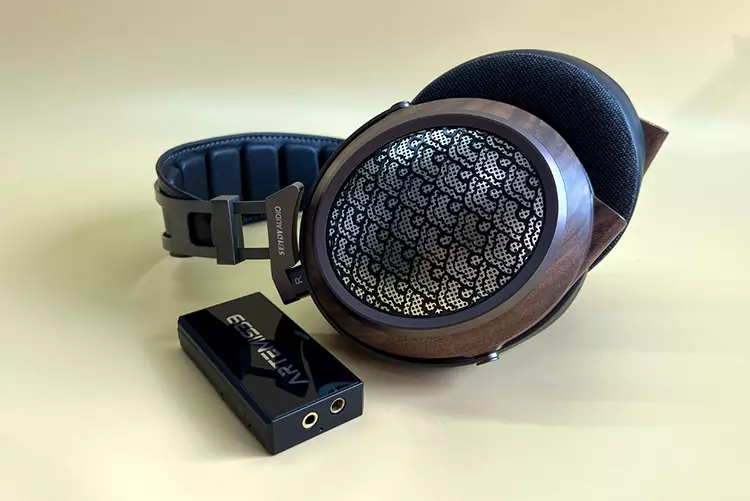
The following sound impressions of the Egret were completed using a range of sources, including the iFi audio ZEN DAC V1, the FiiO K13 R2R, the Shanling EH2, the iFi audio GO link Max, and the 7Hz Artemis39. The stock 4.4mm balanced cable was used for all listening impressions.
Summary
The Sendy Audio Egret delivers a neutral sound signature with a mild U-shape and warm tilt. Its tonal balance emphasizes body and weight in the bass and lower mids while preserving excellent detail retrieval and resolution in the upper midrange and treble regions.
The bass extends solidly with exceptional texture on percussive instruments, the midrange is transparent and lush with outstanding upper-mid resolution, and the treble remains detailed and refined without any trace of sibilance or harshness.
Soundstage presentation is expansive with particularly strong lateral imaging, creating clearly defined positions for instruments and vocals.
Bass
The Egret’s Sub-bass is solid and well-extended, providing a firm foundation for orchestral timpani, synthesizer drones, and modern electronic production.
It digs down with good authority without overwhelming the presentation, although fans of hip-hop and electronic music may themselves want more bass quantity.
Mid-bass elevation adds warmth and body to bass guitars and kick drums without bleeding into the midrange or creating bloat. Bass guitars benefit particularly from the warm tilt, gaining natural weight and presence while maintaining clarity and definition in dense mixes.
Texture and speed are where the Egret truly excels. Individual bass notes have clear attack and decay characteristics, and the planar driver’s inherent speed keeps the low end tight and articulate.
Percussive instruments, especially acoustic kick drums and toms, have exceptional tactile, organic texture that complements jazz and acoustic recordings.
Mids
The Egret has a very clear yet lush-sounding midrange. Vocals, both male and female, are rendered with exceptional clarity and natural tonality that makes them compelling without ever sounding congested or fatiguing.
Male vocals benefit from the lower-midrange warmth, coming through with commanding presence. Female vocals are a particular highlight.
The Egret’s excellent upper-midrange resolution ensures female singers come through clear and well-presented without any hint of shoutiness or harshness. This restrained approach avoids the glare or edginess that can plague some planar designs.
Violins, cellos, and acoustic guitars have gorgeous harmonic richness and natural tonality, while piano reproduction deserves special mention. The Egret handles the complex harmonic structure of the piano remarkably well, with clear note separation even in dense passages.
The slight warmth may not suit purists seeking absolute neutrality, but for emotional engagement and musical enjoyment combined with technical competence, the Egret is quite balanced.
Treble
Egret’s treble presentation is refined, smooth, and decidedly non-fatiguing. Upper treble has particularly good resolution without any trace of sibilance, with details standing out naturally due to their inherent quality rather than artificial emphasis.
Lower treble has gentle energy that lends clarity and definition to cymbals, hi-hats, and vocal consonants. There’s sufficient presence to maintain articulation without harsh peaks, even on recordings that typically expose treble issues.
Upper treble detail is present and well-rendered. String harmonics, cymbal shimmer, and acoustic overtones are audible with excellent resolution.
It integrates seamlessly with the midrange, creating a continuous, coherent frequency response. There are no jarring transitions or obvious peaks, giving the Egret a sound signature that remains inoffensive even to most treble-sensitive listeners.

Staging & Dynamics
The Egret delivers an impressively spacious soundstage with very good imaging performance. The lateral imaging is particularly strong, extending well beyond the physical boundaries of the headphones to create a convincingly wide presentation.
Instruments and vocals spread across a broad left-right axis with excellent separation and distinct positioning.
Live recordings and orchestral performances have genuine width, allowing individual sections to occupy their own space without crowding or overlap. The Egret’s soundstage feels natural rather than artificially exaggerated.
Imaging is precise and stable. The Egret excels at placing individual elements in specific locations within the soundstage.
The dynamic range is excellent. The Egret handles both micro-dynamics and macro-dynamics with authority. Subtle volume shifts and delicate passages are clearly conveyed, while orchestral crescendos and percussive hits have genuine impact and scale without distortion or compression.
Click on page 2 below for my recommended pairings and selected comparisons.
