

Synergy
Battery drain
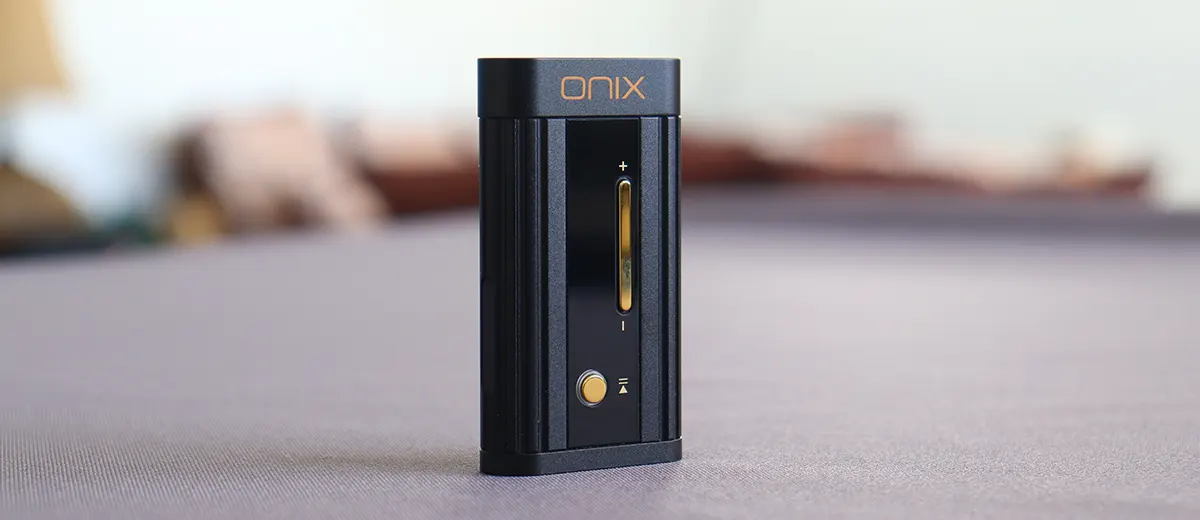
I think ONIX improved on power consumption even though they added two vacuum tubes into the mix. I was playing 20 minutes of music at a high volume level, on high gain, and I only noticed a 1% drain every 20 minutes or so.
Another observation I made was that this dongle runs cool to the touch, and a few degrees over ambient temperature.
Again, even though there’s additional hardware and the addition of tubes, which run notoriously hot, the power consumption and running temperature are kept under control.
Power
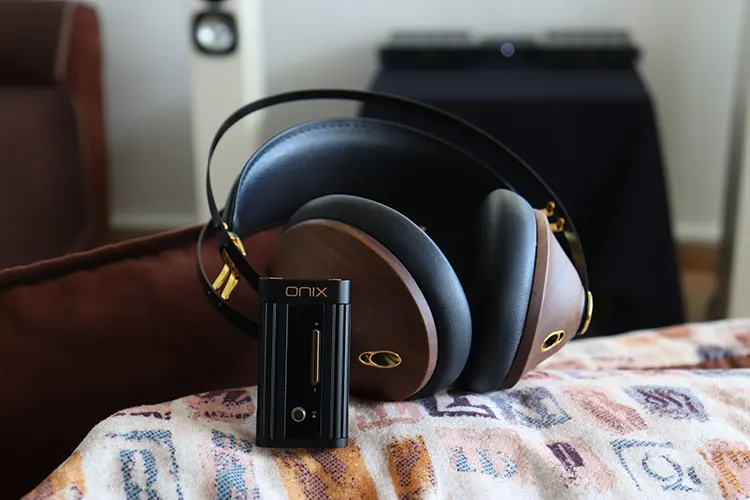
The ONIX Beta XI2 has a very low noise floor, and that makes it a good candidate for sensitive IEMs. One of the most hiss-sensitive IEMs I own is the Flare Audio Studio, and while using them, I couldn’t get them to produce any hiss on low gain.
Aside from that, the Beta XI2 produces enough power on the balanced connection to properly push my trusty Sundara, and of course, the newer models like the Edition XV, or the Audivina LE, which uses a different driver from the rest of the HIFIMAN line.
But when I switched over to a dynamic driver headphone like the Meze Audio 99 Classic Gen 2, the HEDD Audio HEDDphone D1, or the Sennheiser HD 550, which are less efficient, the Beta XI2 can produce performance that rivals some budget desktop units. With some planars, the top volume setting can clip, but that’s an expected result.
As a point of reference, my Sundara was playing at a comfortable volume level, with a higher-than-average listening level on high gain, and the volume position was between 85 and 90% for reference.
Pairing
The great thing about having a device like the ONIX Audio Beta XI2 is that it offers two distinct sonic signatures.
The solid state output caters to those who prefer analytical signatures over one that’s warm and not as strident. These might suit some IEMs like the FiiO FD7, the FD5, or the FX17.
Perhaps you have something like a THIEAUDIO Monarch MKIII, which has a forward-sounding signature, that can be quelled with the tube mode in this dongle.
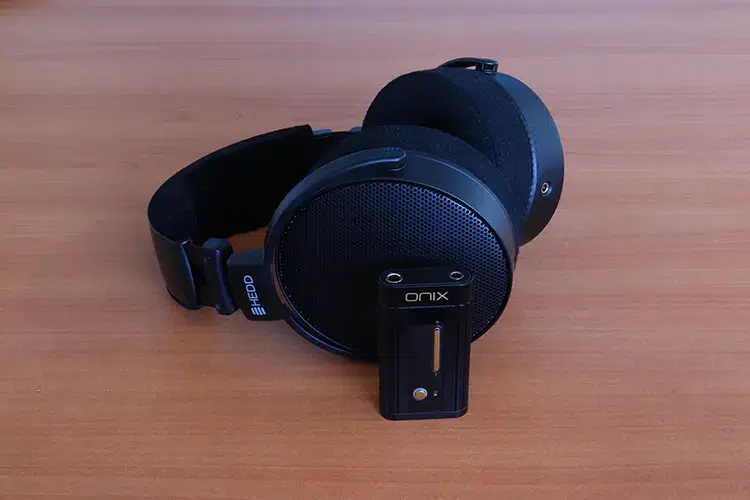
I noticed that the tube mode also works well with dynamic driver headphones like the HEDD D1, or some Sennheiser headphones like the HD 550, or the HD 490 PRO Plus.
The Beta XI2 adds some nice color to the overall listening experience in tube mode without too much coloration as to alter detail, and the natural tonality of the dongle.
Select Comparisons
ONIX Alpha XI1
Technical
These two dongles share most of the same hardware implementation and overall design. They both use the CS43198 on the front end.
But instead of using a quad buffer with an OPAMP configuration, the XI1 Alpha uses some SGMICRO SGM8262 chips that are capable of 500mW on the balanced side and 180mW on the SE connector. The difference here is a mere 50mW.
Design
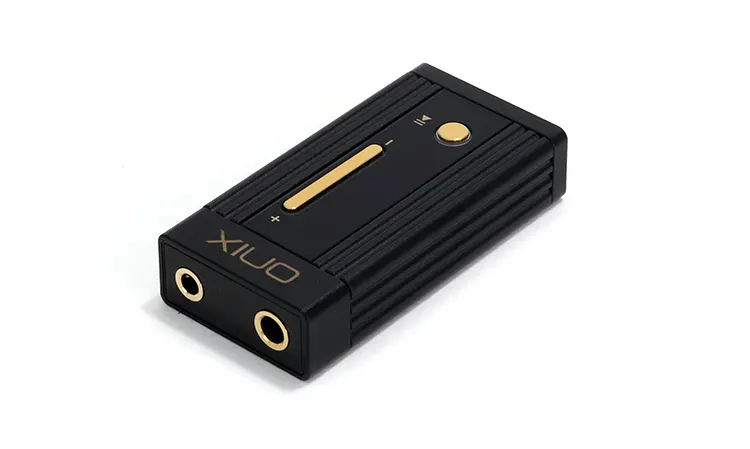
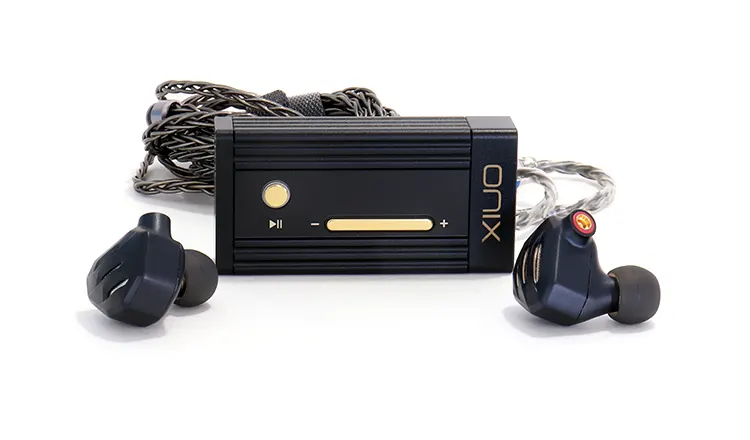
Looking at these two is like looking at two twins. They both have an aluminum body, an 8-inch screen, and a black body with gold-plated buttons.
The Beta XI2 is a bit larger by a few millimeters on each side. That is more than likely to accommodate the glowing side-mounted tubes that distinguish the Alpha XI1 from the Beta XI2.
I noticed that, although both models have the same kind of features available within the menu, for some reason, the Alpha XI1 has one more digital filter than the beta XI2. I would think the more expensive model would have more.
Performance
On single-ended, these dongles sound extremely similar, although there is a slight performance boost when you engage the 4.4mm connection, but the additional 50mW doesn’t do much sonically speaking.
But aside from that, it seems like ONIX went to the drawing board again and improved on efficiency. The Beta XI2 seems to use less power compared to the Alpha XI1. Even though the Beta XI2 has more hardware and tubes in the amp stage.
All the specifications look the same except for the channel separation, which is much higher on the beta XI2. It’s 128 dB max over the Alpha XI1’s 99 dB max on the balanced connection.
It does show because in listening tests, the Beta XI2 produces a better transient response, and also has a slightly lower noise floor. That and the tubes justify the extra cost, in my opinion.
Questyle M18i
Technical
Questyle became a main staple in dongle conversations after they released the M15 dongle, and the reason was that at the time of release, they held the crown for having one of the best-sounding dongles around.
The Questyle M18i came out, and since I’m a dongle fan, I was eager to get my hands on one. It didn’t disappoint in the fact that it sounded pretty good, but it also came with Bluetooth capability, which at the time was novel.
That fact alone placed it in between some of the best dongle DACs around when it came to audio performance, but it also placed it competitively with the likes of the iFi audio GO blu and the FiiO BTR17, which are in different classes from the conventional dongle.
Design
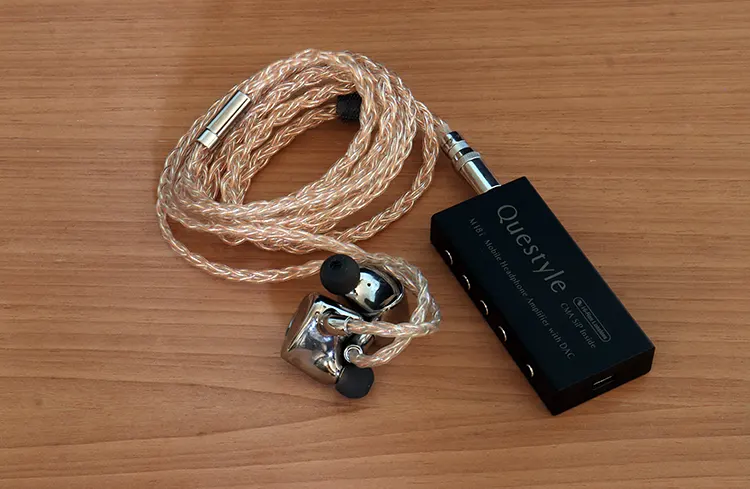
The Questyle M18i uses a standard design. It’s an aluminum box, anodized, and stuffed with audio goodies. A total of five buttons adorn the side, and those are a lot of buttons.
The good thing is that Questyle placed them all on the same side to enable thumb control or single-finger operation.
The Questyle M18i is packed with features, but that works against it at times. You see, it has no onboard screen, so it’s difficult to know where you are at all times, particularly with the digital filters.
On this dongle, you’re going to have to rely on instincts rather than an informative screen.
Performance
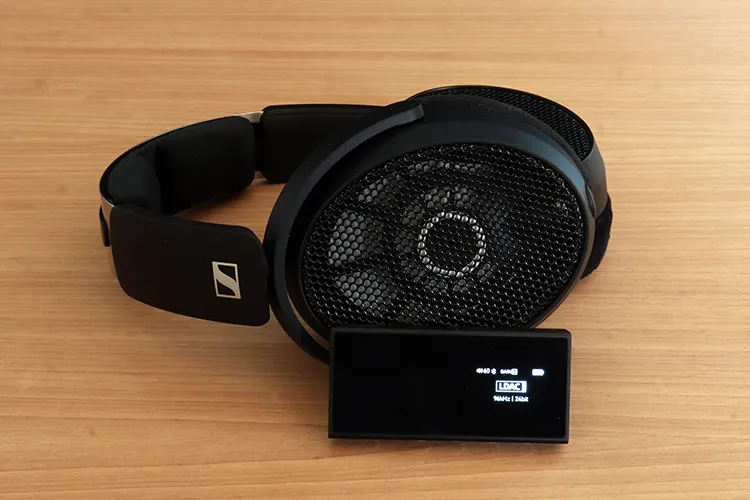
I love the fact that you could take the Questyle M18i to LDAC levels of Bluetooth codec, which is my favorite. I prefer it over aptX Lossless because of the availability, high compatibility, and equal sound quality.
Where the M18i loses points for me is that the ES9219Q is a good chip, but not an outstanding one. A chip like the CS43198 used in the ONIX Beta XI2 will outperform it sonically. The M15 used ES9281AC Pro chips, which will also sonically outperform the ES9219Q, in my opinion.
It’s considered a high-performance DAC chip by the manufacturer, while the 9219 chip is considered a low-powered model with excellent performance, but not audiophile grade like the 9281.
So even though the M18i is the more expensive dongle in the Questyle lineup, it’s still sonically beaten by its smaller brother.
I say no more. Get it if you’re hell bent on Bluetooth and want to go wireless from a mobile device. In that scenario, the Questyle M18i excels.
FiiO QX13
Technical
The FiiO QX13 quickly earned my vote for the most powerful dongle on the planet. It can produce up to 990mW of power per side on the balanced connector.
The drawback of obtaining that kind of power is that you have to engage its desktop mode feature, which involves connecting an extra power source to the dongle, and that could become cumbersome in a portable scenario.
Remember, you can always carry an extra power bank, but the extra bulk might not be pleasant or ideal. The thing is that in regular mode, and with just one power source, it still produces 605mW per side. Six internal Texas Instruments OPAMPS make that possible.
On the front-end, fed by an XMOS XU316, is a single desktop-grade Sabre ES9027SPRO. This chip does not need a dual DAC chip setup since it has a native 8-channel structure and is targeted for professional audio. All this lies within the FiiO QX13.
Design
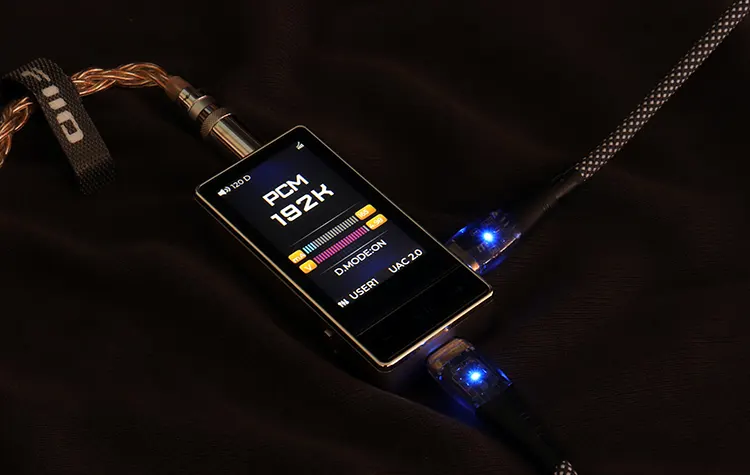
The overall design is one of the nicest to come across my desk. It sports a large 1.99-inch color screen, a separate digital and analog stage board, inside a 21-layer carbon fiber body. Not to mention the etched rear design.
Accessory-wise, it also wins the prize for including a screen protector, a protective case, a cable that is just as nice as the ONIX variant, a maglock to use in conjunction with the protective case, and even some USB-C covers.
I just wish they included some for the unused headphone port so we can make the dongle water-resistant.
But that’s asking a lot because no other maker includes anything similar, although I’ve been asking for the inclusion of covers like these for years now.
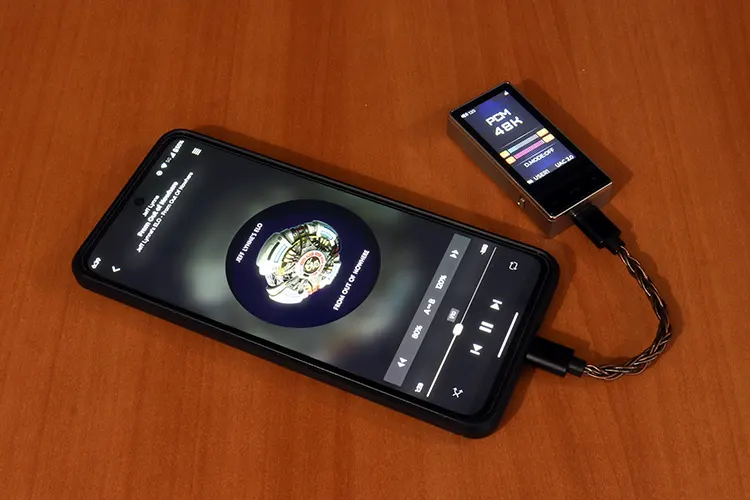
Performance
The QX13 has a fuller sonic presence that gives off the illusory perception of listening to large home equipment. The QX13 is also versatile, as it can power many of my planar headphones without the need to raise the volume to 90% on high gain.
What concerns me the most about the FiiO QX13 is that it can require a lot of juice to run. If you depend on your mobile device for daily chores, the QX13 might not be for you, since I consider it a desktop-esque dongle best suited for desktop use with portability capability.
Sonically, the FiiO might win points on soundstage layering and power delivery. One could say that it has a bright aspect to its sonic presentation, while the ONIX Beta XI2 sounds warmer with a softer mannered demeanor. You could say that the beta XI2 is the more relaxed of the two.
The FiiO QX13 also produces a lot of nuanced detail. I think that the ONIX Beta XI2 is also good at extracting detail in solid state mode.
The FiiO QX13 is a mid-forward dongle with fast bass and clean, vivid highs that can power some hungry cans, but it’s best suited for home use, with portability second.
The ONIX Beta XI2 is a detailed, natural-sounding dongle that is not as strident and is easy on battery life. Those are the choices in a nutshell here.
My Verdict
ONIX elevated their game and made the Beta XI2 dual tube and solid-state dongle DAC better than its predecessor in every way, and I’m not knocking the Alpha XI1 in any way, shape, or form.
The Beta XI2 is a versatile dongle that brings analog and digital together, in a medley of parts, wrapped in a small, tiny box. Some might squinch at the retail price, but you get what you pay for in this case.
Sonically, the ONIX Beta XI2 has made my top three list of all the dongles I own, and that reminds me that I soon need another shelf to put them all in. Need I say more?
ONIX Beta XI2 Technical Specifications
- Dimensions: 69.5 x 39 x 14mm
- Weight: 45.3g
- Hi-Res support: 32bit / 768kHz / DSD256
- Gain: Low and high gain
- Display: 0.89-inch Monochromatic
- Controls: 3 hardware multifunctional buttons
- Input: standard USB-C connector
- Compatibility: Android / iOS / Windows / MAC OS /
- 5mm SE
- Output power: 2.4V @ 32Ω (180mW @32Ω)
- Output impedance: 0.3Ω
- 4mm Balanced
- Output power: 4V @ 32Ω (550mW @ 32Ω)
- Output impedance: 0.6Ω
- THD-N: Less than 0.06% A-weighted @4v
- Dynamic range: Balanced 128db or SE 127db
- Channel separation: 107 dB
- Signal-to-noise ratio: 128 dB
