

Select Comparisons
Noble FoKus Rex5
Features
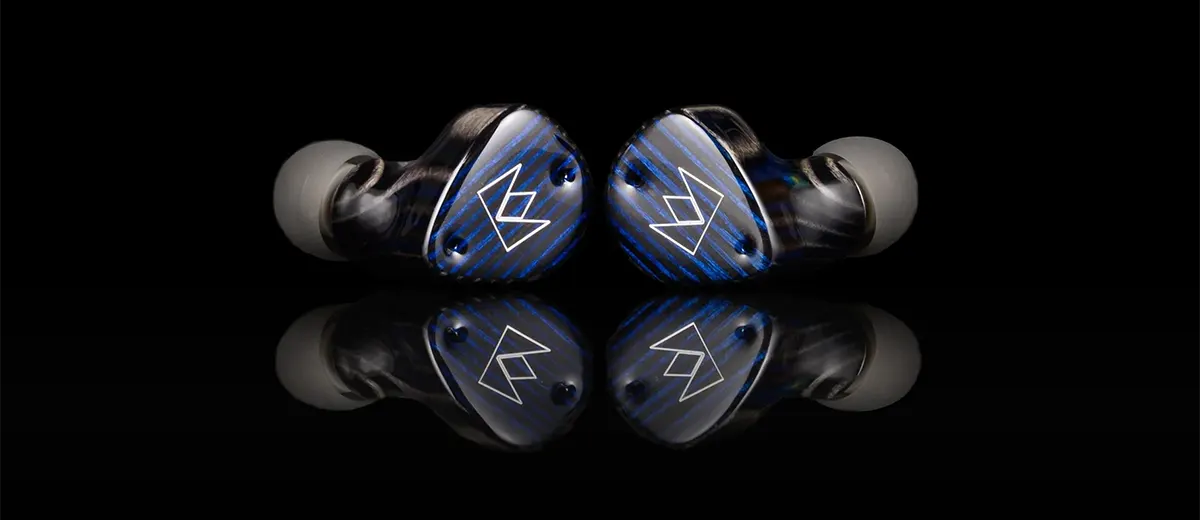
The Noble FoKus Rex5 is a 5-driver tribrid True Wireless System. Its driver grouping consists of a single 10mm dynamic driver for the lows, 3 BA drivers for the mids, and a single 6mm planar driver for the highs. The Encore has one less BA.
The Rex5 now offers the Triumph model’s LDAC decoding capability rather than stopping at aptX Adaptive.
That means a reduction in data compression and a stronger gateway into hi-res audio with decoding now upgraded from 24-bit/48 kHz to a maximum of 24-bit/96 kHz. The Encore follows suit.
iPhone users will still receive AAC, with SBC, aptX, and aptX HD supported as well for the (then) new Bluetooth 5.4-capable Qualcomm QCC3091 chipset. The Encore shares this BT technology.
Design
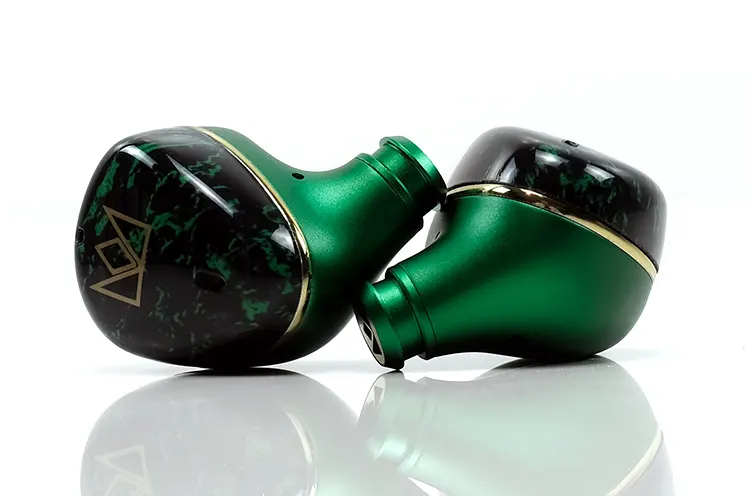
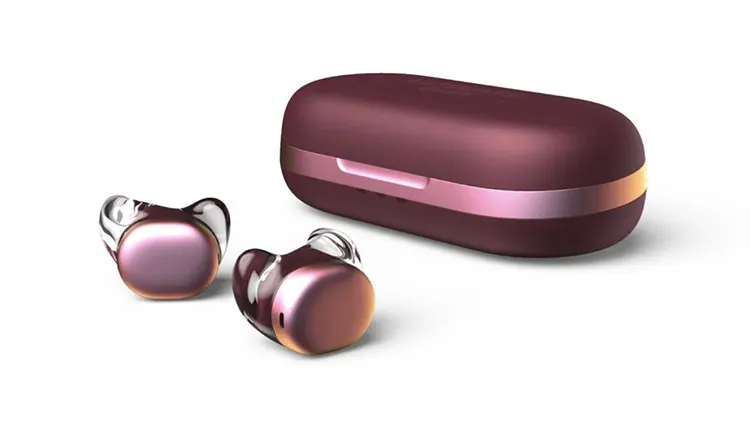
Aesthetically, the Rex5 is all about the green. The two-tone wood of the Encore separates itself from what I might call the “typical” Noble look of the Rex5.
The touch-sensitive face plate is marbled jade and black, with a gold rim and solid aluminum shells in a green finish, comparatively.
There are also multiple port openings for the ANC mics, with two around the nozzle and one low-profile opening on the rear end of the faceplate. The Encore’s dual mic ports are on the faceplate, but call quality was noted as excellent on a very windy day by a neighbor.
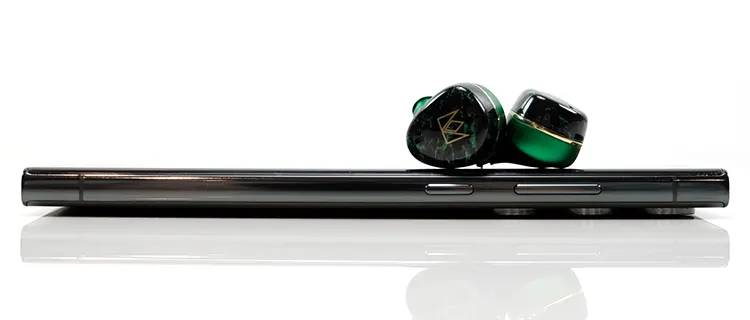
The earbud form factor of both feels refined. The older Noble versions were primarily acrylic shells, while the Rex5 is built with a tougher aluminum material in a slightly more compact and smoother form factor. The wood of the Encore really does make a distinguished statement, too.
Noble monitors usually have deep nozzles, but that’s not the case with the FoKus Rex5. It’s a little stubbier, with slightly shorter nozzles, but, given that the Rex5 comes with ANC, it does not need to rely so much on long nozzles for isolation. The Encore is similar, but just right for me.
As with most of Noble’s high-end TWS offerings, there is no IPX rating for the Rex5. Typically, Noble states it’s ok to use their TWS for short, sweaty workouts, but I do not see that this time on the product page, meaning it’s likely the ANC mic array ports might be fussier for liquids than previous models.
Personally, I would not use the Encore for such operations, although I did wear them when snow blowing earlier this week.
Performance
Compared to previous offerings, the Fokus Rex5 sounds like a TWS on steroids.
It delivers a bigger and bolder set of lows, with a more resolving performance set of mids and sparkling highs than what I have previously heard from Noble’s wireless earbud lineup. The Encore is similar, but with a smooth nature to it that feels sublime.
The coloration is warm to natural with an excellent fundamental frequency and a welcome level of contrast from a pleasingly elevated upper treble, just enough to create a light sheen on the midrange timbre without creating a harsh, edgy tone.
The Encore adds a richness to the smooth, warmer character, without losing levels of clarity. The midrange has some decent ear gain for vocal presence, but it’s not outlandish or shouty in its positioning.
You can soften the coloration further with the foam tips, but the clarity levels seem better for me with the silicone tips, be it the single or dual flange variants. The same can be said of the Encore, but using your personal Audiodo is a nice alternative.
Imaging is quite impressive on the Rex5 and may be slightly better on the Encore. Where the Rex5 defines placement, the Encore allows the placement to be defined naturally.
Vivid and open-sounding mids and highs help to define the Rex5’s character. The Encore resists adding artificial tendencies to exacerbate the mids and highs with stridency.
Not that the Rex5 does, but with the excellent representation of the Encore mids and highs, there is no need. The Rex5 clarity midrange bloom is more evident, especially at the more extreme ends of its comparatively wide stereo field. The smooth character of the Encore counters that.
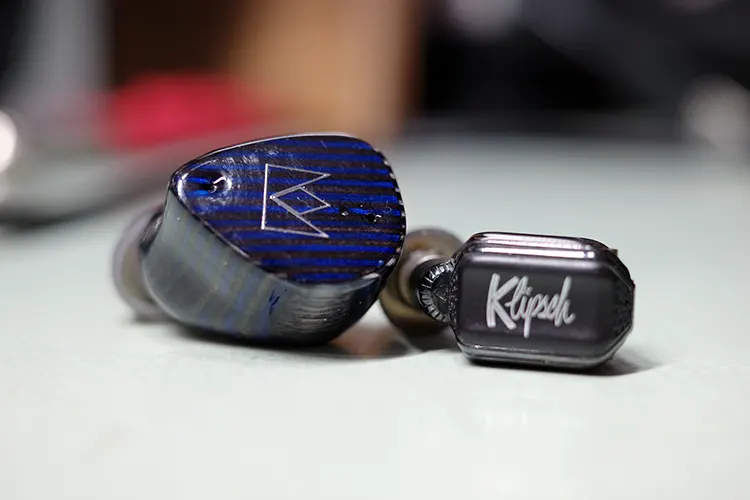
Klipsch x EarMicro T10
My T10 is a first-generation product, and I was the first journalist, worldwide, to receive one.
Since then, enhancements have been made, but the following descriptions still hold for the marque. I can still send the unit back for enhancements and battery change if needed (and will be doing so).
Feature
The T10 is the most expensive TWS I have tested to date, and quite close to the most expensive headphone/IEM I own. It runs an open platform with Bragi OS for hearables and nano A.I. technology on board.
The T10 is capable of downloading and running hearables apps much like a hearing aid would be used, making it even more versatile.
The 9-axis gyroscope for positional and momentum allows for use with gestures and mouth movements. This can be fully programmable for Voice/Touch/Non-verbal Mouth/Head-motion control interfaces (patented) based upon user desires.
Twin Cadence Hi-Fi DSP’s personalized audio tuning and enhancement capabilities allow for Hi-Res audio. You also have clear telephony, with the ability to run apps that enable secure voice-activated walkie-talky communication to selected individuals or groups without the need to dial or conference.
With T-10’s you can tap directly into the early stages of Singularity, cutting the distinction between what a computer can do and a human.
A single balanced armature based on the Klipsch X10 is highly modified. Sometimes, when using a single dynamic driver, you give up clarity and details for increased bass presence.
Sometimes, when using a single balanced armature, you give up bass for the benefit of clarity and detail retrieval.
The T10 throws all of that out the window, with intricate computer-designed sound tubes (Klipsch), enhancing the sound qualities to how Ear Micro envisions a TOTL should sound.
This technology is now an accepted way to fine-tune sound chambers, and the Noble, of course, takes advantage of this using the triple-vent nozzle and in-house designed sound tubes.
Design
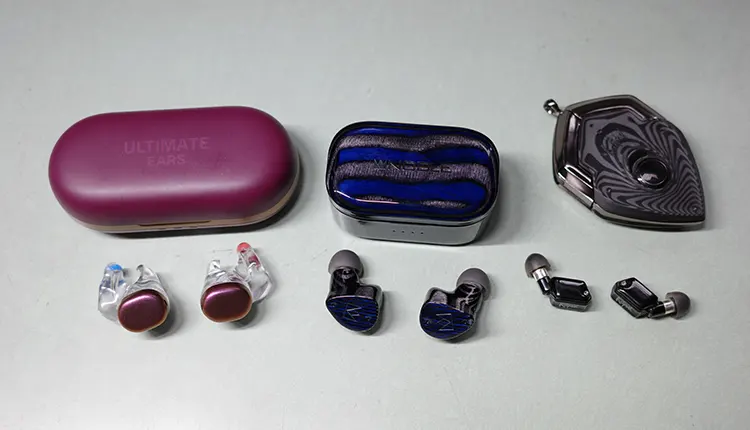
Using a single BA allows for the diminutive size of the earbud, helping to make it the smallest out (less than 1 cubic centimeter) that has similar features.
Since the unit will only be used with the customer’s Smartphone (at this time), Bluetooth technology is paramount.
Going straight to the top, ear micro invested in Sony’s LDAC codec as their main source, going up to 24bit/96kHz. Sony caught wind and wanted to know more about the unit. Collaboration between the two was the outcome, lending a nice backdrop to the product.
With 64mb of available RAM onboard, the processing speed of the ARM M4 is about as fast as you could get at the time. Additional external memory will also be available on upgrades, which is limited only by the micro-SD card used by the customer.”
The diminutive size of the T10 makes for a disappearing act in one’s ears. That small size did take me a considerable amount of time getting used to the controls, but once I activated the gesture technology (and subsequent firmware update), use has become second nature.
The larger Encore seems gigantic by comparison, but the few years between the two show how far technology has come. The Encore functioned flawlessly, and with a much shallower learning curve than the T10.
The proper tip is a must with the T10. First, trying the size 4s, which is the size I normally take, I found the bass lacking, and isolation was average.
Bear & Troy suggested going down a size to the 3’s, and that sealed the deal, literally. The nozzle is longer on the T10, too, promoting a deeper insertion point.
Performance
Bass hits hard, with good authority and thump, using the size 4 tips. Not boomy or bloated at all, but fairly fast and very accurate. The combination of speed and deeper reach makes this an excellent bud for those who like the lower end.
The same can be said of the Encore, except I used the medium as opposed to the large silicone tips that I normally would. Both presented excellent sonics with proper seal, and even though the T10 still provides levels of ANC isolation, the Encore does an excellent job comparatively.
There is good authoritative thump from both, which are superb. Neither low-end becomes bloated, but the T10 could not match the Encore for sheer grunt capabilities.
The Noble flows a bit better into the midrange, but that is not unexpected due to the multiple driver setup.
The level of clarity and detail pulled out from the T10 is quite astounding. The soundstage on the T10 does come across as a bit larger in height than the Noble, but the Encore has nothing to be shy about in terms of detail retrieval, comparatively across the 3D.
There is also sufficient space for the music to breathe, but it does not become thin. The layered textures come across with aplomb and little fuss.
The T10 comes across with good depth and a thickness to the notes, which not only belies their size, but also the fact that this is a BT bud.
The newer Encore follows suit, showing that technology has indeed gotten better. That said, the T10 is slightly better in layering, imaging, and separation. But for the asking, that should be expected. The Noble is indeed no slouch.
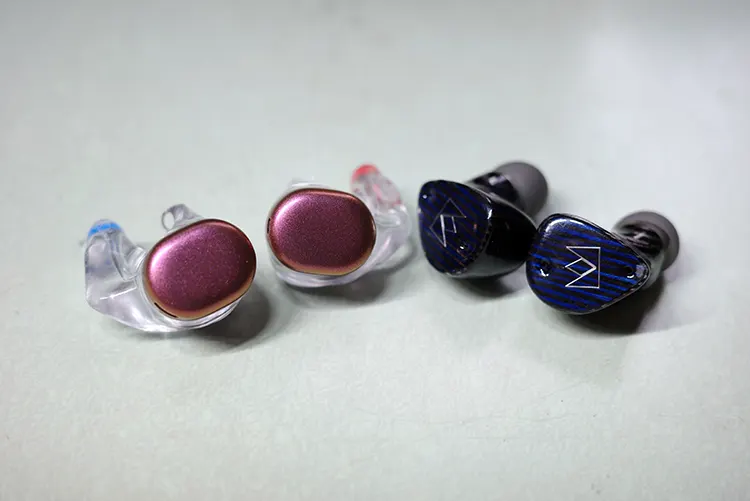
Ultimate Ears Drops Custom
Features
The UE Drops inner components are housed in a glass-like shell that houses the single 9.2mm dynamic driver, quite different than Noble’s multi-driver setup.
There are separate microphones on the top and bottom of each earbud for the Drop, which performed quite well with phone calls and was on par with the Encore.
The custom shell helps account for a lack of ANC (UE doesn’t believe in it), with proper fit of both the custom and stock Drop accounting for noise isolation.
Even with the custom shell, I found a small bit of sound came through when music was not being played, much like the Encore.
The IPX4 rating permits using the UE Drops at the gym or when exercising outdoors, but they might not survive exposure to an intense downpour or the washing machine test. As stated above, I would not use the Encore for workouts (just snow blowing) because of the value associated with them.
Design
All of the electronics, except the sound tube, are mass-produced, which is how UE can offer a “custom” shell for each owner and keep the cost lower.
Essentially, the ability to do this makes it quite practical to go custom, without incurring any (or the untraditional minimal amount) additional cost.
The charging case is on the larger side and delivers two full charges to the earbuds for a total of almost 24 hours of playback time at moderate listening levels, which is less than today’s standards, and the Encore.
I put more than 100 hours of listening time on the UE Drops, and the battery performance has remained consistent at about 6.5 hours, which is less than the Encore, even with ANC on.
Performance
The bass performance of the UE Live is a baseline for me in clarity. But the Drop cannot match that, nor should it.
The UE Drops have a thicker presentation in the bass range, but it never feels too loose or woolly, reaching to about the same depths as the Encore, but with less grunt. The Encore also filters into the mid with a bit more authority and presence.
The Drops have done a very good job in retaining the family resemblance of sound in that regard because they do retain clarity and impact from the sub bass up into the upper bass.
The midrange is wonderfully clean-sounding, but there is a slight dip that came across as sounding somewhat hollow.
There is no such discrepancy in the Encore. Some may confuse that as being ethereal in presentation, but I really think the midrange dip strips away some texture and body, robbing vocals of a degree of warmth that some might prefer.
Where the Encore completes the midrange with a smooth character, allowing the sound to come across as natural and organic, the Drops sound a bit strained. The UE house sound usually offers excellent detail retrieval and clarity, or “accuracy.”
The UE Drops are not entirely linear with their tonal balance and presentation; the low end has some added richness, and the top end has some additional energy and airiness that makes them just lively enough to keep your attention.
The treble strikes the right balance, and that extra degree of presence helps create a more spacious soundstage.
It does extend higher than the Encore, and this is where I disagree with UEs’ tuning. That extra bit of energy up top hinders an otherwise quite competent signature, unlike the Encore.
My Verdict
Coming into this review, I already held the FoKus Apollo in high regard, so my expectations were high. All of those expectations were met.
The low-end has excellent reach and grunt, without becoming bloated. I mention (repeatedly) how that low-end filters into the midrange instead of bleeding.
This is a rare case where the extra low bits help to make the midrange better than its singularity. Plus, the midrange is sumptuous in character, without becoming melancholic or muddy.
The vocals come across with energy and emotion that combine to make an organic nature to it that involves the listener. We become part of the whole, instead of simply listening.
This is a rare treat when combined. Throw in the excellent instrumentation, and you have the making of an excellent sound signature.
If I had to fault the Encore for anything, it would be the fingerprints that are bound to happen. But you can look past that and gaze upon the gorgeous two-tone wood finish of both the case and earbuds. Plus, since there is wireless charging, it really is not a big deal that the USB-C charging cable is short.
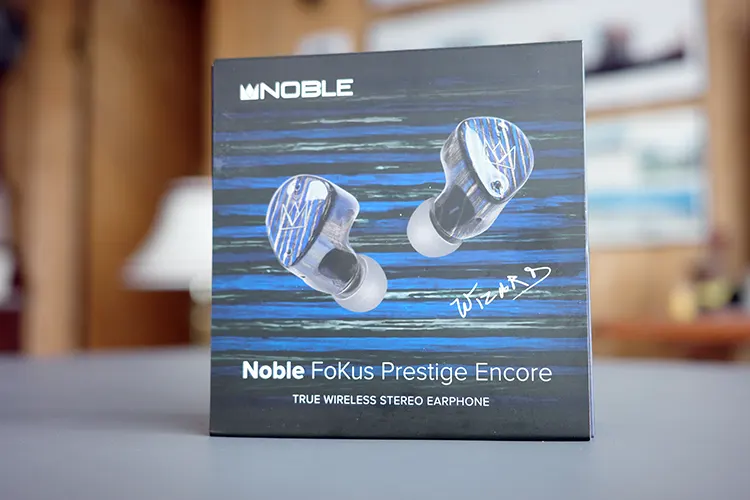
So what we end up with is a TWS version of the Noble FoKus Apollo. Sort of. The familial resemblance is certainly there, but you should really think of the Noble FoKus Prestige Encore as the pinnacle of the company’s wireless earbuds.
And in doing so, the Encore is indeed worthy of the name and can stand side-by-side with the Apollo at the top of Nobles’ wireless wares.
Noble FoKus Prestige Encore Technical Specifications
- Driver system: 1 × 8mm Dynamic, 2 × BA, 1 × 6mm Planar Magnetic
- Chipset: Snapdragon S3 Gen 1 Sound Platform
- Bluetooth: 5.4 with TrueWireless Mirroring and multipoint support
- Codecs: aptX Adaptive, LDAC, AAC, SBC
- Noise control: Hybrid Active Noise Cancelling + HearThrough mode
- Calls: Dual-mic cVc™ noise suppression
- Battery life: 10h (ANC off) / 7h (ANC on), up to 35h total with case
- Charging: USB-C + Qi wireless charging; 10min quick charge = 2h playback
- Design: Smaller housings, triple-vented metal nozzle, refined wood finish
- Personalization: Audiodo per-ear calibration with on-device storage
- App: Custom EQ, touch mapping, OTA updates, multilingual interface
