

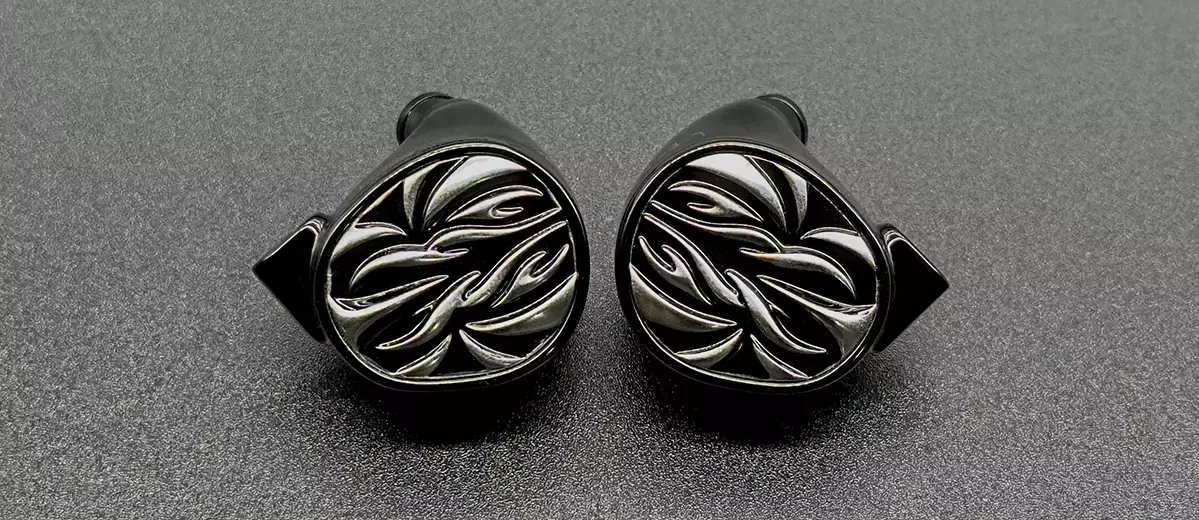
Nihal reviews the LETSHUOER Ember, a new limited-edition flagship 14.8mm planar magnetic driver universal IEM currently priced at $499.00.
Disclaimer: This sample was sent to me in exchange for my honest opinion. Headfonics is an independent website with no affiliate links or status. I thank LETSHUOER for their support.
Click here to read more about LETSHUOER products previously tested on Headfonics.
This article follows our latest scoring guidelines, which you can read in more detail here.
LETSHUOER is one of the leading names in the Chi-Fi IEM scene, and they have built a lineup that covers every price bracket without feeling random.
Premium releases like Mystic 8 and Cadenza 12 2024 are two of their standout releases in their respective price ranges, and I usually end up getting curious the moment they hint at something new.
I first heard about Ember while chatting with Marcus, right after he demoed a prototype at the 19th Shenzhen International Audio Show in 2025. Back then, even the driver configuration was unclear, and that mystery honestly made it more exciting.
I had been waiting for the official reveal since then, but the final product still caught me off guard. Ember is a premium planar magnetic IEM, limited to 999 units, which is not what I was expecting at all.
LETSHUOER has always had a thing for planar. The S12 and S15 are already proof that they know how to do that formula right, but Ember is clearly playing in a different league. And with a premium release like this, expectations automatically go through the roof.
In this review, I will put Ember up against the SIMGOT EM10, the Softears RSV-MKII, and the THIEAUDIO Oracle MKIII to see if it can hold its ground where it really matters.
Features
It often feels like planar drivers are not evolving all that much. Ember uses a brand-new 14.8mm large planar driver.
This is not the same driver platform used in the S12 series or the S15. It is a newer unit developed for a more premium level of performance.
The main idea here is a fuller, more authoritative low end, something many planars do not quite get right. That is also where Ember’s tuning steps away from most mid-fi planar sets. The sound analysis will tell if Ember tries to push things in a different direction.
Ember has an impedance of 30Ω and a sensitivity of 103 dB/Vrms. It needs a little extra juice to show its full potential, but it can still be driven fine by most common sources. We will talk more about it in the “synergy” section on the next page of this review.
Design
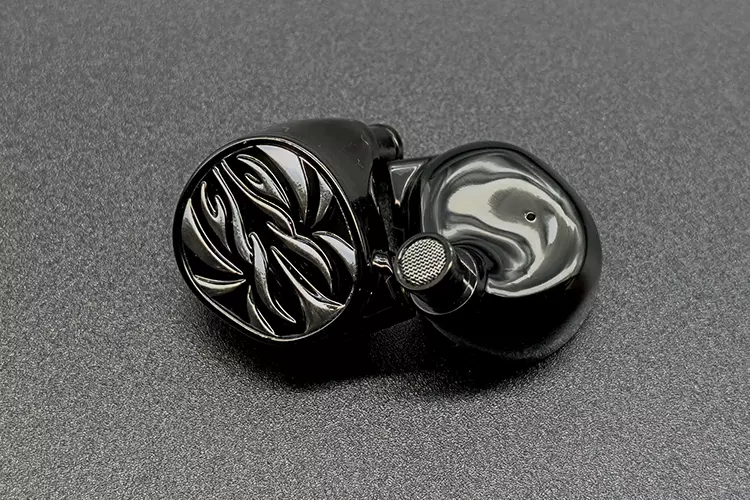
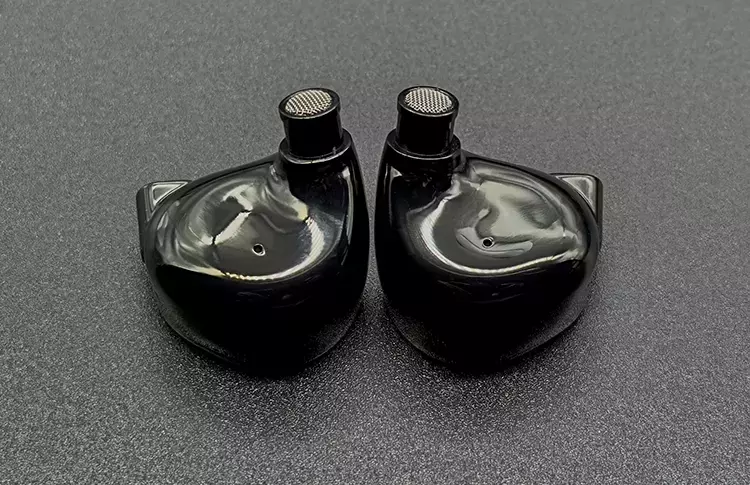
This one is all about the small-shell flex. The shells have a compact, slim footprint that sits in the ear like it’s meant to disappear. The body comes in a matte-black titanium alloy finish, while the faceplate is aluminum alloy, and the contrast works.
It reads “premium” the moment you pick it up. The curves are smooth, and there are no sharp corners on the shells. It shares design similarities with the Mystic 8, but the size is trimmed down.
The faceplate is the visual hook. It has a flame-like flowing pattern. It’s not a loud design. The flames are slightly raised, giving the design some depth. They’re painted silver, which adds a shiny outline.
The glossy finish of the shells is also a little annoying. It looks polished and premium, but it loves fingerprints, so it will pick up smudges and dust over time. You may need to have a cloth around if you’re picky.
The nozzle is on the smaller side, with a fine grill mesh on top. Tip pairing is easy, nothing weird or fussy. The cable connection is a standard 2-pin. Overall, Ember’s build feels solid and confident. This build is definitely an upgrade over their premium planar S15.
Comfort & Isolation
Comfort is one of the strong points here, mostly because the shells are genuinely small. For most ear shapes, I do not see the fit being a struggle. They slide in easily and sit flush, and that tiny footprint helps a lot with stability.
For my larger ear canals, the only real “thing” is tip sizing. Since the nozzle and the shell are on the smaller side, I end up using larger ear tips to get a proper seal.
In my case, the IEM is held more by the tips than the shell anchoring itself, so getting the right tip becomes mandatory rather than optional.
Once I found a snug match, I was set. After that, it does not feel like it is slowly slipping out or asking for constant micro-adjustments. I can just wear it and forget about it, which is honestly what I want from a daily driver.
The shell shape helps, too. It is smooth and rounded, with no sharp edges or corners. That means no pressure points digging into the ear, even after a long session. The weight is on the lighter side as well, so it never feels like the IEM is “hanging” off the ear canal.
Isolation is decent. It blocks a good chunk of outside noise, not total silence, but enough to feel focused. Also, during my time with Amber, I did not notice any pressure buildup or driver flex, which is always a relief.
Ear Tips
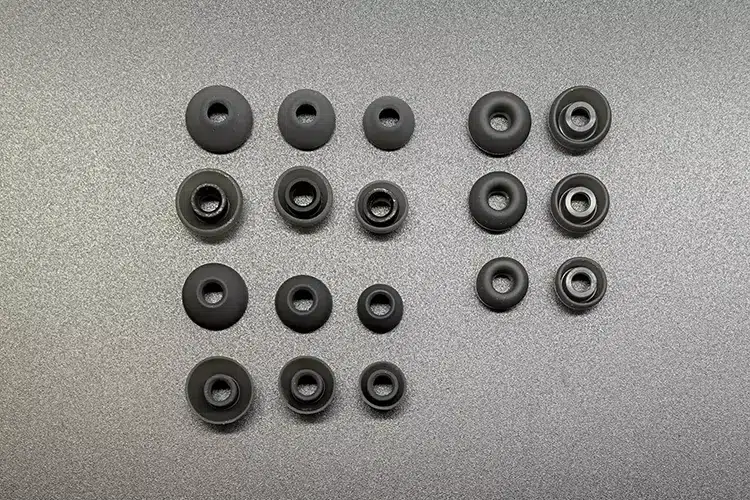
You get nine sets of ear tips in total. They are split into three different tip styles, and each style comes in small, medium, and large. So, you are covered on sizing, and the selection also spans different bores, from wide to medium to narrow.
The only slightly annoying part is that everything is black to dark grey, so there is no quick color cue to tell which is which. You will end up inspecting the bore and stem to figure it out.
In my ears, only one of the three sets really worked the way I wanted. This set has a shorter stem and a wider bore, and it just feels more “open” and natural.
The other two sets, with their narrower bores, sound a bit more closed-in to me. They still seal fine, but the presentation does not breathe as much, and I notice that immediately.
I also rolled a few aftermarket tips, and the Divinus Velvet ended up being the best match. The wide bore helps open things up, and the fit is more secure for my ear shape.
I generally need larger tips with smaller shells like this, because the tip is doing most of the anchoring. With the Velvets in a bigger size, the shells sit in place properly, and I do not have to keep nudging them back in.
Stock Cable
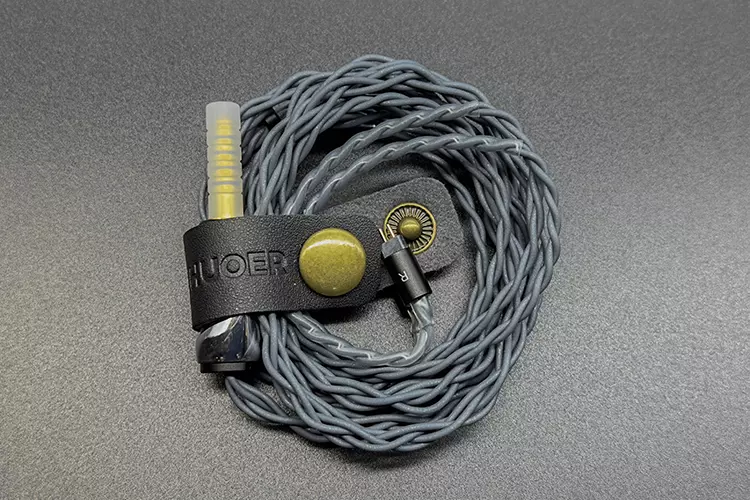
LETSHUOER tapped Effect Audio for the stock cable on the Ember. On paper, it reads “premium,” and the collab angle with Effect Audio makes you expect something a little more. The core is UP-OCC monocrystalline copper, 26 AWG, four-core.
The cable comes in a matte grey sheath, which looks very clean and low-profile. It pairs well with the tiny shells because nothing about it feels bulky.
Even the hardware plays it safe. The plug housing is compact and blacked out, with a small logo hit. Some shiny elements match the faceplate and overall design scheme.
The included cable strap is a nice little detail, though. It’s leather with LETSHUOER branding stamped into it. For such a slim cable, I would hardly use this strap, but it can be handy if you have some other heavy cables.
But build-wise, I am still not fully sold. The cable is thin, and it does not have that rugged, dense feel you usually associate with a premium bundle. The braiding is a bit uneven and inconsistent. There are some loose twists if you put these to use for a few days.
This stock cable is better than the Mystic 8’s stock cable, which felt even slimmer, but I still think LETSHUOER could have easily dropped in something with more presence, especially with Effect Audio involved. Also, the cable is not modular, which has been the norm with most of the Chi-Fi releases.
I would have loved to see an inclusion similar to one of the Signature Series cables. At the same time, I get why they went lean. With shells so small, a thick cable would look and feel kind of overkill.
Packaging & Accessories
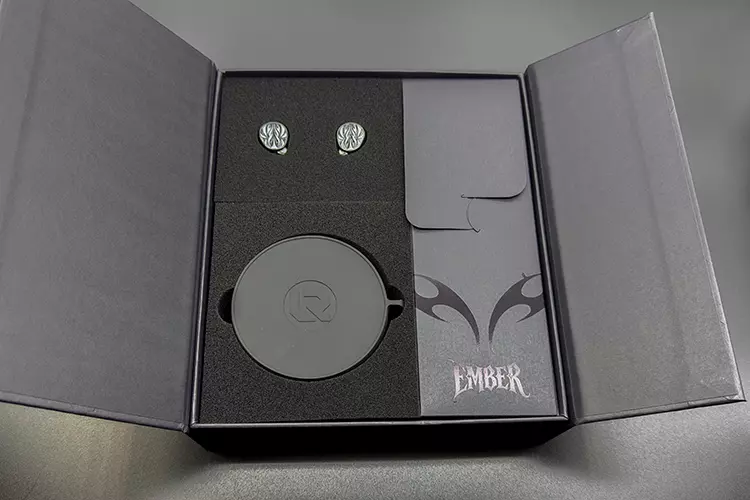
The unboxing feels very familiar if you have seen LETSHUOER’s higher-end stuff before. Mystic 8 came to mind instantly, as the layout is quite similar. It comes in a large box that looks like it wants to make a first impression before you even touch the IEMs.
On the outer sleeve, you get bold “EMBER” artwork in a silver-and-black theme, almost like a poster print, with the name sitting loud in the middle. It looks dramatic and slightly aggressive.
Slide that off, and the inner box switches gears. It is more minimal, less flashy. The top has that subtle LETSHUOER branding and a clean layout, and then you get this dual-door flap design in the middle, sealed with the brand’s logo badge. It feels nice to open, even if it is simple.
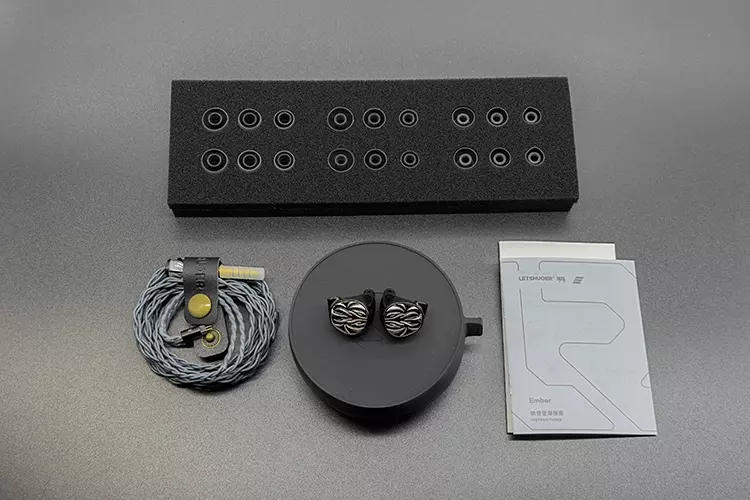
Once you open it up, the layout is straightforward and tidy. The IEMs sit on the top left in a foam cutout. Right below them is the carry case, round and clean, sitting snug in its own slot.
On the side, you have the accessory packet and the ear tips tray, stacked neatly so nothing is floating around.
A few accessories, such as a cleaning cloth, a cleaning tool, etc., are not present, so it is not like you are unpacking ten layers of stuff.
The included accessories themselves feel complete enough, but I still think the box is bigger than it needs to be. The box is half air with a lot of foam and a lot of space doing nothing. It could have been packed in a more compact, tighter way without losing that premium feel.
Carry Case
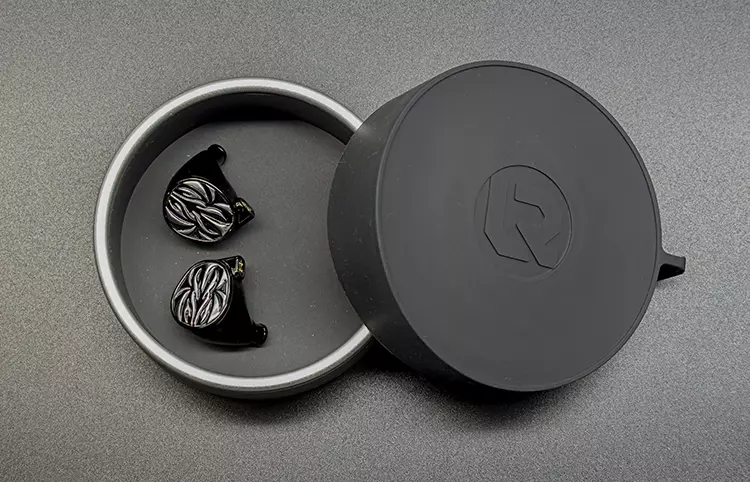
The Ember comes with the same carry case as the Mystic 8. It’s that round puck case. Shiny aluminum body and a thick black silicone lid that sits on top like a cap.
I actually like it. It feels properly made, and it can take a beating. It’s light, easy to use, and it does not lose its shine.
I’ve been using the one I got with the Mystic 8 for more than eight months now, and it still looks quite fresh. The matte finish makes sure the scratches are hidden. No obvious wear, no peeling, and no sad-looking scratches all over. Inside, there’s enough room too.
Ember’s shells are tiny, and the stock cable is lean, so everything fits without you having to fight it. The silicone lid closes tightly. Like, you can feel it seal. That gives a bit of confidence when you’re throwing it in a backpack.
The top has the logo, and there’s a little lip that makes it easy to pull off. Not a big deal, but it helps. Also, the inside of this case has a rubber layer, and the bottom too. The one in the base is a nice touch because it mitigates the scratches.
Click on page 2 below for my sound impressions and recommended pairings.
