

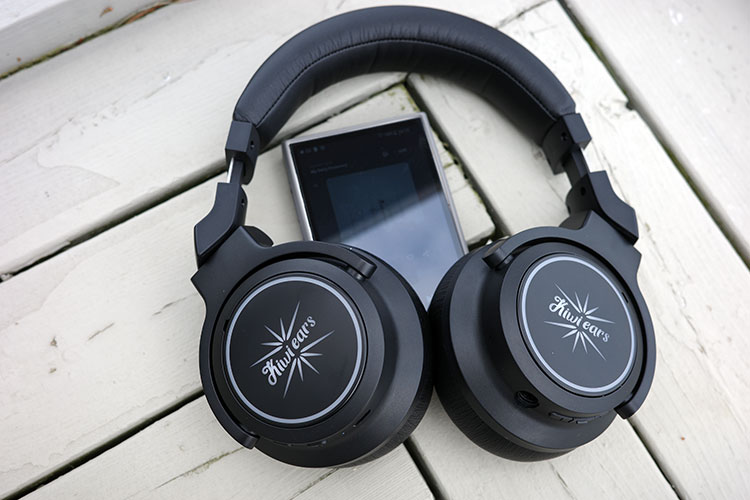
Lynn reviews the Kiwi Ears Aventus, an affordably priced set of Bluetooth wireless closed-back ANC headphones designed for DJs and gamers. It is currently priced at $89.99.
Disclaimer: This sample was sent in exchange for my honest opinion. Headfonics is an independent website with no affiliate links or services. I thank Linsoul and Kiwi Ears for their support.
Click here to read up on the Kiwi Ears gear previously reviewed on Headfonics.
This article follows our latest scoring guidelines, which you can read in more detail here.

The Kiwi Ears Atheia just came through my way, and I was impressed with the build quality, gorgeous looks, and a sound that, while it will not impress everyone, showed a trend for pushy, dynamic bass qualities without apology.
Many of the Kiwi Ears IEMs we have reviewed over the years come with differential tunings to match many needs. From bassy IEMs to detail retrieval-oriented flavors, the Aventus floats a bit differently.
Oriented towards DJs and those who like to have solid bass-foundational wireless headphones with some added flair, makes for a natural stepping out from Kiwi Ears.
As such, the Aventus, while geared towards those who might spin the platters, those of us who want an easy-to-use, affordable, everyday commuting wireless headphones might just appreciate the benefits, too.
Features
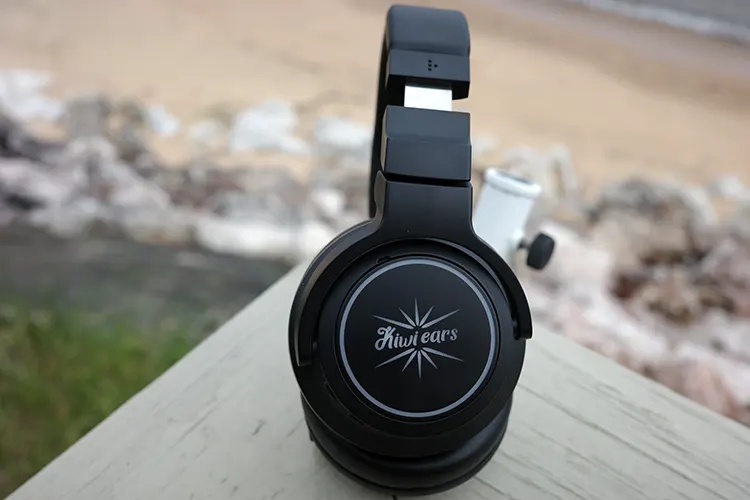
Designed with gamers and DJs in mind, the Aventus comes with two drivers (hybrid), a 40mm dynamic driver for the low-end and mids, and a smaller 10mm dynamic driver to help fill the holes, adding depth and space in the soundstage.
While having multiple drivers may not be unique, the use of affordable BT headphones is a positive contribution to the Kiwi Ears’ stable.
Tuned with what Kiwi Ears call “mild Harmon tuning for strong bass,) the Aventus follows the latest family footsteps with good grunt down low.
Two sets of foam inserts (one mounted already) come with the Aventus, allowing for somewhat of a custom tuning option. There is a difference between the two, which will be delineated below.
The hybrid ANC technology (reducing outside noise up to 35 dB) uses five microphones for precise noise detection, and with three settings: on, off, and transparent.
While not dead silent when engaged, once the music starts, the main focus is right there inside your head, without distraction. Transparent is not quite as open as I would like, but I rarely use that setting on any of my ANC-enabled units.]
Design
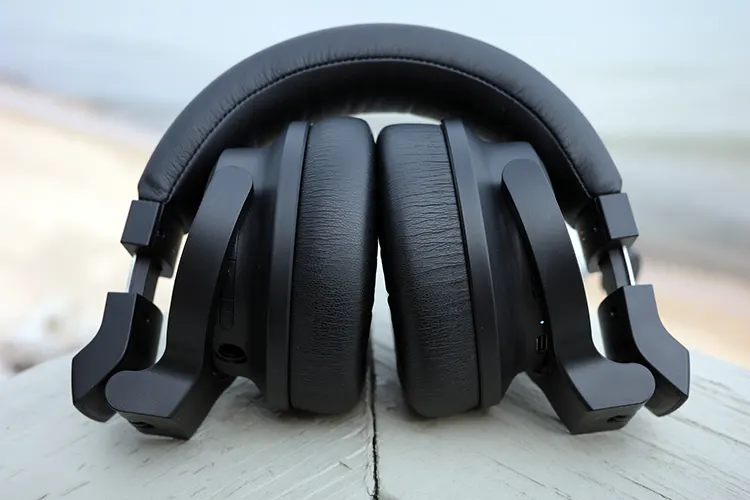
Portability is an aspect that rides high with wireless headphone purchases, and the Aventus accommodates with a different folding design. Not only do the ear cups fold up on the yoke, but those ear cups also rotate 180 degrees vertically, which gives an even smaller footprint for storage.
The case is thin but has a bulbous part where the ear cups reside when folded.
Made mostly of plastic, except the adjusting straps, the design is tasteful and durable, which are two highly regarded traits for wireless headphones as well. The thicker headband and swiveling yoke parts make for added durability.
When not in use, the Aventus can fold flat so you do not mar the cups. Also, when folded for storage, any potential part that may mar a finish touches the extra foam under the headband, a nice touch.
It always takes me a fair bit of time to acclimate to the unit’s controls, and the Aventus is no different. But, since the controls on both cups are on the smaller ear cup part and stick above the flush surface, I found I had less trouble in manipulating those controls.
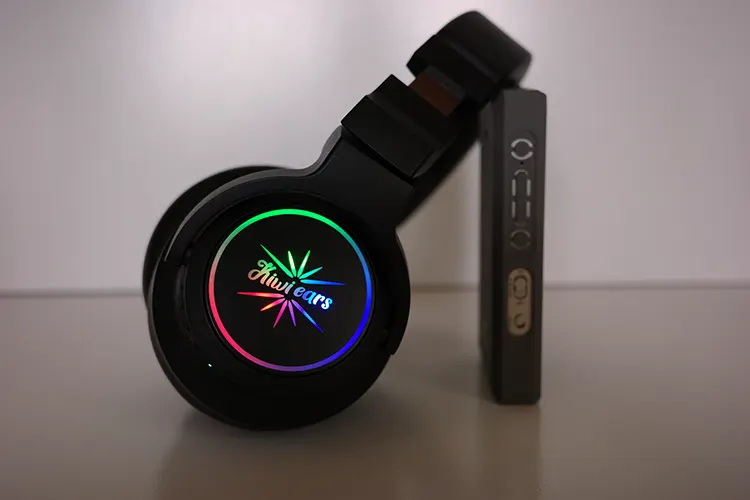
The mostly black color is tasteful and provides a good backdrop for when you activate the light show if desired.
The ear pads are quite cushy, without losing the ability to help keep the Aventus in place, much like a DJ would need when spinning. The pads rotate, coming off with a twist, should you desire others.
A nice-sounding “click” accompanies the reverse when locking the pads in place. The earpads are excellent at cushioning and holding the Aventus in place, but do become quite warm, even with the vegan pleather covers.
Controls
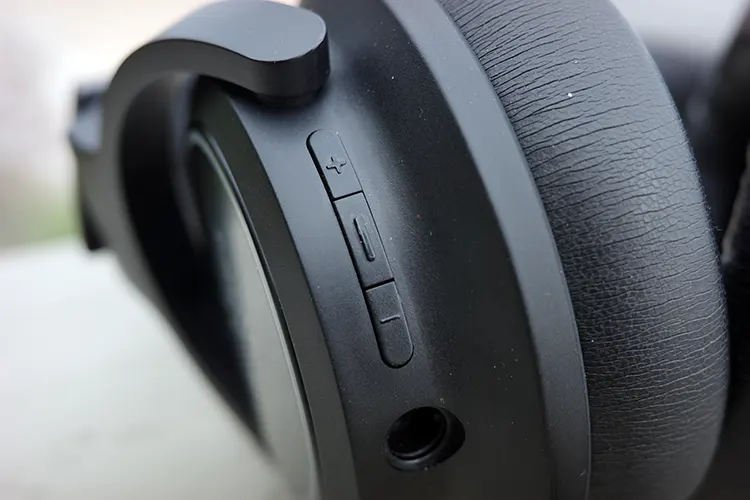
The controls are placed on the smaller part of each ear cup and are easily reachable.
The left carries volume, sandwiching the power/connectivity button. That power button has a higher edge, which makes acclimation to the area easier.
Below that is the 3.5mm SE cable jack. A long press of the raised button turns the Aventus on, and if previously connected, will automatically reconnect to whatever device you were hooked to.
The Aventus can hook up with two devices simultaneously, much like many others, but the voice emanating from inside the cups kindly lets you know if you are connected to two different devices, with “connected” repeated twice. I find this a nice feature that some others may not have.
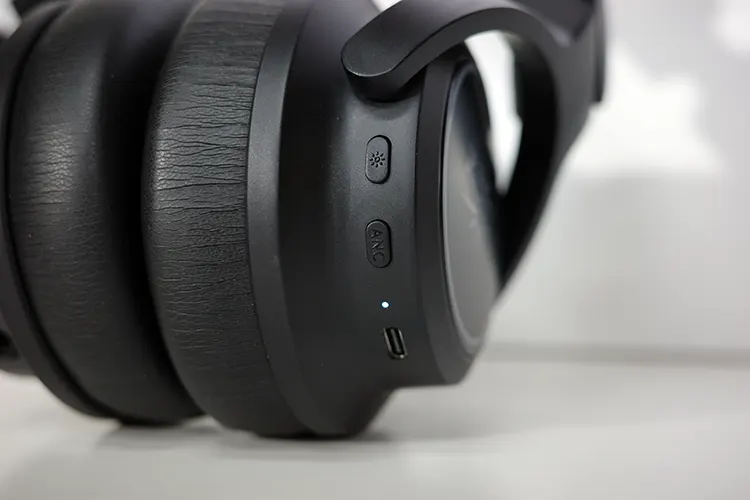
The right ear cup has the LED button and ANC button, with the USB-C jack below. The LED show goes from a solid pattern of RGB colors with a single push to the rotating color themes with another push. A third push turns the LED show off.
Long presses on the volume up fast forwards to the next song, while the same on volume down goes to the previous song.
Battery
Using ANC, the Aventus will run for up to 45 hours, or 18 hours with the RGB lights on. Turning the ANC off results in a near-top-class 82 hours. A 10-minute charge yields 4 additional hours for those times when you forget to charge before the commute home.
Testing of the battery was done three times, after a full charge and depletion to “set” the battery first. During that first complete charge and discharge, time was not kept statistically, but “seat-of-the-pants,” coming back nearly on queue with the reported times.
Kiwi Ears does not have an app with which to gauge battery percentage, but the time kept during the testing was commensurate with my ability to determine when the Aventus shut down due to complete battery drain.
ANC
The Aventus comes with three ANC settings: on, off, and transparent. When the Aventus is powered up, it defaults to ANC-off, which is a minor annoyance, but one that quickly becomes a habit to change.
ANC-on provides up to a 35dB decrease in noise from the outside, which isn’t class-leading, but still commendable.
With ANC off, due to the cushy pads, there is still a modicum of outside noise protection, which can potentially confuse the user if they do not pay attention when turning the unit on (guilty).
I ran most of the testing with ANC-on, but tried transparent when wandering around the house with our dog. I could hear the tags jingle on her collar without a bother. I did prefer ANC-on for the isolating factor, though.
Packaging & Accessories
The Aventus comes in a colorful box, giving an outer space feel to it, with the Earth behind. The RGB colors are lit, adding to the flair.
Sliding the box out the side, you are greeted by the gray, tightly-wound fabric case that gives decent support.
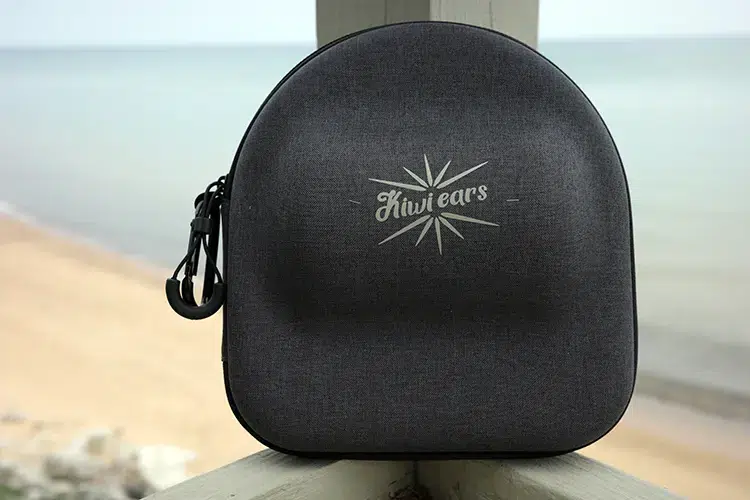
The company logo is emblazoned upon the bulbous section mentioned above, while the case overall gives a good grip. A nicely-sized carabiner is attached for hooking to your briefcase or backpack if desired.
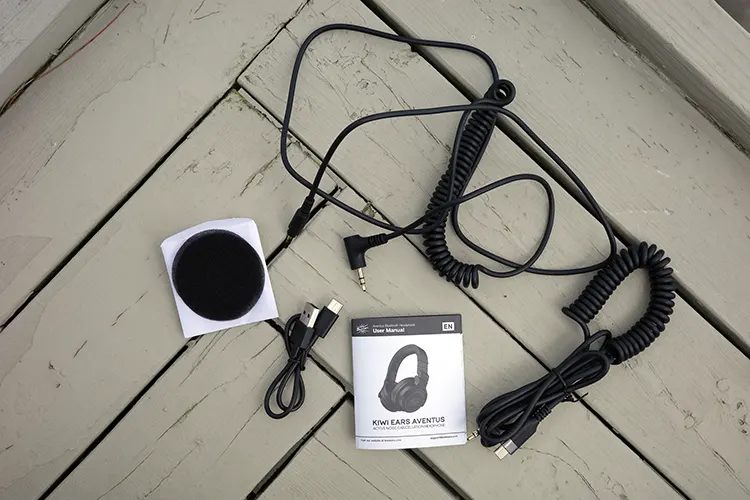
Three cables are included, with a short USB-A to USB-C for charging purposes, a “usual length” 3.5mm SE to 3.5mm SE cable, and a USB-C to 3.5mm SE cable for use with a computer or such device. I am unsure if you can charge the unit while using the USB-C cable.
The paper pouch, which contains the other foam insert pads, is also inside, along with a small but thorough user guide. It is nice that you can carry all three cables along with the Aventus together in the case, not having to worry about any.
Case
While the zipper is one of the largest I have seen of late, it is very much appreciated. Opening the case, each side has a mesh pouch that houses the different cables on the bottom portion, while the Aventus sits above, in a folded fashion.
The bulbous factor of the case might hinder where you place the case within your daily gear, but attaching it via the carabiner is a good option.
Sound Impressions
The Kiwi Ears Aventus was allowed 75+ hours of burn-in before any critical assessment was done. Also, the unit was allowed to drain completely (after a full charge) before testing. The battery was charged and discharged completely twice for battery testing purposes.
Items used for this comparison were an iPhone 16 Pro Max, a MacBook Pro, and the FiiO M21 DAP. Comparisons were made with the MOONDROP Edge and the Sennheiser ACCENTUM Plus.
Summary
Following on the heels of the Atheia, the Aventus shows the same low-end tendencies. A preponderance of low-end grunt comes through, but with less of an authoritative punch than the Atheia. There is still that guttural feel, but with a little less authority and a bit tighter control.
The lower mids tend to dominate the signature, with help from that punch down low, by powering it forward. There is a looseness to this area that leans towards a fun-sounding signature, though.
The mids are not pushed upward, nor forward as much as a result, but the preponderance of lower mids lends to that fun sound.
The upper-end shows forth with a small bit of sparkle, but not enough to give the signature the needed detail retrieval or clarity you often associate with the treble region.
The soundstage counters this by being expansive and high, much like a disco would be on a jumping Saturday night.
Bass
The lower end does reach into the sub-bass area, with decent authority, but less than the Atheia. One might have thought that the DJ version would be built around guttural bass response, but there is more to it than that.
The sub bass is authoritative and bold, like you expect, but without definition. The texture is rough, like an overpowered dance floor speaker set, but it does not proceed into a distorted, flabby encounter.
It does punch hard, with decay lengthening the low notes more than the attack. This elongation is what gives the grunt and fun character, while also portending the looser nature of the lows.
Mids
The authoritative lower mids tie the low end and midrange together loosely, with the same extended decay. This synergy between the sub-bass, mid-bass, and lower midrange adds to the fun, DJ-ish character of the Aventus.
This does come at the expense of an accurate and detailed sound, with vocals becoming emotive rather than immersive and of a higher quality. Made for genres that carry punctuating, looser sound, the Aventus gives vocals authority, but at the cost of clarity.
Somewhat lost in this as a result, vocals come across as subtle and smooth instead of textured. But there is a bit of an edge to them due to the lower-mids moving into the midrange. The noticeable boost around 500 Hz gives us that edginess, but lacks control.
The upper midrange registries come across as brighter and faster, with an emotive effect. The rise at about 2kHz comes into play here.
The upper mids can be colorful and spacious, with emotion, but tend to be held back a bit by the longer decay down lower in the signature. Mind you, this is probably the part that gives the Aventus its best qualities.
Treble
The upper end seems opposed to what a DJ headphone might need. Or a gaming headphone, for that matter. Strong upper reaches, which are controlled with excellent extension, are almost necessary for the DJ to properly hear what they are sending our way to the dance floor.
The same can be said for the nuances in first-person games, where locations are paramount to proper immersion into the game.
But all is not lost with that aspect lacking. The Aventus presents a thoroughly engaging treble region, if not too expressive. The level of detail retrieval is probably best here, which allows the top end to meld into the looser character of the other registries without singling itself out.
Often, the tie comes from the middle, keeping both ends from going in different directions like two dogs on opposite scents during a walk.
Catastrophe can occur when this happens (guilty), but instead, the Aventus top end allows the expressive hits of cymbals to be concise, sharp, and punctuating without overdoing it.
The upper end notes of percussive instruments are just as important to a DJ as the low end. Maybe more so, since that punctuation keeps the rhythm going. And in that regard, the Aventus is very, very good.
I read online somewhere that the Aventus is tuned for a dynamic signature, and the treble region knows not to overstep those boundaries. The punctuating control keeps all of that in check, melding to the signature quite nicely.
Soundstage & Imaging
The soundstage stays grounded due to the low-end reach and looser qualities. But unlike some, I feel that controlled extension up top helps expand the width, allowing notes to spread out horizontally, and vertically a bit less so.
Expansive in width, the genres that favor such a signature, such as EDM, thrive here as you would expect.
The left/right imaging is excellent due to the horizontal spreading, without losing girth to the notes in the vertical plane.
Distinctly defined, the sound comes across as finely separated layers, almost antithetical to the sound signature. The synergy of layering plays into the melding of the sound signature better than it has a right to.
Where the frequencies work together, melding into a semi-coherent signature, the sound stage breaks it apart into separate aspects, but without losing the cohesive nature of the sound.
Click on page 2 below for my wireless performance observations and selected comparisons.
