

Sound Impressions
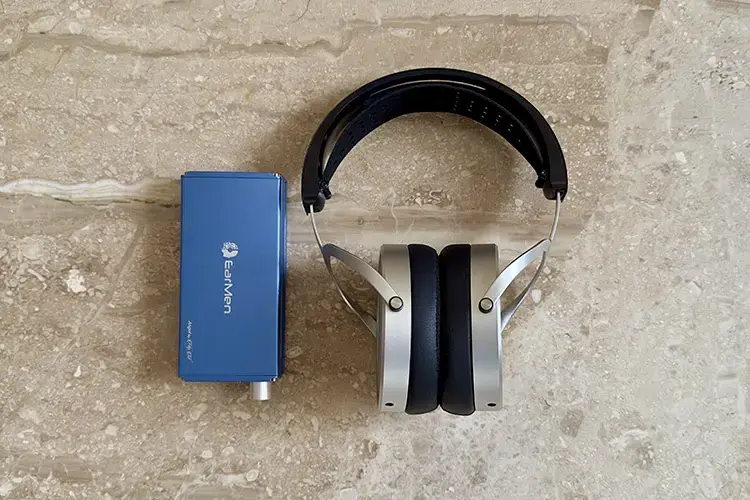
The following sound impressions of the HIFIMAN HE600 were completed using a mixture of my main source, the Questyle CMA18 Master, and the Earmen Angel. For the review, I paired the headphones with the stock cable and stock earpads.
Summary
Not only does the HE600 sport a new build, but it also has a sound that is quite refreshing and inviting. It is tuned fairly balanced, as there was no overemphasis on any frequencies.
The bass hits with authority and is very controlled and precise in the strikes, while the vocals and instruments sound very lifelike in tone and timbre, with just slight emphasis on details that take the tuning away from analytical impressions. The treble is smooth but delivers ample detail and sparkle.
Overall, the timbre performs a great balancing act between neutrality and technical proficiency, with just enough musicality to not sound dry.
It also displays technical prowess with an immersive soundstage, accurate imaging, and a pleasant overall presentation that is somewhat solid and balanced. I find it handles almost every genre quite well.
Bass
The HE600’s bass is technical, well-textured, and layered, delivering accuracy and control rather than warmth or slam. The bass on the HE600 extends deep and has a solid impact.
The sub-bass has good rumble and depth. It’s not one of those earth-shaking sub-bass responses, but the rumble kicks in as and when tracks demand, all without dominating or masking other frequencies. The mid-bass adds just a little warmth and thickness to the bass, keeping the bass tight and clean.
Since the mid-bass stays within limits, instruments like kick drums and bass guitars sound tight and articulate, not boomy. This also avoids adding excess warmth to the overall sound, keeping the upper frequency range quite clean.
The details are presented very effectively, so you can easily discern the bass line from multiple instruments. Because the bass does not have excess bloom, the fine contours of bass notes come through clearly.
The bass regions have good separation, so multiple bass instruments do not blur into each other but instead retain distinct presence.
The planar driver also contributes to the quick speed and fast decay of the bass. The bass notes hit firmly and dissipate rather quickly without lingering, which adds to the sense of control and cleanliness.
While this level of impact and accuracy is commendable, I would have preferred a slight lift in the sub-bass region along with tighter, cleaner, more controlled slams in the mid-bass.
Also, compared to the HE6, this bass does not feel very clean and tight, and the visceral impact of the HE6 is a bit lost here.
In complex tracks with heavy bass, the mix can occasionally feel a bit too dense. Nonetheless, I find it adds a lot to the fun and excitement in the sound.
Midrange
The midrange overall strikes a balance, making it sound resolving and detail-oriented, yet smooth and musical enough to stay enjoyable over long sessions. The midrange carries a pinch of added energy, which makes the overall tuning engaging.
The lower midrange is clean and offers subtle warmth and thickness to the midrange, though it could have a bit more body for sure.
This FR region has enough weight and presence to help details from instruments such as cello, guitar, and vocals emerge clearly. The subtle textures in the instruments pop out nicely, and the region cleanly separates itself from the bass.
In the upper midrange, there is a slight forwardness that gives instruments and vocals added expressiveness and presence.
Female vocals, pianos, and strings have a crisp edge with well-defined articulation. Even with a detail-focused tilt in the midrange, the tonality stays smooth and coherent.
The midrange is a bit forward, placing the vocals in the center, giving them ample space. The tuning is suitable for almost all types of music and benefits from the clean separation among the instruments, with precise positioning and articulate instrument presentation.
Treble
The treble on the HE600 is lively and engaging, with a strong presence in the lower treble region and plenty of air and sparkle.
Notably, the treble region, which can get a bit spicy due to some exaggerated areas on certain HIFIMAN releases, remains quite balanced here, thus avoiding any peaking whatsoever and making the treble a highlight of the HE600.
I tried the HE600 on multiple sources and did not find any hint of sibilance or harshness, even on bright-leaning sources. A poorly recorded track may expose some of the treble peakiness, but that’s fairly common on many headphones.
Treble notes resolve quite well without any overlapping. This contributes to good layering and separation in busy and fast-paced tracks. The treble notes have a natural decay to them, where notes don’t dissipate too quickly, nor do they linger unnaturally.
Instruments such as cymbals, hi-hats, and string harmonics sound crisp and do not carry any more energy. The treble also avoids artificial brightness, so cymbal shimmer comes across as natural rather than exaggerated.
The uppermost treble region offers ample extension, which preserves openness and adds a sense of air around instruments.
Overall, the treble presentation feels smooth, coherent, and detailed, adding sparkle and atmosphere without harshness. For me, the treble pushes boundaries, offering a crisp and highly detailed top end that never bothers me, even in longer sessions.
If I were hard-pressed to complain, I would say it could be a touch smoother and more evened out, but that’s really too much to expect from an otherwise highlight from the HE600.
Staging & Dynamics
The HE600 has strong technical capabilities, making it a great choice if you’re looking for detail-oriented listening.
The soundstage on the HE600 feels quite natural, and it does not span gimmicky wide but maintains a fair width. The depth and vertical height of the stage make up for the width, giving an overall immersive soundstage.
Instruments don’t just spread left and right but also occupy realistic vertical positions, especially noticeable in how vocals are placed just above ear level.
The depth is impressive, with vocals clearly up front while ambient effects and instruments are stacked far into the background. Though it does not reach the depth of the HE6, it is still presented quite well.
Imaging is excellent on the HE600, with very accurate spatial positioning of instruments within the soundstage. Even with a soundstage that is not overly stretched, the HE600 effortlessly places instruments across the stage with enough breathing room among them.
Whether it’s busy, fast-paced metal tracks, orchestral sections, or electronic layering, the HE600 keeps the mix organized without any sense of congestion.
The front-to-back instrument separation could, however, be better. A touch wider soundstage would have done better justice to heavy tracks.
When it comes to dynamics, the HE600 really shines. It handles both soft and loud passages effortlessly. You can easily pick all the tiny details and subtle nuances, making it simple to distinguish each instrument, offering a transparent and highly resolving listening experience
At the same time, macro-dynamics hit with real authority, offering solid impact when it’s asked for, though they stop short of the raw slam and shift their focus to speed and agility.
The result is a presentation that feels balanced, though slightly more restrained when compared directly with the most dynamic performers.
Synergy
Efficiency & Sensitivity
The HIFIMAN HE600 has an impedance of 28Ω @ 1 kHz and a sensitivity rating of 94 dB/Vrms.
Compared to the HE6 series of headphones, the HE600 is very efficient and relatively easier to drive, but it can still take up a substantial amount of power and scales up well. It’s quite a relief for portable DAC/Amps, which can now drive the HE600 fairly well.
I could not drive the HE6SE with sources like the Questyle CMA18P or Earmen Angel, which are otherwise powerful enough for any IEMs you throw at them or even do justice to relatively easier-to-drive headphones.
While these portables drive the HE600 impressively, with stronger power specifications, it does benefit, as the soundstage becomes more expansive and the dynamics improve.
The HE600 has better synergy with neutral to slightly warm-leaning sources. I would avoid sources that are too warm or bright or emphasize treble spikes.
Pairings
I did not bother to pair the HE600 with my DAPs, such as the Lotoo Paw Gold Touch or the Astell&Kern SP3000, knowing these sources would not do justice to the HE600’s power demands.
Even with a volume level of more than 90 on the SP3000, the HE600 felt like it had just started talking. LPGT still managed to drive it, but not authoritatively.
Other sources, such as the Questyle CMA18P and Earmen Angel, manage to power the HE600 more appropriately. I like the overall synergy with the Angel, but some congestion and a lack of dynamics are felt.
The bass did not hit with real authority, which the HE600 can deliver on superior sources. The midrange and treble seemed fine, exhibiting a substantial amount of energy and maintaining clarity overall. The treble, however, felt somewhat less resolving.
The HE600 reaches its full potential when paired with the Questyle CMA Master, a powerful desktop DAC/amp.
With other sources, I did not find the soundstage of the HE600 to be very remarkable, but the way this pairing spreads out the instruments while keeping the vocals right at the center of the stage and maintaining excellent spacing among them makes the listening experience truly immersive.
With this pairing, the dynamics improve significantly, and the bass gains greater authority with stronger impact and refinement.
The sub-bass, in particular, gains depth and has more rumble to it. In the midrange, the resolution is much better, and the details emerge more vividly.
The treble notes resolve very well on the CMA18M, which felt somewhat overlapping and blurred on the Earmen Angel. The treble sounds highly detailed with plenty of air and sparkle, without veering into any harshness.
One notable aspect is the treble smoothness the HE600 maintains across a variety of sources I tried.
