

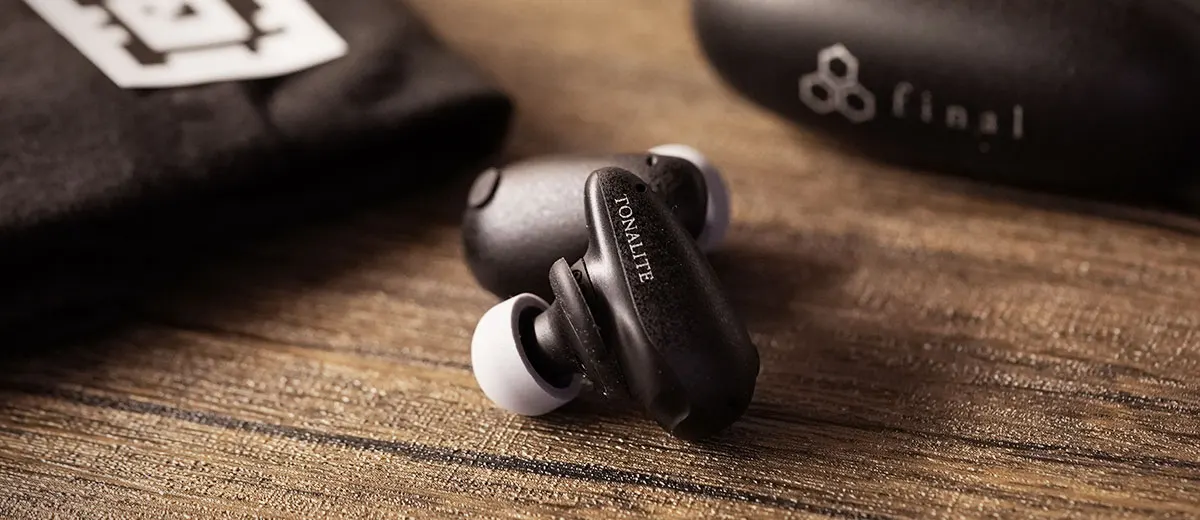
James reviews the final TONALITE, a new TWS with innovative DTAS Calibration technology that creates a personalized timbre profile for the user. It is currently priced at $329 SRP with early bird prices from $247 on Kickstarter.
Disclaimer: I received this sample in exchange for my honest opinion. Headfonics is an independent website with no affiliate links or services. I thank the team at final and Jack Rabbit Media for this opportunity.
Click here to read more on the final audio products previously reviewed on Headfonics.
This article follows our current scoring guidelines, which you can read in more detail here.
final’s new flagship TWS, TONALITE, was first spotted at the Autumn show in Tokyo. It might be the most advanced set of True Wireless earphones released to date, and one which I consider a step up from the ZE8000 MK1 and MK2 series.
The TONALITE comes equipped with a new f-core DTAS (Digital Tonalization and Acoustics System) driver for extremely low distortion performance, surpassing both TWS counterparts and even many wired designs.
There seems to be a lot of effort that went into this product, and from the actual results, I am convinced by this scientific approach, which has produced easily audible enhancements and a realistic timbre.
The calibration experience resembles Genelec’s Smart Active Monitors (SAM) calibration or other DSP impulse response sweeps, but this time the process is done right in your ears.
The TONALITE will be available for $329, which is less than I expected considering its features.
Call me genuinely impressed with the performance after the calibration, and read on for the full details and how it compares to the final’s excellent ZE8000 and MK2 TWS.
Features
DTAS
The TONALITE collects biometric data, including the shape of the head and the outer ear with a camera, along with measurements of the ear canal’s acoustic properties using multiple MEMS microphones.
This data is then sent to final’s cloud server for processing to render a customized sound profile. This technology counteracts how ear and body shape alter different frequencies, helping to recreate a more natural response and achieve more accurate spatial reproduction.
In fact, final also offers a sound profile customization service at their headquarters in Kawasaki, Tokyo. The TONALITE provides a simplified version that you can perform at your own pace, without the need to visit their facility.
Personally, I find this a practical implementation, as we all have different body and ear cavity shapes. These variations can alter perceived tonality, much like how the placement of speakers in rooms of different sizes and angles affects sound.
This is a physical barrier that other TWS earphones or even wired IEMs can’t compensate for when they don’t have built-in mics and DSP engines. With the TONALITE, users of various body shapes can experience the intended performance and tone.
Companion App
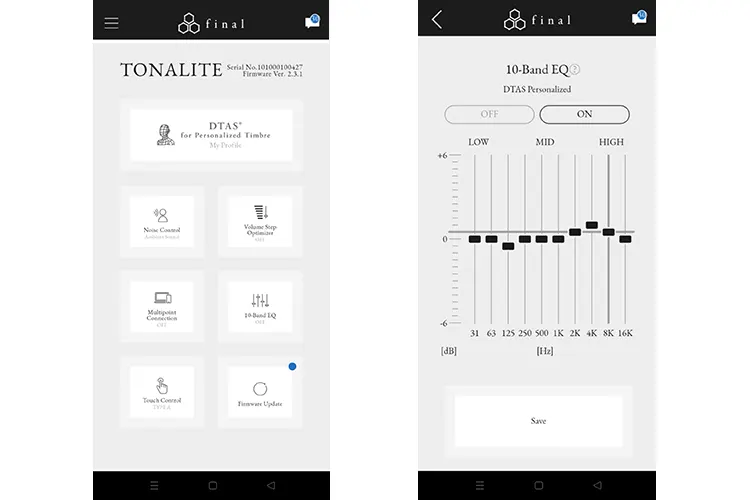
In the companion app, you can create multiple sound profiles, allowing you to calibrate several times and switch between them.
The “General” profile is a target curve based on statistical results from the data accumulated from the JDH service final applied to the ZE8000, and also data they have accumulated from volunteers around the world
Beyond that, the TONALITE app also features a 10-band equalizer and inherits fine volume adjustment features from the ZE8000 series.
Despite all these added features and LDAC support, the TONALITE can play back for 9 hours without calibrated profiles and 7 hours with the personalized tuning profile.
Measurement Process
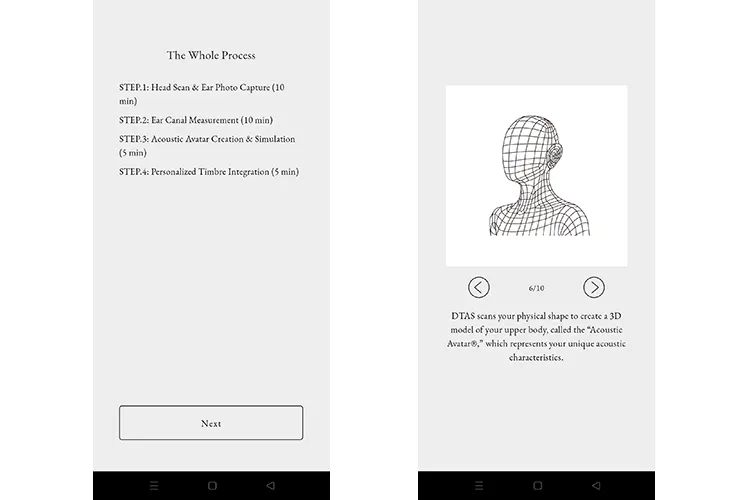
The measurement took around 15 minutes for me. final has set up several breakpoints so you can save your progress and take a break every five minutes.
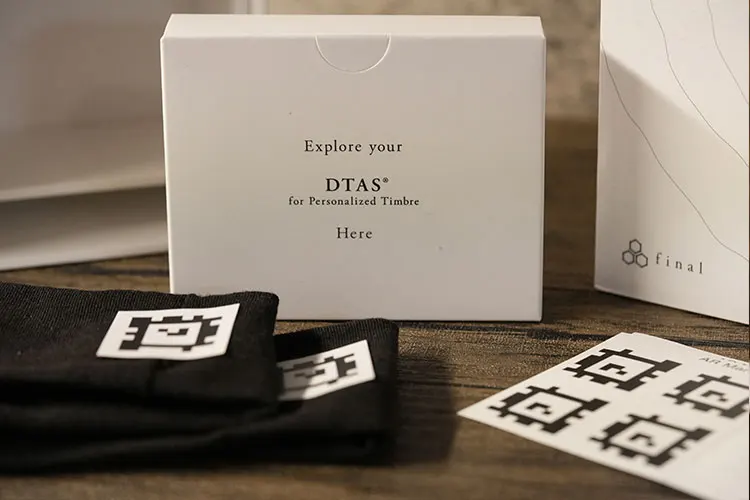
The process begins by measuring head shape, which is why they provide a headband with QR code stickers. Then, users wear earphones with and without tips to measure the response in the ear canal.
During the measurement, the app sends data to final’s server multiple times. In the end, a digital avatar is created, representing the unique profile customized for the user.
The whole process is an engaging experience, with sufficient on-screen instructions and haptic feedback to indicate when photos have been successfully taken for the measurement.
Design
Ear Buds
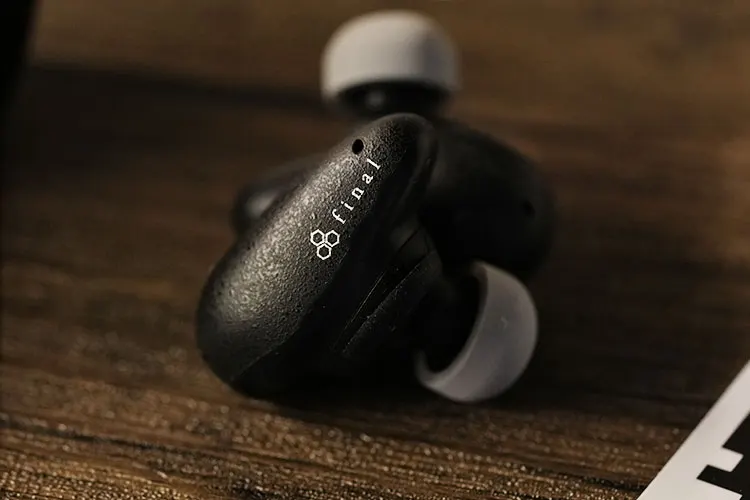
The first moment I saw the TONALITE, I was glad that final made the profile slimmer. The ZE8000 series stuck out too much and caught wind noises more easily.
The TONALITE is much more streamlined and does not require proprietary flanges, enhancing noise isolation and the overall experience.
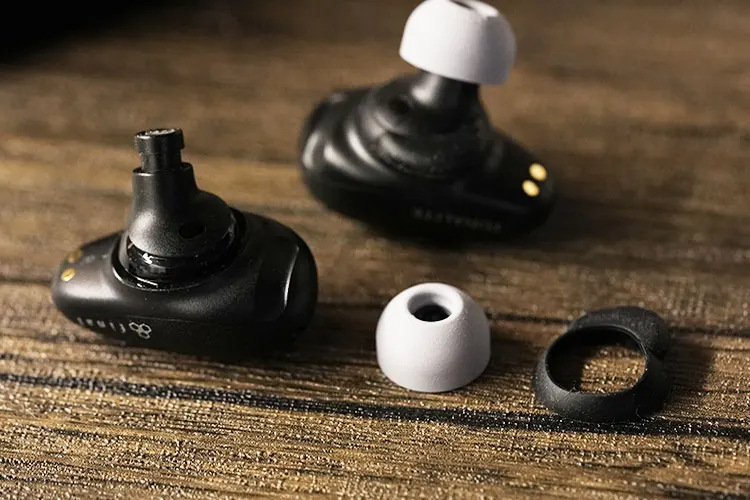
Interestingly, there is a “second flange,” an adjusting ring that sits on the concha. This helps block out some noise while distributing the weight more evenly. There are two different sizes for the adjustment ring, allowing you to swap according to your ear size.
The return to a more universal flange design makes it more adaptable to different ear shapes and allows room for tip rolling.
In practice, the new FUSION-G Tri-brid stock ear tips and longer nozzle help it to hold onto the ear more securely than the previous ZE8000 series.
One fun detail is the small dot that protrudes from the faceplate. final calls it a tactile dot, which helps users locate the touch control area and makes it easier to pull the earpieces out from the cradle. This attention to practical aspects is likely why many of us appreciate Japanese designs.
Another detail I really like is the coating, which makes it scratch-proof. Although the earpieces feel very light, they still look premium, with the molding marks nicely hidden.
Like the previous generation, the TONALITE is also IPX4 certified, so you don’t need to worry about water splashes.
Cradle
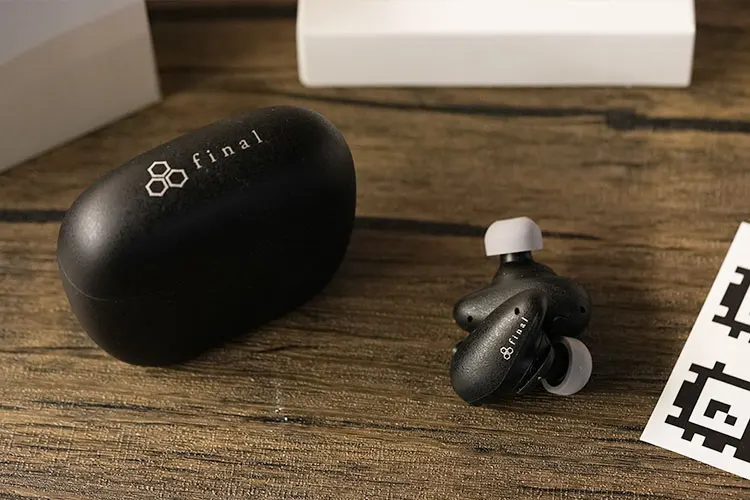
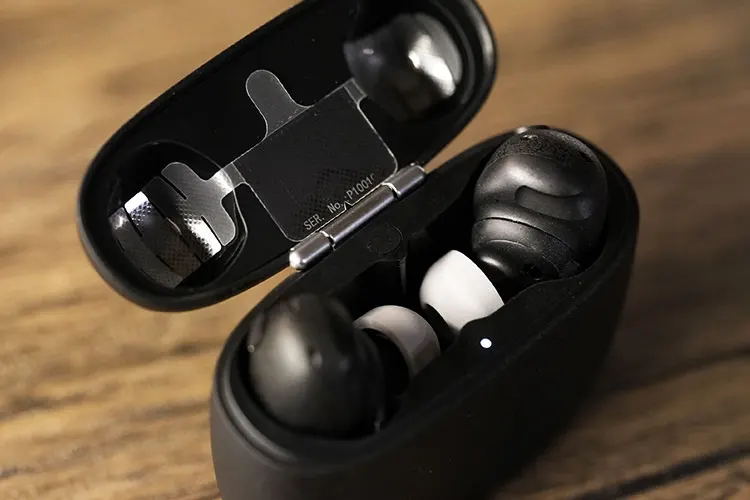
As for the cradle, it returns to a design similar to the AirPods, which is slimmer in profile compared to its predecessors. It is made with flame-resistant material and includes a protection circuit, which is very thoughtful.
Despite its slim design, the cradle provides two full recharges for the earpieces, allowing a maximum of 27 hours of use with fully charged TONALITE earphones and a fully charged cradle. However, using noise reduction mode will reduce the playback time by around 30%.
Comfort & Isolation
final’s smaller IEM profiles are always a great fit for different ears, and the sealing property is excellent, almost airtight. You can feel some suction power when removing the earpieces.
While the new design does not use a large pad of silicone for the tips, it provides enhanced insertion depth.
The thicker material on the tips is even more effective in blocking out noise passively. This new design also requires less adjustment after insertion into the ears, as mentioned.
Hybrid Noise Cancellation
The TONALITE features ANC, just like previous flagship TWS products from final. It includes both an internal and an external microphone to collect noise and cancel it out as usual.
However, this time there is a noticeable change in form factor. final has improved the design, inspired by the A10000, by lengthening the nozzle for better bass control and passive noise isolation.
In my experience, the ANC efficiency has improved compared to the ZE8000 MK2, especially when tested in windy conditions.
Mono-stereo mode
If you put one side of the TONALITE earpieces into sleep mode, you can trigger the single-ear mode that will put both channels into the same side, which is a great feature if you want to use it for calls on the ride.
Personally, I find it slightly uneasy to have noise-cancellation on for one side of the ear and not wear an earpiece on the other side, while ambient sound mode works great.
Packaging & Accessories
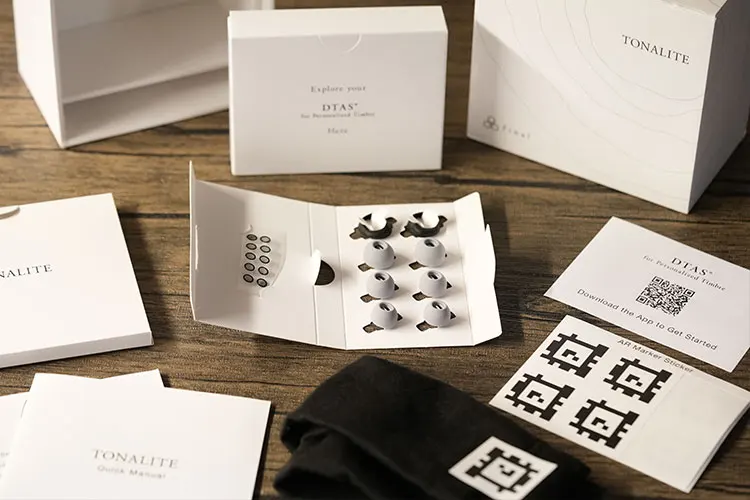
Packaging quality and design are always professional and consistent with final products, and even though the TONALITE comes in a small package, you can see a lot of details that go into the manuals, and protection of the earpiece and cradle when it is fresh in the box.
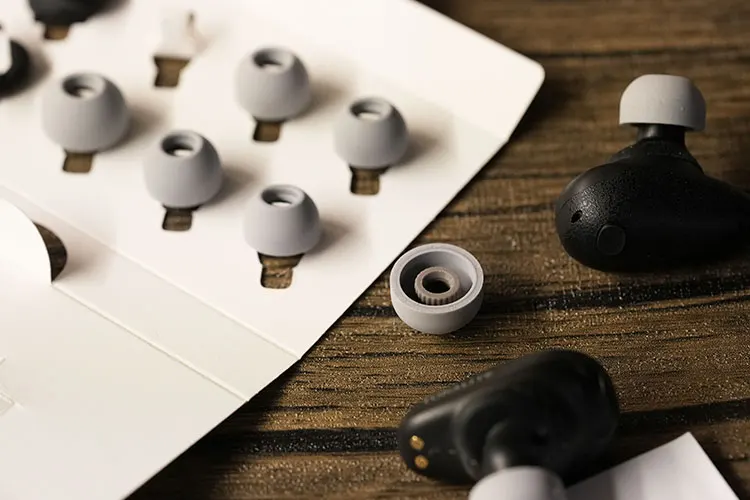
In the packaging, you will find the headband, QR stickers, 4 sizes of ear tips, and two sizes of the special adjusting ring that sits on the concha.
Sound Impressions
The impressions below are based on my experience, mainly after calibration. In the comparison section, I will be contrasting it with the previous generation flagship ZE8000 and ZE8000 MK2.
Summary
The TONALITE has undergone some changes in tuning compared to the ZE8000 MK2, which I will compare below. final aims for a cleaner, unaltered tuning this time, allowing listeners to more easily focus on the positioning of instruments and the overall picture.
The difference after calibration is noticeably significant, especially with complex bass lines and at louder volume levels. This enhances the perceived power and depth while providing an unaltered and realistic timbre, without overly polishing or tweaking the output.
In contrast, the ZE8000 MK2 and many competitors struggle to sound as clear in positioning and as stereophonic. The DTAS correction brings about a more holographic presentation due to the “Natural” target curve made by calculating your face and ear shape.
After the calibration process, I find that my tuning profile is generally flat and very nicely extended. The sound is highly transparent and swift across various music genres I tested.
Timbre
Without the calibration profile activated, final applies a custom tuning to the general profile. I find this profile quite flat, lacking the vocal elevation present in previous flagships, while the bass is more controlled, which is great for instrumentals.
Despite this, you can use the built-in equalizer to adjust the tuning, boosting the lower vocal frequencies and treble for a more exciting signature. With or without equalization, distortion control remains excellent, delivering a swift, balanced presentation that is free from harshness.
When the correction profile is applied, there is clearly better transparency. The bass feels much more layered, and the mids are articulated more swiftly.
Initially, it may sound slightly dark in the mid-bass, but you’ll soon realize this allows for more details in the sub-bass and lower vocal frequencies. I find the bass response to be natural, clean, and well-layered, extending adequately in the subs with decent density.
However, for pop music, I prefer boosting the bass a bit to make it more engaging, especially if you are accustomed to slightly elevated bass in IEMs when listening outdoors.
Regarding vocals, they don’t feel elevated for transparency in the upper vocal range, yet they are clearly delivered in a holographic way with a slight warmth and sufficient body for thicker voices. The sibilance is nicely polished, similar to its predecessors. Most music genres are presented in a rather neutral manner.
While the tuning feels slightly warm and does not boost the bass and upper treble for clarity and dynamics, it remains engaging and balanced with decent, definitive power over the full spectrum.
The control, as well as the response speed and extension, may rival the performance of a wired multi-BA design.
Staging & Dynamics
The headroom rendered by the TONALITE feels well-structured, balanced, and extended, thanks to its swift tuning and strong detail retrieval power, which aligns with final’s claims of super low THD performance.
The soundstage is spacious enough for larger ensembles, preventing instruments from feeling cramped in space. Even with solo instruments or a single virtuoso, the TONALITE maintains adequate body and richness while delivering vocal details clearly, and in a slightly laid-back manner.
For a TWS IEM, the soundstage has excellent openness, thanks to the well-defined, extended performance.
In addition to its natural and balanced presentation, transient performance across the spectrum is excellent. When testing with classic acid and house tracks, the TONALITE delivers fast, punchy, and airy bass, with very clear positioning and a holographic presentation.
This setting maximizes the DSP effect, adding airiness to the treble. Vocals are well-rounded, and the hi-hats and synthesized keyboard notes retain their brilliance with minimal harshness, and it feels softened and smoothened with the lower power setting.
Overall resolution is impressive, especially considering the tuning does not overly emphasize certain frequencies to introduce more sparkle for clarity. You can quite clearly discern the depth and height of percussion instruments, even when they are not deliberately highlighted in the mix.
The TONALITE’s performance showcases a blend of clarity, balance, clear positioning, and plenty of micro-detail, which is not common with TWS designs.
