

Select Comparisons
FiiO SA1
Features
The desktop FiiO SA1 features a 3.5” wood fiber woofer (using the same material as the FiiO FT1 headphone), which allows for a rigid structure capable of rapid acoustic response, as opposed to the 5” Rohacell woofer in the SP5.
An aluminum-magnesium alloy tweeter using monitor-grade material measuring 0.75” allows for quick, crisp sound response, complementing the woofer. This is slightly smaller than the 1” tweeter in the SP5.
The Texas Instruments TPA3118 Class-D amplifiers can provide up to 20W x 2 for the woofers and 5W x 2 for the tweeters (60W and 20W in the SP5). Not earth-shattering, but sufficient for desktop needs and potentially bookshelf usage in smaller spaces.
An electronic two-way crossover, at 3.5 kHz, helps maintain a balance across the sound spectrum, while the FiiO app can provide a 31-band lossless PEQ when using a Smart device as a source, which is quite flexible. The app can be used in conjunction with the PEQ to tailor the sound, fitting your space.
With a multitude of inputs, including BT 5.4, the SA1 supports LDAC when applicable, as well as having AAC & SBC Codecs. The SP5 adds an XLR input.
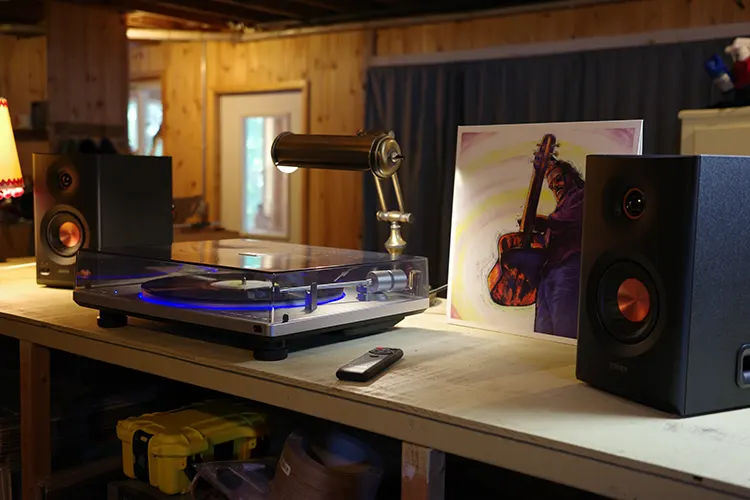
A built-in phono pre-amplifier stage can be used to connect your turntable directly, or you can connect to a BT-capable turntable that has a built-in phono stage.
There is also a subwoofer output included for times when a little more low-end is desired, as in a 2.1 system. Neither the phono stage nor the subwoofer output is available on the SP5.
Design
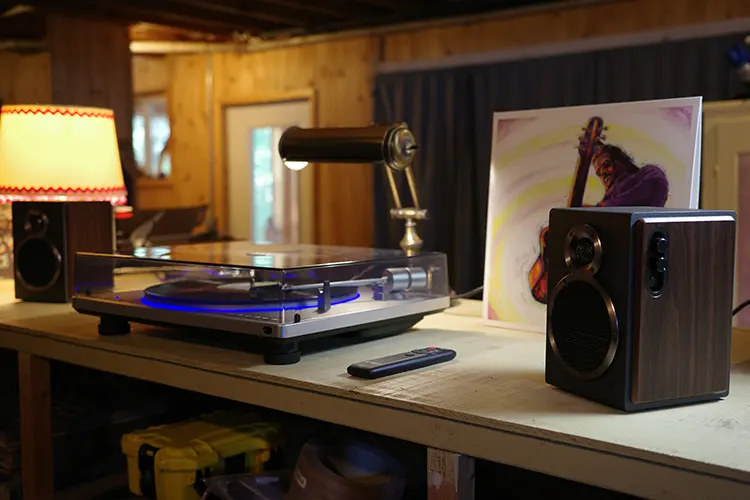
The SA1 uses high-density MDF material up to 12mm thick for the cabinet. The top and sides use 9mm solid wood veneer to reduce resonance, purportedly for a more natural sound. The SP5 uses diecast aluminum in two halves that fit together.
Its diminutive size of just under 8” tall and 5” wide, the 5.5” fits easily upon my desk and other locations, which is almost ½ the size volume-wise of the SP5.
A lower “slot” out the back, combined with two internal shelves of unequal length, acts as a bass port. This allows the SA1 to go as low as 65Hz.
A bass knob allows for added bass, but I found there was not much change to the low-end. The SP5 has a tweeter vent out the back, and the +3 or 6dB bass addition.
The 3.5” wood fiber woofer uses unequal-length fibers bound together, making for a stronger, more responsive structure.
The aluminum-magnesium tweeter provides for crisp, tight sound up top. The Rohacell SP5 woofer provides excellent response times instead of using wood fiber, without losing an emotive effect.
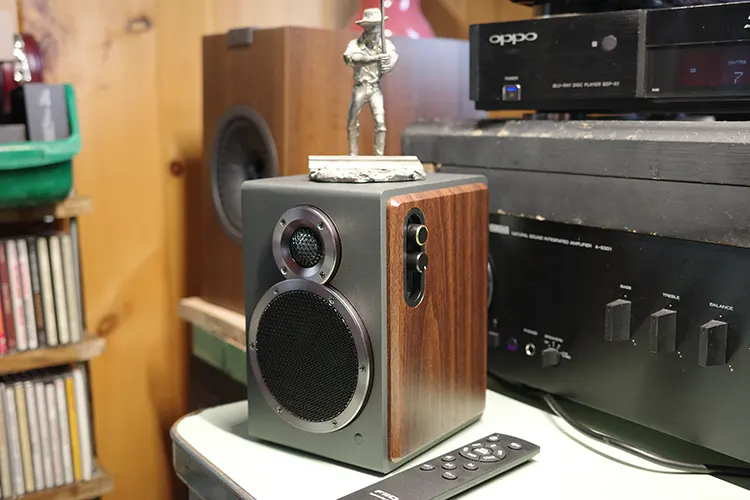
The cabinet is a good-looking unit with a dark gray faux-burnished aluminum look on the top, bottom, front, and back, which combines nicely with the walnut color of the veneer.
The dark metal smoked-chrome rings surrounding the woofer and tweeter look like a two-globe snowman, adding to the appeal. The SP5 looks much more industrial and subdued comparatively.
The business parts are on the side or back of the right speaker, instead of the back of the SP5. The three knobs on the right side of the speaker control on/off, bass enhancement, and input, which glows in the color of operation.
Due to my situational locale, the speakers were switched (R & L) in my office setup. The volume knob on the SP5 glows for the chosen source.
The back of the left SA1 has the typical input/output connections ranging from an RCA/Phono input (with ground wire connection), coax, optical in, USB-C in, subwoofer out, and a 3.5mm AUX in. The SP5 adds an XLR input without having either a coax input or a subwoofer output.
Add a switch for use as either an RCA-in connection or the phono stage, and the SA1 is complete. BT connectivity is internal, with no antenna on the back.
Performance
Proper placement of these ‘Lilliputian’ speakers changes the sound more drastically than the SP5. Suffice to say that even when placed on a desktop, below ear level, the sound qualities were quite adequate, and I noticed less difference from the SP5 and ear level.
I was impressed by the holographic nature of the soundstage. As a nearfield speaker on my desktop, the SA1s promoted a spherical response to each source, with excellent depth to the sound. The SP5s differed only in the placement of the midrange, which sits further back than the SA1.
Bass is lacking, but when hooked to a subwoofer, using the included RCA to 3.5mm AUX cable, the bass expanded greatly. Pushing the bass switch to +6dB on both SP5 speakers added a sufficient amount of bass. I did not miss having a subwoofer.
The top end does suffer a bit as well, falling into an almost polite manner, but with good articulation of notes, lending to a nice extension. The SP5 comes across as smoother with better reach and articulation. But this should not discount the SA1’s sound.
The midrange is defined and vibrant, but without punctuating any one set of instruments or vocals present. A work of cohesion instead of showmanship, if you will. The similarity to the SP5 shows best here, except for the further forward nature of the SA1’s midrange.
Placing the SA1s at ear level gives a bit more transparency along with a clearer midrange. Even when placed at the desktop level, the midrange performed quite nicely. Both worked well below and at ear level.
The treble extended a bit better, as one might expect with proper ear placement. The soundstage becomes a bit taller as well. The same could be said of the SP5.
Klipsch The Sixes
Features
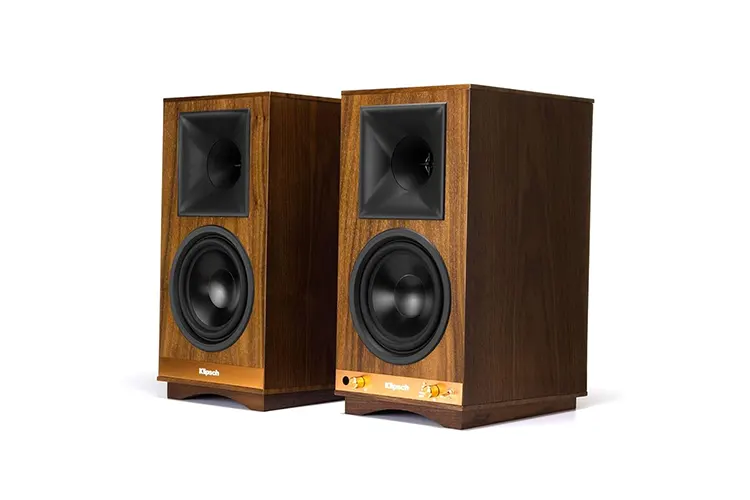
I have owned this pair for close to five years, and use them regularly, besides testing. With a 6.5” long-throw woofer, the Klipsch follows the historical pattern of big low ends, but with purpose. The woofer is larger than the SP5.
The bass port shoots out the back, so placing these much larger speakers can be a bit of a challenge. That port can be plugged with the included foam insert. Plugging has essentially the same aspect as placing The Sixes closer to the wall.
The 1” titanium tweeter shoots into the Tractrix horns, expanding treble output across a more 3D range. A subwoofer can be added, just like the SA1, but truthfully, one is not needed. Differences in sound will be noted below.
Putting out 100W (200W for short bursts, 60W & 20W for the SP5s woofer & tweeter), the Sixes are for much larger spaces than the SP5 but can be successfully utilized in smaller office setups. A frequency response of 40-20,000 kHz goes slightly lower, too.
Design
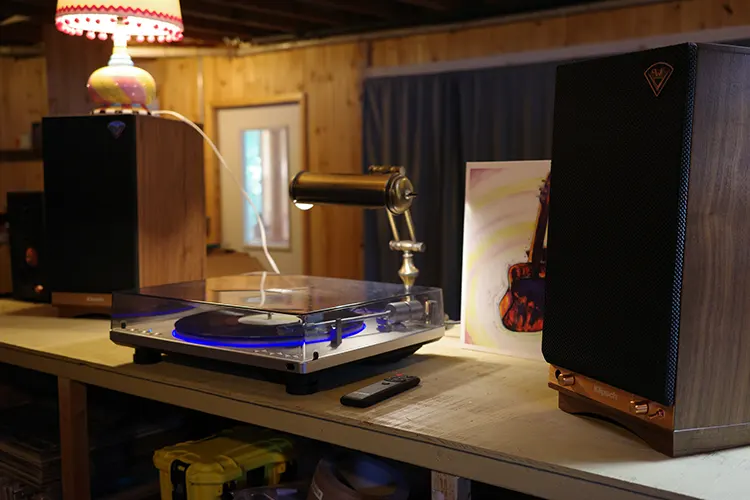
The Sixes are much larger, coming in at 35 lbs. each, and with a size comparable to a larger bookshelf speaker. While they work on the floor, lifting them approximately 12” is ideal.
The real walnut veneer has the vintage look, as do the gold knobs and switches. The front knob allows for switching between inputs, and there is an on/off toggle.
I worry about that toggle, as it could be easily broken off if the speaker is on the floor. The grill is magnetic, and keeping it off allows the vintage look to exude elegance.
Inputs range from USB digital audio input, optical digital audio input, to Bluetooth 5.0 audio, to RCA stereo line level analog input, an auxiliary line level input, and an RCA phono level analog input. Lacking is the XLR input of the SP5.
A fully functional remote helps to control inputs and volume, similar to the FiiO. Aimed at the same category, the Sixes are a good comparison to the SP5.
Performance
This powered speaker forges a path into the mid to upper range of powered speakers at an excellent level. The bass and midrange come across as strong and authoritative. Vocals are precise and persistent.
The SP5 competes well but does not have as much sparkle up top. The Sixes can come across as bright in comparison, which may not be the flavor some would prefer.
The treble from the Klipsch, while excellent, hit a bit more frontally for me than the FiiO. And this is where the SP5 does very well. Both carry a multi-metal tweeter, but the sound could not be more different.
Where the Klipsch hits frontal and is impactful, but spreads out nicely, the SP5s come across with a more toned-in sound that seems a bit tamed, but smooth. The smoothness of the SP5 does not discount its ability up top, though.
Edifier MR5
Features
The Edifier MR5 uses an active/passive configuration, where the active speaker (left) receives all input signals and sends them to the passive unit (right). It supports RCA, TRS, and XLR inputs.
Filters to adjust bass and treble levels are included, much like the SP5, but on a rotating basis, instead of a dedicated switch.
With 110W RMS total output power and SPL up to 101dB (@ 1 meter), the MR5s put out a comparable amount of power compared to the SP5s’ 160W total.
The downward-firing 5″ woofers, along with the frontal 3.75″ mid-range drivers, and 1″ silk dome tweeters make for an active/passive three-way speaker compared to the two-way of the SP5.
The MR5 has settings for room acoustic compensation that act similarly to the +/-3 or 6dB of the SP5.
The difference on the MR5 is that you can fine-tune each, whereas the FiiO has only two settings for each option. Mind you, each can be tailored with more personality using the accompanying app, where applicable.
Additionally, the MR5 also uses the volume knob as a sound-changing option (effect option), too. The user can fine-tune the sound using one of three preset options, tailoring the sound.
Balanced XLR, balanced TRS, RCA, and AUX inputs, with a headphone output jack, highlight the input/output options. The SP5 does lack a headphone port, but it does have USB-C input and a remote.
Bluetooth V6.0 audio receiver supporting multipoint connection, much like the 5.1 on the FiiO.
Design
The tweeter–midrange driver is exposed on the front panel, while a downward-facing 5-inch woofer is hidden inside, with side slots acting as ports in the more traditional-looking bookshelf speaker.
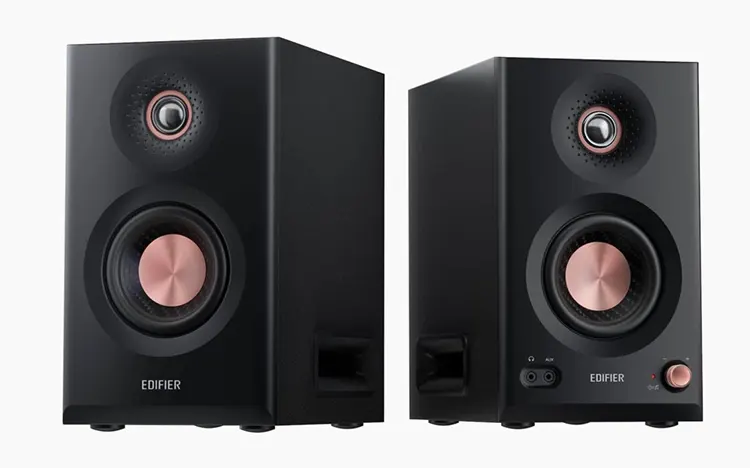
The all-black look, with copper accents on the woofer, tweeter, and volume knob, is reminiscent of The Sixes compared above. If for only a look, the Edifiers could be mistaken for a Klipsch model.
The MR5 is comparable in size to the SP5 but has a more traditional look at 159mm × 264mm × 280mm (Active speaker), and 159mm × 264mm × 257mm (Passive speaker).
The FiiO has identically sized frames. Both do have a recessed setting for the tweeter and woofer (midrange driver in the MR5). The exposed tweeter of the MR5 does cause me a bit of concern.
The back of the active speaker (left) has all of the business options, including power, and all inputs.
The simplistic design of the MR5 will fit nicely into any setting, showing off the accents in copper, where the SP5 does look a bit more artistic in its approach.
Performance
The MR5 reaches deeper than the SP5, due to the downward-firing woofer. Even when it is set at flat, there is a preponderance of bass coming forth from the cavity. Set on a desktop, you will not lack for the low-end. On pedestals or raised, the bass is less prominent, but felt, nonetheless.
Adding +6dB to the SP5s evened the score out mostly, but I never felt either became flabby or out of control.
The midrange melds right into the MR5s signature and may become a bit lost in the overall signature. While vocals do come across with aplomb, they are part of the whole, with less emphasis than the SP5.
Where the SP5 shows a more distinctive separation, the MR5 combines all to benefit the whole, to the detriment of midrange separation.
The treble is more sparkly, too. Especially at ear level. This is where proper placement for your tastes will benefit the user more than the more forgiving SP5.
The MR5 provides a more vibrant signature than the smoother, more mature SP5, which comes across with better detail retrieval.
My Verdict
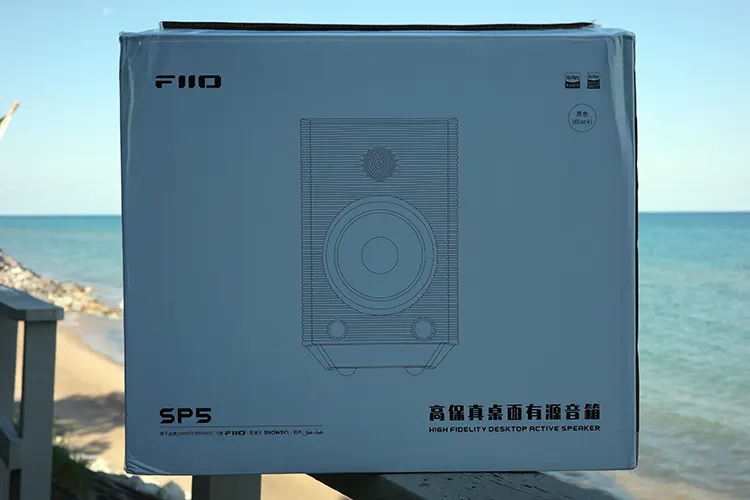
The FiiO SP5 is a diminutive, powered bookshelf speaker that can be utilized in many situations. With plenty of power to cover most, it never lacked in anything except maybe bass response.
The SP3 and SP5, covered here, take the benefits of FiiO’s experience and raise the bar to the powered mid-bookshelf level. There is no denying the cost increase, but once you listen, you find that the SP5 covers those missives quite well.
With excellent levels of detail retrieval and very good clarity, the mature emotive effect of the sound comes across with very good musicality.
Both ends tie together without losing the midrange effect on vocals. There is a cohesiveness to the sound signature that shows this is indeed the flagship powered speaker from FiiO.
The subtle looks add to the understated elegance and signatory response in sound, making one think of a speaker that fades into the background.
Until you hear it. The only thing lacking for me is the internal phono stage. But since many who go this route might have a Bluetooth turntable, the point is moot.
There is a tight, succinct emotion to the music coming from the SP5 that is smooth, mature, and full of detail, all rolled together with excellent soundstage characteristics.
I found that the characteristics from using different sources added to the adaptability of the SP5s instead of being a limiting factor.
The multiple-use options of the SP5 make it a worthy option for having one set of speakers.
FiiO SP5 Technical Specifications
- Amplification Design: Independent 4-channel power amplification (60W x 2 + 20W x 2 per speaker)
- Total Output Power: 160W RMS (80W per speaker)
- Drivers:
- Woofer: 5.25-inch Rohacell cone bass driver
- Tweeter: 1-inch composite silk dome with rear cavity and internal magnet
