

Select Comparisons
FiiO JM21
Features
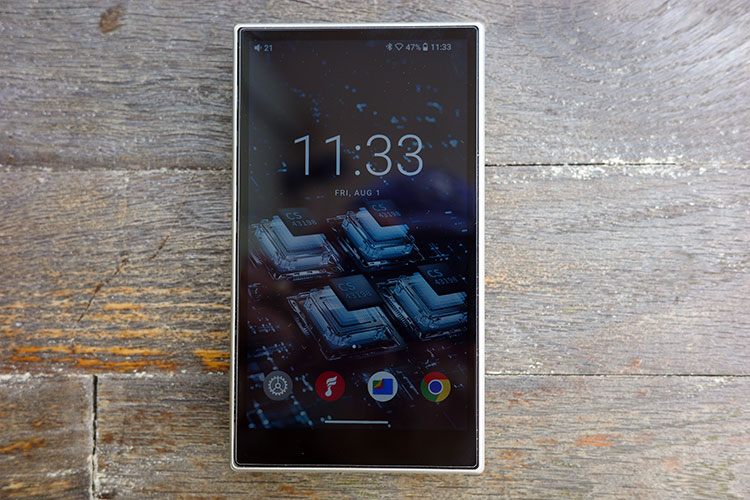
The JM21 runs Qualcomm’s Snapdragon 680 8-core processor with clock response up to 2.4GHz, the same as the M21. With only 3GB of RAM due to cost restraints, FiiO recommends only downloading music streaming apps for use.
They also recommend running an app singularly for best performance. The M21 runs as a full-on DAP, with 4GB RAM and the ability to multitask.
The JM21 provides up to 700mW of power in balanced mode, bettered by the M21’s Super High Gain (SHG) of 950mW.
Meant mostly for IEMs and headphones with easier drivability, it can do some harder-to-drive headphones, much like the M21. Three gain (no SHG) levels help to fine-tune your listening experience.
Dual Cirrus Logic CS43198 DAC chips paired with SGM8262 op-amps run the show in either 3.5mm single-ended or 4.4mm balanced operation. You can also use the USB-C out to another device, such as a desktop amplifier, identical to the M21
Fifth-generation Femtoclocks, just like the M21, help quell any potential issues. Running a custom Android 13 also helps to keep response times short. The M21 runs a full Android 13 without limitations. Two-way LDAC Bluetooth (5.0) is shared by both.
Having a higher latency, FiiO recommends against using this for video or gameplay, unlike the M21. The JM21 can become a streamer or be used with SPDIF (separate cable) for high-quality audio streaming, just like the M21.
A reported run time of up to 12.5 hours can be had with the battery, while the M21 purports to be 15 hours.
Design
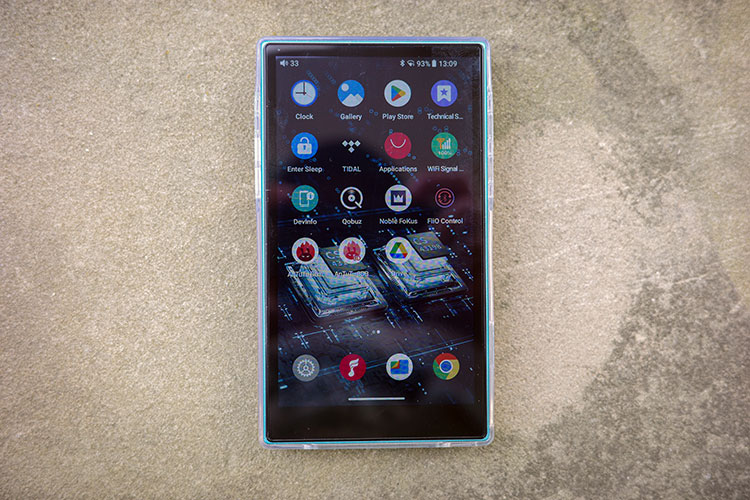
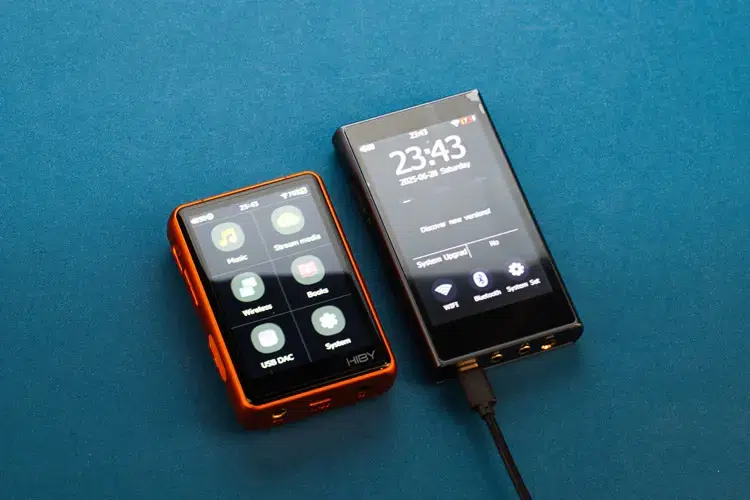
The JM21 is made of aluminum (front half) and plastic (back half), weighing a scant 156g without the included transparent plastic case. The same format is used with the M21, but heavier, of course.
The JM21 feels as good in hand as the M21, and the thinner shape might fit small hands better.
The frosted blue (as does the titanium gold of the M21) looks subtle, highlighting the edges nicely, while the plastic back half has the familiar FiiO triangular shapes as trim, with ridges that provide excellent tactility.
The quality is very good, and I appreciate the surface textures, but the M21 feels like a step up to me.
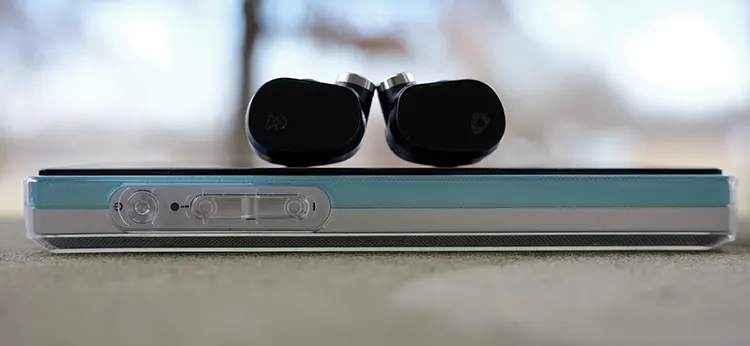
The JM21 is thin, but I like the look and feel of it, which provided easy access to the buttons (once I became accustomed to their location, more below), carrying a simple, understated look to it. The same feeling was had with the M21, even with the thicker stature.
The case is a mismatch, with the M21 carrying the banner for a decided victory. Where the buttons were harder to get to on the JM21, no such issue was had across all three M21 cases.
The screen of the JM21 also sits above the case level, so a fall onto the front will face the whole brunt of the impact, whereas the M21 comes better protected without that issue.
Performance
The JM21 comes across as melodic, with a nearly neutral, slightly bright signature. Even so, the slight brightness does not color the sound at all, allowing the music to carry forth on its own accord. The M21 has better detail retrieval, but a little less note weight.
This may be in the “budget” category of DAPs, but the sound coming forth presents a thoroughly engaging signature that lacks a small amount in the low-end but offers quality down low. The M21 shares many similar qualities but delivers a bit more clarity.
The bass line is taut and controlled, but not especially deep, representing the low end in a less refined manner than the M21. The M21 has a more punctuated low-end.
A lack of sub-bass prevents overlapping bleed into the midrange, which does come across as set slightly behind both ends. The M21 has a more forward and up midrange, with better clarity.
Extension is very good, with only some sibilance coming forth when the track leans towards the bright end. The M21 has no such sibilance, or sizzle, making for a more punctuating and pleasant top-end to me.
The differences lie in what the JM21 was paired with. For instance, running the Noble FoKus Apollo in wireless mode was intoxicatingly good, while using the USB-C presented a calmer, more subdued signature.
Almost exactly the opposite of what I was expecting, but both represented good feedback. The M21, on the other hand, played across multiple listening sources with a better synergy.
Tempotec V3 Blaze
Features
The TempoTec V3 Blaze uses a dual AK4493SEQ DAC chipset (as opposed to the Four Cirrus Logic CS43198 chips in the M21) and is capable of native DSD512 and PCM 32-bit/768kHz.
The V3 Blaze also supports wireless two-way Bluetooth 5.1 up to LDAC, with AAC, and aptX support. The M21 uses BT 5.0. The Tempotec runs a SoC of 2.4GHz max core speed, which is the same as the M21.
Running only 2.4GHz WiFi is a let-down, especially these days when 1GB is essentially the norm for WiFi speeds.
However, the connection was seamless and easy, no matter what the listening device, which countered the slower speed. The M21 functioned flawlessly on my home 5.0GHz network.
The V3 Blaze delivers 825mW+825mW of balanced output power balanced on a 32Ω load (490mW single-ended), which is an upgrade over what the V3 provides, which bests the M21 until you get to SHG.
Using it as a USB-DAC means you can send this to a desktop amplifier for use with an external application of a two-channel system. Switching the PO to LO allows for maximum application of the V3s DAC. The same can occur with the M21.
The LPF uses 2 OPA1652, feeding into 4 SGM8262 (two for each channel, same as the M21) operational amplifier chips, powering the V3 Blaze to a maximum of 1650mW, which is higher than the M21’s 950mW.
A battery with 3500mAh allows for long listening sessions, and excellent standby characteristics (the M21 has a 4000mAh battery for theoretically a longer listening time).
Design
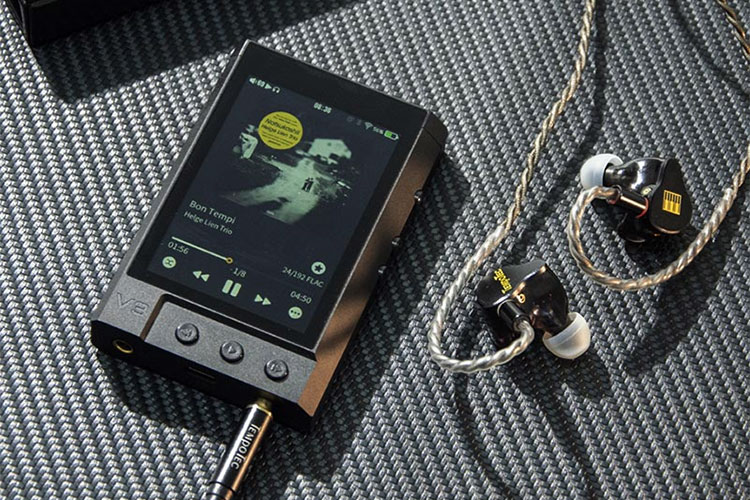
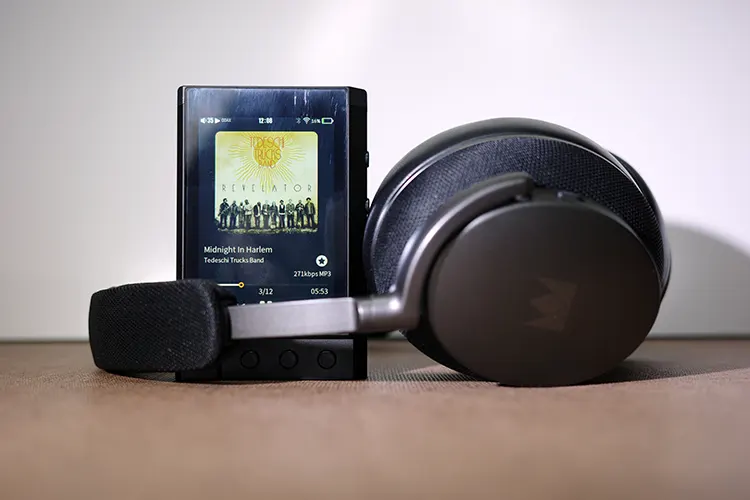
Following the steps of the V3, the Blaze does not change. Using the same size and functionality, the V3 Blaze will feel familiar to those who use the TempoTec architecture.
While the V3 feels a bit chunky in hand, the fit gives a good reassurance of durability, but the M21 functions much more like a smartphone.
The case fits extremely tightly, and if I had my way, I’d run without the case due to the tactility with which the buttons function inside the case.
Tight for good protection, but a definite lack of functionality without effort. The thick, gray silicon case of the M21 carries itself much better, as does the blue pleather case.
The back has a nice tempered glass panel, which is subject to fingerprints and scratching without the case. I do like the design, with the functionality buttons on the right, and connections on the bottom.
Made for right-handed people, I was able to use it with my left hand without issue. The M21’s back is plastic, and I came to appreciate that for its lack of fingerprints.
The all-black look does carry a classic aura to it, and the black, anodized shell helps with durability. The top section, though, did not line up properly, and I could feel the seams on both sides.
Screen protectors on the front and back helped to absorb any potential abuse that may have occurred. There is no such worry on the M21, with impeccable build qualities and a more modern look.
Performance
The TempoTec V3 Blaze has a peppy sound to it that comes across with alacrity. Not overly speedy as can occur sometimes, instead the V3 Blaze presents note weight commensurate with the music.
This adds a vibrancy affording good girth, without being drippy or melancholic, and indeed vibrant.
The M21, on the other hand, has a much more succinct and prompt response to the auditory inputs, making for tighter control of the sound emanating forth.
This seemingly organic natural tendency comes across with good lilt, and that weight is similar to an old standby of the past, the xDuoo T10 transport. The M21 has a more modern sound, with a tightly controlled vibrancy to it that the V3 cannot match.
That would lead you to believe it is headed towards a nearly neutral signature, but that effervescent character gives a good account of itself overall, as opposed to the accuracy of the M21 coming out.
xDuoo X5
Features
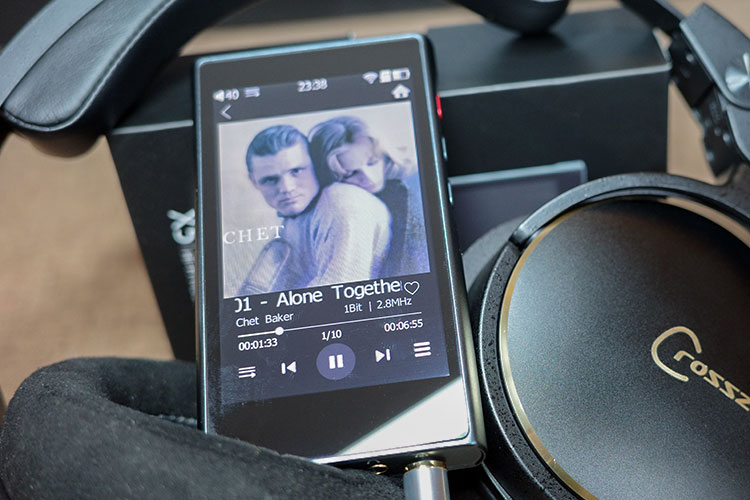
The xDuoo X5 features dual Cirrus Logic CS43131 DAC chips (instead of the four CS43138 in the M21), supporting up to 32-bit/384kHz PCM and DSD256 audio formats, including both wired and wireless connectivity options.
With a 3.5-inch touchscreen, 10-band equalizer, and two-way 4.2 Bluetooth support, it’s designed to be flexible enough for different listening styles, while still being utilized as a source. The M21 is, of course, a fully functioning DAP, with BT 5.0 as well.
The quad DACs of the M21 separate each channel along with positive and negative, furthering the dual option of the X5.
For use with wired headphones or IEMs, you can choose between a standard 3.5mm jack or a 4.4mm balanced output, or Bluetooth 4.2 with LDAC support, for use with your Bluetooth headphones or speakers. The M21 functions similarly, but the BT 5.0 and the desktop power option.
It also works in reverse (two-way BT)—so you can stream music from your phone to the X5, using it as a Bluetooth receiver, just like the M21.
Plug it in via the USB on the bottom, and it acts as a DAC for use in for your listening purposes. The same can be done with the M21, including the desktop option, which isolates the battery completely, relying upon the external power source.
The xDuoo X5 supports microSD cards up to 1 TB, the same as the M21.
With an output power that reaches 270 mW, the X5 is capable of driving various types of headphones, but only matches the 3.5mm single-ended option of the M21.
Design
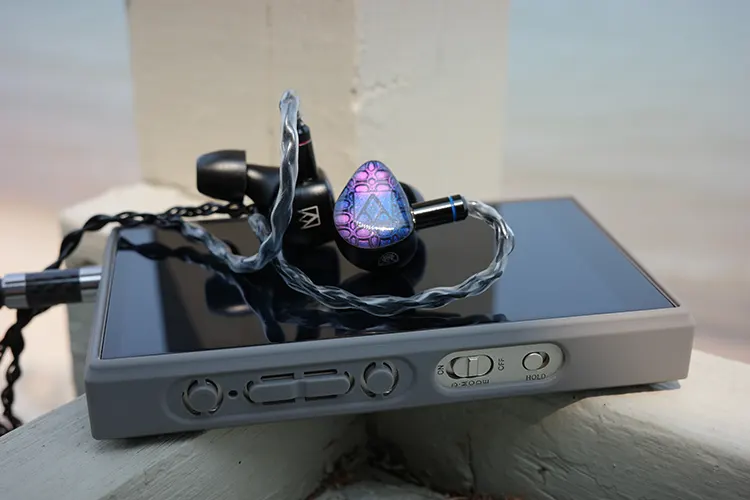
The 3.5-inch IPS high-definition screen with a resolution of 480×800 pixels is surrounded by the device measuring 10.5cm x 6.0cm x 1.6cm with a weight of a scant 0.15kg. Slightly smaller and lighter than the FiiO M21.
The touch screen takes up most of the screen, with a spot to rest your thumb when controlling, making the X5 eminently usable with one hand, unlike the M21.
The microSD slot on the left is unprotected, though, which is a shame, since dirt and dust can potentially enter the slot. The m21 shares that concern.
The bottom has a USB-C plug, an output 3.5mm jack for use as a transport to other devices, and the 3.5mm single-ended and 4.4mm balanced jacks are left to right. The M21 has headphone ports on top, isolating them from the connectivity options on the bottom.
The “Gold-plated” headphone jacks functioned with sufficient force, but to me, they were both a little tight for my liking. The 4.4mm balanced jack on the FiiO was a bit hard too, but it gave a solid feel to it once the headphone was fully inserted.
The right side has the red on/off button, which also functions to wake the device, and the volume up and volume down buttons. That’s it. Functionality of the M21 seems a bit more straightforward to me, due to the placement of the buttons.
An odd design on the back has a rectangular “glass” plate inlay on the top ⅓ over, well, nothing. There is no logo or design; it is simply an inlay over the blue-gray color of the X5.
There is already a micro-scratch or two in that area. Here is where I appreciate the plastic back of the M21, which showed no such scratches during testing.
Performance
Harkening back to the xDuoo X10T, I remembered how impressed I was with the sound. A marked difference from streaming services at the time, the X10T was my go-to listening source for close to six months while reviewing or for comparisons.
The X5’s familial resemblance is heard with excellent detail retrieval and transient response right up there with many more “diverse” offerings. There is a better note weight than the M21 portrays, giving a more immersive effect.
A punctuating midrange delivers excellent volume to the note weight without becoming brittle or overbearing.
The bass response is taut, but not thunderous, carrying forward the music of the recording with minimal impact upon clarity. The M21 has a more forward nature to the mids, while also being lifted higher.
The extension up top is one where, for once, I appreciate the extended reach, which did not bother my high-end intolerance.
The level of detail retrieval heard from the upper end provides excellent detail while allowing individual offerings to shine. The M21 shares my positive notes regarding extension and the lack of harshness present.
One might think this disconnected nature would hinder the overall signature. Rather, the combination presents an airiness and weight to the sound signature that comes across as vibrant without becoming thin or invasive.
The M21 ties the whole thing together better, but without the emotive effect that the X5 has. More accurate than emotive, this will come down to preferences in sound signature and most likely genres preferred.
My Verdict
The FiiO M21 follows on the heels of the successful JM21, using many of the same components. But that is pretty much where the similarity ends.
The M21 comes with more power, a desktop mode with “superhigh gain” for those harder-to-drive headphones, and the ability to stream and surf at the same time. Downloading apps is quick and painless using the Snapdragon SoC, and four Cirrus Logic CS43198 chips help quell any potential hiccups.
The M21 is also the right size to fit into your pocket, after you have held it while surfing or changing music apps.
If I had to pick a bone or two, it would be the 4.4mm balanced connection. It did not work with all jacks smoothly, and those with a thicker jack cover did take some effort to fully engage. Also, the desire to run without a case could lead to issues should you be less careful while handling it.
A positive is the M21 back, which does not carry fingerprints across its plastic. So while it may not look the best, I gladly trade that for fingerprint protection.
I also appreciate how the M21 functions when shipping music to external items such as a desktop amplifier or a streamer. The two-way BT functioned the same way, giving another option across most people’s devices.
So, to me, there are far more positives to the M21 than potential negatives. It isn’t even close, and functioning as a pure music player, especially at this mid-fi price, offers excellent musical capabilities, no matter what the source music option chosen.
The M21 now resides in my regular rotation for good reason and will continue to do so.
FiiO M21 Technical Specifications
- Operating system / SoC – Android 13 riding on a 6 nm Snapdragon 680 (octa-core up to 2.4 GHz)
- DAC array – Four Cirrus Logic CS43198 chips working in parallel (eight channels summed to two)
- Amplifier stage – OPA1692 × 2, SGM8262-2 × 2; three gain levels plus “Super-High-Gain” in Desktop Mode
- Output power (balanced 4.4 mm)
- 950 mW + 950 mW @ 32 Ω (Desktop / Super-High-Gain)
- 540 mW + 540 mW @ 16 Ω
- 185 mW + 185 mW @ 300 Ω
- Output power (single-ended 3.5 mm) 405 mW + 405 mW @ 32 Ω; doubles as SPDIF-coax and line-out
- Battery/runtime – 4000 mAh; ≈ 15 h (3.5 mm) / 12.5 h (4.4 mm); 20 W PD3.0 fast-charge; optional Desktop Mode bypasses the battery entirely.
- Screen & chassis – 4.7-inch 750 × 1334 IPS; full metal body, 68 × 121 × 17 mm, ~193 g
- Memory – 4 GB RAM, 64 GB on-board (≈ 52 GB free) + micro-SD to 2 TB
- Wireless – Dual-band Wi-Fi, Bluetooth 5 (TX & RX) with SBC, AAC, aptX, aptX HD, LDAC, LHDC
- USB-C ports –
- USB-C 3.0 for data/charge / USB-DAC
- Dedicated POWER IN USB-C for an external supply
