


Synergy
Under no circumstances have I heard the JT3 pick up some noise from any device, even when the cables are placed close to the DAPs or phone. And I find the JT3 not sensitive enough to expose the noise floor of the sources I used in this review.
The JT3 isn’t particularly hard to drive, as it can be driven loudly with modestly powerful sources. The issue is that the sound quality suffers, the bass isn’t as tight or impactful, and the treble isn’t as detailed as it should be.
This forced me to exclusively use my most powerful source for critical sound evaluation and comparisons, the FiiO M15S.
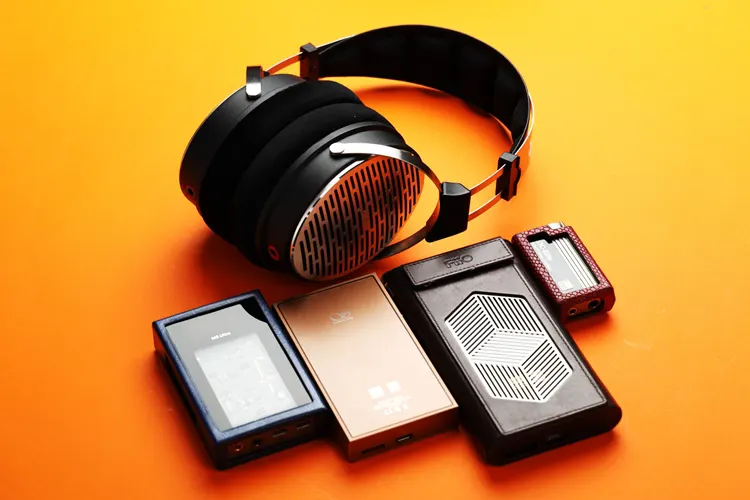
Pairings
When paired with the iBasso DC-Elite, the sound is good, but I can’t help but think it’s not the best from the JT3. There’s a slight lack of impact and tightness in the bass, and the treble doesn’t have the details I was expecting.
Additionally, I have to turn the volume to 90 percent or more to achieve a normal listening level, which makes me feel the DC-Elite and JT3 weren’t meant for each other.
With the MUSE HiFi M5 Ultra in its transistor amplification high gain mode, there is an apparent improvement in dynamic headroom over the DC-Elite, even though I still have to turn the volume to 90 percent for my normal listening level.
The bass sounds deeper, fuller, and more controlled, with improvements in soundstage size, detail, and air.
When I switch to Vacuum Tube amplification mode, there is a smoothness in sound that only Tubes can deliver. However, if I go just a little louder than my normal listening volume, I hear the tube amplifier clip.
I get similar performance when paired with the Shanling M3 Plus, as I have to set the volume near 90 percent to reach my normal listening level, even in high gain mode.
Here, the JT3 easily reveals the sound signature of the Shanling M3 Plus, characterized by a tight and somewhat lean bass rendition and slight treble forwardness.
Finally, the FiiO M15S has a high power output, designed to drive headphones. This is by a wide margin the best the JT3 ever sounded. I only need 65 percent volume to reach my normal listening level, and the sound is effortlessly dynamic and clean.
The bass is impactful, deep, and tight, and the midrange is clean, lush, and full of details. The treble is smoothest with this pairing; it is detailed and airy, and the soundstage is big.
I must say that while the JT3 sounds alright with most sources, for the best sound quality, a powerful source designed to drive headphones is essential.
Select Comparisons
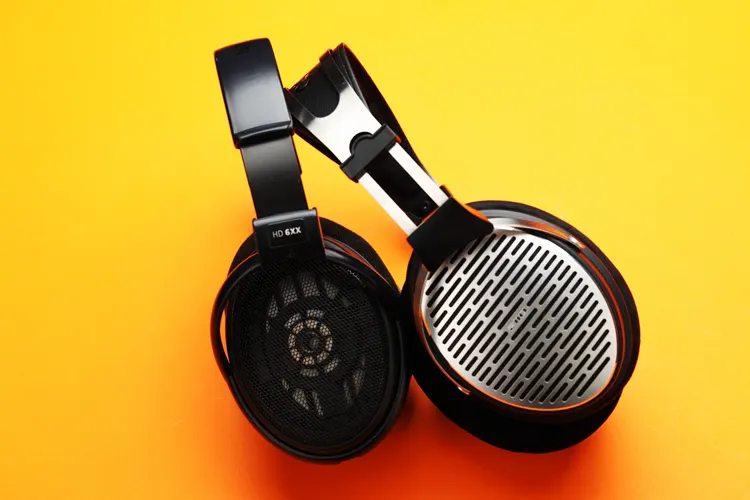
Sennheiser HD 6XX
Technical
The Sennheiser HD 6XX utilizes a 38mm dynamic driver in an open-back acoustic design. It has a sensitivity of 109dB, an impedance of 300 OhmsΩ, and a weight of 260 grams.
Design
The HD 6XX is primarily made of plastic, except for the grill and the clamp on the headband. The design is utilitarian and uninspiring; it includes a detachable 6-foot-long cable, 3.5 mm TRS with a 1/4″ adapter.
Performance
The HD 6XX is apparently more neutral with its flat perceived frequency response and equal representation of bass, midrange, and treble. There is no warmth or brightness in it, unlike the JT3, which sounds bassier, warmer, and has slight upper treble elevation.
When it comes to soundstage, the JT3 is bigger and wider because of its stronger upper treble presence, which contrasts with the flat and slightly relaxed upper treble of the HD 6XX, though the difference is not significant.
In terms of imaging, the HD 6XX has more definition and presence; however, the JT3 project images in front of the listener, while the HD 6XX seems to come from the sides.
Both have good dynamics, but the JT3 is apparently more energetic due to its slightly V-shaped sound signature, which gives it a more contrasty sound and bass punch.
MOONDROP Horizon
Technical
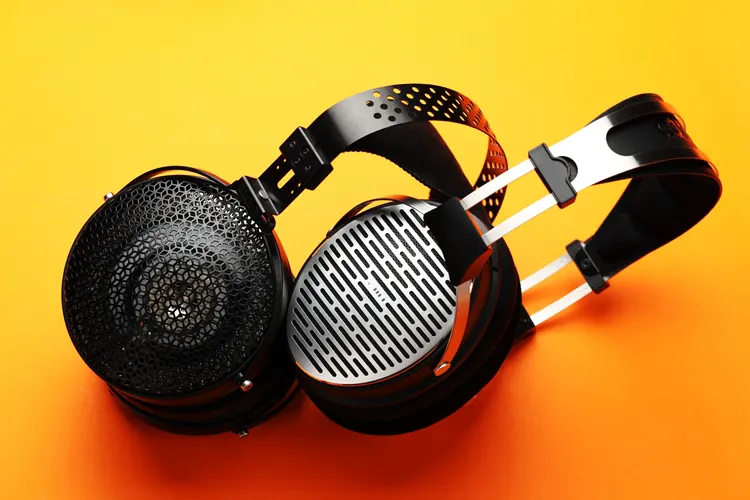
The MOONDROP Horizon features a 50mm UHE Dynamic Driver with an angled driver arrangement and an open back acoustic design. It has an impedance of 32Ω, a sensitivity of 109 dB, and weighs 351 grams.
Design
The Horizon has a classy yet science fiction look and is quite fashionable in a mature way. It has large earcups with soft earpads, and the grills feature a unique perforation pattern.
It includes a very nice 1.5-meter-long cable with a replaceable plug, which accommodates 3.5mm and 4.4mm plugs. The cable has two 3.5mm connectors at the headphone end.
Performance
Both have a similar tendency towards warmth, but the JT3 is warmer with its more elevated bass, recessed upper midrange, and elevated upper treble, compared to Horizon’s mildly elevated bass, more present upper midrange, and neutral upper treble.
Both have similarly sized soundstages, which are above average, and both have a similar shape, which is near spherical, giving both a nice, natural feeling soundstage.
Both have the images projected in front of the listener, with similar definition and separation; the main difference is in the presentation. The Horizon has a more forward presentation.
In terms of dynamics, both are about equal. Although the Horizon was designed to be a sensitive headphone for use with less powerful sources, the JT3 can handle more power and go louder than the Horizon.
FiiO JadeAudio JT7
Technical
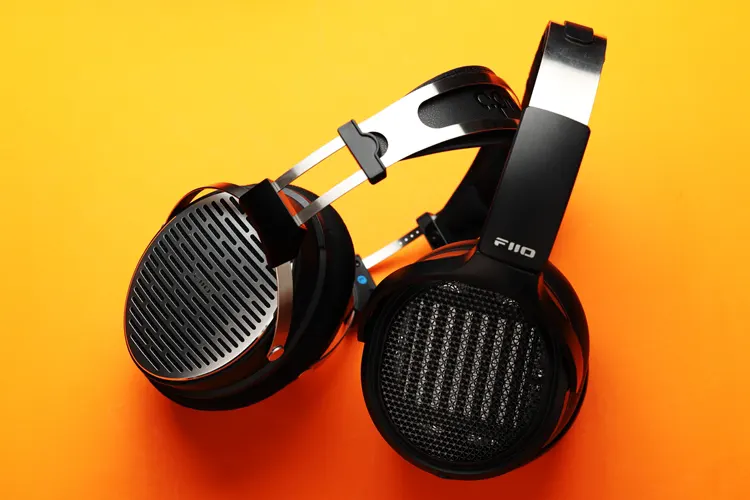
The FiiO JT7 features a 75mm planar driver with an open-back acoustic design, an impedance of 18Ω, and a weight of 321 grams without the cable.
Design
The JT7 combines a professional and utilitarian aesthetic, avoiding a fashionable look; instead, it has a somewhat mature, serious, and straight-to-business appearance.
The earcups can swivel and fold to make them smaller for storage. It includes a 1.5 m cable terminated with 3.5mm connectors at the input and two 3.5mm connectors at the headphone end.
Performance
While both have a slightly V-shaped sound signature, the JT3 has more bass and warmth, whereas the JT7 offers more balanced bass and treble and is generally more neutral-sounding.
The JT7 has a wider soundstage, but its shape is less spherical than JT3’s smaller, more rounded stage. Although the JT7’s imaging is more defined, its images appear to come from the sides, whereas JT3’s images are projected towards the front.
Even though the JT7 has less bass, I feel it sounds more dynamic compared to the JT3, as the faster transients with the JT7 are more apparent to my hearing.
But overall, they are not far apart in terms of dynamics, and both are equally musically engaging.
My Verdict
As my first FiiO headphone review, I feel lucky because the FiiO JT3 is a treat to my ears with its warm, bassy, V-shape, and engaging sound. I also like how it projects the images to seem to emanate from the front instead of the sides, providing a natural spatial experience.
I highly appreciate the handsome looks, metal parts, and build quality of the JT3, which seem better than those of some more expensive headphones.
However, I wish the earcups could swivel because I feel a little more pressure towards the front of my ears than the back. It’s not a deal breaker, though; the JT3 is still comfortable for long-term use as it is.
I must caution potential buyers that to achieve the best sound from the JT3, they should use decent sources designed for headphone use. Most portable dongle DACs might sound fine, but are not optimal for the JT3, based on my experience.
That said, I believe many people would be happy with the FiiO JadeAudio JT3, and I would happily recommend it to listeners who prefer fun and engagement in sound over seriousness and accuracy.
FiiO JT3 Technical Specifications
- Headphone type: Open dynamic headphones
- Frequency response: 10 Hz–35 kHz
- Driver: 50 mm dynamic
- Impedance: 80 Ω at 1 kHz
- Sensitivity: 97 dB/mW at 1 kHz, 110 dB/Vrms at 1 kHz
- Weight: approx. 330 g (without cable)
- Cable material: palladium-coated 4N oxygen-free copper
- Cable length: approx. 1.5 m
- Headphone connector: two 3.5 mm TRS connectors
- Audio plug: 3.5 mm
