

Wired Connectivity
USB-DAC
The majority of my testing time was with both USB-C connections. I found no difference between the front and back (and shouldn’t). Convenience-wise, the front is a nice option to have, allowing access quickly to a popular source.
Coax
Hooking the BR15 R2R to the Oppo BDP-83 through coax presented another nice option for listening. You can leave the CD player connected, much like an integrated amplifier. Leaving the Oppo connected, I could easily switch between this option and another using the remote.

Optical-In/Out
Connecting my older Arcam CD-73T using the optical in, then optical out to the FiiO SA1 provided a nice option. This was tried briefly, with the majority of the time using the XLR out to the SP5 and an older set of Soundcraft Spirit Absolute 4Ps that were given to me.
RCA-Out
Hooking the BR15 R2R briefly to the SA1s presented yet another option, showing the versatility of the FiiO head unit. Sound, while quite good, fell behind the XLR balanced option.
XLR-Out
By far (90%+), I used the XLR out option, hooking the BR15 R2R to either the FiiO SP5 or the previously mentioned Absolute 4Ps.
To me, this is the real gem of the FiiO, having the ability to utilize this high-quality balanced output allowed for an expansive 3D soundstage, filling our medium-sized living room with ease.

Synergy
The majority of listening time was spent tethered to the FiiO SP5 speakers. I did spend a fair amount of time with the BR15 R2R tethered to the Absolute 4Ps, with excellent results.
An older powered studio monitor, with copious amounts of power, the 4Ps never felt strained or left wanting for more power. For an old studio monitor, the 4Ps are still worthy of inclusion. But for such a large speaker, they do lack a bit of grunt down low, compared to the SP5s.
The sound quality was top-notch notch though, with crisp details and a midrange that presented itself better than the SP5s (at least in this comparison). The 4Ps did sound better without EQ input, too. The BR15 R2R showed that it could work well in a studio monitor situation.
The same holds for use with the SP5, especially since the speakers were designed with that in mind, somewhat. I found the top end with the SP5s sounded a bit smoother but rounded.
Where the 4Ps had exceptional extension without becoming bothersome, the SP5 came across as smoother, with a more organic sound. Here again, the BR15 R2R simply provided the conduit for passing music along, without inserting any “character.”
Paired most of the time with the FiiO JM21, the pair seemed destined to work together. Running the whole FiiO setup from source to speakers, this could very well become the mainstay of my living room setup. That and the 4Ps are simply too big for our situation.
BT from my iPhone was used for quick listening and paired well with either speaker through the BR15 R2R. I will note that the limitations of an Apple device still hinder what could be, but that is where our DAPs come into play.
Select Comparisons
FiiO BR13
Features
Using the ES9018K2M DAC, the BR13 boasts 5 independent LDOs for precise voltage regulation and a dedicated OVP for over-voltage protection.
This last aspect is important when switching the unit on and off, and between codecs, which are adjustable.
Design
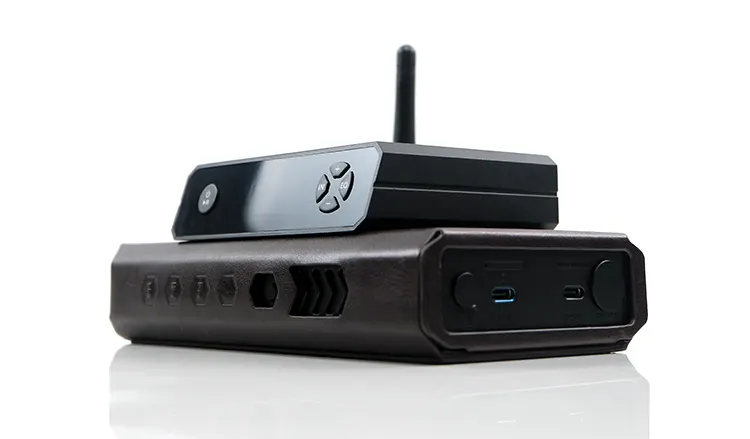
Small and discreet would be apt descriptors for the BR13. At 98x96x26.5mm and weighing only 135g, the unit can be easily placed almost anywhere within your systems. The BR15 R2R is a device you will not want to hide, even if it is larger.
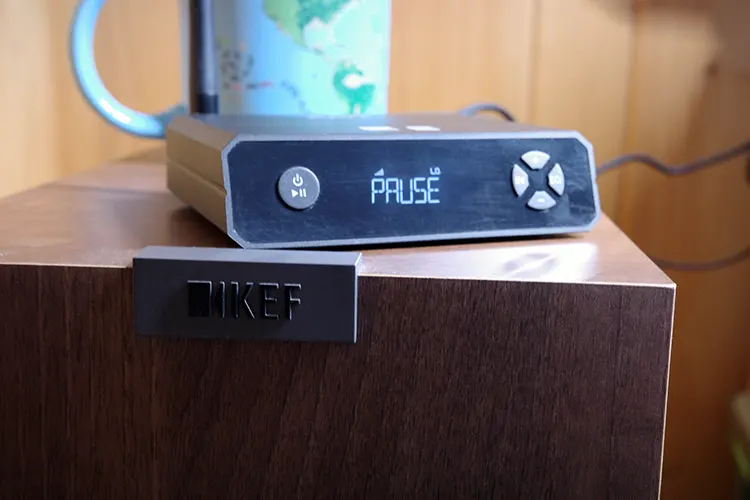
The front of the all-black unit has a larger lacquer-finished screen, with an LCD screen, on/off, and the four individual smaller buttons for source (IN), equalization (EQ), and volume (+/-).
The LCD screen purportedly minimizes the burn-in effect while staying on. You can alter the time allotted for staying lit through the app.
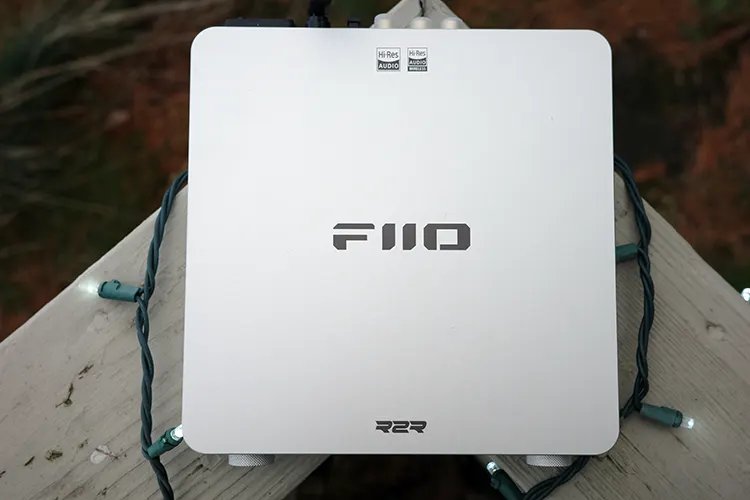
For a small unit, the BR13 takes up much more of the front with the LCD screen. The BR15 R2R incorporates the two knobs, USB-C, and power button nicely for an upscale look.
The chassis is made from a single piece of polymer plastic, eliminating most “breaks” except for the front and rear panel insertion. The textured finish gives a metallic look to it, exuding a premium feel. The BR15 R2R is aluminum, making for a fit that slides right into your system.
The front panel, which is slightly canted back at the top, allows me to see the unit display with ease since chances are the unit will be mounted lower than eye level.
I never felt wanting with the BR15 R2R screen, even from a distance, using the remote to change volume, and the two lit knobs to discern coding rate.
Performance
The BR13 was connected to much of the same equipment as the BR15 R2R, but was used mainly in my office system. The FiiO Control app was used on my iPhone to gauge EQ settings and Global Upscaling (vs Compatible) for both.
Source plays a part in the overall character of the BR13, more so than other devices I have tested of late. The same holds for the BR15 R2R, but with its neutrality, less so.
This isn’t necessarily a bad thing. Quick listens through my iPhone using either Compatible or Global Upscaling give a pleasant sound quality to it, with Global Upscaling sounding fuller and with better texture to the music. There was a significant difference for me.
Using the Cayin N6ii under BT and LDAC, the sound quality became even more prevalent, with better detail retrieval and clarity to the songs played. USB-C DAC mode raised the quality a bit more as well.
The versatility of listening choices became readily apparent quite quickly. The above observations were made across all listening sources and playback systems.
As versatile as the little FiiO was, the BR15 R2R raised the bar and included the R2R signature sound, making it a choice for when you “outgrow” the BR13.

SMSL RAWPro-DAC1
Features
The RAWPro-DAC1 runs the ESS9039MPRO DAC chip, putting on the “PRO” aspect for its users. This is the same chipset used in the venerable SMSL SU-X, which sits one level above the Pro.
Running a single chip, the RAWPro-DAC1 also has MQA CD decoding. The RAWPro-DAC1 is not an R2R, which benefits the BR15 R2R.
With the now familiar 3rd gen XMOS XU-316 true 32-bit USB processor, the RAWPro-DAC1 is capable of up to PCM 32-bit/768kHz and DSD512. All of this is now familiar to most, but the combination makes for the difference. This is similar to the BR15 R2R.
Just like the SU-X, the DAC section is capable of playing back MQA and MQA CD-certified files at the hardware level.
But this cannot be done at the USB input. The user must use the Optical, Coax, or AES port. All interfaces except BT support DSD, though. The same holds for the BR15 R2R. Coax, optical, and AES/EBU are capable of DoP64.
Design
Unless you are brand new to the portable audio scene, you should recognize the familiar black of SMSL in their designs. Except for their higher-end units, such as the SU-X (which looks quite good) and the RAWPro-DAC1, which comes in silver.
The BR15 R2R has a slightly smaller footprint, and my sample came in a very tasteful silver color. Both are pretty much immune to fingerprints.
This color highlights the unit more than the familiar black, allowing you to showcase the unit within your desktop system or even with powered speakers and a turntable if you choose. I do prefer the silver of both over the more traditional black.
The SMSL volume knob dominates the front right, with the screen to the left, still slightly off-center to the right. The rest of the front is bare except for the lettering.
I’m not sure if this was the intent, but that off-center look adds to the sleek theme, but it seems like something is missing. The FiiO has a more balanced look, especially with the lights surrounding the knob, adding a bit of upscale to the design.
The silver chassis isn’t necessarily a bad thing, with dimensions similar to the RAW units slotted below, and larger than the FiiO. Coming in slightly larger than its lower-tiered siblings, the 254 X 203 X 48mm (W x H x D) size and weight of 1.9kg/4.19lbs, the proportions look about right.
With an efficient spatial layout, the RAWPro-DAC1 is a versatile tool, especially since once the unit is on, you only need the remote for functioning and to put it into sleep mode. The same is true of the FiiO, drawing minimal power by leaving it on.

Performance
ESS chips are known for their accuracy in sound presentation without putting much of a stamp on the signature.
This allows for an uncolored sound, unencumbered by the nuances that other chips may have on the sound. The R2R of the FiiO presents not only accuracy but a slightly more neutral signature.
Pairing with a variety of amplifiers allowed the amplifier to dictate the sonic characteristics heard. But changing the Soundcolor settings allows the user to fine-tune what we hear. If you pair it with a tube amplifier, you can add more subtle bits through the three tube options.
This is very similar to the native EQ changes of the FiiO, allowing the user to fine-tune for each genre or song. Add the parametric EQ of the Fiio, and it moves slightly ahead.
Prefer a more crystal response for genres such as micro-detailed classical? There are options for that, as well as adding richness to the scale, much like the ability of the FiiO.
I found myself changing with different songs played, allowing for a fine-tuning that almost became a ritual. But if one focuses on a single (or two) genre(s), know that setting and forgetting is worth it, too. I did the same on the FiiO.
Coming across as neutral, both allowed for your listening pleasure without distracting from the overall excellence. But add in the ability to tailor each, and that makes for a personal listening experience.

SMSL RAW-DAC1
Features
The RAW-DAC1 is built around the AK4191+AK4499EX chipset. The RAW-DAC1 also features the 3rd-gen XMOS XU-316, which supports up to 32-bit/768kHz and DSD512.
In addition, it has full support for MQA and MQA-CD. Very similar to both the RAWPro-DAC1 and BR15 R2R.
All of the other usual source options are present, including Bluetooth 5.1 with LDAC and aptX HD. The BR15 R2R is similar, but with more input options, and BT5.4.
One interesting addition is an I²S input, which reduces jitter and provides a direct digital connection for more precise, transparent audio. XLR out is a plus, especially since its partner, the RAW-HA1, has XLR in. The BR15 R2R has an XLR out, but two optical options (one in, one out).
There’s a specially designed, built-in shielded power supply inside, enhancing power efficiency and lowering power consumption while keeping external noises to a minimum. The BR15 R2R does not.
Design
The physical design of the SMSL RAW-DAC1 has the familiar aesthetic of the RAW-HA1 headphone amplifier. In fact, I reviewed the pair together. The plain black box can unassumingly fit into your system without a bother. I do like the silver of the BR15 R2R more.
A tempered glass panel on the front houses the 2.33-inch display. To the right of the display is the function knob used to adjust the volume and navigate the system menu.
The rear panel offers a comprehensive range of inputs and outputs, including both XLR and RCA output connections.
Featuring dual coaxial, dual optical, USB-C, I2S, and Bluetooth inputs helps round out a full Monty of connectivity options. The BR15 R2R boasts dual optical and dual USB-C options.
The RAW-DAC1 includes a fully-featured remote control, allowing convenient access to all settings when the device is out of reach. The remote of the FiiO is just as good, with better labeling, to me.
Even with the smaller screen, changing between settings was easy, especially if you chose the visual option of bitrate with larger numbers (universal setting). The graphics setting adds the source used for viewing.

Performance
The SMSL RAW-DAC1 could be the current culmination of all those machinations within the company. Keeping the DAC separate is always in the best interest of sound quality.
The RAW-DAC1 is startlingly neutral in presentation, more so than the BR15 R2R, with a crystalline nature that presents a whole new aspect.
The clarity with which the music is presented through the various sources here is equally impressive, no matter what the budgetary limitations of each are.
I do prefer the note weight of the FiiO to the SMSL, though, because that added weight does not hinder clarity of the presentation. While the two are similar in presentation, the FiiO presents a little better note girth without tainting the overall signature.
The RAW-DAC1 allows vocals to come through with a level of clarity they have no right to and carries forth a thoroughly engaging signature.
The FiiO is similar, but that extra amount of note weight makes vocals sound simply sumptuous in comparison.

My Verdict
Now that the full specs are out, I note that BT is Qualcomm’s 6.0, moving to the next logical step. Setup and operation were straightforward on the BR15 R2R, no matter what the source.
I mentioned early (and often) that the XLR output was indeed a positive. Many higher-level powered speakers come with an XLR input option, adding to the appeal of both the speaker and the input.
From the onset, I considered this the best part of the BR15 R2R. But that would be selling the rest short. No matter the input, the BR15 R2R paired with the output speakers seamlessly, whether it was the FiiO SP5s or the Absolute 4Ps.
The sound coming out of either was about as neutral as it gets, and yet, still musical. The BR15 R2R presented what was played without overriding the underlying sound of the source music. That is about as good as it gets when inserting a unit such as the FiiO into your system.
If I had to nitpick, it might be that no USB-C cable was included, and from a distance, the OLED screen can read a bit small. But, since this is mainly a desktop unit, that is all but a moot point.
Another might be the sheer volume of competitors out there that can compete with the BR15 R2R.
But giving options such as that may be another strong point to the FiiO BR15 R2R because, after all, aren’t choices a good thing? The BR15 R2R will be a regular in one of my home systems now and does so without apology.
FiiO BR15 R2R Technical Specifications
- Bluetooth Chipset: Qualcomm QCC5181
- Bluetooth Version: 5.4
- Supported Codecs: aptX Lossless, LDAC
- DAC Type: Fully differential true 24-bit R2R resistor array
- Operating Modes: NOS (Non-Oversampling) / OS (Oversampling)
- Decoding Inputs: Bluetooth, USB-C (x2), SPDIF (Optical x2 and Coaxial)
- Analog Outputs: 2 × RCA, 1 × XLR (balanced)
- EQ: Global 10-band parametric EQ (via FiiO Control App)
- Power Supply: Built-in low-noise switching power supply
- Accessories: Remote control, dual RCA interconnect included
