

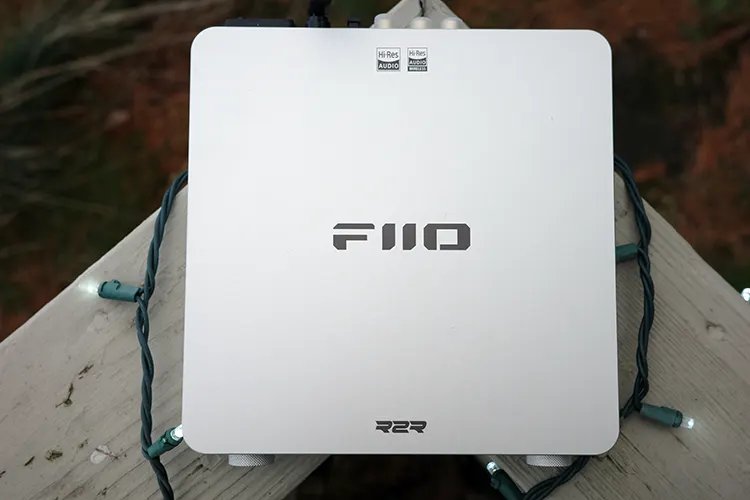
Lynn reviews the FiiO BR15 R2R, a compact desktop Bluetooth 6.0 streamer equipped with a 24-BIT R2R DAC and aptX lossless streaming. It is currently priced at $199.99.
Disclaimer: I received this sample in exchange for my honest opinion. Headfonics is an independent website with no affiliate links or services. I want to thank FiiO for their support.
You can click here to learn more about the FiiO audio products previously reviewed on Headfonics.
This post follows our current scoring guidelines, which you can read in more detail here.

FiiO needs little to no introduction in the DAC/AMP space, especially with their previous desktop units, such as the K9 Pro ESS and K9 AKM, that we have reviewed.
Today, the brand has shifted to smaller designs such as the K13 R2R reviewed by Meldrick, and its latest (almost) all-in-one, affordable, wireless-capable DAC, the BR15 R2R, priced at $199.99.
FiiO continues to be a juggernaut, still releasing numerous products in a time when others may be pulling the reins a bit.
There is also familial resemblance with many of the company’s offerings, building on successful drivers in headphones, or designs that look quite similar to each other (the resemblance here to the K13 R2R is on purpose, one would guess).
Substituting a dedicated USB-C on the front instead of headphone ports separates the two, as do some of the internals.
Features
An R2R DAC is a type of digital-to-analog converter that translates binary data into analog voltage using a simple but precise resistor network.
Unlike delta-sigma DACs that rely on high-speed modulation and oversampling, R2R DACs convert digital bits directly through a ladder of resistors with only two values: R and 2R.
The result is a more direct signal path, prized by some audiophiles for its natural tonality and transient clarity.
Because every resistor pair contributes a specific voltage step, accuracy depends on how tightly matched the resistors are. Even minor mismatches can affect linearity, leading to increased cost and complexity to maintain consistency.
This can result in a presentation that feels more “organic,” although it may not measure as linearly as delta-sigma converters. But, it is often praised for natural tone and coherent timing, predictable impedance, and analog behavior
An R2R DAC seemingly represents a purist approach to digital-to-analog conversion: simple in theory, intricate in execution.
The FiiO BR15 R2R benefits from this proprietary 24-bit R2R resistor array architecture similar to the K13 R2R, featuring 192 precision thin-film resistors arranged across four channels with 0.1% accuracy and ultra-low 3 ppm temperature drift.
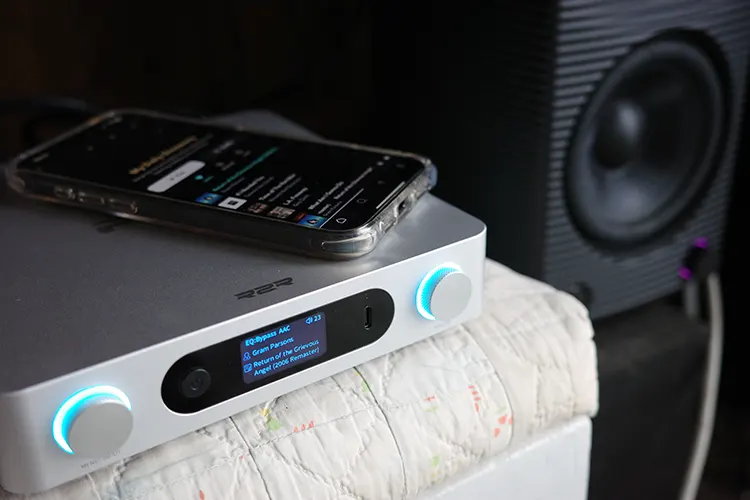
The BR15 R2R includes a 10-band parametric EQ system, accessible via the FiiO Control app or web interface, offering precise frequency-specific adjustments.
Design
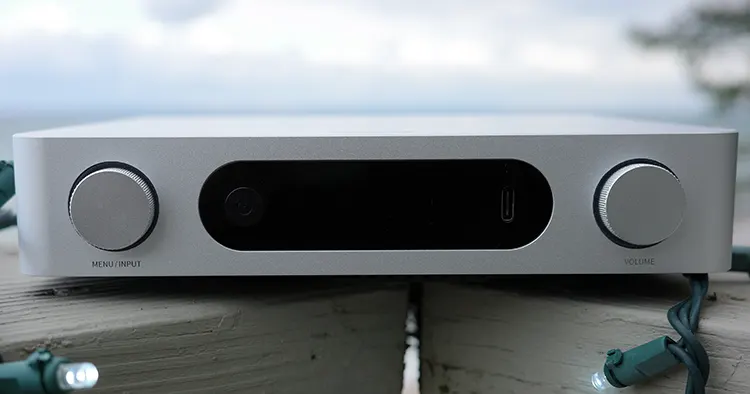
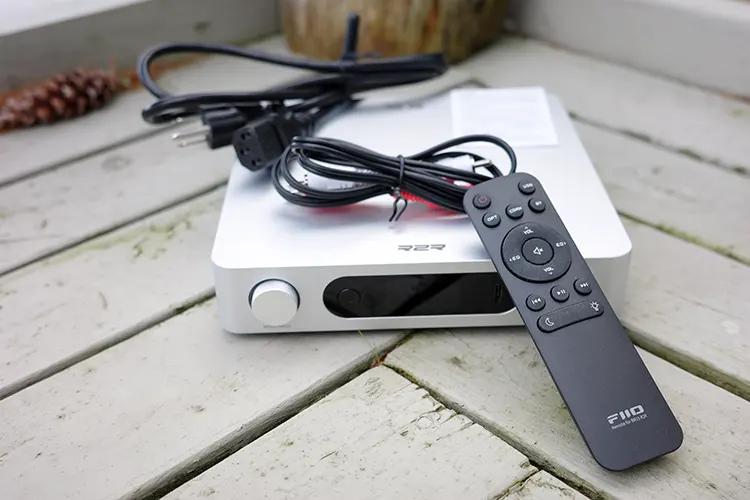
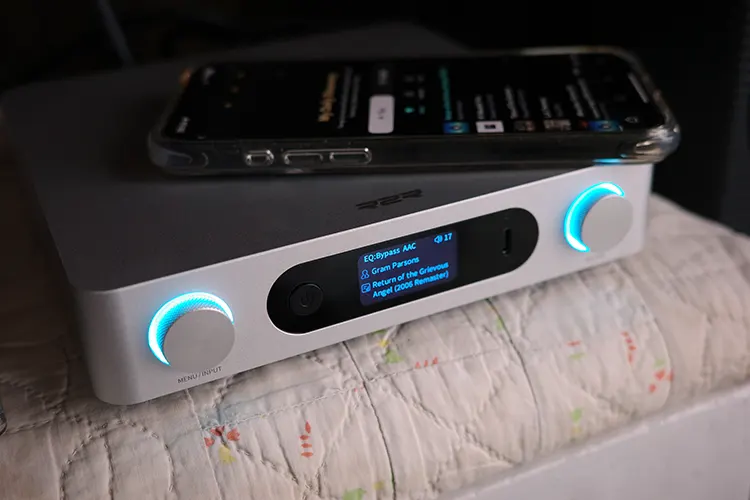
Measuring approximately 7.5 inches square, just like the K13, the BR15 R2R’s closed-top design is highlighted by the two front knobs, which both light up in the frequency response color, and an oval OLED screen, which shows necessary information. The unit is light. Almost too light.
The unit features a unibody CNC-machined aluminum chassis that comes in either a black or silver anodized finish. My unit is silver, and its finish provided good scratch and fingerprint resistance during testing.
The rounded black OLED display sits centered between the two lit knobs, one for menu options and the other for volume control and sub-menu choice. Both knobs feature tactile detents and smooth rotation with distinct stops, as well as RGB addressable LEDs, which change based on bitrate input.
Substituting a USB-C connection on the front instead of headphone jacks like the K13 R2R, the BR15 R2R can be used with either a USB-C AUX input. When both are connected, the front does take preference.
On the opposite side of the OLED display is a black power button, subtly laid out.
I/O
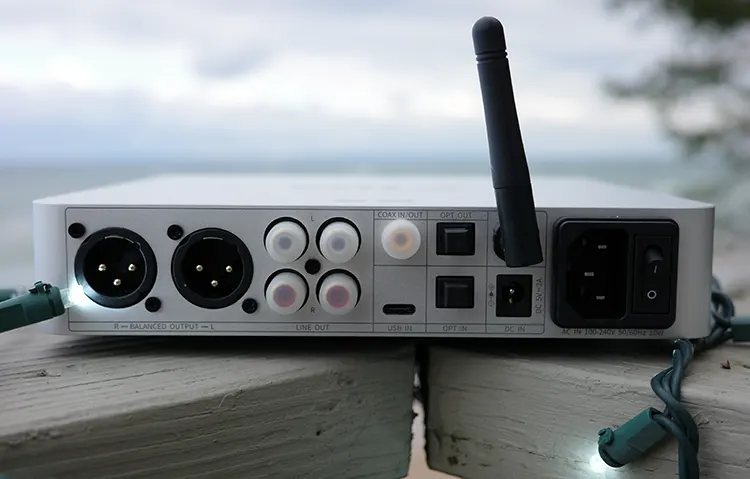
The highlight to me would be the BR15 R2R’s balanced XLR outputs, which allow the use with studio monitors, or hooked into powered speakers, or use with an amplifier that can handle XLR, too. This option received the majority of my listening time.
The BR15 R2R has two RCA LO options too, for use with amplifiers or powered speakers. Next to that is a Coax in/out port.
Per the user manual notes, “The coaxial in/out works only as the input port in the Coaxial decoding mode, and the output port in other modes.” This means you can coax out if you are utilizing other inputs.
Dual optical ports (top one out, bottom one in) can be used, such as connecting a CD player in, then out to the optical port on powered speakers or a more modern amplifier. The internal BR15 R2R DAC would then be used.
Bluetooth is limited to input only, which includes connecting to multiple devices. You can easily switch between connected devices, too.
The front and back each have a USB-C port for input (a change from the KR13 R2R’s side USB-C port), with the front one taking precedence if both are connected.
Controls
The BR15 R2R has two round knobs that control all of the necessary options, including access to the menu and changing of items from the subsequent sub-menus. The volume knob moves smoothly, with a solid detent for each step.
The full-function remote is a very welcome addition, and the labeling is quite large. There is even a button (toggle?) on the round dial for changing through EQ settings.
This is applicable for all preset EQ and the PEQ, which can be carried over from other FiiO devices via the app. I still wish FiiO would include backlighting for the remote. This would make it nearly perfect.
Menus
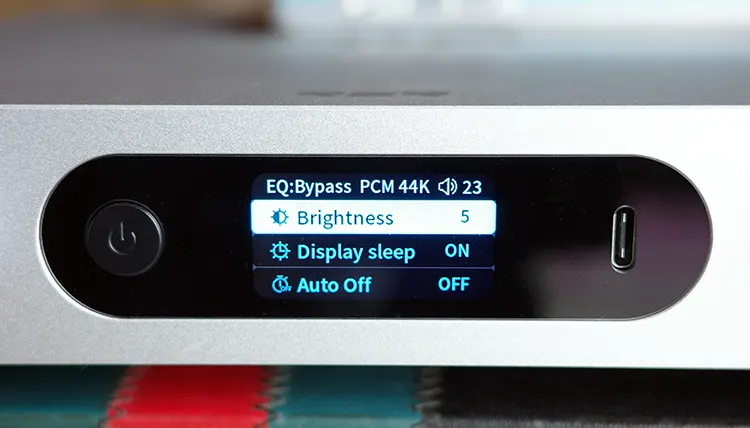
Much like other BT receivers or DAC/Amps, the BR15 R2Rs sub menus are thorough and easily changeable.
You can change the background color of the knob rings, including an alternating scheme, mimicking all of the bitrate colors.
You can also change the OLED display color to one of three choices: ice blue, orange, or white, with the corresponding background taking a tinge of the chosen color.
The overall display can be changed, making this one of the better screens to read from a distance. This will, of course, be utilized most of the time in desktop situations where longevity of sight is not an issue.
Using the remote, you can change EQ settings from off to bypass, Jazz, Pop, Rock, Dnce, R&B, Classical, Hip-Hop, Retro, De-essing 1&2, and 10 User personal EQs.
When off, there is no effect. Bypassing disengages the current setting, and the others work with respective effects based upon the genre chosen or user set.
The user can also change the OS, ranging from off to 96K, 192K, and 384K, and DSP to either D2P or 1-bit, further customizing the sound. You are, of course, limited by the source music rate.
Wireless Performance
Using Qualcomm’s QCC5181 BT5.4, connecting was straightforward, with little lag. Latency was low enough not to hinder the enjoyment of streaming videos.
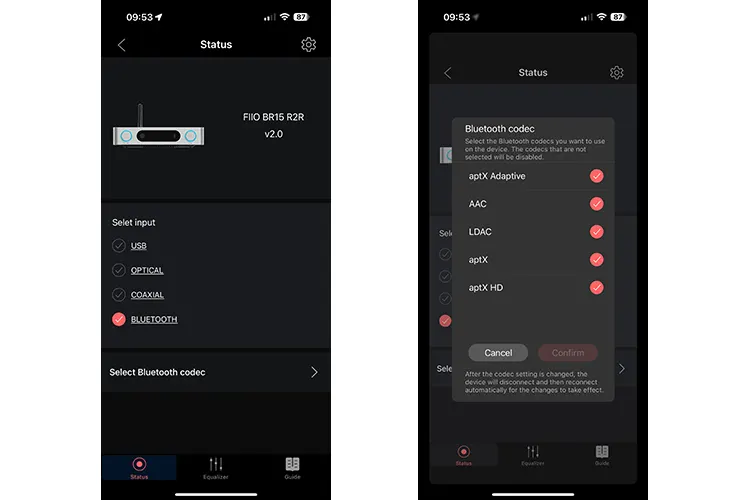
Supporting SBC, AAC, aptX, aptX Lossless & LDAC, the BR15 R2R may not seem like it is all that versatile, but it can compete with much that is out currently.
FiiO Control App
While streaming from my iPhone 16 Pro Max, I ran Tidal and Qobuz, but utilized the EQ abilities of the FiiO Control app.
Upon first connection, I was met with a firmware update. I promptly did the update, which took approximately 40 minutes, and it went seamlessly.
After the update, I was able to use the custom EQ setting or set up the PEQ without issue. The native EQ settings could also be used while BT streaming.
Packaging & Accessories
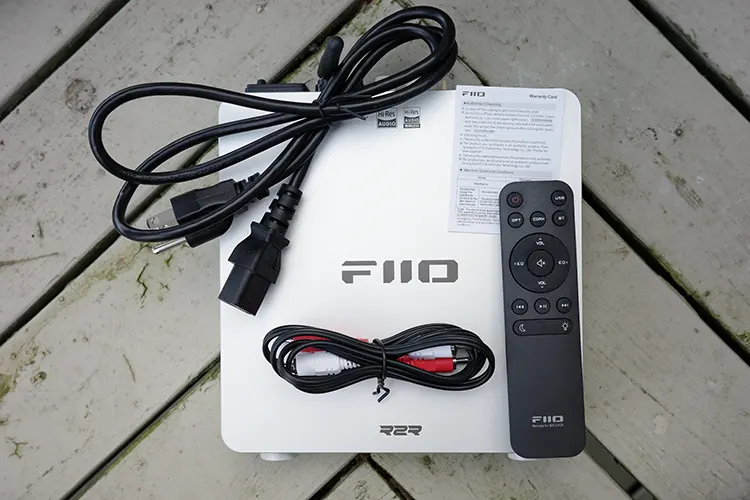
The BR15 R2R came protected in a double-boxed effort, with the internal box in gray, laden with all the necessary information.
The box and color scheme are pretty much identical to the KR13, and FiiO is not the only manufacturer to share boxes or color schemes within their wares. Included items are the power cord, remote (no batteries), and a short dual RCA cable.
Sound Impressions
Testing was done using the FiiO SP5 speakers (majority of the time), the Soundcraft Spirit Absolute 4P powered speakers, FiiO’s SA1 (briefly), Oppo‘s BDP-83, the Arcam CD-73T, FiiO’s JM21, and an iPhone 16 Pro Max.
Summary
Using the R2R technology has paid off for the BR15 R2R. Detail was rich and inviting, with clarity that allowed for clear, concise music to come across without being sharp, thin, or dry.
The emotive effect of that detail retrieval made for an enveloping, organic sound, which also provided the necessary clarity for the subtlety of music to come forth.
The lower regions grabbed hold when called upon, and the upper stretched when necessary. The midrange came across as inviting, enveloping, and teasingly thorough. Never was there a lack of depth or thinness to the music, coming across as emotive and expressive.
The 3D awareness of the balanced XLR output into appropriate listening devices proved fruitful and expansive.
Even with speakers not in ideal locations (yet), there was never a lack of one channel or overbearing of another. Both provided good holography and expanse to the presentation.
Timbre
R2R DACs are known for clean, clear, crisp sound signatures, and the BR15 R2R is no different. The only coloration taken on is what comes from the music. This is one of the more neutral DACs I have heard.
This can also lead to a sterility in sound that might be desired in some genres, but not others. That would not be the case here, as there is plenty of girth, grunt, and soul to the sound. There was never a lack of feeling or expression to the music, which could come across as sterile and thin.
The sound is presented in a thoroughly engaging manner, which often leans more toward the analytical side of the equation. Not so here, as the organic presentation leans in to present an inviting sound that contains a highly detailed aspect, too.
What I found was that even with that thorough signature presented, there was no pushing or shoving from any one aspect.
The midrange did not sound lifted or forward. The treble notes extended properly without harshness, and the low end presented grunt and girth when needed. Honesty comes to mind in that regard.
Staging & Dynamics
The balanced XLR out into a competent set of powered speakers is the culprit here, adding to an expansive 3D effect that borders on some holography to fill in the signature.
Equal parts of height and width help stretch the depth, but that is dependent upon speaker placement as much as anything.
Compensating for that, the SP5 comes across as excellent in response. The 4P also presented a wide, high soundstage, and with more room to breathe, a deeper stage, too.
Transient response was quite fast and accurate, but did not impinge upon note quality. Notes were thick, without being cumbersome, and tight without becoming analytic or dry. The dynamics of the source music shone through accurately, in other words.
I never felt that either the music was artificial or too drippy with melancholic warmth. While there was a small bit of warmth (almost defying what I said above about neutrality), it never hindered the presentation or dynamic response of the sound signature.
Click on page 2 below for my recommended pairings and selected comparisons.
