

Selected Comparisons
EarMen L-Amp
Technical
The L-Amp is an integrated DAC and portable tube amplifier. It uses a single ESS SABRE DAC (32-bit, 384kHz PCM, DSD DoP128), paired with the NOS military-grade JAN6418 USA-made tubes.
The dual tube setup is mounted on an innovative suspension system using 4 silicone O-ring mounts to reduce vibration and minimize mechanical feedback, according to the EarMen.
A statement that bears out while listening. The L-Amp MK2’s reconfigured suspension system is used across the board.
While there is still the familiar ‘ping’ of a tube amplifier, the isolation works its magic once the music starts. Plugging in headphones or IEMs will bring on a short, fairly soft ‘pop’, which is typical of amplifiers of this sort. Only briefly, upon insertion, is a ping heard on the L-Amp MK2.
The fully balanced circuitry on both outputs runs seamlessly, with no need to change any switches. The power stage of the L-Amp then comes into play, built with Burr-Brown INA1620 operational amplifiers to provide 1W at 8Ω.
I had no problem running the notoriously hard-to-drive SJY Horizon headphones with the L-Amp, which surprised me. The same mostly held for the second-generation EarMen product, even though I compared others.
To save battery power on your source, another USB-C port supports an external power source. I utilized the L-Amp in both ways.
A nice feature is Full Power Protection, which automatically resets power to protect the headphones and the device from potential damage from overdriving. This very nice feature is also incorporated into the L-Amp II, thankfully.

Design
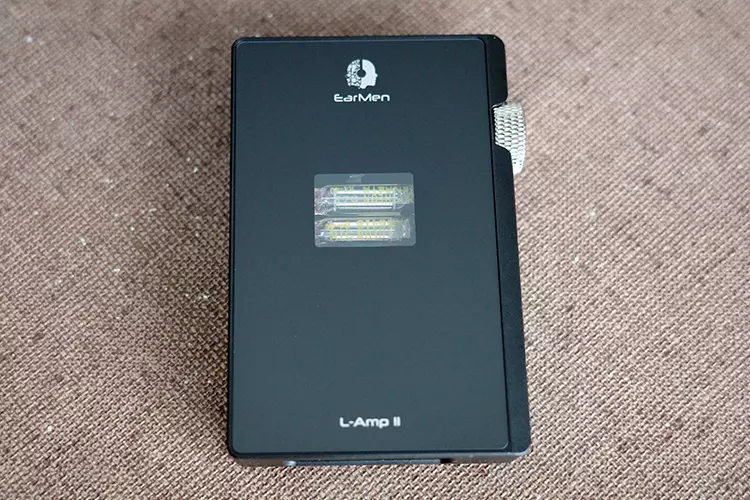
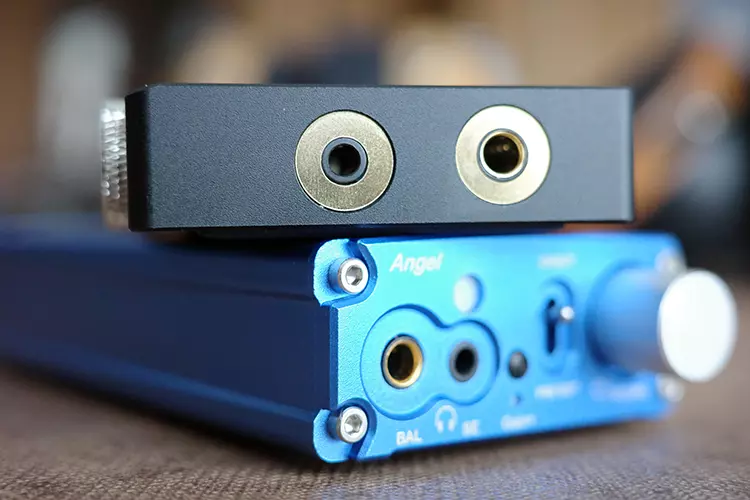
The glossy black rectangular L-Amp looks the part and, thankfully, is fingerprint-resistant. The top features gold-plated 4.4mm balanced and 3.5mm single-ended headphone jacks, while the bottom features two gold-plated USB-C ports.
The left one is for data (and power if you do not use the other), and the right is for external power, should you want (or need) to save the battery of your source.
The front carries both EarMen and L-Amp in tasteful gold lettering. Set between the two is the window to the past, so to speak.
While the tubes do not light up, the red LED behind them emits a tube-like glow for the Raytheon tubes. When activated, the red LED for Bass+ also shows below the tubes. The same is true for the second-generation EarMen.
The left side carries the aforementioned Bass+ switch, with the play/pause button above; both are recessed so they are flush with the side. The L-Amp MK2 lacks a play/pause feature, but I did not miss it.
The right side carries the volume up/down buttons, with the IEM switch above, again inset. The IEM switch eliminates noise for sensitive IEMs, letting the music come through quietly.
The clean lines of the L-Amp MK2 right side are ‘broken’ only by the silver potentiometer volume wheel, giving it a sleek look and an easily findable knob.
This is a classy-looking unit that really should be showcased. Those feet can do double duty when paired with your smartphone or DAP, allowing you to stack them like in the old days if you prefer.
The L-Amp MK2 is slightly thicker, which I would surmise helps with the suspension system and heat dissipation.
Performance
The precision with which the ESS shows forth counters the tube-like sound with aplomb. An excellent balance between the two allows the listener to experience both, much as on a desktop unit.
I found the power completely adequate to drive even the hardest headphones I own, the SJY Horizon, without a bother. That last bit of voltage to drive those hard headphones was only slightly lacking in both, to me.
This shows that power is not an issue and can be controlled even with those harder-to-drive units. IEMs, on the other hand, benefit from the IEM switch, darkening the background to a minimum, especially with the notoriously delicate Campfire Audio offerings.
What transpired is a thoroughly organic, yet musical sound, emanating deep-reaching bass (especially with Bass+ on) that flowed without bother into the sumptuously tube-like midrange.
The treble reach, while not far-reaching, lends enough presence to expand the sound’s height. Vocals come across as thick and lush but accurate, finishing off the L-Amp sound signature.
The L-Amp MK2 took that signature and cleaned it up a bit, with better detail retrieval and clarity.
Dynamically speaking, the second generation builds upon the first with better transient response and a melding across the three dimensions. Think of the second gen as a Subaru WRX STi, versus a ‘plain’ WRX.
EarMen Angel
Technical
The DAC chip EarMen decided to use for the Angel is the ES9038Q2M, a balanced-capable converter from ESS designed for portable devices, and the same as the TR-Amp II.
This chip has also been used successfully in higher models from EarMen, too. The Angel supports most modern media formats, including 32-bit/768kHz PCM, native DSD512, and MQA. Again, similar to the L-Amp II.
The fully balanced circuitry of the Angel presents gobs of power here, too. With no problem running hard to drive headphones, the Angel handles everything thrown its way. This is EarMen’s version of the legendary iFi audio Micro Black Label, and it can certainly go toe-to-toe.
If in doubt, a gain button is included for even more. There is also a linear power supply hiding inside the Angel, getting a good handle on keeping noise low. The L-Amp MK2 only has the IEM/Headphone switch, which can be used as a gain feature.
Two 3000 mAh lithium-polymer batteries give the Angel up to 10 hours of playtime. With a charge time of 3 hours and a separate charging port, you can run either on battery power or plugged in, like the L-Amp II, but the latter requires a power source.
Design
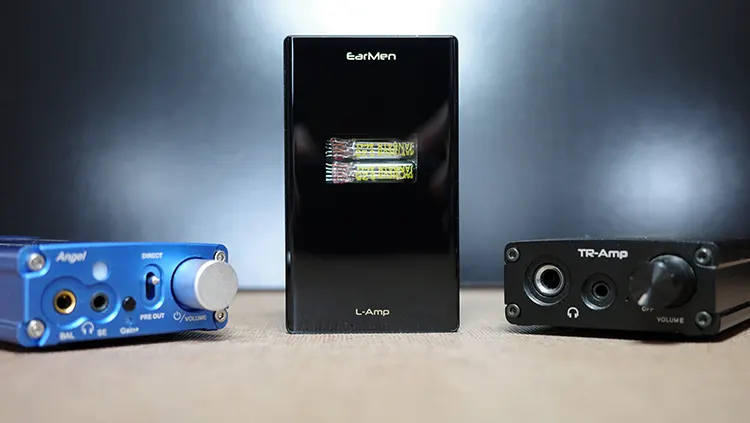
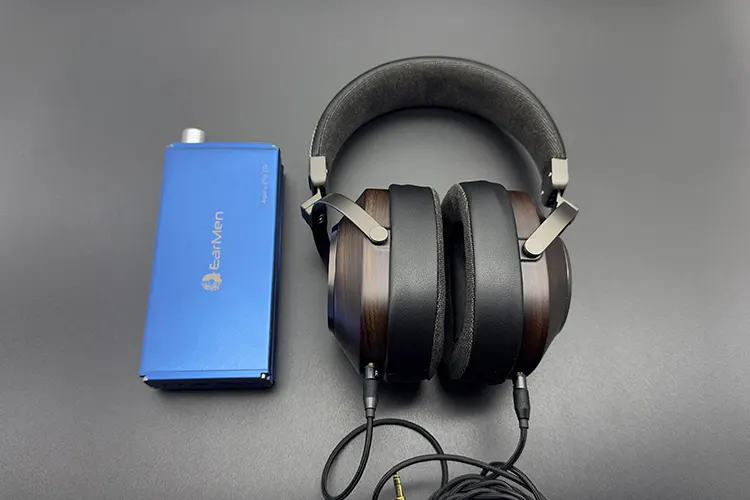
The similarities between the TR-Amp, Angel, and L-Amp MK2 are again obvious.
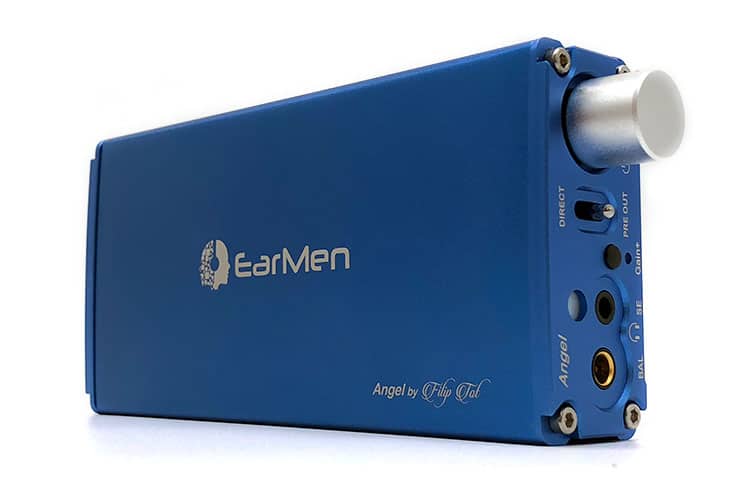
The easiest way to describe the Angel to those who have owned or seen the TR-Amp is to elongate its chassis and move some components around to bring it up to today’s standards. The industrial look pervades, but in blue this time, and looking sharp.
Doing away with the 6.35mm and RCA sockets of the TR-Amp, the Angel uses a more compact set of 3.5mm and 4.4mm jacks to highlight the amplifier’s balanced design.
The Angel also moved the preamp switch to the front and added features, including a new Gain+ button and S/PDIF interface.
You can also run balanced 4.4mm out or single-ended 3.5mm out from the back, providing a fully balanced sound when tethered to another balanced device.
Four visible screws hold the three-piece assembly of the Angel together, just like the TR-Amp. It is one of the more prominent features used by EarMen to add depth to the otherwise simple case of the device.
A large volume knob protrudes out the front, with the direct/Pre-amp toggle next to it, very much like the silver knob on the L-Amp II, and the familial resemblance shows forth.
Performance
It may be described on paper as a portable DAC/Amp, but power the Angel on, and you’ll get desktop-quality sound. The definition and power of each note make me sometimes forget that I am listening to a battery-powered source. And it provides plenty of power.
Power is comparable to the L-Amp MK2, with up to 8.5 Vrms at 0 dBFS on 4.4mm balanced. That is impressive for such a diminutive device. That said, the Angel, to me, provided a broader volume spectrum, giving harder units that last bit of juice to “properly” drive them.
The midrange is very well-behaved, tending slightly toward neutrality, similar to the L-Amp II. But while it does inch towards a forward presence, it is still safely tuned for non-fatiguing use.
Both can be called smooth, but the Angel has a tad more vibrancy in its tonality, while the L-Amp MK2 goes for a more organic smoothness.
Expecting linearity with the low end, the Angel surprised me with its impactful presence. In this case, I use the word impactful to highlight the Angel’s scale and reach as it springs to life with dynamic beats.
There is more dynamism in the Angel, but that is the tuning presented. This is a vibrant tool for presenting levels of detail that can make some desktop units blush.
The L-Amp MK2 goes against the grain with its smooth, tube sound. Add in the BASS X on the L-Amp II, and there is more presence, though, along with impact, which is a fair trade-off in my book.
Both come across as showing no compromises in sound quality or in how the sound is represented. The family resemblance is applaudable, but each shows its own merits when asked for differing purposes.
EarMen TR-AMP
Technical
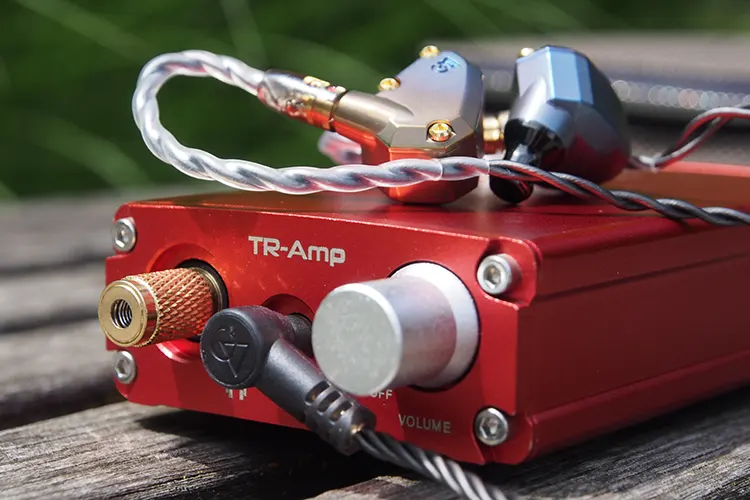
The ES9038Q2M was an improvement over the previous-generation 9018Q2M chip. The circuit sounds much more mature, with a higher degree of clarity. The familial resemblance between the TR-Amp and L-Amp MK2 can be heard quite easily.
With the Texas Instruments High Fidelity TPA6120 chip powering them, the AKG240DFs were never left wanting for more power.
The 3700 mAh battery provides up to 10h of playtime. It is recommended to use a 5V/1A–2A charger as well. The same could be said of the L-Amp MK2 with the LCD-3.
Design
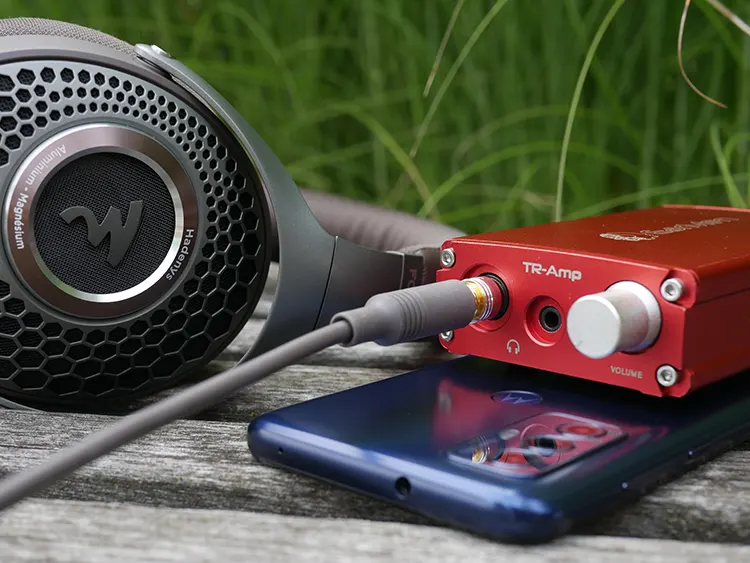
The chassis is full aluminum. The industrial look of it hearkens back to a previous generation for EarMen, replete with exposed Allen-head bolts. That design allows the company to replace the battery if needed.
The robust structure counters the softer lines (and color) of the L-Amp II, but the familial resemblance remains with many of the inputs and outputs.
With the familial look of a smaller, squat Angel, the two here are probably the most diverse-looking in the family. I appreciated both lines of design.
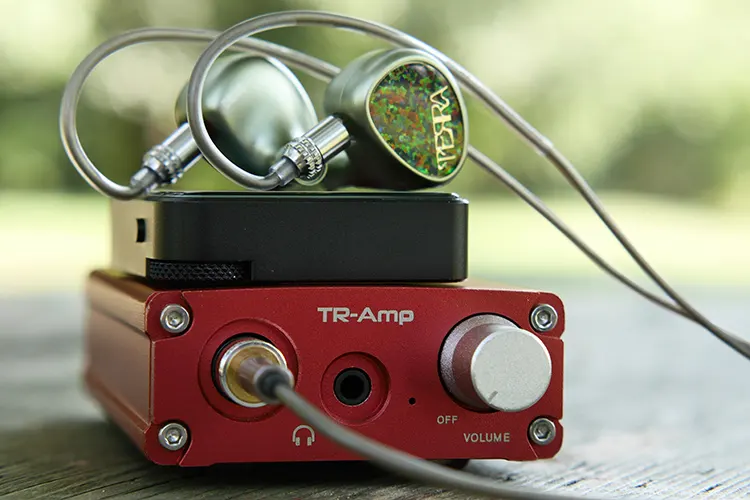
The USB ports are sturdy, as are the 6.35mm and 3.5mm ports, both single-ended. This allows use with older headphones, but only with non-balanced headphones.
To be honest, that isn’t a big deal, so I can pull out some old pre-balanced headphones. The L-Amp MK2 forgoes the 6.35mm in favor of the 4.4mm balanced jack.
Use can be made via either USB-C in or RCA LO for pre-amplifier use. No gain switch is included, since you have an actual volume knob.
Performance
The TR-Amp can be used as a preamplifier, focusing solely on DAC performance, or in conjunction with the amplifier. While I used both, I’ve used USB-C the vast majority of the time since I have had it. The L-Amp MK2 is strictly an amplifier.
Presenting a rich, smooth signature, but carrying a certain edge to it that shows off the EarMen’s traditional sound. Vibrant in clarity, with excellent midrange and extension, it affords the user a full-sounding approach that also carries plenty of power.
The vibrancy of the TR-Amp counters the tube sound of the L-Amp MK2 quite well, offering the user options again.
The L-Amp II, on the other hand, offers a more well-rounded, smoother signature, especially with the additional thump down low when using BASS X.
The TR-Amp was a unit I quickly fell for when I reviewed it, thanks to the immense power it offers and a sound signature that vibrantly presented itself, with an almost Ray Samuels-like character. Gobs of power, tamed by an excellent signature.
The L-Amp MK2 follows in the family footsteps, adding the legacy of the first generation and adding that tube sound, cementing its place in the lineup.

My Verdict
The first-gen L-Amp was a fine product, though it had a couple of discrepancies. EarMen took the criticisms and corrected those faults. Gone is the pinging. Gone is the delay (mostly) in tube warm-up and connection.
The design is sleeker and more refined. Pretty much everything about the L-Amp MK2 is about improving the first-generation while preserving its sonic appeal. And the L-Amp MK2 has succeeded across all the boards.
There is still that tube lusciousness many crave. There is a warmth and richness to the signature that many fondly remember, or, in some cases, still experience, from their two-channel systems. There is plenty of power for a portable unit, without shouting gigawatts.
The redesign hits all the sweet spots, from the improved construction to the improved isolation to the refined signature that affords clarity and warmth to coexist. Add in portability, and you have a unit that should become a hallmark of one’s portable scene.
If I had to nitpick, I would prefer a bit more power, but be aware that the source power can accommodate one’s volume preferences as much as adding to the L-Amp MK2. Also, a nice leather case would look sweet as an option.
The L-Amp MK2 is an improvement across the board over the first, and I highly recommend a listen, especially if you have the first or would like to try affordable portable tube gear. Yes, the price has increased, but when you factor in the improvements, it is a no-brainer to me.
EarMen L-Amp MK2 Technical Specifications
- JAN6418 NOS Tubes
- Hi-Res Audio 32bit/384kHz
- ESS Sabre DAC
- Burr-Brown INA 1620 OPA
- Max power: 1W @ 8 Ohm
- Balanced & SE outputs
- IEM friendly
- BASS X Superior DSP
