

Select Comparisons
Elysian Acoustic Labs APOSTLE
Technical
The Elysian APOSTLE features a 5-driver tribrid IEM setup, including one custom dynamic driver, one Knowles, and one Sonion balanced armature driver, and two new-generation Sonion electrostatic drivers.
The custom-tuned Liquid Silicone Rubber (LSR) dynamic driver delivers deep, controlled bass with minimal distortion. Additionally, a newly designed 4-way crossover ensures quick and precise frequency distribution among the drivers.
APOSTLE has an impedance of 10 Ω @ 1 kHz and a sensitivity rating of 97 dB/Vrms. It does not require extra power and can be comfortably driven by low-power sources such as dongles and smartphones. It takes less power than the Omega.
On my LPGT, APOSTLE takes a volume level of 30 while Omega can go as high as 40. Both the IEMs are quite stable with some additional power and show some scalability.
Design
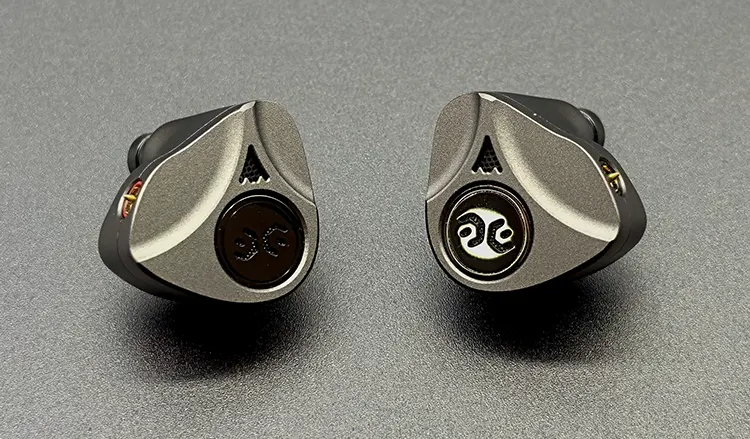
APOSTLE’s design features an avant-garde and mechanical approach, deviating from traditional metal shell IEMs. The shells are built from aluminum alloy and feel very robust while maintaining a lightweight. The faceplate is designed in a tri-cornered structure with a circular black accent at one end.
Omega, with its resin shells, does feel a bit less robust, but I do not take sides in the metal vs. resin war; for me, comfort is an important factor, and both IEMs are equally similar in this regard. Omega, with its lightweight shells and ergonomic design, does not cause any issues with fit at all.
The nozzle is relatively wide on both IEMs, so the same set of ear tips works well on both. Omega connects via a 2-pin, 0.78mm socket, while the APOSTLE connects via a Pentaconn system, which I do find more reliable and convenient.
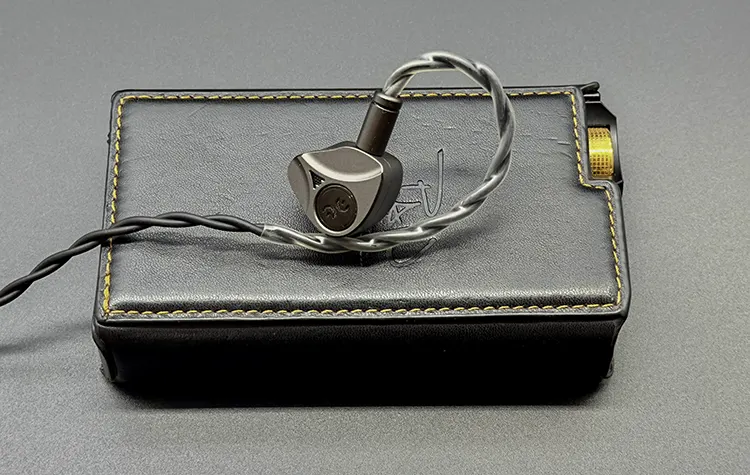
APOSTLE’s stock cable is thicker and less pliable, but surely has a robust build. In terms of usability, I would put the stock cable on Omega ahead, as it is more flexible and its performance is a bit better.
APOSTLE and Omega have a similar unboxing experience; however, the arrangement on APOSTLE is a bit more thoughtful and premium. APOSTLE is equipped with better accessories, such as the DIVINUS Velvet ear tips and small IEM protection pouches.
Performance
APOSTLE has a more V-shaped curve than the Omega, which makes the bass on APOSTLE more pronounced. Omega’s bass is about a balance of quality and quantity.
On APOSTLE, the bass is thick and dominates the higher frequency region. Omega’s bass stays clean, with enough rumble and punch. Thanks to its wide, spacious soundstage, the bass is well-contained in its own space and does not overwhelm the mix.
In the midrange, APOSTLE follows a more neutral approach, but due to the thicker bass shelf, the midrange is slightly shadowed, so in comparison, details are more prominent on the Omega.
Omega has a cleaner timbre, and the tonality strikes the right balance of warmth and emotion. APOSTLE lacks these traits; however, I appreciate the vocals, as they feel quite full and rich. The extension of instruments and vocals is better portrayed on the Omega.
Omega leads with a more open and detailed treble response. The treble is more natural and reveals micro-details more effectively. The APOSTLE is a bit smoother in this region and lacks a sense of space and airiness, which also makes it a bit reserved in comparison.
One of the positives of Omega’s treble is that it has enough brilliance and sparkle without pushing them to the front, so it does not feel forced or pushed; rather, it feels very natural.
Omega has a wider soundstage than the APOSTLE. The depth from the APOSTLE is commendable, but Omega does a better job at maintaining appreciable depth along with a wide, spanning stage.
The holographic stage on Omega is more 3D-esque with imaging that is more precise and accurate. Owing to its spacious presentation, the instruments and vocals enjoy more separation among them, something that feels more confined and restricted on the APOSTLE.
Kinera ThorKing
Technical
The Kinera ThorKing is a flagship tri-brid IEM that features 1 dynamic driver, 6 Knowles balanced armature drivers, and 4 Sonion electrostatic drivers. It implements a four-way crossover that ensures precise frequency distribution among the drivers.
ThorKing has an impedance of 10 Ω @ 1 kHz and a sensitivity rating of 105 dB/Vrms. The IEM can be comfortably driven by sources with fewer power specifications, such as dongles and smartphones.
Both ThorKing and Omega are quite stable on powerful sources. Omega can take a few volume levels more than the ThorKing on my LPGT.
Design
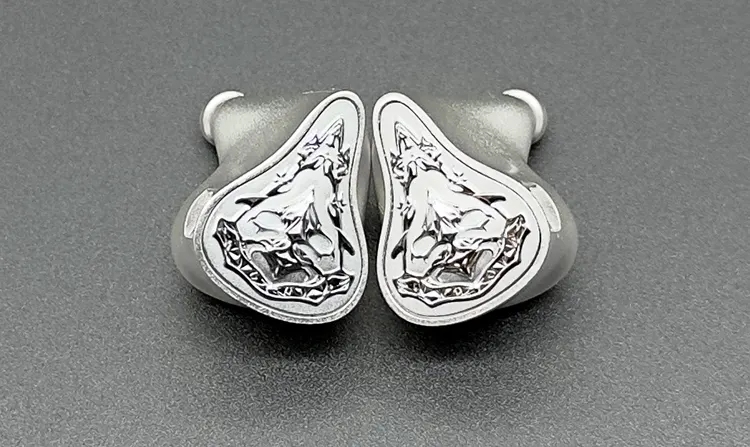
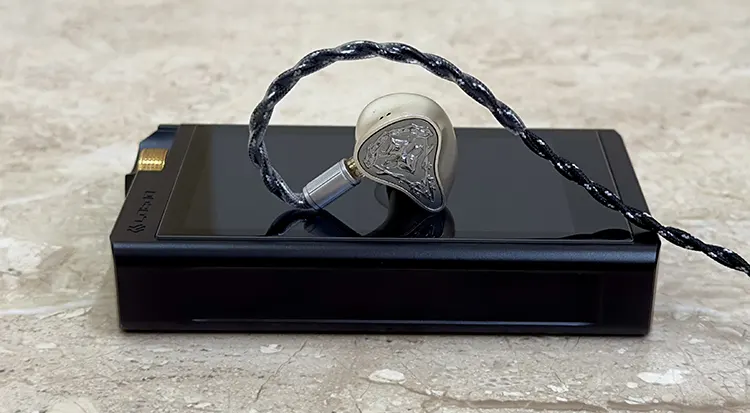
ThorKing boasts a very premium design with an intricate faceplate build. The unit I have is built with matte brass shells, and there is a polished silver version available as well.
I prefer the matte one, as it is less prone to scratches. The faceplate design is inspired by Norse mythology, depicting the legendary battle between Thor and Jörmungandr.
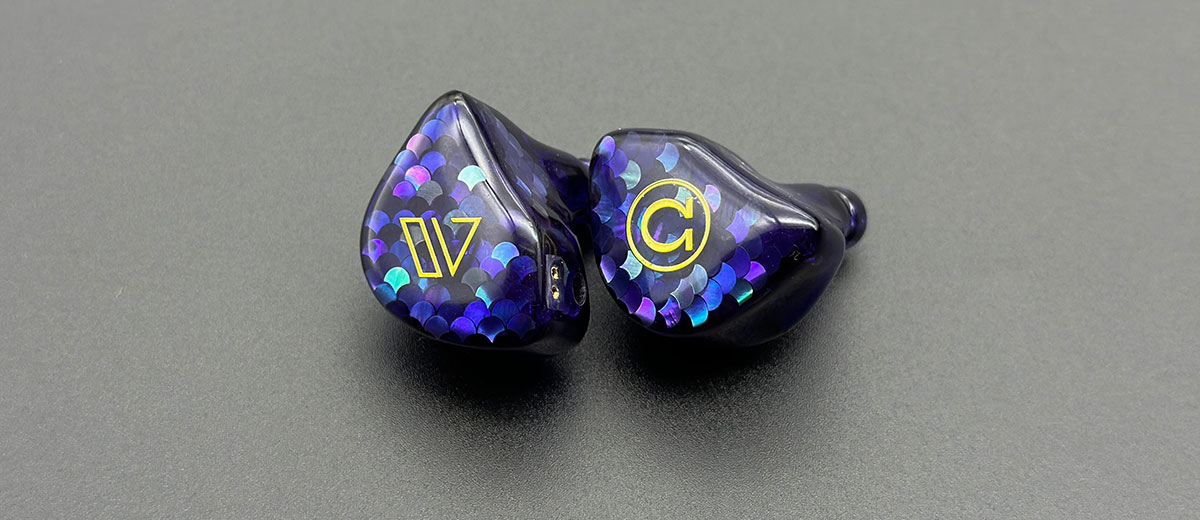
The design language of both IEMs is polar opposite: on one hand, we have the shiny, colorful design scheme of the Omega, while the ThorKing is a very sophisticated and luxurious-looking IEM.
The shells of the ThorKing are surprisingly lightweight and have a very ergonomic design; thus, the fit is easy and comfortable. The Omega’s resin shells are lighter and equally comfortable, though the larger nozzle can be a bit of trouble for some, especially folks with smaller ear canals.
Both IEMs connect via a 2-pin, 0.78mm socket. While the stock cable of the ThorKing is decent, I would rate the performance of the Omega’s cable a bit higher, and the synergy it brings makes it very suitable as well. I find noise isolation on the ThorKing to be a bit better.
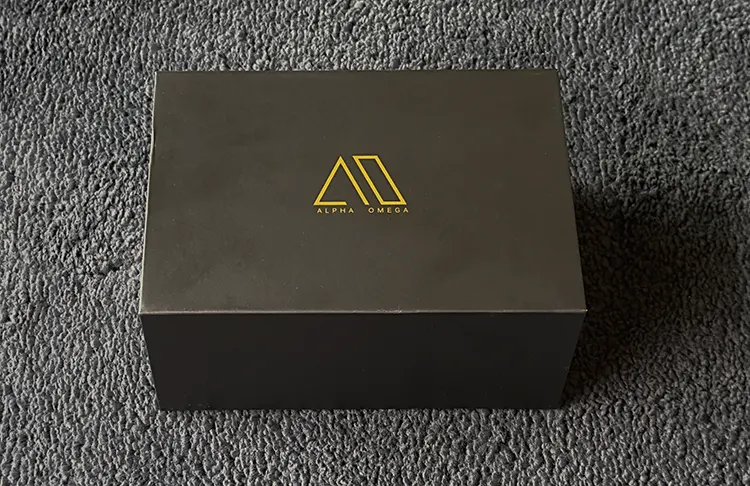
There is no comparison in the packaging and unboxing experience, as Kinera has put in great effort. ThorKing has a grand presentation, against which the Omega feels a bit like preschool packaging. Kinera packs a few extra accessories, so that’s an added benefit.
Performance
ThorKing has a leaner and more restrained bass response, resulting in fewer punches and less presence. Omega has noticeably elevated bass, with a stronger sub-bass and mid-bass presence.
Omega delivers a deeper and more powerful physical bass, with more rumbles and impact. However, it is worth noting that ThorKing’s bass maintains high quality, with its texture and crisp layering, but misses the fun and excitement.
In the midrange, the ThorKing remains very neutral but is richer and fuller. The lower midrange on ThorKing adds body to string instruments and vocals, making them sound more natural.
Omega has a bit of warmth in the midrange and a boost in the upper midrange, making the midrange a bit more detailed and expressive. However, it is a bit thinner in the lower midrange region. Omega has better bass-to-midrange separation, avoiding any muddiness.
ThorKing is brighter and more energetic in the treble region. Omega is slightly less peaky and smoother through the lower and mid-treble regions, with less exaggerated peaks.
It has noticeably more activity in the treble region, with pronounced peaks here and there, which adds more sparkle and presence. Thankfully, ThorKing avoids too much sharpness and thus is not harsh or fatiguing. ThorKing reveals more details, but the decay and “trails” feel shortened or less organic.
ThorKing is more technical, with a sharper focus but a less enveloping, slightly flatter presentation. It spans wider in the soundstage than Omega, but the latter presents better depth and a taller soundstage.
It is more “in-your-head” than tall and enveloping. ThorKing provides more precise, pinpoint imaging, while Omega is a bit softer, especially in busy, complex tracks with lots of low-end energy. ThorKing is much better in instrument layering and separation; however, Omega never feels congested.
LETSHUOER Cadenza 12 2024 Version
Technical
The new LETSHUOER Cadenza 12 (2024 version) is a universal in-ear monitor featuring a 12-driver setup, including one dynamic driver and 11 balanced armatures, with a mix of Sonion and Knowles drivers and a 6-way crossover.
The Cadenza 12 has an impedance of 16 Ω @ 1 kHz and a sensitivity rating of 110 dB/Vrms. Even if the Cadenza 12 does not demand additional power, it does benefit from a powerful source.
Like Omega, it also exhibits some scaling properties. On my LPGT, Cadenza 12 takes a few fewer volume clicks than the Omega.

Design
The shells of the Cadenza 12 are made from titanium alloy. These shells are highly polished, almost having a mirror-like finish, but get scratched easily. The resins on Omega do not ask for careful handling, but most of us would be inclined to opt for the Cadenza’s premium shells.
The unboxing experience of Cadenza 12 is better than that of Omega. It arrives in a large box and includes more accessories. I prefer the more robust and durable carry case of the Cadenza 12.
The ear tips included with the Cadenza 12 do not feel premium, and I had to instantly swap to an aftermarket one.
Like the Omega, the Cadenza 12 connects via a 2-pin system. I find the cable on both the IEMs to be nicely built and functional. The stock cable on the Cadenza 12 is modular, so that’s an advantage if one is looking to connect to different termination types.

Performance
Omega has a bolder, more tactile bass response, delivering more punch and rumbles that are felt as much as they’re heard.
The low end on the Cadenza 12 has a good presence, but is not as powerful. It takes a more balanced approach. The bass notes, which feel merely present and have a softer impact, feel more alive on the Omega.
Both IEMs deliver excellent quality, but Omega takes the lead with a more detailed and layered bass response.
The midrange on the Cadenza 12 is more natural, smooth, and even. Cadenza 12 sounds more neutral and accurate due to its linear midrange, but lacks some of the forwardness of the Omega in the upper midrange.
Omega has a mild recession in the lower midrange, but the upper midrange rises smoothly, and the boost adds a sense of space and clarity. Vocals and instruments stay separated without any feeling of congestion.
The Omega has less emphasized peaks and dips in the treble, making it more forgiving in the treble region. Cadenza 12 is the brighter and airier of the two and carries more energy. It can feel a bit aggressive, but it is not harsh or fatiguing.
Cadenza 12 adds plenty of brilliance and sparkle, pushing the micro-details to the front. The shimmers and treble notes feel more accurate on the Cadenza 12.
Due to its leaner bass and energetic treble, the imaging feels sharper and more accurate on the Cadenza 12; however, the Omega also maintains strong spatial cues.
The stage feels more immersive and holographic on the Omega, which may appear a bit flat in comparison to the Cadenza 12. The reverb and decay in the bass and trailing notes all hang in the air longer, giving music a more three-dimensional feel on the Omega.
My Verdict
Since my introduction to the Ra, I had been following the releases of Alpha Omega and had been in touch with Clement about all that he was planning. Omega had always intrigued me, and I waited patiently to get a unit. If Ra is a glimpse of what Clement can build, Omega is a full-blown revelation.
The Omega surprised me in many ways. Firstly, the bass, with tons of detail and texture, is one of the most spectacular I have ever tried. The sheer quality leaves a lasting impact every time I listen to them.
The clean timbre, the detailing, and the resolution truly justify its flagship status. The treble pushes the boundary of extension and detail without any hint of harshness.
With its warm midrange and smooth sound, Omega solidifies the emotional and musical sides but does not sacrifice the technical side at all. The wide, spacious soundstage, along with well-separated sound, balances the technicality well.
I wish they had paid a bit more attention to the tangibles, as a bit more premium packaging and accessories would have taken things to new heights.
Despite these lacking whims and fancies, if you prioritize sound, you are well served, and the premium price is rightfully justified.
Alpha Omega Omega Specifications
- Driver Configuration: 1 x 10mm Dynamic Driver,
- 4 x Sonion Ba Drivers,
- 4 x Sonion Electrostatic Drivers,
- 6-way Passive Crossover
- Cable: Astral Acoustic Amethyst, 4.4mm balanced with 2-pin connection system
