

Synergy
Although the M5 should be difficult to drive with its low impedance of 20Ω, this is compensated by its above-average sensitivity, which means all my sources, including the small dongle DAC, never had a hard time taking the M5 to high volume levels.
Pairings
Thanks to the M5’s neutral tuning and power sensitivity, it pairs well and is handled easily by any sources I tried. The only concern left is whether the source is resolving and sounds good enough to make the M5 achieve its highest sound quality potential.
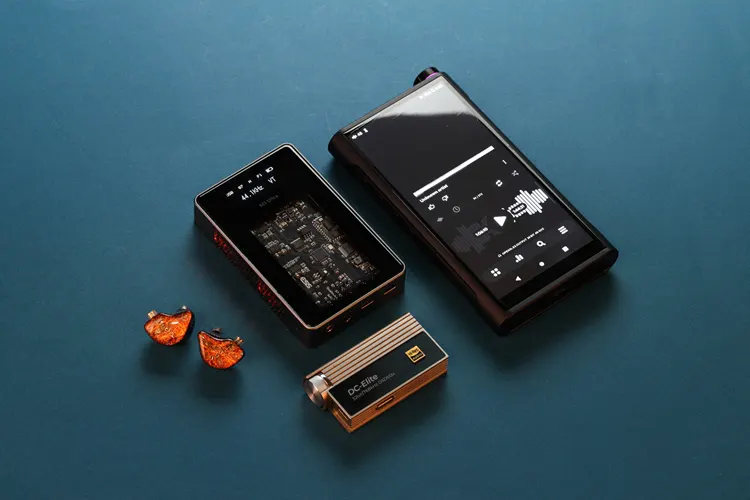
I paired it with the beautiful-sounding MUSE HiFi M5 Ultra BT DAC amplifier in vacuum tube mode. The M5 easily reveals the Ultra’s mellow and smooth sound, along with competent resolution. However, resolution is clearly improved with a more resolving source.
When paired with the iBasso DC-Elite dongle DAC, the resolution is increased, along with instrument separation, soundstage size, and imaging. But when paired with a more powerful source such as FiiO M15S, the sound became cleaner at high volumes.
I must add that, for the best tonality, I would pair the M5 with mellow or warm-sounding sources such as the M5 Ultra and other DAC amplifiers with a similar sound profile. The M5 could sound bright with lean and clinical-sounding sources.
Select Comparisons
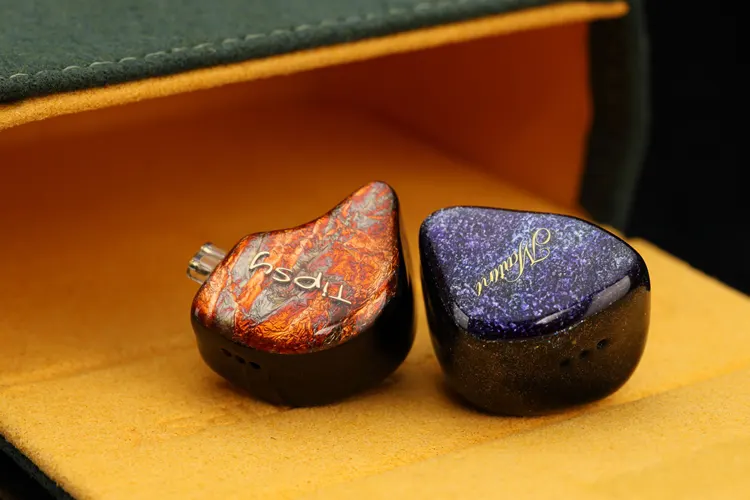
Kinera NOTT Phantom
Technical
The Kinera NOTT Phantom is a hybrid set of 1 + 4 drivers featuring an 8mm polymer fiber composite dynamic driver, two Knowles balanced armature drivers for the midrange, and two Sonion balanced armature drivers for the highs and ultra highs. It has an impedance of 54Ω and a sensitivity of 105 dB.
Design
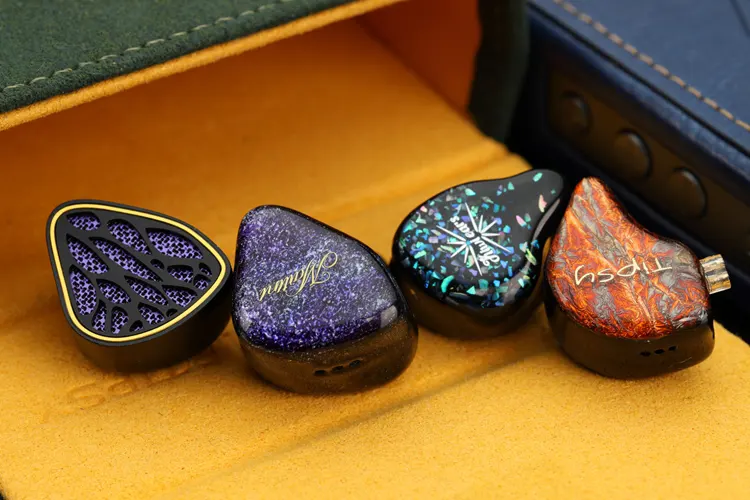
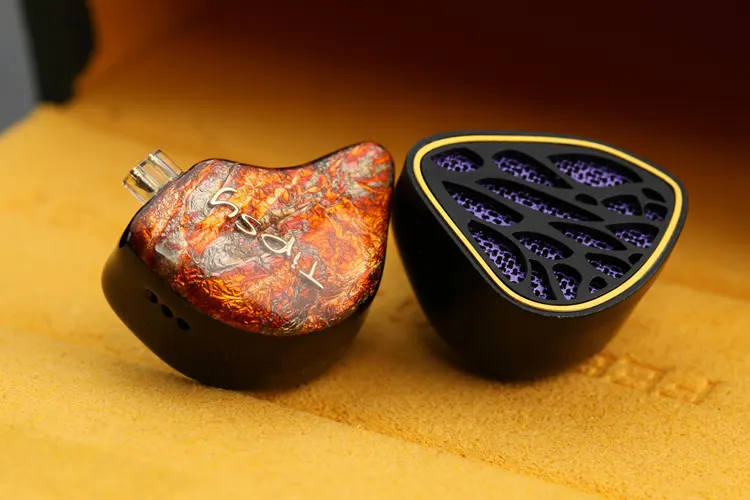
The NOTT Phantom has a beautiful, lightweight metal shell with an intricate faceplate design composed of three layers of differently shaped materials.
The thick stock 4-core cotton sleeved cable is designed to match the black, gold, and purple color scheme of the shell, making the whole set look aesthetically cohesive.
Performance
I had a hard time comparing the two because they sound similar with only small differences here and there.
After extensive comparisons, I find the M5 has a denser-sounding bass and lower midrange due to the inclusion of bone conduction drivers, compared to the tighter, dryer, and slightly leaner bass from the NOTT Phantom.
The M5 has a more relaxed upper midrange with slightly laid-back vocals and instrument presence, compared to the more forward instrument and vocal presentation on the NOTT Phantom.
Neither are fatiguing nor shouty in the upper midrange, though, and the difference is small.
Both the M5 and the NOTT Phantom have a very extended upper treble presentation, and both sound airy and detailed.
Still, I find the M5 has slightly more upper treble presence, which could be both a good or bad thing, depending on the listeners and the source pairing and ear tips.
Regarding staging, I find it hard to differentiate between them at first comparison. Still, I find that both have similar soundstage sizes; however, I perceive the NOTT Phantom’s soundstage as more spherical, while the M5 is wider than it is deep.
In terms of imaging, the M5 has a more laid-back main vocal presentation, while the NOTT Phantom is more accurate and holographic.
I would also give a small edge to the NOTT Phantom when it comes to image definition. Overall, the difference in this regard is small.
Dynamically, they are almost identical; they both sound dynamic and energetic even at low volumes, can take power well, and can go loud without distorting or compressing audibly.
QoA Martini
Technical
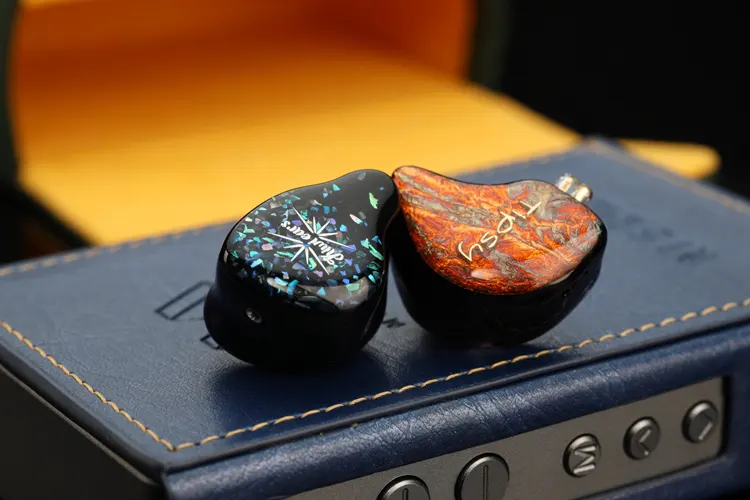
The Martini is a six-driver tribrid set, consisting of one 10mm bone conduction driver, one 6mm dynamic driver, and four balanced armature drivers. It has an impedance of 14Ω and a sensitivity of 105 dB.
Design
Martini features a cleanly designed, ergonomically shaped 3D-printed shell and is finished with fine, dark, blue-colored metal flakes throughout the shell, as well as a coarser metal flake pattern on the faceplate. It includes a thick, high-quality, customized cable with metal parts.
Performance
Martini has a mildly V-shaped sound signature, characterized by a slight recession in the midrange with slightly warm tonality. This contrasts with M5’s neutral, flat sound signature, which features leaner bass, a neutral midrange, and a more forward treble presentation.
I find the Martini to have a bigger soundstage with a much deeper presentation and cleaner decay of the instruments. Compared to the M5’s shallower and smaller soundstage. The M5’s soundstage is still big on its own.
Regarding imaging performance, I find the Martini to be better, with more precise placement and definition, as well as a more holographic presentation.
In contrast, the M5 is not bad in imaging, but it sounds less precise and defined, resulting in less holographic imaging performance.
Both are dynamic, lively, and can go very loud, but I find the Martini to have more impactful bass while the M5 has more energy in the midrange and treble.
Kiwi Ears Astral
Technical
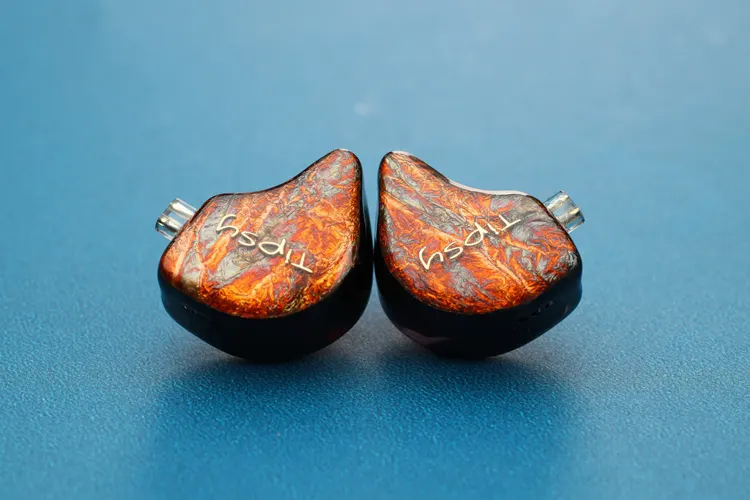
The Astral is a seven-driver hybrid IEM set consisting of one 10mm dynamic driver assigned exclusively for bass, and six balanced armature drivers to produce midrange and treble. It has an impedance of 23Ω and a sensitivity of 105 dB.
Design
The Astral is made of an attractive-looking black 3D printed resin shell with a faceplate featuring metal flakes and the Kiwi Ears logo embedded. Astral utilizes a metal nozzle, and a vent port is located on the side near the 2-pin connector.
Performance
The Astral has a U-shaped sound signature characterized by its boosted sub-bass, slightly dark midrange and lower treble, and an increased upper treble.
This contrasts with the M5’s neutral, flat sound signature with a brighter overall sound due to the more forward lower treble presentation.
In terms of sound staging, the Astral has a narrower but deeper stage presentation; it sounds as if you are sitting further away from the stage, compared to the M5’s broader and shallower stage, which has a more forward presentation, giving the illusion that you are seated near the stage.
Regarding imaging, Astral has smaller but more precise and defined images with a laid-back presentation, compared to the M5’s bigger, but less defined images. The Astral is more holographic, too.
I find the M5 to be more dynamic and energetic-sounding due to its even sound presentation across the frequency range compared to Astral’s darker sound presentation with recessed midrange and lower treble.
My Verdict
I must say that Tipsy really fulfilled its promise of having a reference level, monitoring IEM in the M5, and I will be using it as my reference monitor when evaluating songs and other IEMs for comparison.
And before you say it’s a Harman-tuned sound, it’s not. A Harman-tuned sound has a more upper midrange and less upper treble presence, and it is more fatiguing due to the upper midrange elevation in response. The M5 does not sound like that at all.
However, I wish there were just a tiny bit of reduction in response in the upper treble, as that made the M5 slightly picky for source pairing. The M5 easily exposes most cheap sources’ less-than-stellar upper treble quality.
Still, it is rare to find a reference-level monitoring IEM these days, as most follow a certain tuning, sound style, or house sound, which adds flavor to the sound. The Tipsy M5 is one of the least colored-sounding multi-driver IEMs I’ve heard and thus earns my recommendation.
Tipsy M5 Technical Specifications
- Driver configuration: 5 driver quad-brid
- Ultra-low frequency: 1 x 10mm bone conduction driver
- Low frequency: 1 x 8mm PU+DLC composite dynamic driver
- Mid-high frequency: 2 x self-developed custom balanced armature drivers
- Ultra-High frequency: 1 x self-developed planar speaker unit
- Crossover: Physical independent 4-way crossover
- Effective frequency response: 20-20 kHz
- Sensitivity: 109 dB
- Impedance: 20Ω @ 1kHz
- Distortion: <2%@1kHz
- Cable length: 1.2m
- Cable type: Detachable 3.5mm
- Wearing Type: In-Ear
- Weight: 5.3 g
- Nozzle Diameter: 5.7 mm
