


Louis reviews the ONIX Beta XI2, a hybrid solid-state and JAN6418 tube Dongle DAC capable of up to DSD512 decoding and 550mW output power. It is currently priced at $349.
Disclaimer: This sample was sent to me in exchange for my honest opinion. Headfonics is an independent website with no affiliate links or status. I thank ONIX and Shanling for their support.
Click here to learn more about the ONIX products previously discussed on Headfonics.
Note that this article follows our current scoring guidelines, which you can read here.
ONIX Audio debuted its portable dongle DAC amplifier prowess last year when it introduced the Alpha XI1. It is a highly competitive dongle that features two CS43198 DACs, a 500mWpch power output stage, and a modest price tag.
ONIX decided this time around to spruce things up and incorporate an interesting design twist into their new dongle DAC amplifier design, the $349 Beta XI2.
The ONIX Beta XI1 joined a small group of hybrid dongle DACs such as the iBasso Nunchaku and Woo Audio‘s TUBE Mini (sadly, neither unit is with me for testing).
It also belongs to a short list of dongles that produce surprisingly good audio for its size. The hybrid design is just the icing on the cake.
So, how does it perform and compete with the likes of the Alpha XI1, FiiO’s QX13, and the Questyle M18i? I found out in my full review below.
Features
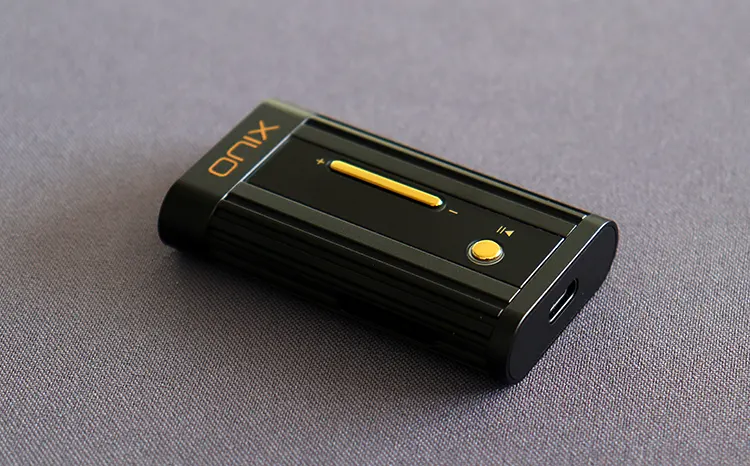
The key selling point of the ONIX Beta XI2 is its dual JAN6418 tube output stage, selectable via the onscreen menu on the 0.89-inch front-mounted screen.
The options menu in the Beta XI2 offers a selectable solid-state or tube mode. Meaning, you can go into the options and enable or disable the tubes and use solid-state instead. That’s the novelty of the Beta XI2. It offers two distinct sonic signatures in one dongle.
There’s also a solid-state OP-BUF amplifier stage on the Beta XI2 that uses a dual OPA1662 amplifier chip configuration with a quad buffer that uses four BUF434A chips.
This allows this dongle to produce 550mW max per side off the balanced connection at 32Ω and single-ended capable of up to 180mW on the same load.
The front end is not too shabby either. It uses a pair of the same Cirrus Logic CS43198 DACs used on the Alpha XI1.
That means the Beta XI2 is capable of decoding up to PCM 32-bit/768kHz and DSD512, and is compatible with Windows, Android, iOS, or Macs.
Design
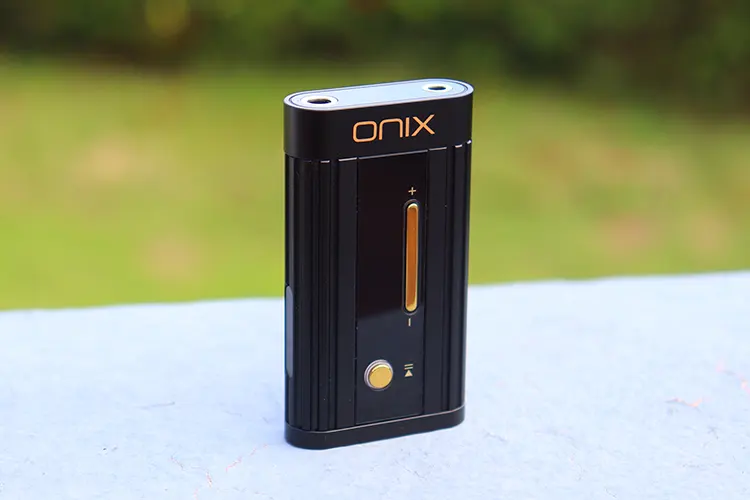
ONIX tends to favor its trademark Black with Gold trim and uses it on all its gear, including the Beta XI2.
It’s a classic color combination that can stand the test of time. I also like the side-mounted tubes that glow orange. The tradeoff is that the Beta XI2 is slightly wider in size compared to the XI1.
If you’ve seen the Alpha XI1, you will notice the resemblance. Gold trim is used throughout. The ONIX name, the buttons, and the headphone connections are gold-plated, minus the USB-C port that sits at one end of the dongle.
The Beta XI2 casing is made from aluminum, and ONIX uses a tube construction, according to their literature. I’m pretty sure what they mean is that the body is made as a hollow structure, and the electronics are slipped inside from the side and then capped off.
The front sports a 0.87″ screen and includes some hardware buttons. You can access all the features within the menu that include the two-stage gain via these buttons.
There’s a tube mode, the PCM filters, the key mode, font style, balance, the screensaver timeout, and the screen orientation.
The sides of the dongle are ribbed, which increases the surface area; hence, a natural, passive cooling effect occurs.
The sides also sport the tubes behind glass, and they show the tubes glowing an Orange hue. This dongle has a lot of eye candy.
I/O
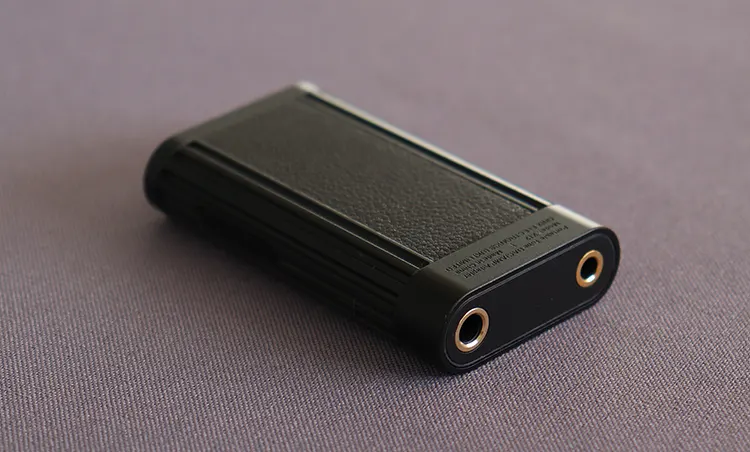
The ONIX Beta XI2 uses a Comtrue CT7601 USB chip with a dual set of analog PO jacks that includes a 4.4mm Pentaconn connection as well as the conventional TRS 3.5mm connection.
There’s nothing fancy about the Beta XI2’s IO section. Its connectivity section is the norm nowadays.
Upfront, there are two volume control buttons and a 100-step implementation that gives the user plenty of control of those output ports.
Plus, there’s a 2-stage gain within the menu that gives the user further control over the listening levels and output. There’s also a UAC1.0 mode that’s obtained by powering up while you hold the multifunction button.
Eddict App
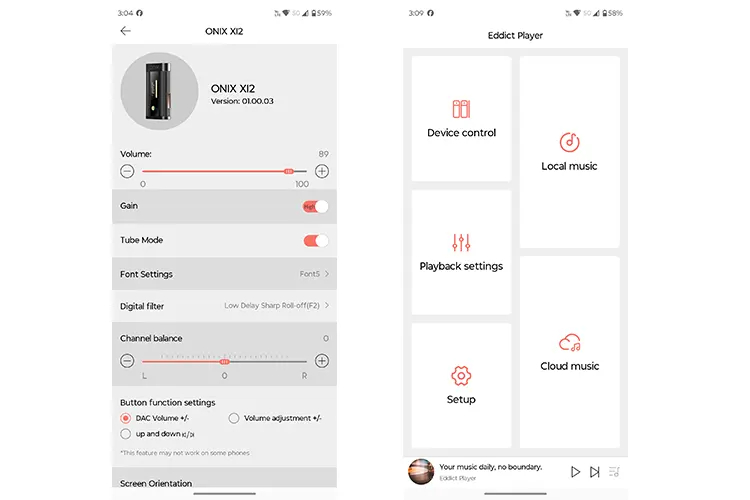
Again, don’t get confused when looking for a control app for the ONIX Beta XI2 because it’s the Eddict Player, which is from Shanling.
I’m not going to explain all the features within that app. My only qualm with it is that all the features are hidden. For example, you have to access the device control within the app to gain access to the Beta XI2’s features. It’s not upfront.
All the other features are scattered in sections. There’s a player, an equalizer, and a lot of wireless connectivity options.
The main options are the device control, playback settings for the player, a main setup page, and two other options to access either locally stored music or music on the cloud.
Packaging & Accessories
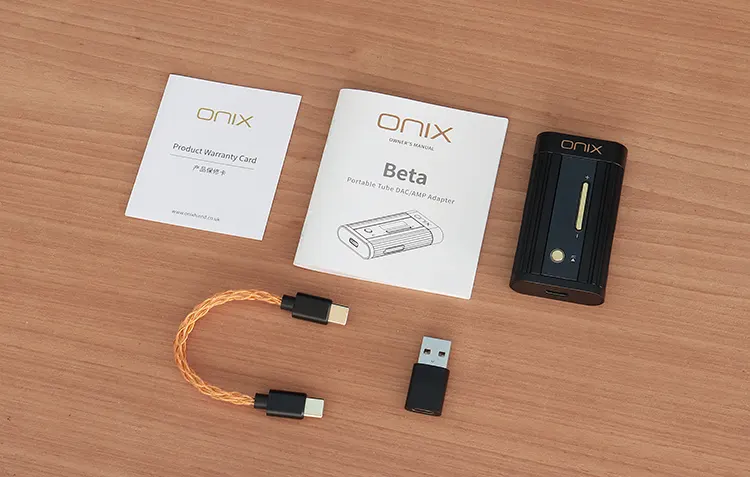
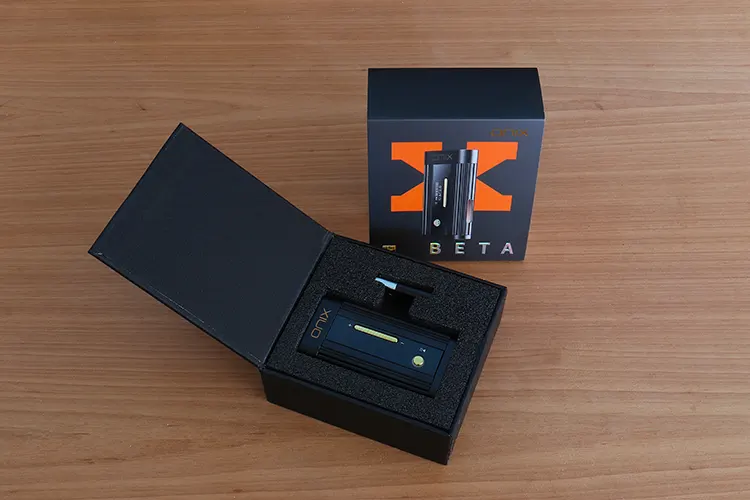
I’ll let you guess what color scheme ONIX used to decorate the box that the Beta XI2 comes in. It’s a slipcover over a flip-top hard box. But who cares about boxes, right?
I like the cable assembly that comes in the box. It’s terminated with two USB-C connectors, plus ONIX supplies the buyer with a USB full-size adapter. No Lightning connectivity is included.
The cable itself is an 8-wire braid. The connectors aren’t metal or anything, but they’ll do. They use small rubber strain reliefs and are nickel-plated rather than gold-plated. It would have been a stellar cable if the connectors were of a higher grade.
Sound Impressions
My main source was my daily mobile device, which is a Motorola Edge with the Dolby feature off. The phone has a 6000mAh battery and runs stock Android 15.
I used a well-broken-in HIFIMAN Sundara, their Edition XV, and the Ananda Unveiled. I also pulled out the Sennheiser HD 550, the Meze Audio 99 Classics Gen 2, and the new HEDD Audio HEDDphone D1.
The Flare Audio Studio was used to test for hiss. The FiiO FX17 and the HIFIMAN Svanar were also used.
Solid State Mode
I like the way the ONIX Beta XI2 sounds first and foremost because it sounds balanced and natural. The overall tone gives vocals and instruments a faithful presentation. A smooth upper region presentation is also an obvious characteristic.
It’s one of those devices that surprises you, especially when you consider the size-per-performance ratio it offers.
You would expect less performance, and considering that the Beta XI2, along with a few new generation dongles, are improving compared to models released just a year ago.
I find that dongles that have the CS43198 sound neutral, or flat, but not overly sterile or analytical, and so does the Beta XI2. The solid state mode produces a cleaner, more defined sonic signature.
The midrange has a higher level of presence, the bass tightens up, and the high frequencies take on a wider stance in the soundstage.
To be honest, I’ve always veered to solid state and prefer it on this dongle for the simple fact that it produces more detail, and I’m a detail junkie.
Tube Mode
The tube mode is there to give you another sonic signature, or as I call it, a second opinion. In this mode, a warm aspect is introduced, and a softer demeanor emerges. Vocals take on a gentle character, different from the sharp, well-defined solid-state signature.
The bass takes on a resonant character in which some of the defining characteristics take on a fatter, or meatier, characteristic. It seems that the tube mode elevates the midbass a hair over the stock solid-state mode.
The midrange takes on a warmer character and loses a decibel in output, which quells some mid-centric IEMs.
The Beta XI2 took IEMs like the HIFIMAN Svanar and the FiiO FD7 into vocal relaxed territory, even though those are notoriously vocal-forward IEMs.
Staging & Dynamics
If you compare dongle DACs of just two years ago with a dongle like the ONIX Beta XI2, which can produce a 3D landscape with a fairly accurate soundstage placement capability. You do obtain a wider soundstage in solid-state mode over the tube mode, however.
The Beta XI2 produces great placement with the exception of depth, which is upfront more than the forward expansiveness produced by esoteric gear. You can expect layering and well-placed elements that are easily identifiable in the overall space.
There are differences in positioning between the two modes. For example, the bass response shifts from one that’s omnidirectional to one that is just so but lifted within the soundstage in tube mode. The treble response also seems to take a seat two rows back.
Digital filters
The ONIX Audio Beta XI2 only comes with five digital filters to choose from. I do feel that this is a downgrade from the six you get on the XI1. It’s not a big deal and is not a deal breaker at all.
There’s a fast roll-off filter, a slow roll filter, a low-latency fast and slow filter, and a non-oversampling which is the one I use. Although the slow roll-off filter was close.
These filters don’t change the overall tonality of the dongle much and don’t do much for the sonic quality of the dongle.
Click on page 2 below for my recommended pairings and selected comparisons.
