

Sound Impressions
EQ Profiles
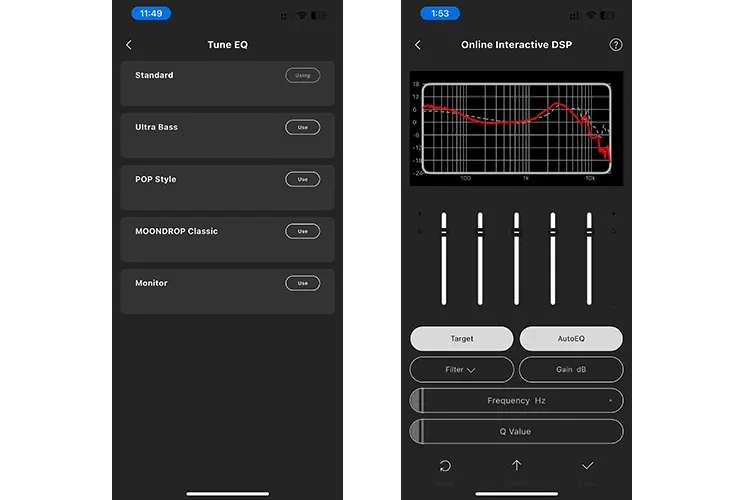
As of firmware version 1.3.0, the Star Rail Robin ships with five EQ presets accessible through the MOONDROP Link app: Standard, Ultra Bass, Pop Style, MOONDROP Classic, and Monitor.
Of these, Standard, Pop Style, and Monitor share a broadly similar foundation, with bass quantity being the key differentiator. Monitor had the least bass punch, Pop Style pushes the low end forward the most, and Standard sits comfortably in between.
Ultra Bass, despite its name, isn’t the overwhelming “bass cannon” tuning one might expect. Instead, it smooths things out slightly with a lift in the mid-bass, a more recessed vocal presence, and a touch of added energy up top.
The weakest preset by far is MOONDROP Classic, which dramatically hollows out the midrange and sub-bass, leaving vocals and strings sounding thin, sharp, and at times outright sibilant.
In practice, I found myself gravitating toward Standard or Ultra Bass depending on the track, with Ultra Bass serving as my default profile for the following listening impressions.
Bass
The MOONDROP Star Rail Robin has an organic-sounding tuning with a gentle tilt toward warmth, emphasizing tight sub-bass and a smooth, lush mid-bass presentation.
The sub-bass comes through with authority and presence, but without straying into excessive territory. Instead of overwhelming the mix, it maintains a controlled delivery, providing just the right amount of weight when the track demands it.
Kick drums and 808 hits are rendered with commendable texture on the Star Rail Robin. On well-recorded material, the subtle differences between drum strikes add depth and engagement, giving tracks a more layered and immersive feel.
The mid-bass region is equally well handled, offering a warm and inviting character. In disco and funk recordings, bass lines carry a full-bodied, rounded quality that lends itself to a laid-back yet musically satisfying listening experience.
That said, the Star Rail Robin is not the last word in resolution within the mid-bass. More reference-oriented sets, such as MOONDROP’s own Golden Ages, will retrieve finer detail in this range.
Still, the Star Rail Robin’s tonal balance and warmth-focused tuning make it a natural fit for genres like R&B, funk, and disco, where its presentation complements the groove-driven character of the music.
Mids
Despite carrying a thick and warm sub-bass foundation, the MOONDROP Star Rail Robin manages to deliver a midrange that remains clean and organic, avoiding excessive bloom or muddiness from the lower registers.
String instruments come through with commendable dynamics and harmonic presence. While they lack the same note weight as the bass region, resolution is sufficient to capture nuance and keep the presentation from sounding flat or veiled.
Male vocals benefit most from Star Rail Robin’s tuning, coming across with warmth and a sense of authority that feels natural and engaging. On jazz and blues recordings, vocal tones deliver a rich, enveloping quality that places the singer firmly within the mix.
Female vocals are also well-represented, with good clarity and detail retrieval, though they do not always carry the same weight and body as their male counterparts.
Still, the Star Rail Robin handles delicate vocal passages gracefully, lending itself well to softer or more nuanced performances.
Where the Star Rail Robin particularly shines is with deeper female vocalists, where the combination of warmth and weight allows the singer’s power and emotion to come across with remarkable presence throughout the track.

Treble
The Star Rail Robin’s treble region remains clean and resolving, though its tuning clearly favors a smoother, more relaxed presentation over brightness or sharpness.
Rather than drawing focus, the highs sit comfortably in support of the midrange and bass, ensuring that the overall tonality remains fatigue-free and devoid of sibilance.
Percussive elements such as hi-hats and chimes contribute a subtle sparkle that gives tracks an added sense of air and energy, but they stop short of dominating the mix.
This approach underscores the Star Rail Robin’s tuning philosophy: one that prioritizes long-term listening comfort over treble-forward excitement.
For casual or background listening, this balance works in the Star Rail Robin’s favor, allowing the music to remain engaging without becoming distracting.
However, those who prefer a more analytical or detail-forward treble response may find themselves wanting more presence and bite from the upper registers.
Staging
The Star Rail Robin delivers a level of imaging and separation that sits comfortably above average for a true wireless set.
Instruments and vocal layers maintain a solid sense of definition, aided by the Star Rail Robin’s clean dynamics and smooth harmonic presentation.
Rather than blending into a flat wall of sound, each element of the mix retains a degree of individuality, making it easier to follow subtle shifts in placement or layering.
This is particularly noticeable in more complex arrangements, where background instruments remain discernible instead of being lost behind the main vocal line.
When it comes to soundstage, the Star Rail Robin performs with a surprising amount of breadth.
While it cannot match the scale of large-format wired IEMs or the atmospheric reach of open-back headphones, it still manages to carve out a respectably wide panorama.
Instruments extend beyond the immediate left-right plane, giving music a sense of openness that goes beyond the more closed-in presentation typical of budget TWS sets.
That said, the Star Rail Robin stops short of offering a fully three-dimensional 360-degree staging. Still, for casual and even moderately critical listening, its balance of width, separation, and imaging accuracy makes the Star Rail Robin’s stage one of its more enjoyable qualities.

Wireless Performance
Pairing
The Star Rail Robin pairs quickly and seamlessly with a wide range of devices, including macOS laptops, Windows PCs, iPhones, and Android smartphones.
The process of entering pairing mode, however, feels less intuitive than it should be, as the Star Rail Robin lacks a dedicated pairing button.
Still, once paired, reconnecting to a previously used device is smooth and reliable, with the Star Rail Robin responding promptly each time.
Stability and Range
In day-to-day use, the Star Rail Robin maintains a generally stable connection when paired with a phone, even while walking around the house.
Minor audio dropouts only occurred when moving two rooms away, roughly 11 meters, with multiple concrete walls in between.
The signal held up well until I moved to the lower floor, at a distance of about 13–15 meters, where it finally disconnected. Given the obstacles, this performance is more than reasonable for a TWS in its category.
Latency
In music mode, the Star Rail Robin performs respectably with minimal audio lag. Running an online latency test, I consistently observed delays in the range of 100–200ms, which is typical for most true wireless sets in this category.
While this level of latency is generally acceptable for music playback and casual video watching, it can become slightly noticeable during fast-paced content.
Switching over to gaming mode, however, brought a clear improvement. The same latency test registered delays at around 50ms, placing the Star Rail Robin among the better-performing TWS IEMs for low-latency applications. In real-world use, this translated into seamless synchronization with on-screen action.
During extended testing in gaming mode, I did not encounter any perceptible delays in gaming, videos, or movies
