

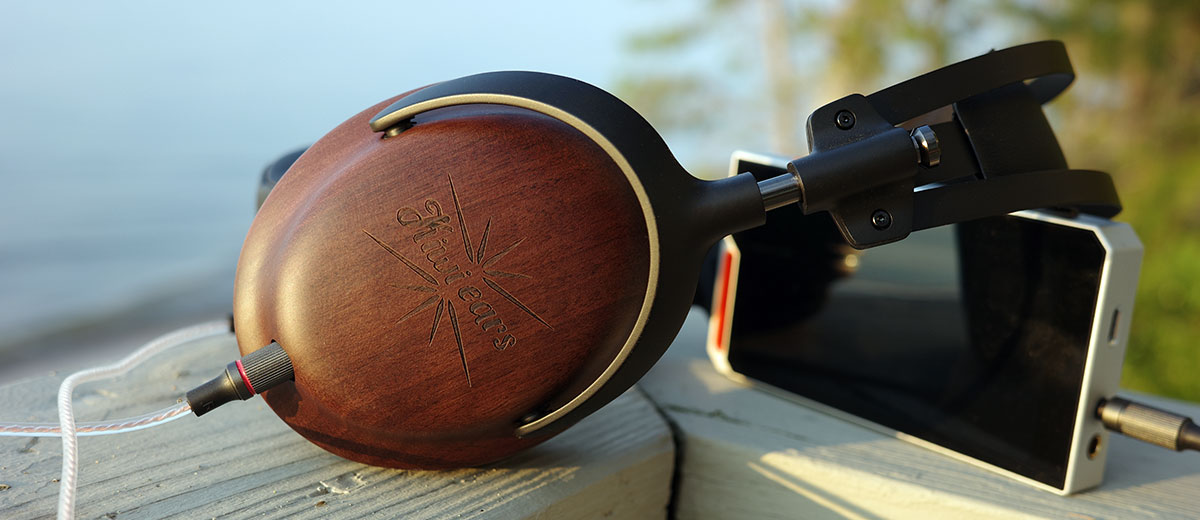
Lynn reviews the Kiwi Ears Atheia, a set of hybrid 50mm dynamic and 14.5mm planar driver circumaural closed-back walnut wood cup headphones. They are currently priced at $349.00.
Disclaimer: This sample was sent in exchange for my honest opinion. Headfonics is an independent website with no affiliate links or services. I thank Linsoul and Kiwi Ears for their support.
Click here to read up on Kiwi Ears gear previously reviewed on Headfonics.
This article follows our latest scoring guidelines, which you can read in more detail here.
Having reviewed Kiwi Ears IEMs in the past, such as the KE4, I am familiar with the brand. Producing understated offerings, which present good sound qualities, the brand tends to slip below the radar. Lately, though, the company has included headphones in its productions.
The Atheia is marketed as Kiwi Ears’ flagship headphone, complete with walnut cups, hand-crafted, and providing an excellent fit. If the initial impressions are anything to go on, the Atheia is off to a good start.
How does it perform and compare to the likes of other well-known wood cup headphones, such as the Meze Audio 99 Classics? I found out in my full review below.
Features
Tucked inside the ear cups are a 50mm dynamic driver and a 14.5mm planar magnetic driver. More and more, we see companies combine drivers in headphones to handle different musical sections.
The larger dynamic driver helps to push the low-end to the forefront, despite the company stating the Atheia has a “neutral sound profile.” It doesn’t. Expect good reach down low to set the tone.
The walnut cups help to disperse sound qualities equally through the hardwood, making for a more accurate sound signature, purportedly.
The 3.5mm single-ended cable has a braided business end up to the Y-splitter, then a plastic sheathed, wrapped copper cable.
Microphonics are kept to a minimum this way, but can still be heard when physically touching the cable. Left to its own, the cable lies nicely, though that braided part tends to wrap around itself a bit.
A sensitivity of 102 ±3 dB @1KHz 1mW and impedance of 32Ω ±10% @1KHz make the Atheia not only easy to drive, but also compatible with a variety of source inputs.
I ran the Atheia across many DAPs and amplifiers during the test, and while some worked better (see below), all were handled without issue, which is not often the case in today’s market.
Design
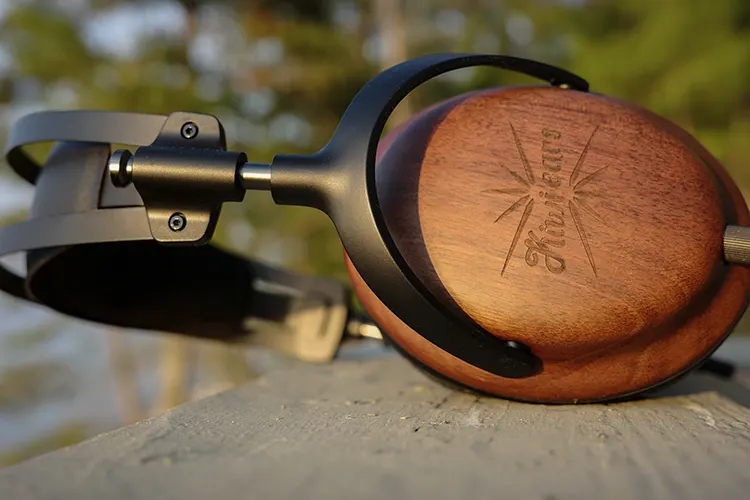
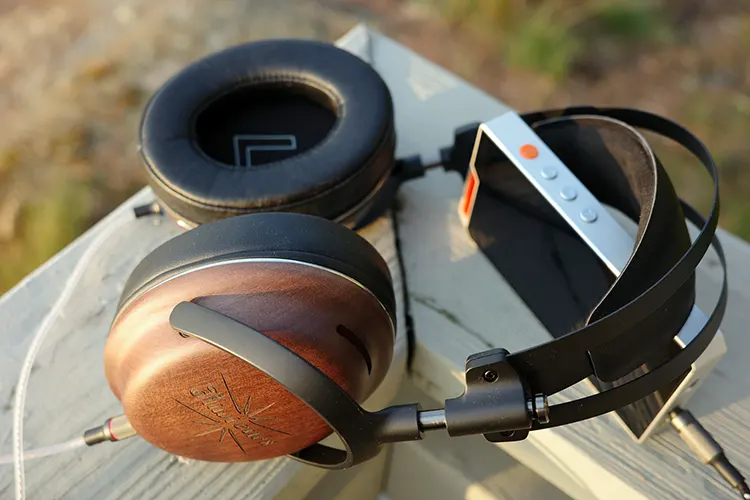
There is no denying that the walnut cups make for a stunning, understated look to the Atheia. From the opening of the box to first listen, I was impressed with the craftsmanship and fit/feel.
The vegan leather cups are plush without being gushy. Structured without being flabby. A nice combination.
Handcrafted, the cups show nary a flaw but do give off that handmade flair. The darker aluminum alloy stanchions, gimbals, and yoke add to the appeal, along with giving presence to the headphone without the weight penalty (349g). Lighter, solid-looking, and excellent fit come about as a result.
The cable insertion into the headphone also has a notched mounting “system,” with a plug-and-twist approach that prevents the cable from being pulled out while in use.
This may not be much of a thing lately, what with the good-fitting cables on most headphones of today, but I appreciated the extra step anyway.
The downside is that if you want to add a balanced cable to the mix, it must be able to handle that notch on the headphone end or fit inside without disturbing the notch. Something to consider when looking for an upgraded cable.
I was able to utilize the ddHiFi 4.4mm balanced Air Nyx headphone cable successfully. But, I had to leave the plug slightly out to get both sides working. Not an ideal situation.
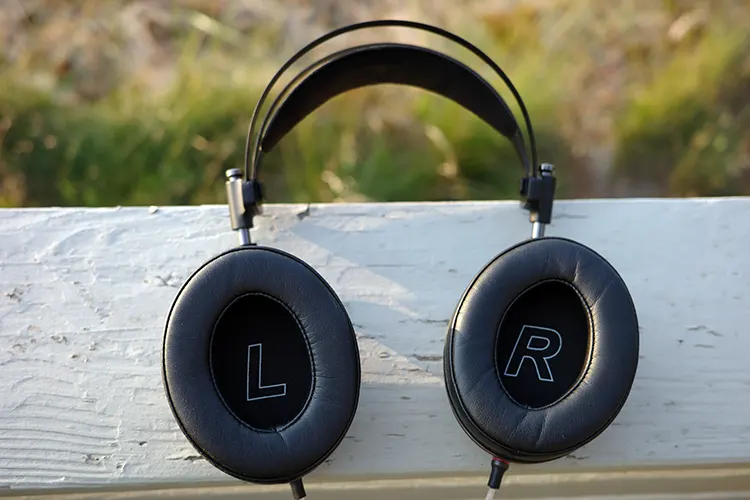
The Atheia uses a fairly loose slider on the side to adjust fit, along with the double headband straps on top. The fit and feel were very comfortable, with minimal shifting while moving my head.
The Atheia’s quality build and fit make it to the top of this segment, easily. I do wish for a slightly tighter fit, though.
Comfort & Isolation
The easy adjustability to those looser stanchions makes for a good fit, but a looser fit. Clamping pressure is not as high as I would like, especially with the excellent fitting, soft pleather ear pads.
Those ear pads give very good isolation, letting in a small amount of outside noise. Until the music starts. There is very little leaking of noise outside the headphones, too.
The Atheia sits lightly on my head, too. I never felt any pressure on the top of my head, and only slight pressure below my ears due to the headband sliding a bit looser than I would like.
However, the pressure was not enough to bother me, and long listening sessions came about without issue. Head build-up can occur with the large pads, and I did have to readjust the headphones in our 90%
Taken together, the build, fit, and comfort of the Atheia are excellent, lacking only a tighter clamping pressure to prevent any sliding around on one’s head.
Packaging & Accessories
The floral colored outer box has a life-sized picture of the Atheia, along with the Kiwi Ears logo. The back has the necessary information, such as model number and “contact us” information.
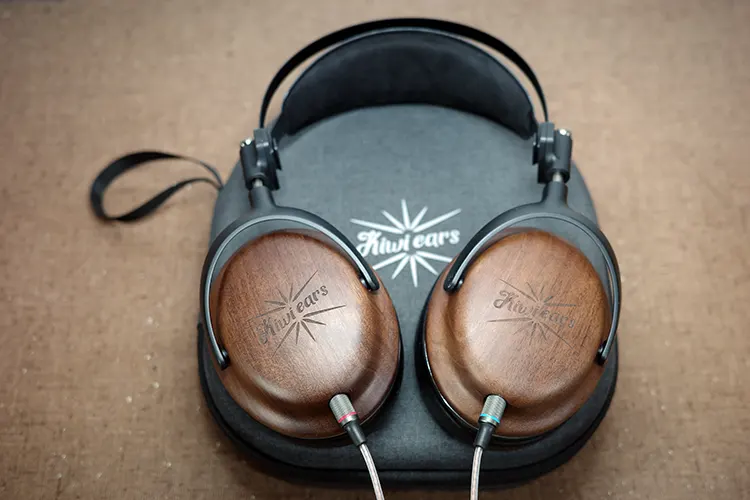
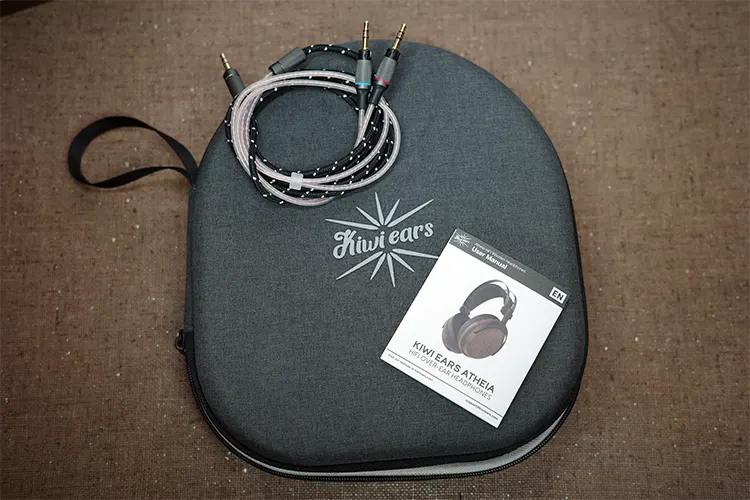
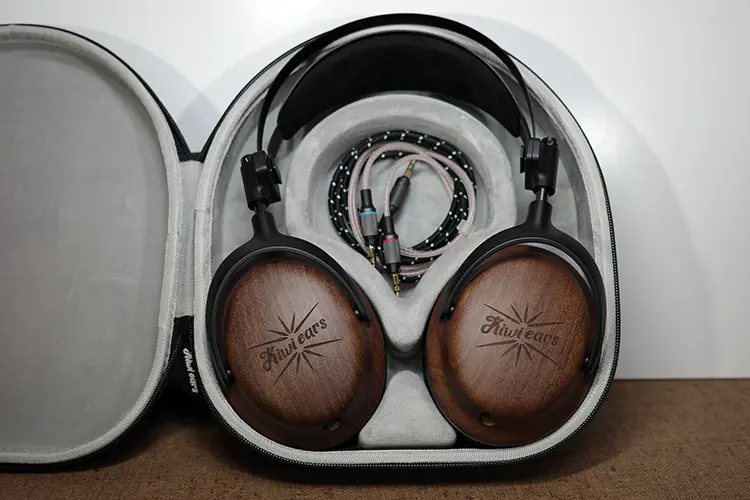
The sliding tray opens with the Atheia in a slim fabric hardcase that reminds me of Noble’s FoKus Apollo case. Folding the cups flat allows for this thinner case, which easily slides into a backpack or briefcase. There is excellent tactility to the case, too, making it easy to grab and hold.
No 6.35mm adapter is included, but frankly, I do not mind. Most of us have a plethora of these hanging about anyway. Included with the Atheia, though, is the requisite warranty and quick start guide.
Sound Impressions
The following impressions were made using the stock cable hooked to the HiBy R4, FiiO JM21 as singular sources, along with connection to the xDuoo TA-32 and JC Acoustics UDP-5. Additionally, the ddHiFi Air Nyx 4.4mm balanced headphone cable was utilized across options.
Comparisons were made with the venerable Meze Audio 99 Classics, FiiO FT3 (32Ω), and the HIFIMAN Deva Pro (wired, w/o BT adapter).
Summary
There is no denying that the Atheia is not neutral. The preponderance of bass exudes a thumping low-end, overshadowing the rest. Bleed into the midrange couples with a recessed midrange, making for a polite instead of exuberant midrange.
Vocals are slightly lifted to counter this, making for good height and a presence that belies the guttural low-end. The warm-sounding signature extends north into the treble region, without too much sizzle, which is something I appreciate.
Instrumental passages carry better clarity and detail retrieval than mixed passages, making for a decent amount of vibrancy going along with that deep-reaching bass note.
This is a more musical headphone than an accurate one, and should be taken as such, without thinking too deeply into the details.
Bass
The bass reaches deeply into the sub-bass region, helped by the excellent pads that keep externalities out and the music in. That grumbling low-end offers good reverb and thumping to it, but less controlled than I would like.
Bassheads will like this (please do not take that as an insult) for the punctuating, loosely-controlled low-end, but those seeking accuracy and tightly controlled lows will feel let down.
The bass does carry forth into the lower-midrange too, clouding and moving backwards vocals that struggle to come forth.
Tighter decay would lead to a more accurate representation of the bass, but both attack and decay elongate the note weight, which gives too much presence, working against the rest of the signature.
Mind you, I like the bass, but not at the expense of the rest of the signature. A slight taming of decay might do wonders to the overall signature, which does remain musical if crowded, overall.
Mids
Taken in isolation, vocals can come across as full, organic, and warm, but feel covered by the bass grunt, which cannot be hidden. Complex passages feel cramped, fighting for a place out front, and as a result, get lost in the signature.
Instrumental details remain high when taken in isolation, making the Atheia good for genres that cater to instrumental, especially acoustic, responses.
A narrowing of the soundstage pushes vocals a bit too high in the presence region, making for a disconnected nature to them. Seeking isolated aspects may work for some genres, but not all.
Treble
The planar driver makes itself heard here, with grain to the lower treble region, especially the 6KHz region. This follows the boosted mid-bass region in the 2-3KHz region, working to color what is heard.
Moving higher, there is a good 3D effect, but there is a lack of controlled vibrancy to it. Instead, there is a stretching of notes that seems almost counter to the guttural bass note.
A little EQ’ing might make for a more cohesive signature here, but I find the disconnect keeps the planar driver from completely fulfilling its objective.
I do appreciate that the high-end was not artificially enhanced, keeping the notes from becoming too hot or sparkly. Thankfully, the rolled-off top-end prevents this, but lacks a bit of clarity in the finishing.
Staging & Imaging
The 3D effect from the Atheia’s tuning makes for an excellent soundstage, which may counter the individuals listed above. The height overrides the width and depth, expanding like a vaulted ceiling venue.
This does allow the music to spread up and down, as measured by the mentioned low-end, but keeps a bit of compression to the width. I will note that using a balanced cable helped to expand the width more than the depth.
Imaging suffered a bit from the stock cable, making for a more intimate signature that becomes immersive rather than expansive. For a closed-back headphone, though, the sound belies its nature, giving a better sense of space and imaging of instruments.
This seemingly opposite response shows the engineers worked to expand the signature across the three dimensions, countering the closed-back nature of the sound. The isolation with the included pads makes for a very musical experience that somewhat mimics an open-back design.
You can still tell this is a closed-back headphone, which is not bad, but the expanded height makes for better placement of instruments in the vertical plane, at least.
Click on page 2 below for my recommended pairings and selected comparisons.
