

Select Comparisons
EarMen L-Amp
Features
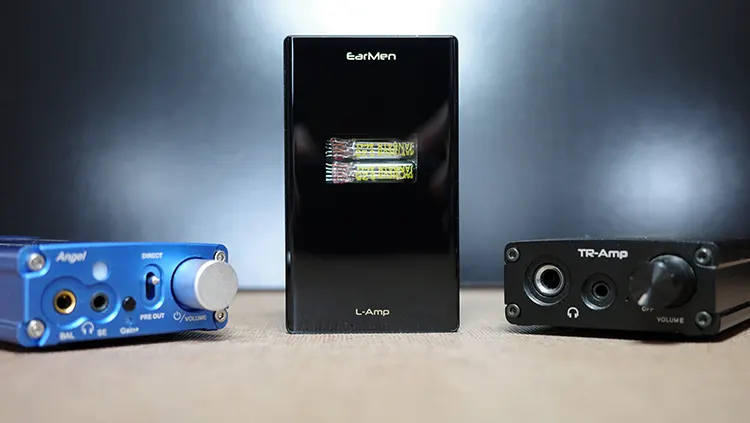
The L-Amp is an integrated DAC and portable tube amplifier. It uses a single ESS SABRE DAC (32-bit, 384kHz PCM, DSD DoP128, similar to the CH-Amp Signature), paired with the NOS military grade JAN6418 USA-made tubes.
The dual tube setup is mounted on a suspension system using 4 silicone O-ring mounts to reduce vibration and minimize mechanical feedback, according to the EarMen. A statement that bears out while listening. The CH-Amp Signature isolates the power unit in a separate unit.
The fully balanced circuitry on both outputs runs seamlessly, with no need to change any switches. The power stage of the L-Amp then comes into play, built using the INA1620 Burr-Brown operational amplifiers to provide 1W at 8Ω (3.8W at 32Ω in 4.4mm balanced for the CH-Amp Signature).
I had no problem running the notoriously hard-to-drive SJY Horizon headphones on the L-Amp, which surprised me. Similarly, the Horizon worked without issue on the CH-Amp Signature.
To save battery power on your source, another USB-C input allows for an external power source.
I utilized the L-Amp in both ways. A nice feature is the Full Power Protection, which automatically resets power to protect the headphones and the device from potential damage caused by overdriving.
Design
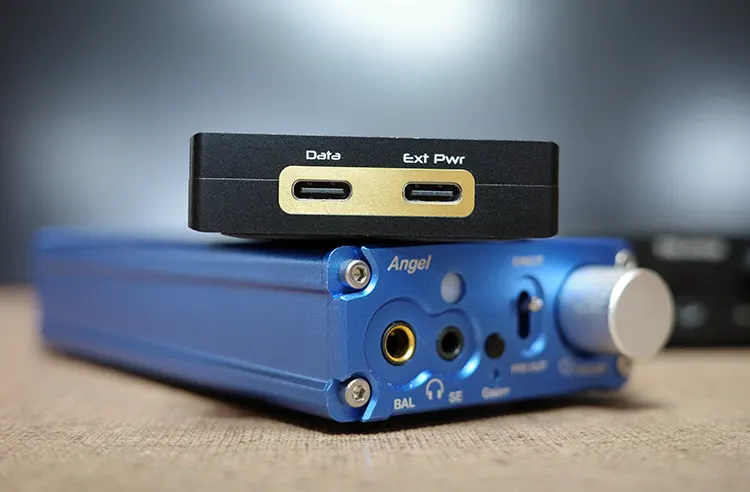
The glossy black rectangular L-Amp looks the part and, thankfully, does so without being prone to fingerprints. The tophas gold-plated 4.4mm balanced and 3.5mm single-ended headphone jacks, while the bottom has two gold-plated USB-C ports.
The left one is for data (and power if you do not use the other), and the right is for external power, should you want (or need) to save the battery of your source.
The front has both EarMen and L-Amp in tasteful gold lettering. Set between the two is the window to the past, so to speak. The familial resemblance is there between the two in shape, color, and functionality.
While the tubes do not light themselves up, the red LED behind gives off a tube-like glow to the Raytheon tubes. When activated, the red LED for Bass+ shows below the tubes as well. The screen on the CH-Amp Signature works well, even in bright light.
The left side of the L-Amp has the aforementioned Bass+ switch, with the play/pause button above; both are withdrawn into an inset so they are flush with the side.
The right side has the volume up and down buttons with the IEM switch above, again inset. The IEM switch quells any noise for sensitive IEMs, allowing the music to come forth silently.
The back’s two large, rounded rubber “feet” are for use on your desktop, with the “Media Sample 2” and “Limited Edition” embossed between, along with Miki’s signature.
This is a classy-looking unit that really should be showcased. Those feet can do double duty when paired with your smartphone or DAP, stacking them like in the old days if you like.
Simplistic in design, yet dare I say stunning in execution, both show top quality in build and looks.
Performance
The precision with which the ESS shows forth counters the tube-like sound with aplomb. An excellent balance between the two allows the listener to experience both, much like you would on a desktop unit.
Where the L-Amp puts out a tube sound, the accurate detail retrieval of the CH-Amp Signature counters.
I found the power completely adequate to drive even the hardest headphones I own, the SJY Horizon, without a bother. The CH-Amp Signature could similarly do the same, but I did have to use maximum volume.
This might show that while power is not an issue and can be controlled even with those harder-to-drive units, the ability is handled in differing manners.
What transpired is a thoroughly organic, yet musical sound emanating forth with deep-reaching bass (especially with Bass+ on) that flowed without bother into the sumptuously tube-like midrange.
Conversely, the L-Amp could not match the level of clarity that the CH-Amp Signature did. But this is to be expected due to the different approach methods. Both sounded fabulous on their own merits.
The treble reach, while not far-reaching, lends enough presence to expand the height of sound offered. Vocals come across as thick and lush but accurate, finishing off the L-Amp tuning.
The CH-Amp Signature extends that top end into a higher ceiling, and with greater control. The extension added flavor, whereas the L-Amp presented a smoother, more organic top.
JC Acoustics UDP-5
Features
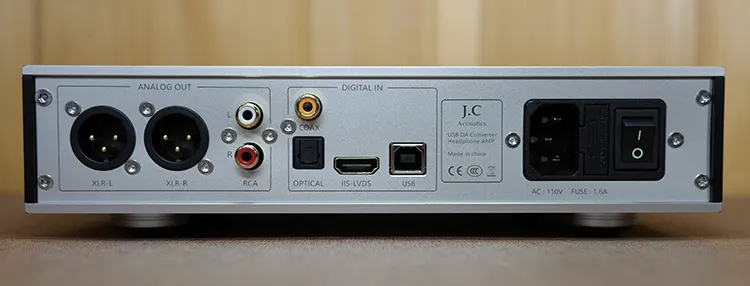
The J.C. Acoustics UDP-5 is a standalone midrange desktop DAC/Headphone amplifier and uses two near-flagship ESS ES9039Q2M chips for decoding, as opposed to the single ESS9038 of the CH-Amp Signature.
The chips are also isolated from interference by placing them away from the FPGA core processor and the balanced amplifier circuits. The CH-Amp Signature keeps this in separate units.
USB-C decoding supports high-resolution audio streams of up to DOP & Native DSD64-DSD512 and PCM of 16-32bit, up to 32K-768KHz, which is similar to the CH-Amp Signature.
The UDP-5’s balanced PO output produces an impressive 6.8W at 32Ωs. Raising the volume produced a linear response, just like the lower-powered CH-Amp Signature. I appreciated the linearity between the two.
The smooth performance can be attributed to FET OP1642 on the front end, with TPA6120A2 parallel balanced amplifier circuits closing the deal.
Optimized are the start-up delay and headphone protection circuits of the audio line-out for further protection from spikes. The CH-Amp Signature also has a start-up delay and activates when a headphone jack is inserted, protecting the user from any unwanted noise.
Output power does drop using the 6.35mm single-ended jack to “only” 90mW@600Ω, but I found my 600Ω AKG 240DF could be used, albeit at -13 dB, which was nearly full volume. This is similar to the CH-Amp Signature, which shows just how hard the AKGs are to drive properly.
Design
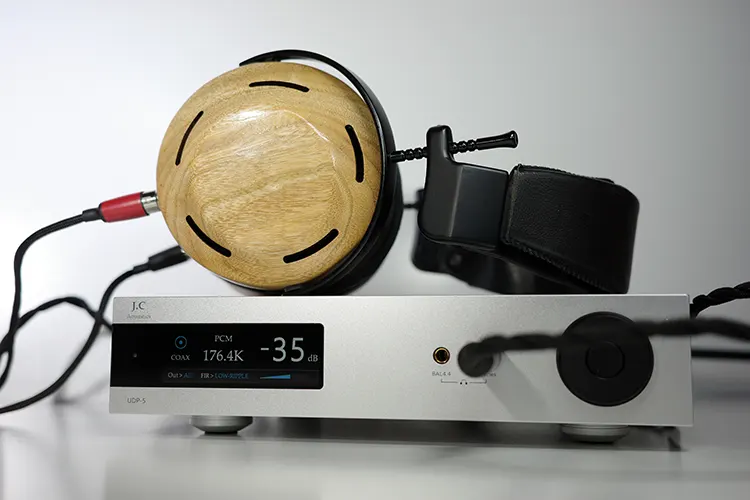
The UDP-5 shows off the typical slim-height dimensions of desktop amplifiers with vastly different characteristics than the CH-Amp Signature, and a weight of 3kg, which is slightly heavier. Both fall within the parameters of peers.
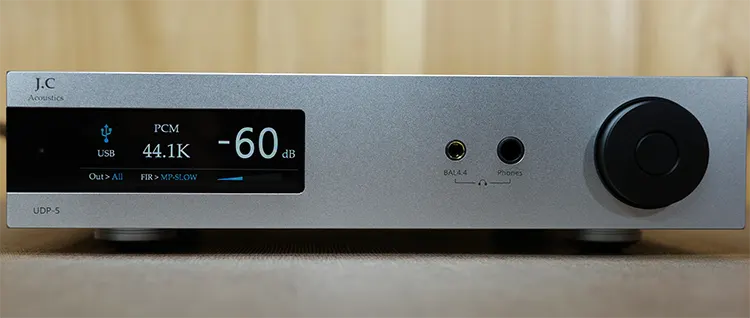
The large black volume knob dominates the front right, with two features described below. Matte black and plastic, it does not look out of place. While the designs are different, both could be thought of as modern.
To the left are the two headphone jacks labeled in black lettering on the silver design. Moving to the screen on the left, the volume level has the largest lettering part of the equally split 3” IPS screen.
I found the lettering of both screens to be smaller, while both were easily readable from my desktop setup, and easier than some alternative units that have larger lettering.
The sides carry black vents to dissipate heat from the large amplifier, and as an option, you can order a separate radiator fan unit for each side, which further cools the unit (they move passively). There are slot vents on the bottom of the DAC unit of the CH-Amp Signature.
Aviation aluminum is finished with ceramic sandblasting on par with our Smartphone technology, showing the precision taken in construction. The black of the CH-Amp Signature looked smart, but a bit dated by comparison.
Performance
What I did not expect from the UDP-5 was for an ESS-chipped DAC to sound more like an AKM-chipped set than the known clean, clarity-driven sound of a typical ESS.
The ESS-chipped UDP-5 comes across as musically smooth, without any of the potential pitfalls known, such as piercing highs or thinner note quality. The two share similar aspects in tuning, which is not hard to believe.
I found the UDP-5 sounded organic without becoming too thick or slow across many listening platforms, including harder-to-drive headphones such as the ones I used. The bass hit a bit deeper on the CH-Amp Signature, with the same musicality.
Filter choice can fine-tune the sound a bit, but should not be relied upon to make a huge difference. Think of those choices as additive instead of changing. The CH-Amp Signature relies upon the sound, without filters, or upon source input EQ options.
I did note some holographic effects to some of the choices, such as Linear phase-fast-sharp roll-off; something I was not expecting.
This became my favorite filter setting, but I will note different choices when appropriate. The CH-Amp Signature, on the other hand, relied upon the sound emanating from the listening choice for “flavoring.”
xDuoo TA-32
Features
It might seem odd to pair the two together and compare them at the same time, but the multi-capability of both allows for this additive beneficial aspect.
The xDuoo TA-32 is a fully operational tube amplifier and pre-amplifier that is capable of true 1-bit DSD while using the made-for-home-audio ROHM BD34301 interchangeable chip set.
You can order the TA-32 with the ROHM or, for an additional fee, have the TA-32 with AKM’s AK4499EX DAC card.
Having the ability to change cards, combined with tube rolling, makes the TA-32 worthy of much personalization. The CH-Amp Signature has but one choice, albeit a good one.
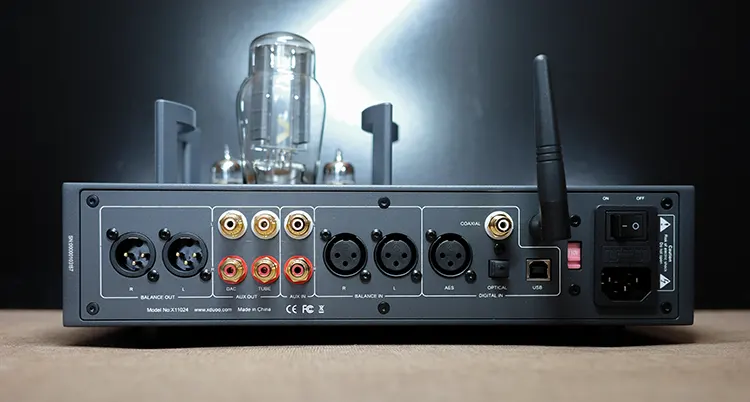
Capable of PCM up to 16–32-bit / 44.1kHz–768kHz, DSD DSD64–DSD512, and MQA, which are all similar to the CH-Amp Signature.
Bluetooth 5.1 paired with a Qualcomm QCC5125 receiver chip, the TA-32 supports SBC, AAC, aptX, aptX LL, aptX HD (24-bit/48kHz), and LDAC (up to 24-bit/96kHz), much like the CH-AmpSignature.
But, the CH-Amp Signature is also geared for the gaming community, which cannot be said (but can be used) of the TA-32.
With the use of balanced XLR-out, you can easily run the TA-32 with powered speakers or use the tube-out option in a two-channel system. I was able to demo both, now that I am back to my full-system setup.
Used mainly as a headphone amplifier, though, the versatility shines. The CH-Amp Signature can be used with powered speakers, but from the RCA out to another option, then to the speaker.
Combined with all of this, the TA-32 is also capable of up to 3000mW (at 32Ω) for use with headphones from 16-600Ω. This falls right in line with the CH-Amp Signature, except for the dedicated ability to drive hard headphones (which it still can).
Design
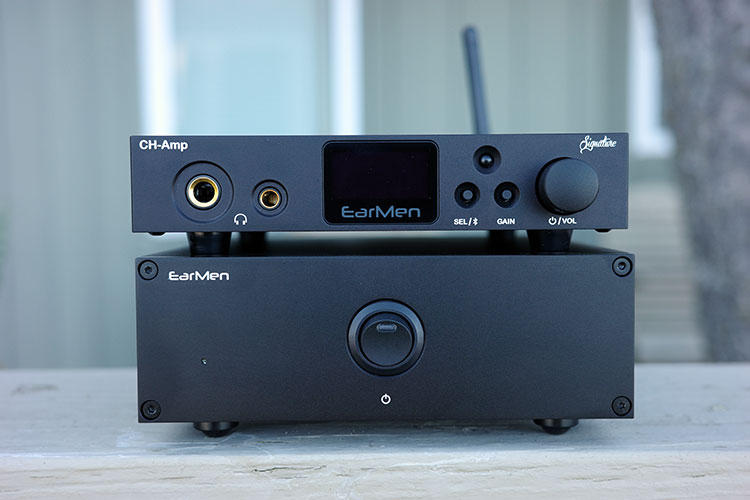
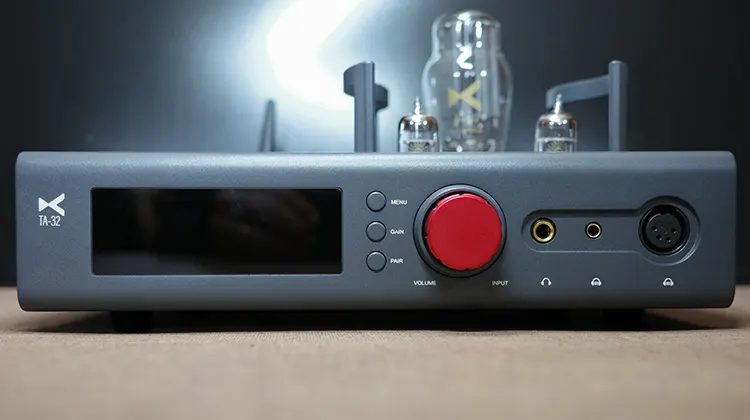
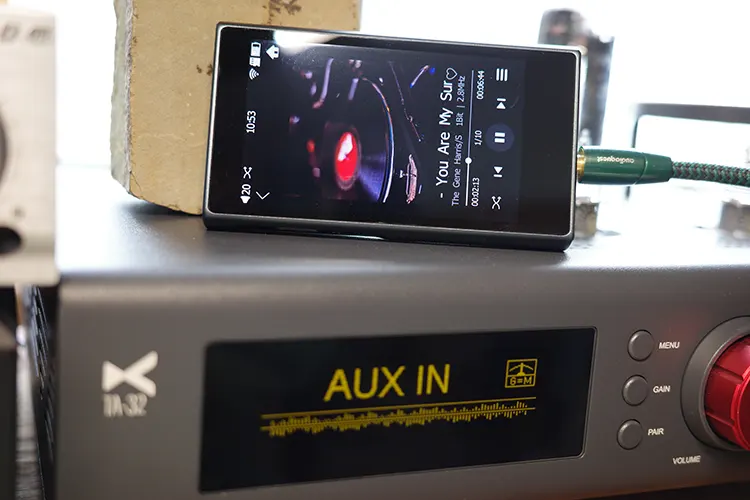
There is a certain industrial look to most xDuoo products, and the TA-32 shows this off in a semi-gloss dark gray color that reminds me of The Peaky Blinders’ gray Birmingham landscape. I like both. The understated simplicity of the CH-Amp Signature will, of course, have its own appeal.
Coming in at slightly over 11 lbs., the TA-32 is stout, carrying a staunchness to it that exudes business. The curvaceous railings carry over from the TA-30 but, alas, are not removable.
No bother, though, as this works to highlight the three tubes doing the business. This is a much larger unit than the CH-Amp Signature.
The tube area, which lies on the right side on top, has multiple vent holes meant to dissipate heat. It works. There is even enough space to the left of that for a set of headphones to lie without coming close to the tubes.
The 3.12” OLED screen has a lighter olive-green color to its lettering, which is easily discernible from a distance.
Access to the sub-menus is via three vertical buttons to the right, with a large red multi-function volume knob to the right of that. The three headphone jacks lie to the right of the knob, without bother.
No remote is included, but once acclimated, the functionality is easy to remember. The CH-Amp Signature relies upon its remote and provides an excellent response.
Performance
As the top xDuoo model, you expect two things: great power to handle all it can and sound to back that up. The TA-32 handles both with aplomb.
The 3000mW on both 4.4 balanced and XLR shows it can handle the most demanding headphones out there, and the ability to play nicely with easier-to-drive units as well.
The stock tubes promote a tube-like sound that also shows off very good levels of detail retrieval in the sound characteristics. The CH-Amp Signature presents a more vibrant sound, with better clarity.
Tight, controlled bass can be heard through the music when the source plays a more analytical sound, while an additional, melodic midrange has excellent clarity to it, and the lusciousness of tubes when called upon.
The CH-Amp Signature seems to linger in bass decay a bit, with an almost tube affinity to it, but there is no mistaking which one is the actual tube unit.
The listener’s choice of headphone or IEM plays a good bit into the sound, so the TA-32 adapts to your devices with good results, much like the CH-AmpSignature. Think of the two as different knives for different culinary purposes.
My Verdict
I came into this knowing full well the reputation and respect EarMen garner with their products. Lauding their products crosses many reviewers. I am one of them.
But this did not jade me in the review of the Ch-Amp Signature. Rather, it gave me the perspective of knowing I like and appreciate many of their products, but look with micro-detail for potential faults. First and foremost is the familiar high level of detail and vibrancy associated with previous products.
Thankfully, that is still present, and to a high degree. Also, there is a proportional amount of power to drive the more discerning of our headphone collection.
Those harder-to-drive headphones can produce very good sound from the source/CH-Amp Signature combination. I was never left wanting more power, since what is present satiated my desire.
Lacking, though, are some of the connectivity options the competition might include. This can also be looked at as a positive, because when you include many connectivity options, there might be shortcomings as part of that.
EarMen skip right past that, providing the most obvious connection needs we may have right now, and those others can be added with various external devices.
I also wish the power unit had four feet instead of the triangle of three. While it looks good, connecting and taking out headphones from the jack can cause the pair to tilt. If you are careful, this isn’t a problem.
In the end, though, the EarMen CH-Amp Signature desktop DAC and headphone amplifier delivers exactly what I expected. Excellent sonic characteristics, a vibrant tonality that is not grating or harsh, and enough power to run most of our headphone collections.
EarMen Ch-Amp Signature Technical Specifications
- USB DAC (ESS9038) – 32bit / 768kHz with ultra-low distortion
- Hi-Res Bluetooth input – wireless audio without compromise
- Gain switch with IEM mode – perfect for all headphones, including sensitive in-ear monitors
- External linear power supply – quieter operation and superior dynamic range
- OLED display with VU meter – clear visual feedback at a glance
- Rechargeable aluminum remote – CNC-machined from a single block
- Compact CNC aluminum chassis – sleek, robust, and premium
