

Synergy
Efficiency
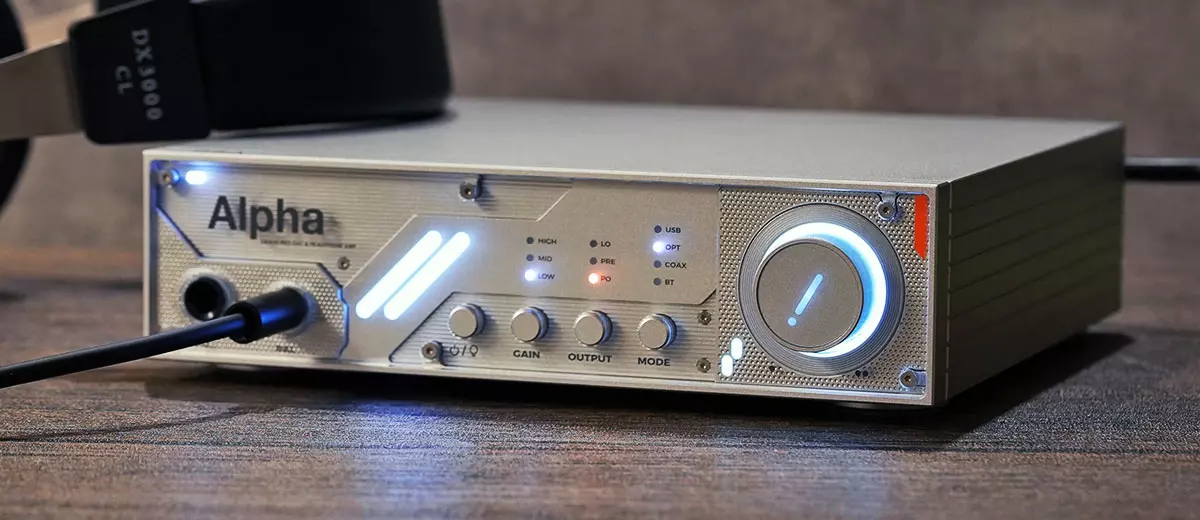
Noise control is excellent on the Alpha. Even with sensitive IEMs at high gain, the output remains extremely quiet.
The lower gain level works well with IEMs and CIEMs, and only the track’s gain noise is faintly audible; nothing from the device’s background noise is audible.
At higher gain, the dual-tone switch enhances flexibility, adding warmth when the output feels clean or flat on some pairings.
Overall, the mids are delivered swiftly, without the vocals or soundstage becoming compressed or dull when used with high-impedance gear, and there is sufficient contrast with most pairings.
Power
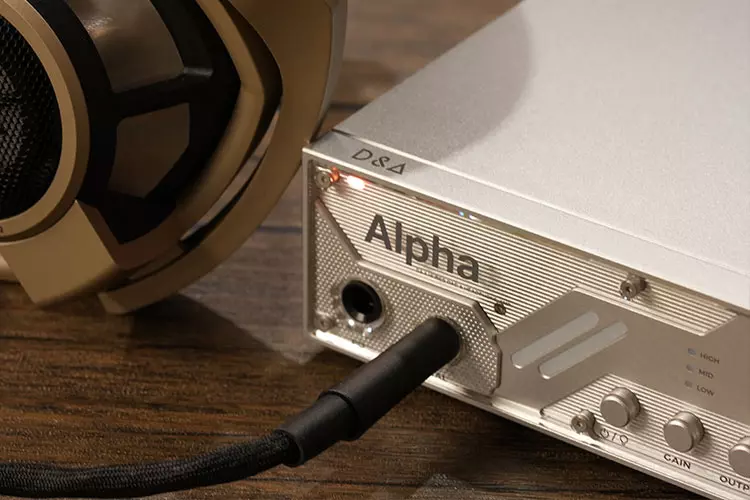
The Alpha clearly aims to be one of the most powerful integrated decoders and amplifiers, delivering 9,000 mW per channel for 32 Ω loads.
With unbalanced output, it can still deliver 5000 mW per channel for 16Ω loads and 2500 mW for 32Ω loads, which is sufficient for most headphones.
In practice, the Alpha sounds quite clean when paired with older headphones like the K701 and newer planars like the FiiO FT7, which I prefer to use Tone-X mode to shape the mids for a more stereophonic sound.
The bass is solid, and the dynamics are adequate, which is a positive sign. I would still recommend using balanced headphones, as this allows you to leverage the higher output power. The separation is stronger, and the sound has a more natural tone.
Generally, lower gain settings offer a more controlled, balanced sound with the best dynamics, while higher gain levels add more air and sharpen transients. The warmer tuning mode can nicely complement this effect.
Pairings
With a lot of power and three gain levels, the Alpha handles various loads nicely, and even with sensitive gear, it doesn’t lack bass or sound flattened.
When paired with various planars, including the MOONDROP Venus and FiiO FT7, the middle gain is sufficient, while the high gain results in a firmer and more exciting treble response.
The inclusion of the new Tone-X mode is commendable, which renders the vocals even more vivid and full.
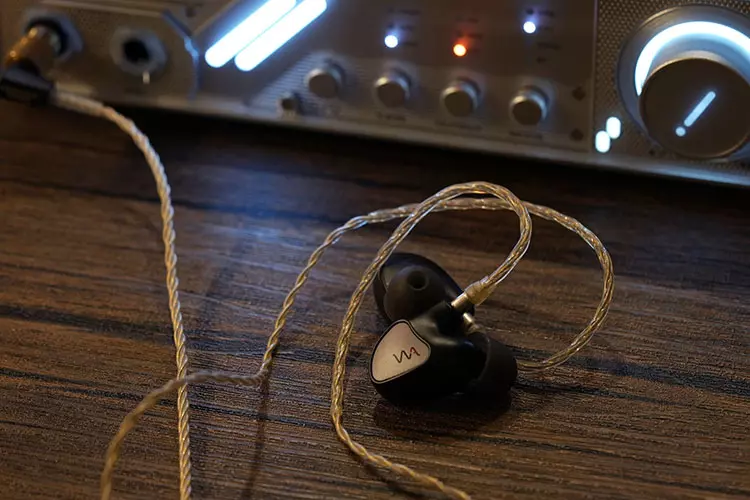
This works especially well with IEMs and monitoring-style headphones, such as the Meze Audio 105 SILVA, which has a relatively clean tuning, and the Westone Audio AM Pro X20, which is less rounded in the upper register.
The Tone-X mode helps tame the treble, making the vocals sound lusher and more rounded, with more elaborate harmonics. It does not significantly alter the output but extracts more nuance from the vocal range, shifting the focus from the broader picture to virtuoso details.
It also enhances the performance of devices that may not produce a dynamic output due to impedance mismatching or their original stock tuning, making them sound more vivid and natural by giving the mids more texture and fullness.
Selected Comparisons
FiiO K15
Technical
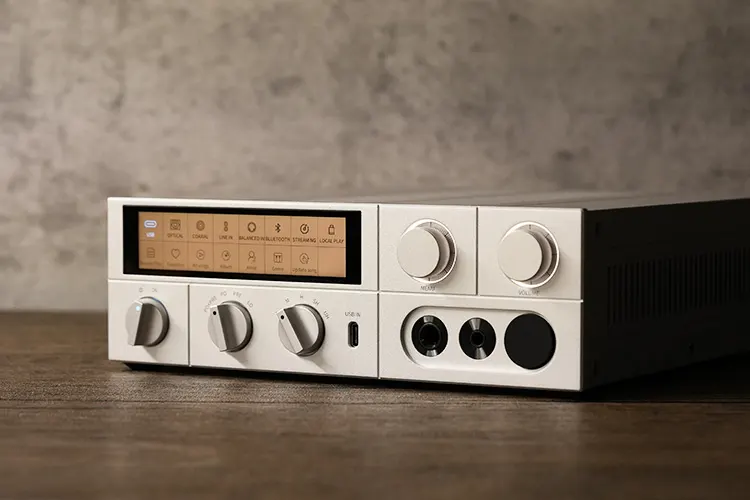
The FiiO K15, with dual AKM AK4497S decoders, is another popular and versatile decoding and amplification device packed with features, including local playback.
Compared to the D&A Alpha, several notable differences emerge. For instance, the K15 delivers 3000 mW per channel at a 32Ω load, which is one-third of the Alpha’s output rating.
Both devices utilize decoding solutions within a similar tier, yet there are perceptible differences in their tonal qualities.
The K15 features Bluetooth 5.1 and a 10-band parametric equalizer (PEQ), while the Alpha supports Bluetooth 5.3 and includes a simpler, instant tone-switching mechanism.
In terms of output impedance, the Alpha is clearly superior, with a rating of less than 0.1Ω, compared to the K15’s rating of less than 1.5Ω.
This suggests potential variations in how each device interacts with very sensitive gear such as CIEMs. Although the Alpha’s output is three times more powerful, it also achieves better total harmonic distortion (THD) ratings.
The THD+N on the Alpha’s headphone output is 0.00017%, whereas the K15 measures at 0.00054%, demonstrating the superior precision in the Alpha’s circuitry design.
Design
As I compared the D&A Alpha PRO with the K17, I continue to appreciate the retrograde casing design and the multiple functions offered by the FiiO K series.
The Alpha is a more dedicated decoding device with fewer functions, further enhanced by the addition of the Tone-X switch, and has a more futuristic design and cooler light effects.
If you’re using your PC or laptop as a source and have limited desk space, the Alpha clearly stands out as a more convenient and space-saving option. Given their slightly divergent design purposes, I will primarily discuss the output tonality and performance below.

Performance
One common perception about AKM and ESS chipsets is that the ESS option tends to sound slightly brighter and more vivid.
While many factors influence the actual tonality, when comparing the Alpha and the K15, the more powerful Alpha does offer a more vivid and dynamic response, with stronger resolution in the mids and lows, whereas the K15 exhibits a stronger sense of compression, or a flatter response when no equalization is applied.
Testing with higher loads, such as the HD 800s, the Alpha delivers bass with greater impact and a deeper soundstage.
In contrast, the K15 sounds comparatively softer, rolls off faster, and adds slightly more warmth in the lower end, but doesn’t sound as impactful or defined.
I still find the K15 enjoyable with the HD 800s, but the Alpha clearly has the advantage in delivering firmer attacks and a more 3D, euphonic mid-range, especially when the Tone-X mode is activated.
Overall, the higher output power in the Alpha’s amplification design contributes significantly to its performance.
When using sensitive gear like the Meze Audio 105 AER, both devices can produce a well-articulated and dynamic output, but the Alpha exhibits better control and feels more refined in the treble.
Although these differences are less noticeable with streaming content such as pop music, the Alpha displays slightly superior resolution at higher volumes.
Testing with sensitive high-end IEMs like the Empire Ears Odin Mk II, the K15 sounds smooth and detailed.
However, the Alpha surpasses it with a more stereophonic vocal image, stronger contrast, more layered bass, better depth and separation, and a gentler roll-off that retains more air and detail.
In general, the Alpha performs better technically, especially when powering less sensitive and high-impedance gear that demands the swing, so it works better for those with a more diverse collection.
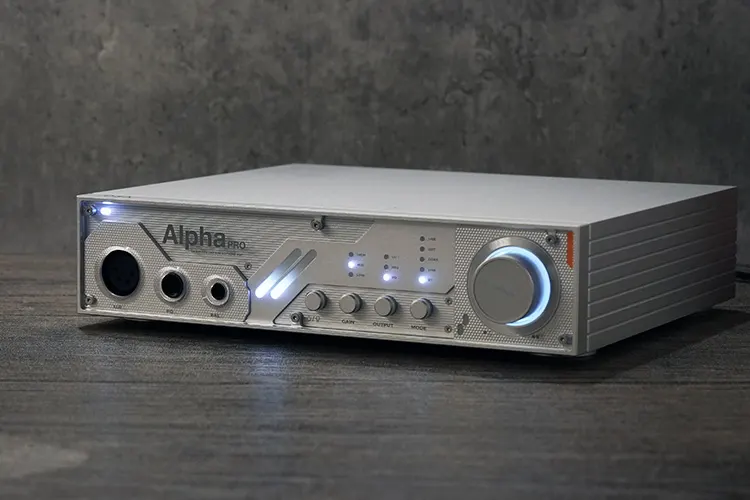
D&A Alpha PRO
Technical
The Alpha is approximately 60% of the price of the Alpha PRO, which features the flagship ES9039MSPRO DAC. Despite this, the Alpha can deliver significantly more power across different loads.
For example, at a 32Ω load, it provides a maximum output that is 50% higher. It is also marginally lighter, though interestingly, most measured specifications are closely comparable to those of the Alpha Pro.
Distortion figures for both units are very close, with each measuring 0.00006% for XLR output and 0.0001% for headphone output.
The dynamic range of the XLR output is slightly superior on the Alpha PRO at 133 dB, while the Alpha achieves 131 dB. The signal-to-noise (S/N) ratio is quite similar as well, with the Alpha PRO measuring at 133 dB and the Alpha reaching 131 dB.
An obvious difference is that the Alpha omits the Line In function, so it cannot serve as an amplifier for another decoder, unlike the Alpha Pro. Additionally, Bluetooth has been upgraded from 5.1 on the PRO to 5.3 on the Alpha.
A notable merit of both devices is their excellent channel balance at low volumes, with minimal output compression, probably thanks to the many components, including the PSU and transistors from the PRO version, that have been retained.
This allows the Alpha to achieve excellent technical performance for its price.
Design
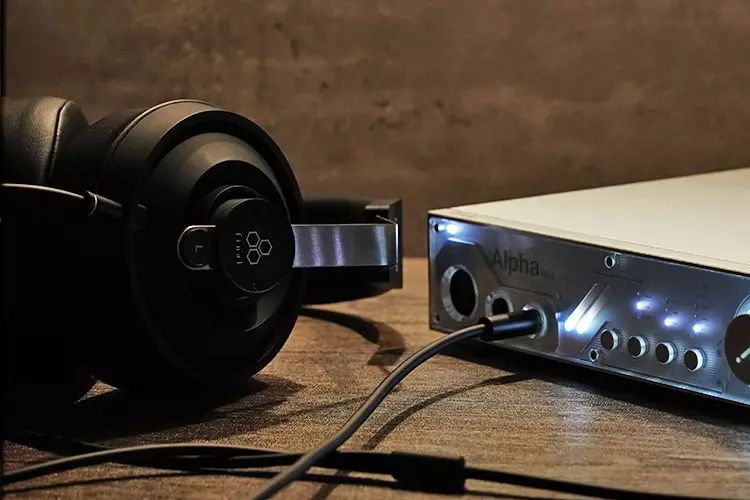
The Alpha is essentially a slimmed-down version of the Alpha PRO. Cosmetically, it has removed the XLR output and the Line-in input mode from the front panel.
At the back, most of the I/O options remain the same, except that the Line-in has been eliminated, and the power socket has been updated to a sleeker design.
Performance
In stock tuning mode, the Alpha feels smoother and stresses transients less. This leads to vocals that are less textured and lack the penetration power of the Alpha PRO, which has more treble brilliance and handles fast orchestral music and rapidly attacking guitars with greater intensity.
The Alpha has a softer attack and maintains cleanliness in decay, though it doesn’t layer instruments as deliberately as the PRO does. It colors the vocals fuller and meatier, which sounds more engaging with Pop music and other vocal works.
The Alpha proves more forgiving with sharper voices or poorly mastered older recordings. It accommodates cleaner voices and sharper instruments with its gentle roll-off and lusher presentation, making it sound less brittle in the sibilance zone with sensitive gear and allowing more breathy, airy details in the vocal to be heard.
In contrast, the Alpha PRO is well controlled and brighter, with tighter transients, though it lacks the warmth of Alpha’s stock tuning and the warmer Tone-X profile option, and it sounds less elaborate in the mids, cleaner and free from coloration.
The PRO is more potent in overall detail retrieval, accuracy, and speed, with treble definition and smoothness a step up.
When it comes to current demanding gears like the MOONDROP COSMO, the Alpha PRO also has an advantage, sounding more defined, agile, and clean in the bass, whereas the Alpha may struggle a bit to sound as dynamic and engaging, especially in the bass.
Overall, while the Alpha PRO provides a tighter response and stronger dynamics, the Alpha is commendable, remaining well-articulated, lusher in the mids, and more powerful in its output, making it advantageous with higher-impedance gears and for an airy, impactful sound.
My Verdict
The D&A Alpha PRO impressed me upon its release, and I hoped there would be filters to achieve a richer tonal profile. That’s why I’m pleased to see that the cheaper Alpha version addresses these concerns while offering more power and fullness, as well as up-to-date Bluetooth connectivity.
The design, derived from the Alpha PRO, is also a significant highlight. Few competitors match its aesthetic appeal, making it a true winner in the looks department.
The higher output power compensates for some sharpness lost when moving to the Q2M implementation, which is a good move.
The resulting tone and dynamic performance are enjoyable when paired with dynamic driver-based designs or even older headphones with single-ended terminations that need extra power to perform optimally.
For the price, the D&A Alpha DAC and headphone amplifier offers good technical capability, decent decoding power, a pleasantly neutral, warm tuning, adequate dynamics, powerful amplification, and excellent distortion control.
Despite having removed the RCA input, I believe D&A has developed an appealing device for the price bracket.
The overall package is competitive, and I would easily recommend the Alpha to those who always think their amplifier sounds dry or too clean in the mids and need the extra power to let their headphone collection shine.
D&A Alpha Technical Specifications
- Inputs: USB / Optical / Coaxial / Bluetooth
- Outputs: RCA / XLR headphones / 4.4mm headphones / 6.35mm headphones
- Line output voltage: XLR: 5.2Vrms / RCA: 2.5Vrms
- Headphone output level: 7500mW x 2 (16Ω) / 9000mW x 2 (32Ω) / 2200mW x 2 (150Ω) /
- 1100mW x 2 (300Ω) / 550mW x2 (600Ω)
- THD+N: XLR: 0.00006% (−124dB) (UN-WTD) / RCA: 0.00007% (−122dB) (UN-WTD) / HP: 0.0001% (−115dB) (UN-WTD)
- SNR: XLR: 131dB / RCA: 127dB / HP: 125dB
- Output impedance: Line out: 100Ω / Headphone out: Near 0Ω
- Bluetooth: 5.3, codecs supported: SBC, AAC, aptX, aptX HD, LDAC
