

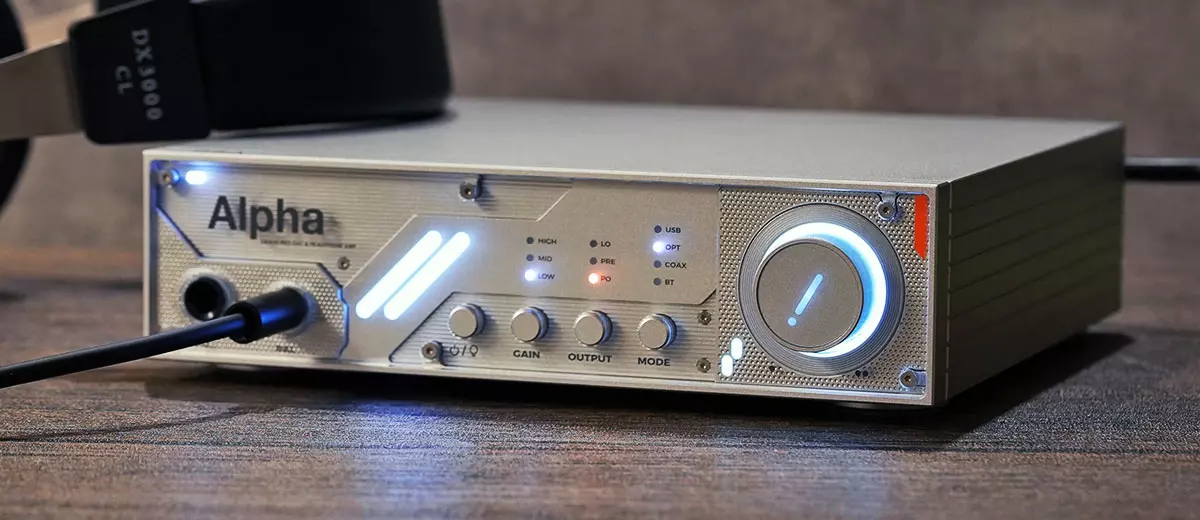
James reviews the D&A Alpha, a new entry-level integrated dual ES9039Q2M DAC and headphone amplifier capable of up to 9W of output power. It is currently priced at $399.00.
Disclaimer: This sample was sent to me in exchange for my honest opinion. Headfonics is an independent website with no affiliate links or status. I thank DIGI & AESTH and Shenzhen Audio for their support.
Click here to read more about the Shenzhen Audio products we have previously reviewed on Headfonics.
This article follows our current scoring guidelines, which you can read here in more detail.
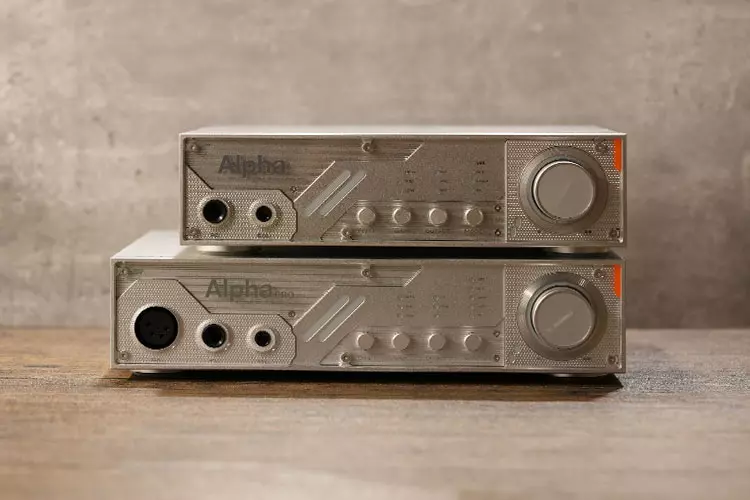
A few months ago, I reviewed the Digi & Aesth (D&A) Alpha PRO decoder and amplifier, which impressed me with its compact size, design, and technicalities. Today, I have its sleeker, smaller counterpart, the D&A Alpha, on my desk for review.
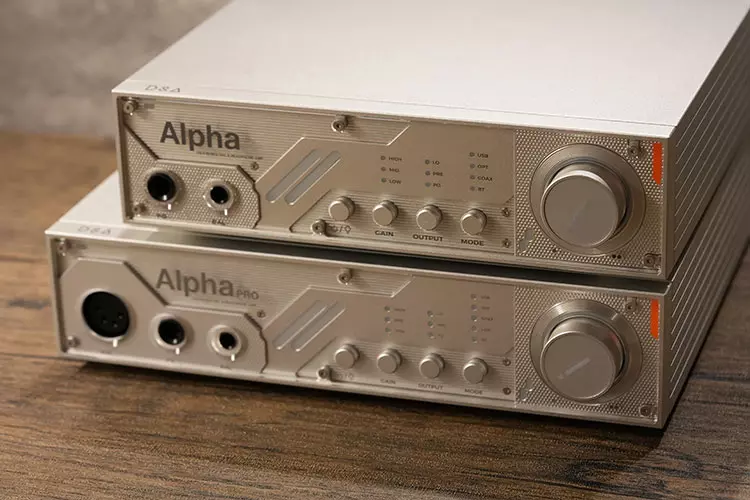
Priced more affordably at just $399, the Alpha features a slim profile and nearly identical aesthetics, including the LED visualization effects, while housing different hardware components.
Key features include a powerful 9000mW output per channel, femtoclocks, and two swappable tone profiles.
I will test whether the Alpha performs as well as the PRO version when paired with planar and sensitive gear, and explore the key differences compared to other models, such as the FiiO K15.
Features
DAC
The D&A Alpha features SABRE chips from ESS, just like the PRO version, but uses the lighter ESS9039Q2M chips, making it more affordable.
There is a second PLL clock for jitter compensation of the Bluetooth, optical, and coaxial inputs, further stabilizing the clock signal. Another pair of Femtosecond oscillators are utilized to generate stable and precise clock signals around the DAC chips.
The design continues to feature 4-ply PCBs, separating digital and analog sections, and implementing their SIGMA DAC topology. D&A combines four channels per side to minimize noise, reducing it to just one-fourth of normal levels and enhancing dynamics.
Like the Alpha PRO, the Alpha supports decoding up to DSD512 and PCM at 32-bit/768kHz, achieving an output impedance of <0.1Ω and a total harmonic distortion (THD) of just 0.00017% in its outputs.
Amplification
Even though the Alpha is significantly more affordable and features a smaller profile, it still incorporates high-quality components, including the Nisshinbo Micro Device NJU72315 volume-control chipset, +1% tolerance MELF resistors, and a Meanwell linear power supply.
These elements help preserve dynamics by reducing noise, particularly at lower listening volumes.
The output power impressively reaches 9000 mW per channel at 32 Ω loads, placing it among the top contenders in its category.
The output impedance remains impressively low at just 0.1Ω, which favors a gear that requires more raw power or gain factors to perform optimally. However, I’ll also assess how well it pairs with sensitive IEMs.
With its fully balanced discrete amplification (FBDA) architecture and 32 matched discrete transistors across its four amplification channels, the Alpha is built similarly to the Alpha Pro.
As such, I expect it to deliver consistent performance or a similar tone with planar headphones and other current-demanding devices, just like its PRO counterpart.
Dual Sound Modes
Although there are no EQ features, D&A includes a simple DSP tweak that lets you switch between a cleaner profile and a warmer, analog-like presentation with enriched harmonics at the click of a button.
The LED changes to orange for the warmer Tone-X profile, which is a welcome feature that enhances synergy with various gear and helps mitigate ambient noise when listening with open-back designs.
The output feels natural and is very handy if you don’t want to play with EQ tweaks.
Design
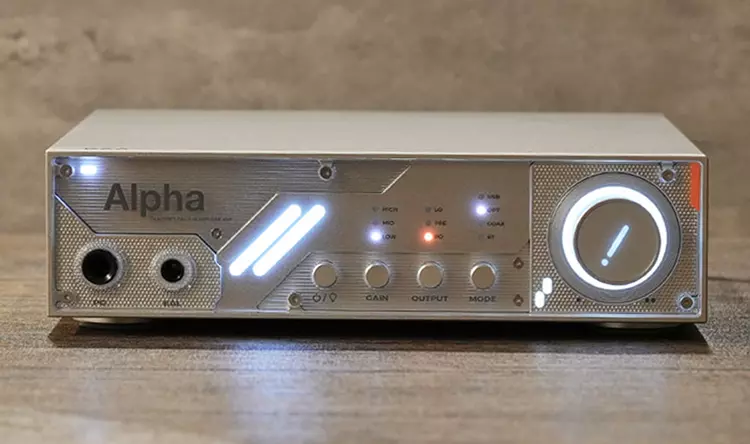
At roughly 50% smaller in size, the Alpha’s design language closely resembles that of the PRO version. It features an acrylic front plate, a CNC-tooled aluminum case, and an LED light to show elements that evoke a sci-fi aesthetic.
You can cycle through various lighting modes to enjoy different effects with the VU meter or simply dim the lights. The volume control ring is illuminated, and other buttons also feature LEDs to indicate the current mode, status, and levels.
Additionally, the design includes rubber feet that further reduce resonance, enhancing decoding performance. Once again, I consider both the Alpha and the Alpha PRO among the most aesthetically pleasing options in the decoder and amplifier market.
I truly appreciate manufacturers that blend cool design with sound, as this approach strengthens the ambiance and overall experience for listeners. Given Alpha’s price point, this design stands out as one of the best while remaining user-friendly.
I/O
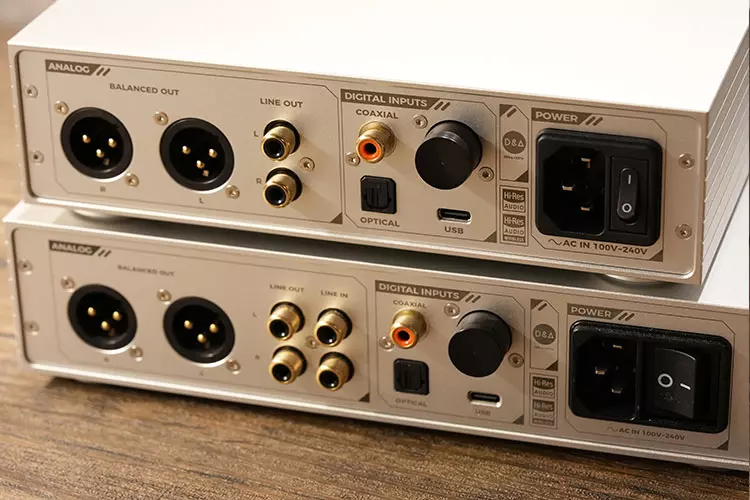
The Alpha lacks the XLR output found in the Alpha PRO, but it does include 6.3mm and 4.4mm balanced outputs. You can cycle between inputs and outputs with a button, and there are no popping noises when switching.
On the back, you’ll find an XLR output for preamp use, along with RCA line out, coaxial, optical, and USB inputs. RCA input is gone this time, though it is upgraded to Bluetooth 5.3 and has a similarly extruded module like the Alpha PRO, which connects stably.
Overall, the connectivity is satisfactory for the price, especially for those who want a little bit of wireless connectivity and seek a compact preamp for their speakers.
Packaging & Accessories
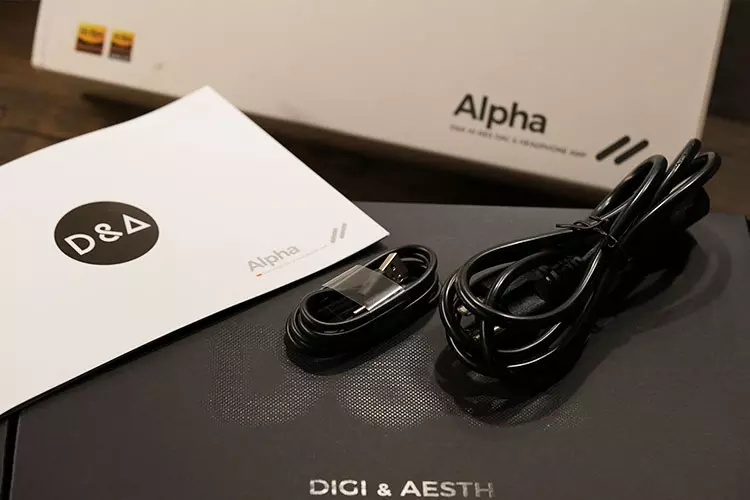
The packaging for the Alpha is professional and aligns with that of the Alpha PRO, prominently displaying D&A’s logo at the top. There are no overly fancy elements.
The unit is well-padded to ensure safe shipping and comes with power cords and manuals for those who wish to understand every detail of its functions and features.
Connectivity
Bluetooth
The Alpha features an upgrade from the Alpha PRO, now including Bluetooth 5.3 instead of 5.1, supporting LDAC, aptX HD, and other lightweight profile codecs.
With a similar protruding module extending from the metallic casing, the connection remains stable throughout the living room and even maintains strength through the walls.
Expect Bluetooth range to be slightly better than with 5.1, though it may only be noticeable when you move your source far from the Alpha.
While the decoding quality is only marginally behind that of USB, it is still somewhat less dynamic. However, this difference may not be noticeable unless you’re paying close attention.
If you’re simply looking to enjoy music in the background, the Bluetooth connection is certainly more convenient.
USB-DAC
The Alpha inherits the Alpha Pro’s USB decoding solution, featuring the 16-core XU-316 XMOS USB receiver and USB-C connection. This allows it to support decoding up to DSD512 and PCM at 32-bit/768kHz.
The USB connection is still preferred for superior quality and dynamics, delivering firmer bass and smoother treble. The coaxial input is also decent, exhibiting similar transient performance while offering a slightly warmer sound profile.
Sound Impressions
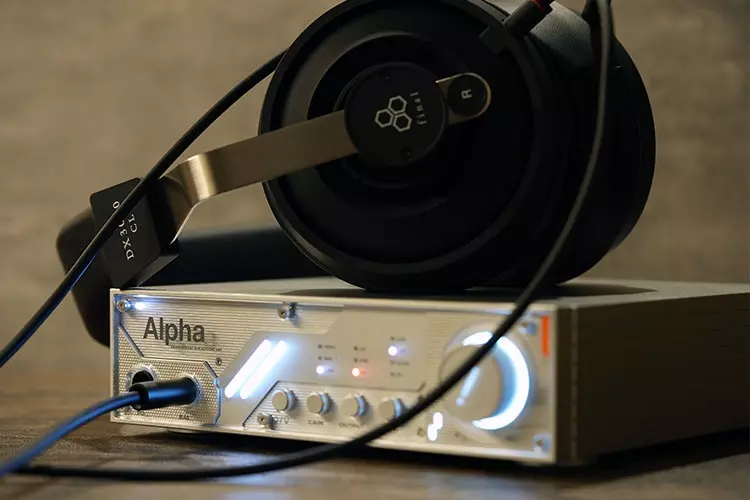
After a week of burn-in and experimenting with various inputs and outputs, I have my impressions below, using headphones such as the Sennheiser HD 800s, MOONDROP COSMO, HIFIMAN Ananda Nano, FiiO FT7, and the Meze Audio 105 SILVA.
Various IEMs included the high-impedance Westone MACH 20, rated at 96 Ω, and the more sensitive Odin MK II from Empire Ears.
Summary
The D&A Alpha delivers a slightly warm, smooth output with decent dynamics and extension. Across the various gear I tested, the tonality remains quite consistent, effectively capturing dynamics with agility in the lows and with smooth presentation in the upper register.
While it shares similarities with the Alpha PRO, it is not as detailed in texturing every part of the spectrum. Instead, it offers a more forgiving, slightly warmer, and polished tone.
In addition to its resemblance to the Alpha PRO, the Alpha features two selectable tones, enhancing its flexibility for different pairings and music genres.
In practice, the warmer Tone-X profile operates like a vocal-boost mode, with enhanced mids and harmonics, providing a more relaxed, vibrantly colored vocal output.
When paired with planar headphones, especially in noisy environments or with open windows, it helps the vocals gain more body and separates the vocalists more distinctly.
Timbre
Using primarily USB and Coax inputs for testing, the output feels clean and energetic in the treble, with punchy bass attacks that enhance overall dynamics.
The Alpha maintains decent control, avoiding exaggerated frequency emphasis for artificial clarity, and delivers consistent tonality across loads when tested with FT7, Ananda Nano, HD 800s, and the older K701.
Original Mode
In the original tuning mode, it offers smooth lows and mids, with a slight treble boost that enhances vocal presence and penetration without harshness.
The sound feels powerful and firm at both ends, with sufficient extension that captures upper-register overtones clearly. Sub-bass reaches moderately deep, which helps convey spacious ambience in large-venue recordings.
Tone-X Mode
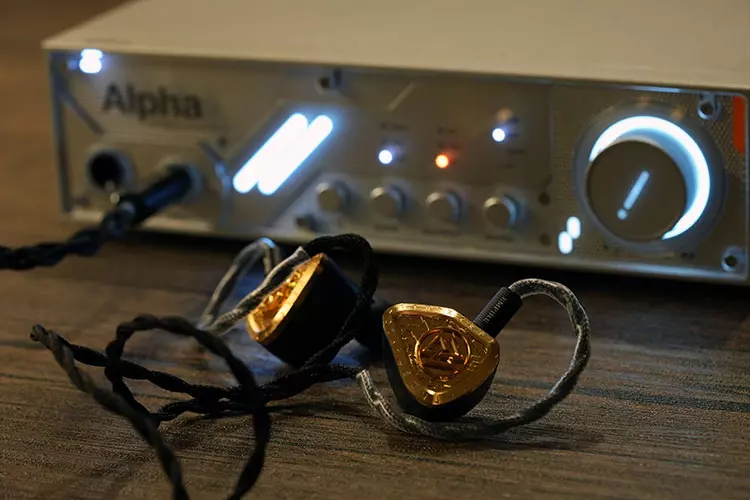
Switching to the warmer Tone-X profile keeps the upper registers clear and detailed while adding noticeable body to the bass and mid-lows.
Vocals gain a sweeter, fuller character. I particularly prefer this mode, as the stock tuning doesn’t feel as lush and elaborate in the bass, nor as relaxed with Jazzes and tracks at slower BPMs.
With high-impedance headphones like the HD 800s, the Alpha delivers dynamic, firmly punchy bass with adequate layering. The Tone-X mode sounds lusher, though the stock tuning mode gives a stronger sense of definitive power.
Somehow, I feel like the Tone-X mode works better with vocal-shy IEMs, and it can press down the brittleness on some cleaner-sounding gears.
Overall, articulation remains smooth and natural across different loads, and the power helps higher impedance gears to open up nicely, while at lower gain levels, it also sounds dynamic and detailed with sensitive IEMs without feeling compressed or flattened in the bass.
With moderately sensitive gears at around 32Ω, such as the recent DX3000 CL from Final Audio, the Meze Audio 105 AER, and the Shanling HW600, it yields the best dynamics with punchier bass response.
I find the switchable tonality feature very user-friendly; no extensive EQ is required, and you can instantly switch between the swifter stock sound profile, which works nicely with instrumentals, and the more mid-centric, warmer Tone-X mode with extra harmonics, giving pairings more versatility and fun.
Both modes sound quite relaxing with adequate resolution, and the overall experience feels like a more relaxed, less pinpoint-accurate version of the Alpha PRO that doesn’t stress extracting details but presents the music’s flow more swiftly.
Staging & Dynamics
The Alpha delivers a wide, extended soundstage with adequate detail retrieval of power and an overall smooth tuning.
Its 9000 mW output can be excessive for sensitive gear, but even at mid gain, most planars and dynamic headphones sound controlled, without harshness or compression.
The inclusion of the new Tone-X mode also helps the mids sound more distinctive, further enhancing perceived positioning, clarity, and fullness.
In the cleaner original tuning mode, bass remains smooth through the mid-lows while allowing deep sub-bass to emerge naturally, enhancing perceived depth and layering.
The warmer Tone-X mode shifts toward greater intimacy, where vocals and acoustic instruments are brought closer, and with bass elements pulled more forward.
Both profiles maintain sufficient spaciousness, and the stock tuning mode feels comparatively more laid-back, yet I would still consider it rather balanced.
Across modes and gain settings, dynamics stay lively with good air and texture in the bass. Even at high volumes or with higher-impedance loads (e.g., HD 800s), the Alpha maintains definition across most genres.
It proves less forgiving on poorer recordings, especially with larger ensembles, where midrange dynamics and separation demand better mastering to shine, possibly due to the rather neutral-warmish tuning.
In Pop music and smaller-scale instrumental works, the performance is more enjoyable, offering a good balance between detail, roundness, and satisfying dynamics.
This combination of high power, versatile tonality switching, and uncompressed character makes the Alpha highly adaptable with different headphones and sensitive IEMs, delivering a sound that is expansive and not hollowed out in the mids while maintaining adequate resolution.
Click on page 2 below for my recommended pairings and selected comparisons.
